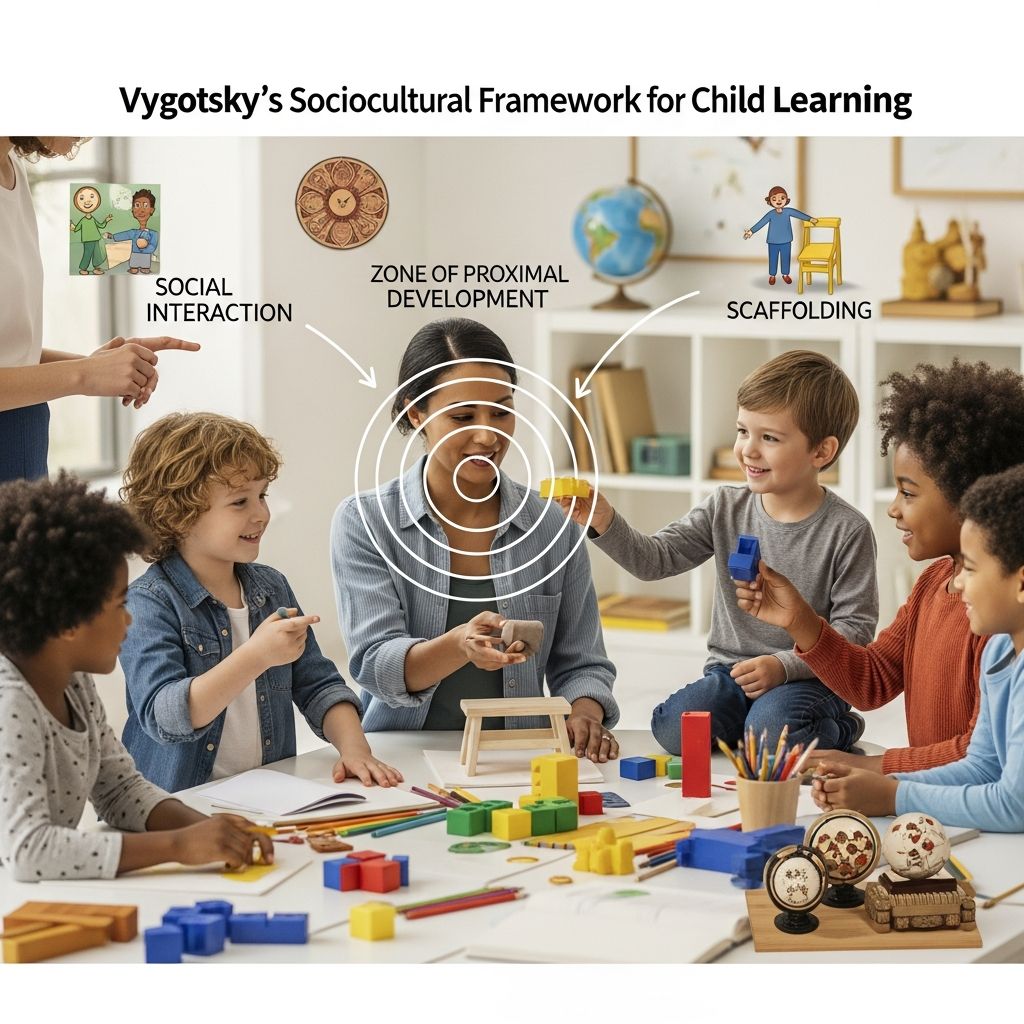
Lev Vygotsky’s sociocultural theory revolutionized our understanding of how children develop cognitively by placing social interactions and cultural contexts at the heart of learning. Unlike views that see development as purely individual, Vygotsky argued that children advance through collaborative experiences with more knowledgeable others, such as parents, teachers, or peers.
Foundational Principles of Sociocultural Development
At its core, Vygotsky’s approach posits that cognitive growth emerges from the interplay between innate abilities and environmental influences. Children start with basic mental functions like attention and memory, which evolve into advanced skills such as logical reasoning and self-regulation through social engagement. This transformation hinges on internalization, where external social activities become internal thought processes. For instance, a child imitating a parent’s problem-solving steps gradually adopts those strategies independently.
Culture plays a pivotal role, providing tools like language and symbols that mediate thinking. Vygotsky emphasized that what and how children learn is shaped by their cultural surroundings, from traditional storytelling to modern digital interactions. These elements form the scaffold for higher mental functions, enabling voluntary control and conscious awareness.
The Zone of Proximal Development: Bridging Potential and Ability
Central to Vygotsky’s theory is the Zone of Proximal Development (ZPD), defined as the gap between what a child can do alone and what they can achieve with guidance from a skilled partner. Within this zone, learning accelerates as support helps the child stretch beyond current limits.
Imagine a toddler stacking blocks: alone, they manage a few; with a parent demonstrating balance techniques, they build taller structures. This ZPD is dynamic, expanding with experience and shrinking as skills solidify. Effective teaching targets this zone, ensuring instruction is challenging yet attainable, propelling development forward.
| Aspect | Within ZPD | Outside ZPD |
|---|---|---|
| Independent Performance | Limited by current skills | Mastered tasks |
| With Guidance | Optimal growth area | Too easy or frustrating |
| Outcome | Skill internalization | Stagnation or overload |
This table illustrates how ZPD-focused strategies optimize learning compared to mismatched approaches.
Scaffolding: The Art of Guided Support
Scaffolding is the temporary assistance provided within the ZPD, gradually withdrawn as the child gains competence. Parents might break down a puzzle into steps, offering hints before stepping back. This method fosters independence while building confidence.
- Model the task clearly to demonstrate expectations.
- Provide prompts or questions to encourage thinking.
- Offer feedback to refine efforts.
- Reduce support incrementally for mastery.
Research shows scaffolding enhances problem-solving and retention, making it invaluable for home and classroom use.
Language as a Cognitive Tool
Vygotsky viewed language not just as communication but as a primary instrument for thought. Children’s private speech—talking aloud to themselves—serves as a self-regulatory mechanism, evolving from social dialogue to inner speech. Around age three, thought and language merge, enabling verbal planning and reflection.
In practice, narrating activities aloud helps children organize actions: “First, we sort the colors, then build.” This verbal mediation strengthens memory and reasoning. Cultural variations in language use further influence cognitive styles, underscoring diversity in development.
Play: A Natural ZPD Arena
Play is where children operate beyond their everyday capabilities, acting “a head taller than themselves”. Pretend scenarios demand rule-following, impulse control, and symbolic representation—a stick as a sword cultivates abstract thinking foundational to math and literacy.
Parents can enhance play by joining in: suggesting roles or props extends the ZPD. Structured play builds self-regulation, as children enforce imaginary rules more rigorously than real ones.
Contrasting Vygotsky with Piaget
Vygotsky’s ideas diverge sharply from Jean Piaget’s stage theory. While Piaget saw development preceding learning—children must mature before grasping concepts—Vygotsky believed proper instruction propels development.
| Feature | Vygotsky | Piaget |
|---|---|---|
| Learning-Development Link | Learning drives development | Development enables learning |
| Social Role | Essential via ZPD | Secondary to individual exploration |
| Language | Shapes thought | Follows thought |
| Culture | Fundamental shaper | Universal stages |
These differences guide applications: Vygotsky favors collaborative guidance, Piaget emphasizes self-discovery.
Practical Strategies for Parents
Apply Vygotsky at home by creating interaction-rich environments. Engage in joint reading, questioning to probe understanding, or peer playdates for mutual scaffolding. Daily routines like cooking offer ZPD opportunities: guide measuring, then let the child lead.
For homework, resist doing it for them—instead, ask leading questions: “What do you think comes next?” Track progress to adjust support levels.
- Observe your child’s independent level.
- Introduce collaborative challenges.
- Celebrate internalization milestones.
Classroom Implications for Educators
In schools, Vygotsky inspires group work, peer tutoring, and dynamic assessments measuring ZPD potential, not just solo performance. Teachers model think-alouds, fostering private speech for self-guidance. Culturally responsive curricula incorporate diverse tools, ensuring inclusivity.
Cultural and Modern Contexts
Globalization amplifies Vygotsky’s cultural emphasis. Digital tools like educational apps serve as modern scaffolds, bridging ZPDs remotely. Yet, screen time must pair with human interaction for true internalization.
Studies affirm ZPD’s relevance in diverse settings, from urban preschools to rural communities, adapting to local norms.
Frequently Asked Questions
How can parents identify their child’s ZPD?
Observe tasks they struggle with alone but master with hints. Start support there and fade it as proficiency grows.
What age group benefits most from scaffolding?
All ages, but it’s crucial in early childhood when social learning foundations form.
Does Vygotsky’s theory apply to neurodiverse children?
Yes, tailored scaffolding accommodates varied needs, promoting inclusive growth.
How does private speech aid learning?
It externalizes thinking, aiding planning and error correction before becoming silent inner dialogue.
Can technology replace human scaffolding?
No, it supplements but lacks the nuanced, responsive interaction of people.
Challenges and Critiques
Critics note Vygotsky’s limited empirical stages compared to Piaget, and his early death halted full elaboration. Modern neuroscience supports ZPD via brain plasticity studies, validating social learning’s impact. Nonetheless, over-reliance on guidance risks dependency if not faded properly.
Balancing ZPD with independent play ensures holistic development. Parents should blend strategies, monitoring for frustration or boredom.
References
- Vygotsky’s Theory of Cognitive Development: ZPD and Scaffolding — Structural Learning. 2023. https://www.structural-learning.com/post/vygotskys-theory
- Vygotsky’s Sociocultural Theory of Cognitive Development — Simply Psychology. 2023-10-15. https://www.simplypsychology.org/vygotsky.html
- Lev Vygotsky’s Theory of Child Development — Gowrie NSW. 2024. https://www.gowriensw.com.au/thought-leadership/vygotsky-theory