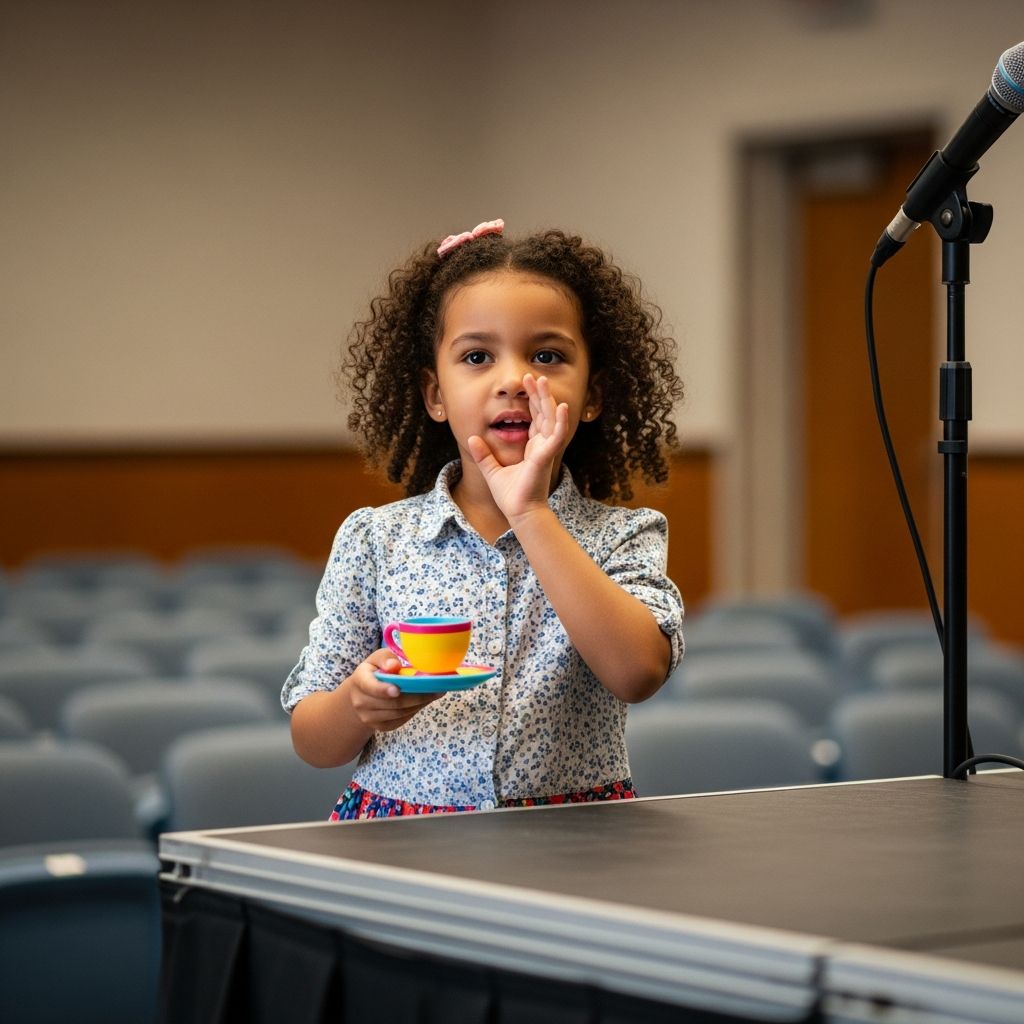
A sweet school program, a confident 4-year-old, and one very honest attempt to “spill the tea” turned an ordinary day into a viral moment that has families everywhere laughing and thinking about how children share their feelings.
What Actually Happened on Stage?
During a school program, a young girl stepped up to the microphone at the end of the event and began what sounded like a perfectly polite thank-you speech. She shared that she was proud of herself and her classmates, and everything seemed charming and predictable. Then she casually shifted gears and announced that her class was really sweet “except one little boy,” hinting that she had more to say about him before an adult quickly and gently took the microphone away. The clip of that split-second decision — stopping her just as she was about to “spill the tea” — is exactly what sent the internet into a fit of laughter.
- She began with a proud, confident message about herself and her friends.
- She then singled out “one little boy” as an exception and tried to continue.
- A nearby adult immediately stepped in, removed the microphone, and ended the moment onstage.
Why the Moment Went Viral
The scene felt instantly relatable: every adult knows that young children mix honesty and drama in a way that is both hilarious and unpredictable. In just a few seconds, the video showed a child’s desire to tell the full, unfiltered story while adults scrambled to protect feelings and keep things light. People watching saw themselves in both the little girl, eager to speak her mind, and the grown-ups, eager to keep the peace.
Parents, teachers, and caregivers shared the clip widely because it captured so many everyday parenting themes — like managing oversharing, teaching kindness, and handling public embarrassment — in a funny, low-stakes way. The girl’s obvious confidence and sense of humor made it easy for viewers to cheer for her while still understanding why the adult stepped in.
The Meaning of ‘Spill the Tea’ for Kids
The phrase “spill the tea” usually refers to sharing gossip or inside information, and it is more common in teen or adult conversations than in preschool classrooms. When a very young child tries to “spill the tea,” it often just means she wants to tell her version of the truth, especially if she feels something unfair, funny, or dramatic happened. In this situation, the girl seemed determined to expose whatever that “one little boy” had done, fully believing her audience needed to hear every detail.
Children at this age are still learning how to handle private versus public information. They do not always understand that calling out specific people in front of a crowd can be embarrassing or hurtful. For them, sharing everything they know feels natural and honest, so phrases like “spill the tea” become playful ways of describing their strong urge to be heard.
The Adult’s Split-Second Decision
One of the funniest and most telling parts of the moment was how quickly the adult stepped in to take the microphone away. It was a clear sign that the grown-ups on stage could see exactly where the speech was heading and wanted to avoid embarrassing the unnamed classmate or causing any hurt feelings. Their response balanced the need to protect the children involved while still letting the audience enjoy the humor of the situation.
In a school setting, adults constantly weigh children’s freedom of expression against community norms, privacy, and kindness. Grabbing the microphone in this case worked as a gentle boundary: the girl had her chance to speak and shine, but the grown-up cut things off right before the moment crossed the line from funny honesty into public criticism of another child.
Why Parents Found It So Relatable
Parents watching the clip immediately recognized the mix of pride and panic that comes with having a bold, talkative child. Many have experienced their kids sharing personal or awkward stories at the grocery store, in front of guests, or in a classroom. The only difference here is that the entire internet was able to watch it unfold in real time.
The moment also highlights how kids often see themselves as the narrator of their own world. When something feels important to them — especially a conflict with a peer — they instinctively want to bring adults into the loop, no matter where they are. For many parents, this was a reminder that kids will choose any available microphone, literal or figurative, to share their side of the story.
Table: Key Elements of the Viral Moment
The following table breaks down the core elements that made this brief school speech so memorable and shareable.
| Element | What Happened | Why It Resonated |
|---|---|---|
| Setting | A school program with young children performing for families. | Parents recognize this as a common, wholesome environment where anything can happen on stage. |
| Child’s behavior | The girl gave a confident speech, then tried to single out “one little boy” to share more details. | Her mix of sweetness and drama felt incredibly authentic and funny. |
| Adult intervention | An adult quickly stepped in and removed the microphone before she could continue. | Viewers saw the classic adult instinct to prevent embarrassment or conflict in front of a crowd. |
| Audience reaction | People laughed, and the moment later spread across social platforms. | The shared laughter turned a small, local event into a widely relatable parenting story. |
| Underlying theme | A young child tried to “spill the tea” about a peer during a heartfelt speech. | It captured children’s honesty, emotional intensity, and emerging social awareness. |
What This Reveals About Child Development
This moment gives a quick, vivid snapshot of early childhood development. At this age, kids are building language skills, emotional awareness, and social judgment, often all at the same time. They are capable of expressing pride and gratitude, but they also feel a strong urge to report perceived wrongs or unfair treatment in dramatic ways.
It also underscores how children test boundaries in public spaces. Taking the microphone and speaking freely shows confidence and a growing sense of independence. Having an adult place a limit on that speech is part of how children learn what is appropriate to share in front of an audience and what is better discussed privately.
Practical Takeaways for Parents
While this incident was lighthearted, it points to a few helpful strategies families can use when raising outspoken, honest children. Parents do not need to silence their kids, but they can guide them toward compassionate communication. That includes explaining which stories are private, how to talk about classmates kindly, and why some conversations belong at home rather than in front of a crowd.
- Talk about privacy in simple terms: explain that some stories are just for family or for trusted adults.
- Role-play how to share feelings about friends without naming or shaming them in public.
- Before performances or events, remind kids of the general plan: say thank you, be kind, and save long stories for later.
- Celebrate their confidence while gently correcting them when they cross social lines.
Helping Kids Handle Peer Conflicts
The girl’s desire to call out “one little boy” suggests there was some kind of conflict or irritation behind the scenes. For children, it can feel satisfying to state openly that someone bothered them, especially when a caring audience is listening. Adults can use moments like this as a cue to check in privately later and find out what really happened between the children involved.
Teaching kids to handle conflict constructively means giving them language for what they are feeling and tools for resolving problems. Instead of publicly naming the person who upset them, parents and teachers can coach them to describe what happened, how they felt, and what they would like to be different next time. That way, the instinct to “spill the tea” becomes an opening for growth rather than a source of embarrassment.
How Social Media Amplified the Clip
Without cameras and social platforms, this would have remained a funny family story repeated at dinner for a few days. Instead, the video traveled widely online, reaching people far beyond the school community. Viewers stitched, shared, and commented on it, often adding their own experiences of kids almost saying too much at ceremonies or performances.
This kind of rapid sharing shows how quickly small, everyday parenting moments can turn into global talking points. It also raises gentle questions for adults about how much of children’s lives get documented and posted. In this instance, the story stayed lighthearted, but it still offers parents a chance to think about what they choose to record and how they talk to their children about being filmed.
Tips for Talking to Kids About Being on Stage
School performances and programs can be exciting and overwhelming for young children. They may feel a burst of courage when they see a microphone or a crowd, especially if they are natural performers like the girl in this story. Adults can channel that energy in positive ways by preparing kids in advance for what to expect and how to behave.
- Explain the purpose of the event: singing a song, thanking families, or celebrating a holiday.
- Practice short, simple phrases at home so children have something rehearsed to say if they are invited to speak.
- Set clear boundaries ahead of time: no calling people out, no sharing secrets, and keep comments kind.
- Reassure them that their feelings still matter and can be talked about later in a quieter, safer space.
Frequently Asked Questions (FAQs)
Why did the little girl try to call out a classmate during her speech?
Young children often feel a strong urge to share what they see as the “real story,” especially if a peer has annoyed or upset them. In this case, the girl likely wanted to share her personal experience about that “one little boy” and believed that a public thank-you speech was the perfect opportunity to do it.
Was it wrong for the adult to take away the microphone?
The adult’s decision to remove the microphone helped prevent potential embarrassment for another child and kept the event focused on celebration rather than conflict. It modeled a boundary for respectful public speech while still allowing the girl her moment to be seen and heard.
How can parents stop kids from oversharing in public?
Parents can reduce oversharing by talking ahead of time about what is okay to say in front of others and what should be discussed at home. Practicing simple guidelines like “no naming names” and “speak kindly” gives kids a clear framework while still honoring their need to express themselves.
What should adults do if a child publicly calls out another kid?
If a child begins to call out a peer in public, adults can gently redirect or end the conversation on the spot, then check in privately with both children later. The goal is to protect everyone’s dignity while still listening to what the upset child wants to share.
Why do moments like this become viral videos?
Moments like this spread quickly because they combine humor, innocence, and universal parenting experiences in a short, easy-to-share clip. Viewers see both the child’s personality and the adult’s quick reaction, and they recognize similar episodes from their own lives.
Final Thoughts on a Tiny, Honest Voice
The little girl’s attempt to “spill the tea” during her school speech turned a routine event into a viral snapshot of what it means to raise expressive, big-feeling kids. Her short speech, interrupted at exactly the right moment, reminded families everywhere that children’s honesty is both hilarious and deeply revealing. When adults respond with gentle boundaries and empathy, these moments can become opportunities to teach kindness, respect, and thoughtful communication — without losing the joy and spontaneity that make childhood so memorable.