Vietnamese last names are much more than simple labels on official documents. They preserve stories of conquest and resistance, trace family origins across regions, and reflect how Vietnamese people understand kinship, identity, and social belonging.
This guide walks through the origins of Vietnamese surnames, explains why some names like Nguyễn are extremely common, explores meanings of key family names, and shows how naming traditions work in Vietnam and the global Vietnamese diaspora.
The Origins of Vietnamese Last Names
Systematic use of family names in Vietnam can be traced back to the period of Chinese domination beginning in 111 BCE, when the Han dynasty incorporated the Red River delta into its empire. Before this era, written records are scarce, so historians know little about earlier naming systems.
When the Han administration expanded into what is now northern Vietnam, it imported Chinese-style bureaucracy. Family names were used to:
- Register households for taxation and corvée labor
- Keep population records and census data
- Identify local elites cooperating with the imperial regime
Many early Vietnamese surnames were thus adapted from Chinese family names. Over centuries, pronunciation and spelling changed, producing distinct Vietnamese forms while preserving Sino-Vietnamese roots.
From Imperial Rule to Everyday Family Names
After Vietnam regained independence in the 10th century, the new dynasties did not abandon family names. Instead, they expanded and reshaped how surnames were used.
Several patterns became especially important:
- Association with ruling houses: Elites would adopt the surname of a new dynasty to signal loyalty and seek favor at court.
- Distribution of surnames to commoners: As the state sought to record more of the population, surnames spread beyond aristocrats and officials.
- Symbolic changes: People sometimes changed surnames after political upheavals to avoid persecution or to align with the new order.
By the early modern era, family names had become a near-universal feature of Vietnamese society, forming the first element in the standard three-part Vietnamese personal name.
Why So Many Vietnamese Share the Same Last Name
Visitors are often surprised that a small set of surnames is shared by a large share of the population. Studies and demographic estimates indicate that a handful of names—especially Nguyễn, Trần, and Lê—account for a very large proportion of Vietnamese citizens.
Several historical forces explain this concentration:
- Dynastic loyalty and adoption: When a new dynasty took power, many families voluntarily adopted the imperial surname to demonstrate allegiance or secure opportunities in administration and the military.
- Imposed name changes: Some regimes compelled defeated dynasties and their descendants to change surnames, often to those associated with new rulers.
- Administrative assignments: Both Chinese and later French colonial authorities sometimes assigned surnames to people without registered family names, further enlarging already common surnames.
Over time, these patterns produced a naming landscape in which shared surnames bind together millions of people who may not be closely related in a genealogical sense.
The Story of Nguyễn and Other Major Surnames
Each widely used Vietnamese surname carries distinct historical and cultural associations. The table below summarizes some of the most prominent names, their rough meaning or origin, and typical connotations.
| Vietnamese surname | Origin / meaning (broadly) | Historical & cultural associations |
|---|---|---|
| Nguyễn | Derived from a Chinese surname (often linked to 阮) | Most common surname in Vietnam; name of the last imperial dynasty (1802–1945), associated with royal courts and later with many ordinary families. |
| Trần | Cognate of the Chinese surname 陳 | Linked to the Trần dynasty (13th–14th centuries), remembered for successful resistance to Mongol invasions and military strength. |
| Lê | Related to the Chinese surname 黎 | Connected to the Early and Later Lê dynasties, often symbolizing prosperity and classical Confucian statecraft. |
| Phạm | Likely from the Chinese surname 范 | Frequently associated with ideas of duty, morality, and loyalty in popular explanations. |
| Hoàng / Huỳnh | Variants ultimately linked to the Chinese surname 黃 | Commonly interpreted as evoking royalty or nobility; the southern form Huỳnh reflects historical taboos on writing rulers’ names. |
These names illustrate a broader pattern: many Vietnamese surnames bear traces of Chinese etymology, but they have been reshaped by local pronunciation, politics, and cultural interpretation over more than a millennium.
Regional and Ethnic Diversity in Vietnamese Surnames
Although a few surnames dominate numerically, Vietnam’s family-name system is far from uniform. Historical research indicates that hundreds of different surnames emerged in the Red River delta region alone, the cradle of early Vietnamese civilization.
Diversity arises from several factors:
- Regional variation: Certain surnames cluster in specific provinces or historical regions, reflecting the influence of local lords or migrant communities.
- Ethnic minority groups: Vietnam is home to dozens of officially recognized ethnic groups, and some preserve surnames distinct from the Kinh majority, including lineages linked to the former Cham polities and highland communities.
- Localized adaptations: Over generations, spelling, tones, or characters tied to a surname might shift in one area but not another, creating regionally distinctive forms such as Hoàng and Huỳnh.
This variety reveals how family names simultaneously express a shared national culture and more localized identities.
How Vietnamese Full Names Are Structured
Vietnamese personal names typically follow a three-part structure:
- Family name (last name in English usage) placed first
- Middle name (which may reflect gender, generation, or family branch)
- Given name (individual personal name)
For example, in the name Nguyễn Thị Minh Khai:
- Nguyễn is the family name
- Thị is a middle name traditionally associated with women
- Minh Khai is the given name
Scholars of Vietnamese society often emphasize that names carry layered meanings. Middle names can signal generational links within a sibling group, or they may carry markers of desired virtues such as brightness (Minh) or benevolence.
Patrilineal Traditions and Evolving Practices
Historically, Vietnamese naming followed a strongly patrilineal model: children inherited their father’s family name, and women generally kept their natal surname after marriage. This practice reflects Confucian ideas about ancestral lineage and the central role of the father’s line in family rituals.
Some contemporary trends, however, are beginning to diversify this pattern:
- Double surnames: In some families, especially among urban or overseas Vietnamese, children receive both the father’s and mother’s family names, usually in that order.
- Flexible middle names: Parents may use middle names creatively to honor maternal relatives or express values important to the family.
- Hybrid conventions abroad: In countries where Vietnamese migrants settle, legal and social norms sometimes encourage alternative orders or combinations of names.
Even with these changes, however, the traditional order—family name first, followed by middle and given names—remains widespread in Vietnam.
Meanings and Symbolism in Vietnamese Surnames
Unlike given names, which are often chosen for specific aspirations or poetic meanings, surnames tend to be more stable and less explicitly symbolic. Yet families and communities do attach meanings, stories, and expectations to certain family names.
Common layers of symbolism include:
- Connections to nature: Some surnames originate from words related to elements such as rivers, mountains, or plants, often tied to ancestral homelands or local geography.
- Virtues and moral qualities: A number of surnames are linked in popular understanding with loyalty, humanity, or moral conduct, supporting a Confucian moral framework.
- Royal or noble associations: Names historically used by royal houses or noble lineages may carry connotations of prestige or authority even when held by ordinary people today.
These associations are not fixed rules but shared cultural narratives that shape how people talk about their own and others’ family backgrounds.
Vietnamese Surnames in the Global Diaspora
Large communities of Vietnamese people now live abroad, especially in North America, Western Europe, Australia, and neighboring Asian countries. In these settings, surnames interact with new linguistic and bureaucratic environments.
Common adaptations include:
- Reversed order in Western contexts: Official documents may list the family name last, following English-language conventions, even though Vietnamese speakers continue to think of it as the first element.
- Simplified spelling: Diacritics that signal tones and vowel qualities in Vietnamese are often omitted in foreign passports and forms, so Nguyễn becomes Nguyen, Trần becomes Tran, and so on.
- Hybrid naming for children: Some parents choose to blend Vietnamese and local naming practices—for instance, retaining a Vietnamese family name but selecting a given name that is easy to pronounce in the host country.
Despite these adjustments, surnames remain an important marker of Vietnamese identity abroad, often serving as a first clue to shared heritage among strangers.
Genealogy, Clan Systems, and Ancestral Worship
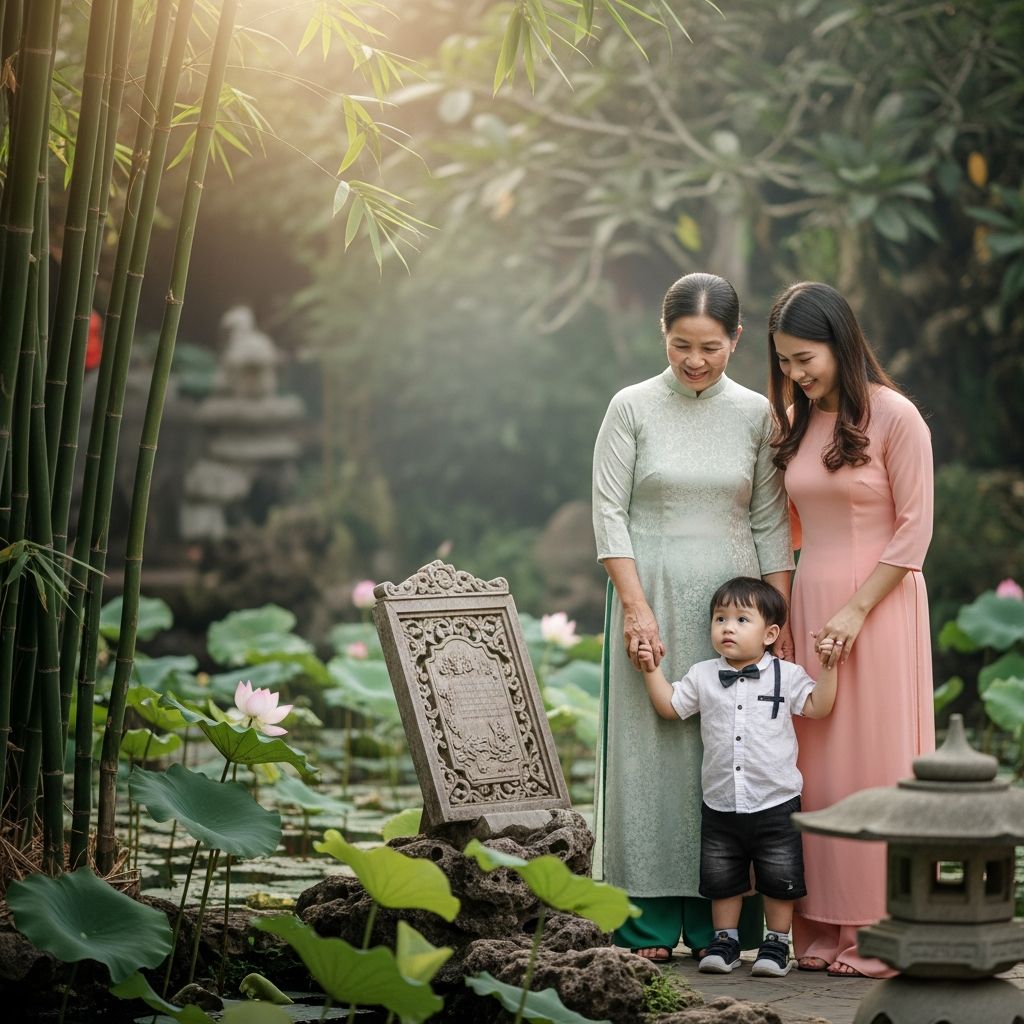
Family names in Vietnam are closely tied to ideas of ancestry and filial duty. Anthropological and historical research highlights the role of clan-like organizations built around shared surnames, especially in rural areas of northern and central Vietnam.
Key features of this system include:
- Common ancestral halls or temples where members of a surname-based lineage honor shared forebears during festivals and death anniversaries.
- Genealogical records (family books) tracing male lines across generations, sometimes maintained for centuries.
- Collective responsibilities, such as supporting less privileged clan members or organizing joint rituals.
These practices vary widely by region and have evolved with modernization and urbanization, but they underscore how surnames are embedded in a larger moral and ritual universe, not just in paperwork.
Tips for Choosing or Understanding a Vietnamese Last Name
People interested in Vietnamese surnames—whether for naming a child, writing fiction, or researching family history—benefit from paying attention to cultural context rather than choosing at random.
- Recognize the dominance of a few major names: If you want a realistic Vietnamese character or persona, using common surnames like Nguyễn, Trần, Lê, or Phạm will often be most authentic.
- Consider regional backgrounds: Researching which surnames are frequent in specific provinces or among certain ethnic groups can deepen realism and respect local histories.
- Think about the full name: In Vietnamese culture, the combination of family name, middle name, and given name is what carries meaning and rhythm. The surname alone never tells the whole story.
Frequently Asked Questions About Vietnamese Last Names
Why is Nguyễn such a common Vietnamese last name?
Nguyễn became widespread through a combination of dynastic politics, migration, and administrative practice. It was the surname of Vietnam’s last imperial house, and many people adopted it either voluntarily, under pressure, or via assignment during later colonial censuses, leading to a very high share of the population using this name.
Do Vietnamese women change their last name after marriage?
Traditionally, Vietnamese women keep their natal surname after marriage, reflecting a patrilineal but not patrilocal naming system. Children usually take the father’s family name, while the mother retains her own surname in legal and social contexts.
Is it possible to have two Vietnamese surnames?
In classical practice, most people had one family name. However, it is increasingly common, especially in urban areas and among overseas Vietnamese, for children to receive both parents’ surnames, creating a double family name used at the start of the full Vietnamese name.
Are people with the same Vietnamese last name always related?
Not necessarily. Because a small number of surnames cover a large share of the population, many unrelated families share the same name. Some lineages maintain detailed genealogies and clan structures, but beyond those documented relationships, shared surnames do not automatically imply close kinship.
How are Vietnamese surnames written outside Vietnam?
In many foreign systems, Vietnamese surnames appear last, following Western order, and diacritics are usually omitted. For example, Nguyễn Trần Anh would often be written as Anh Tran Nguyen on English-language forms, though Vietnamese speakers still interpret Nguyễn as the family name.
References
- Vietnamese Last Names and Surnames: Vietnam’s Rich History — Asia Legend Travel Blog. 2023-08-01. https://asialegend.travel/blog/vietnamese-last-names-and-surnames-all-to-know
- Vietnamese Last Names and Meanings — FamilyEducation. 2022-05-10. https://www.familyeducation.com/baby-names/surname/origin/vietnamese
- Exploring Your Family’s Vietnamese Origin: Common Vietnamese Surnames — Ancestry. 2021-11-15. https://www.ancestry.com/c/ancestry-blog/exploring-your-familys-vietnamese-origin-common-vietnamese-surnames
- Vietnamese Last Names: Most Common Surnames and Their Meanings — Vietnam Teaching Jobs Blog. 2023-03-20. https://vietnamteachingjobs.com/blog/vietnamese-last-names/
- Vietnamese Last Name: A Guide To Explore Vietnamese Culture — Autour Asia. 2022-07-18. https://www.autourasia.com/vietnamese-last-name-a-guide-to-explore-vietnamese-culture-b776.html
- “Vietnamese Names Mean a Lot” — University of Massachusetts Boston, Vietnam War Digital Archive. 2014-01-01. https://vietnamwar.lib.umb.edu/country/docs/VietnameseNames.html