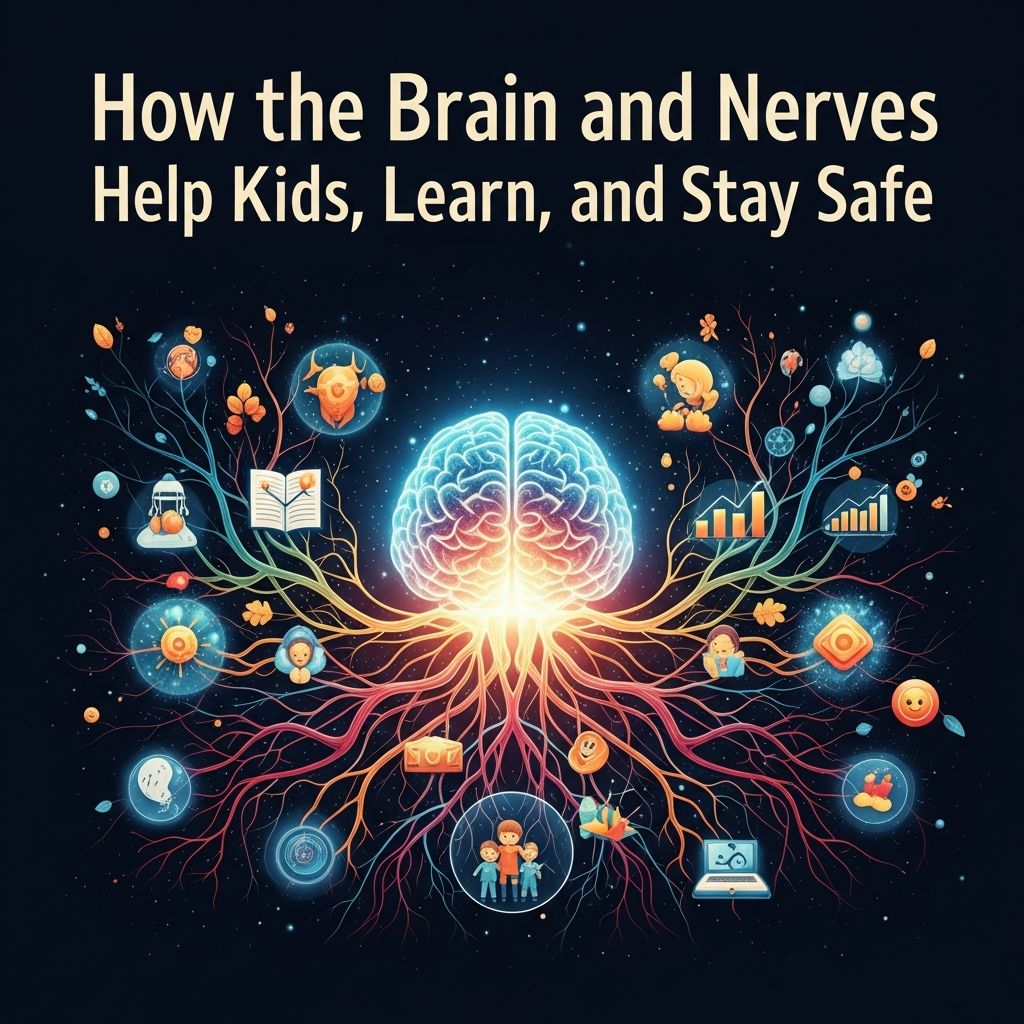
The brain and nervous system form the communication network that allows your child to move, feel, think, and grow into an independent person. While this system is incredibly complex, parents can understand the basics well enough to support healthy development and know when to seek help.
This guide explains how the brain and nerves work in children, how they change over time, and what you can do every day to protect and strengthen this vital system.
1. The Nervous System in Simple Terms
Think of your child’s nervous system as a high-speed communication grid that connects the body and brain. It helps your child react to danger, enjoy a hug, learn to read, and balance on a bike.
Key parts of the system
- Brain: The control center that processes information, makes decisions, stores memories, and manages emotions.
- Spinal cord: The thick bundle of nerves that runs down the back, carrying messages between the brain and the rest of the body.
- Nerves: Branching “wires” that spread throughout the body, sending signals to and from the brain and spinal cord.
- Sense organs: Eyes, ears, nose, tongue, and skin that collect information about the outside world.
How messages travel
Signals in the nervous system move using tiny electrical and chemical changes in cells called neurons. When your child touches something hot, nerve cells in the skin send a message to the spinal cord and brain, which quickly respond by pulling the hand away and creating the feeling of pain.
2. Major Brain Regions and What They Do
Different areas of the brain take on different jobs. In children, these areas are still maturing, which is why thinking, behavior, and skills change so much over time.
Main regions to know
- Cerebrum: The largest part; handles thinking, language, planning, and voluntary movement.
- Cerebellum: Coordinates balance, posture, and smooth movement, helping kids walk, run, and play sports.
- Brainstem: Controls automatic functions like breathing, heart rate, and swallowing.
- Limbic areas: Deep structures that help manage emotions, motivation, and some types of memory.
- Prefrontal areas: In the front of the brain; important for judgment, impulse control, organization, and long-term planning.
Sample roles by region
| Brain Region | Main Role | Everyday Example in Kids |
|---|---|---|
| Cerebrum | Thinking, language, voluntary actions | Solving math homework or telling a story |
| Cerebellum | Balance and fine-tuning movement | Learning to ride a bike without training wheels |
| Brainstem | Vital automatic functions | Breathing and heartbeat continuing during sleep |
| Limbic system | Emotions and motivation | Crying when upset or smiling when praised |
| Prefrontal cortex | Planning, self-control, decision-making | Resisting the urge to interrupt or waiting in line |
3. How the Nervous System Is Organized
The nervous system is usually divided into two big parts: the central nervous system and the peripheral nervous system. Together, they constantly exchange information, allowing the body to function smoothly.
Central nervous system (CNS)
- Includes the brain and spinal cord.
- Acts like a central office where decisions are made and signals are processed.
- Stores memories, coordinates movement, and interprets sensory information.
Peripheral nervous system (PNS)
- Includes all the nerves that branch out from the spinal cord and brain to the rest of the body.
- Carries information from the sense organs to the CNS and sends commands from the CNS to muscles and organs.
- Has two main branches: one that controls voluntary movement and one that manages automatic body functions.
Voluntary vs automatic control
- Somatic system: Lets kids consciously move muscles, like jumping, writing, or tying shoes.
- Autonomic system: Regulates things that happen without thinking, like digestion, body temperature, and stress responses.
4. Growing Brains: Development from Baby to Teen
Children are not just smaller adults. Their brains are still under construction, building and reorganizing connections especially quickly in the early years and again during adolescence.
Early childhood
- Newborn brains are already active, responding to touch, sound, light, and basic needs.
- In the first few years, the brain forms a huge number of connections between nerve cells as children explore, move, and interact with caregivers.
- Experiences like being spoken to, comforted, and played with help organize these connections into useful networks for language, emotional control, and learning.
School-age years
- Connections that are used often become stronger and more efficient; unused ones may be trimmed away.
- Skills such as reading, writing, reasoning, and self-control improve as brain circuits become more specialized.
- Children become better at following complex instructions, paying attention for longer, and juggling several tasks.
Pre-teens and teens
- Areas involved in planning and judgment mature more slowly than regions that handle reward and emotion.
- This “mismatch” can lead to risk-taking, strong feelings, and sometimes uneven behavior.
- Supportive relationships, clear boundaries, and good sleep and nutrition help guide the brain toward healthier long-term patterns.
5. How Kids Sense, Move, and Think
Everyday activities—like catching a ball or reading a book—depend on many brain and nerve pathways working together. Understanding this helps explain why some children may struggle in certain areas and need extra support.
Sensory pathways
- Special sensory cells in the eyes, ears, nose, tongue, and skin convert light, sound, chemical signals, and pressure into nerve impulses.
- These impulses travel to the brain, where they are turned into what your child sees, hears, smells, tastes, and feels.
- Some children are more sensitive to certain types of input, which can affect behavior and comfort in busy environments.
Motor pathways
- Signals from the brain travel through the spinal cord and out to muscles to create voluntary movement.
- Fine motor skills (like writing) rely on tight control, while gross motor skills (like jumping) depend on large muscle groups and balance.
- Practice, physical activity, and play strengthen these pathways and improve coordination.
Thinking and emotion
- Networks that support attention, memory, language, and problem-solving grow more sophisticated with use.
- Emotional centers communicate with thinking areas, which is why strong feelings can make it harder to focus or remember instructions.
- Helping kids name and manage their feelings supports both emotional health and learning.
6. Everyday Habits That Protect the Brain
Parents cannot control every influence on a child’s nervous system, but many daily choices can support healthier brain growth and function.
Healthy lifestyle foundations
- Nutritious food: Balanced meals with fruits, vegetables, whole grains, and protein supply the building blocks for brain cells.
- Regular physical activity: Active play improves circulation, reduces stress, and supports learning and mood.
- Adequate sleep: Sleep is vital for consolidating memories, restoring brain energy, and regulating mood and attention.
- Hydration: Drinking enough water helps the brain work at its best and may reduce headaches and fatigue.