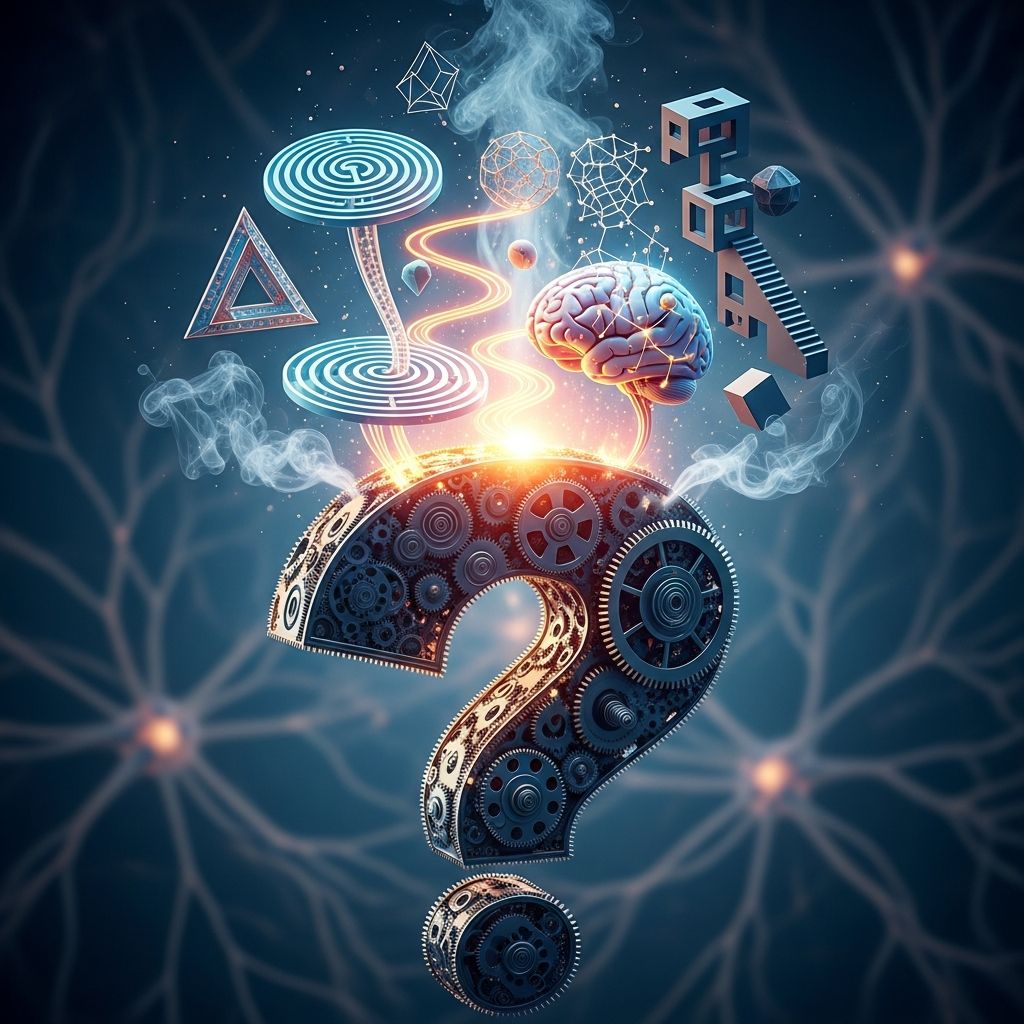
Riddles have entertained people for thousands of years, from ancient myths to modern game nights. Today, tricky riddles are more than just a way to pass the time. They can sharpen reasoning skills, improve focus, and create memorable moments with kids, friends, and partners.
This guide walks you through different types of challenging riddles, explains what makes them clever, and shows you how to use them for learning and fun. You will also find original sample riddles (with answers) and practical tips to host your own riddle challenges at home.
Why Our Brains Love Tricky Riddles
When you wrestle with a good riddle, your brain is doing much more than guessing a punchline. You are:
- Spotting patterns in language and logic
- Testing different mental models of a situation
- Holding information in working memory and updating it
- Switching between literal and figurative meanings of words
Research in cognitive psychology shows that solving puzzles and logic problems can engage executive functions such as working memory, cognitive flexibility, and reasoning, especially when the problems require planning and error correction. These mental abilities are crucial for everyday tasks like decision-making and problem-solving at school, work, and home.
Core Types of Tricky Riddles
Most hard riddles fall into a few broad families. Knowing these categories can help you both solve and create your own brain teasers.
| Riddle Type | Main Challenge | What It Trains |
|---|---|---|
| Logic & deduction riddles | Use clues to eliminate impossible options and reach one solution. | Reasoning, attention to detail, systematic thinking |
| Wordplay & lateral riddles | Interpret ambiguous wording, puns, or hidden meanings. | Verbal creativity, flexible thinking, language skills |
| Math & number riddles | Apply arithmetic or number patterns, often in disguised form. | Numeracy, pattern detection, symbolic thinking |
| Perspective & trick-question riddles | Notice missing assumptions or misleading framing. | Critical thinking, skepticism, checking assumptions |
Logic Riddles: When Clues Are All You Have
Logic-based riddles present a situation with limited information and ask you to figure out who, what, or where using careful deduction. Every word in the setup matters.
How to Approach Logic Riddles
- List the facts explicitly instead of keeping them only in your head.
- Note what cannot be true and cross options out as you go.
- Check consistency after each new deduction so you do not follow a false path too far.
Sample Logic Riddle (With Answer)
Riddle:
Four friends — Alex, Bea, Carl, and Dana — each live on a different floor of a four-story building (1st through 4th). You know that:
- Alex does not live on the top floor.
- Bea lives on an even-numbered floor.
- Carl lives above Alex.
- Dana does not live directly above or below Bea.
Which floor does each person live on?
Answer (spoiler):
1st: Alex, 2nd: Bea, 3rd: Dana, 4th: Carl.
Why it works: By trying possible floors for Bea (2nd or 4th) and using the constraints that Carl must be above Alex and Dana cannot be directly next to Bea, only one consistent arrangement remains. This is a small example of the process used in classic grid-based logic puzzles used in classrooms.
Wordplay & Lateral Riddles: Thinking Beyond the Obvious
Some riddles are hard not because they need complex math or long chains of logic, but because the wording nudges you toward the wrong idea.
Typical Tricks in Wordplay Riddles
- Double meanings: Words like “light,” “period,” or “left” can refer to several things.
- Hidden assumptions: You supply details that were never stated (for example, assuming something must be a person).
- Unexpected categories: The answer is an object, concept, or property you did not initially consider.
Sample Word Riddle
Riddle:
I travel the world while staying in one corner. What am I?
Answer:
A postage stamp.
Many traditional riddles of this kind use simple vocabulary but hide the correct perspective behind misleading imagery. Thinking flexibly about categories — objects, places, ideas — is the key to cracking them.
Math & Number Riddles: Calculations in Disguise
Math riddles do not always look mathematical at first. They might be wrapped in a story, but the challenge is really about quantities, rates, or patterns.
How to Tackle Math Riddles
- Translate the story into symbols or a simple diagram.
- Check if the numbers suggest a known pattern (doubling, halving, geometric shapes, etc.).
- Test small examples to see how the pattern behaves before solving the full case.
Sample Math Riddle
Riddle:
A puzzle box has three dials, each showing a digit from 0 to 9. The correct code adds up to 15. The middle digit is twice the first, and the last digit is one less than the middle. What is the code?
Answer:
The code is 483.
Reasoning: Let the first digit be \(x\). The middle is \(2x\), and the last is \(2x – 1\). So the sum is \(x + 2x + (2x – 1) = 5x – 1 = 15\). Solving \(5x – 1 = 15\) gives \(x = 16/5\), which is not a digit. That means our first assumption about all digits being distinct was unnecessary; instead, you try integer possibilities directly under the constraints. Checking candidates where the middle digit is even and one more than the last (for example 4 and 3) quickly leads to 4 + 8 + 3 = 15. The point of this riddle is to show that sometimes structured trial and error is quicker than full algebra for limited ranges.
Perspective & Trick-Question Riddles
These riddles rely on catching what is not said. The phrasing invites you to imagine a complex situation, but the real answer is often simple.
Sample Perspective Riddle
Riddle:
A plane crashes on the border of two countries. Every single person on board dies. Where do they bury the survivors?
Answer:
Nowhere — you do not bury survivors.
Here, the key word is “single,” which makes you focus on location instead of noticing that survivors are not buried at all. Classic trick riddles of this style teach careful reading and the habit of questioning automatic assumptions, a useful aspect of critical thinking.
How Riddles Support Learning and Development
Challenging riddles can be more than entertainment, especially for children and teens. Educators and psychologists have pointed out several benefits of puzzle-based activities:
- Supporting logical and mathematical reasoning: Structured puzzles are widely used in gifted and enrichment programs to practice multi-step reasoning without relying on memorization.
- Encouraging productive struggle: Working through a tough but solvable problem helps students build persistence and confidence in problem-solving.
- Promoting metacognition: Explaining how you solved a riddle makes you think about your own thinking — a skill linked with better learning outcomes.
For adults, puzzles and mentally demanding leisure activities are associated with maintaining cognitive function as we age, particularly when they are combined with social interaction and ongoing learning.
Turning Riddles into a Family or Group Game
Riddles can become a recurring family ritual, a low-tech party game, or an icebreaker at work. Here are a few simple formats you can try.
1. Riddle Round-Robin
Everyone comes to the table with at least one riddle. Take turns presenting your puzzle while others think aloud. To keep it fun:
- Set a time limit (for example, 3–5 minutes) for guesses.
- Allow each person one “hint request” per riddle.
- Score a point for solving someone else’s riddle and another point for stumping the group.
2. Riddle of the Day
Choose one challenging riddle and post it on a whiteboard, fridge, or chat channel in the morning. Let everyone think about it throughout the day, then share answers in the evening. This format:
- Encourages slow, reflective thinking instead of quick guessing
- Gives quieter kids or coworkers time to process
- Creates a small shared ritual without needing a long meeting
3. Collaborative Riddle-Building
Designing your own riddles can be just as brain-twisting as solving them. To create original puzzles together:
- Pick an answer first (an object, place, or number).
- List surprising or indirect properties of that answer.
- Turn those properties into short, slightly mysterious lines.
- Read the draft riddle aloud to check rhythm and difficulty.
This activity combines creative writing with logic and is easy to adapt for different ages.
Guidelines for Age-Appropriate Difficulty
To keep riddles engaging rather than frustrating, it helps to match difficulty to the group. Here is a rough guide:
| Age Group | Recommended Riddle Style | Tips |
|---|---|---|
| 6–8 years | Short, concrete riddles about animals, objects, and everyday experiences. | Use simple vocabulary and give extra hints quickly. |
| 9–12 years | Basic logic, simple math, and obvious wordplay. | Encourage kids to explain their reasoning, not just shout answers. |
| Teens | Multi-step logical riddles, lateral puzzles, and harder trick questions. | Let them lead discussions and even “teach” puzzles to younger siblings. |
| Adults | Complex logic puzzles, probability or strategy riddles, and elaborate wordplay. | Use them as warm-ups in meetings, game nights, or escape-room style activities. |
Five Original Riddles to Try Right Now
Use these ready-made riddles as a starter pack. Say them out loud for extra impact.
Riddle 1: The Silent Clock
Riddle: A clock hangs on a wall with no numbers and no hands. It never ticks, but people check it every day. What is it?
Answer: A calendar.
Riddle 2: The Shared Secret
Riddle: Three friends share a secret. Each tells exactly one other person, and no one else finds out. How many people know the secret now?
Answer: Six people — the original three plus the three they each told.
Riddle 3: The Vanishing Step
Riddle: A staircase has 10 steps. If you walk up two at a time, you still land on the top step. If you walk up three at a time, you also land exactly on the top step. Without changing the staircase, how is that possible?
Answer: You are allowed to take a mix of steps (for example, a pattern like 2–2–2–2–2 or 3–3–2–2). The riddle plays on the assumption that the size of steps must be the same each time.
Riddle 4: The Invisible Bridge
Riddle: You cross a bridge every day, but you have never seen it. It is not in your dreams. Where is the bridge?
Answer: In your mouth — the “bridge” between your teeth, also called a dental bridge.
Riddle 5: The Room With No Walls
Riddle: I am a room without doors, windows, or walls. Yet people enter me every day. What am I?
Answer: A chat room or virtual meeting “room.”
Frequently Asked Questions (FAQs)
What makes some riddles feel so much harder than others?
Riddles feel hard when they force you to abandon your first interpretation and search for a new perspective. Problems that require you to change mental “rules” mid-way, or that hide key information behind ordinary wording, often feel more challenging than long calculations.
Are riddles actually good for the brain or just fun?
While no single activity is a magic cure-all, regularly tackling mentally demanding puzzles is associated with better reasoning and may help maintain cognitive skills over time, especially when combined with other forms of learning and social interaction.
How many riddles should kids try at once?
For younger children, a handful of short riddles in one sitting is usually enough. The goal is curiosity and conversation, not exhaustion. Ending on a success or an “aha” moment keeps motivation high for next time.
What if someone never solves the riddle — should you just give the answer?
Offering graded hints before revealing the full answer helps people experience partial success and learn problem-solving strategies. Explaining the reasoning together afterward is often the most valuable part of the activity.
Where can I find more structured logic puzzles?
Many school districts, universities, and educational organizations publish collections of logic and reasoning puzzles for enrichment programs, often freely available as PDFs or worksheets online.
References
- Executive Functions — Center on the Developing Child at Harvard University. 2016-01-01. https://developingchild.harvard.edu/resources/wp1/
- Improving Students’ Learning With Effective Learning Techniques — Dunlosky, J. et al., Psychological Science in the Public Interest. 2013-01-01. https://doi.org/10.1177/1529100612453266
- The Big Logic Puzzle Extravaganza — Rosemead School District. 2012-09-01. https://www.rosemead.k12.ca.us/cms/lib/CA01902711/Centricity/Domain/49/Logic%20Puzzles%20for%20Gifted%20Students.pdf
- Critical Thinking — Foundation for Critical Thinking. 2019-01-01. https://www.criticalthinking.org/pages/defining-critical-thinking/766
- Cognitive Activity and Cognitive Function in Older Adults — Wilson, R. S. et al., Neurology. 2002-06-25. https://doi.org/10.1212/WNL.59.12.1910
- Puzzles and Problem Solving — National Council of Teachers of Mathematics (NCTM). 2018-01-01. https://www.nctm.org/Classroom-Resources/Illuminations/