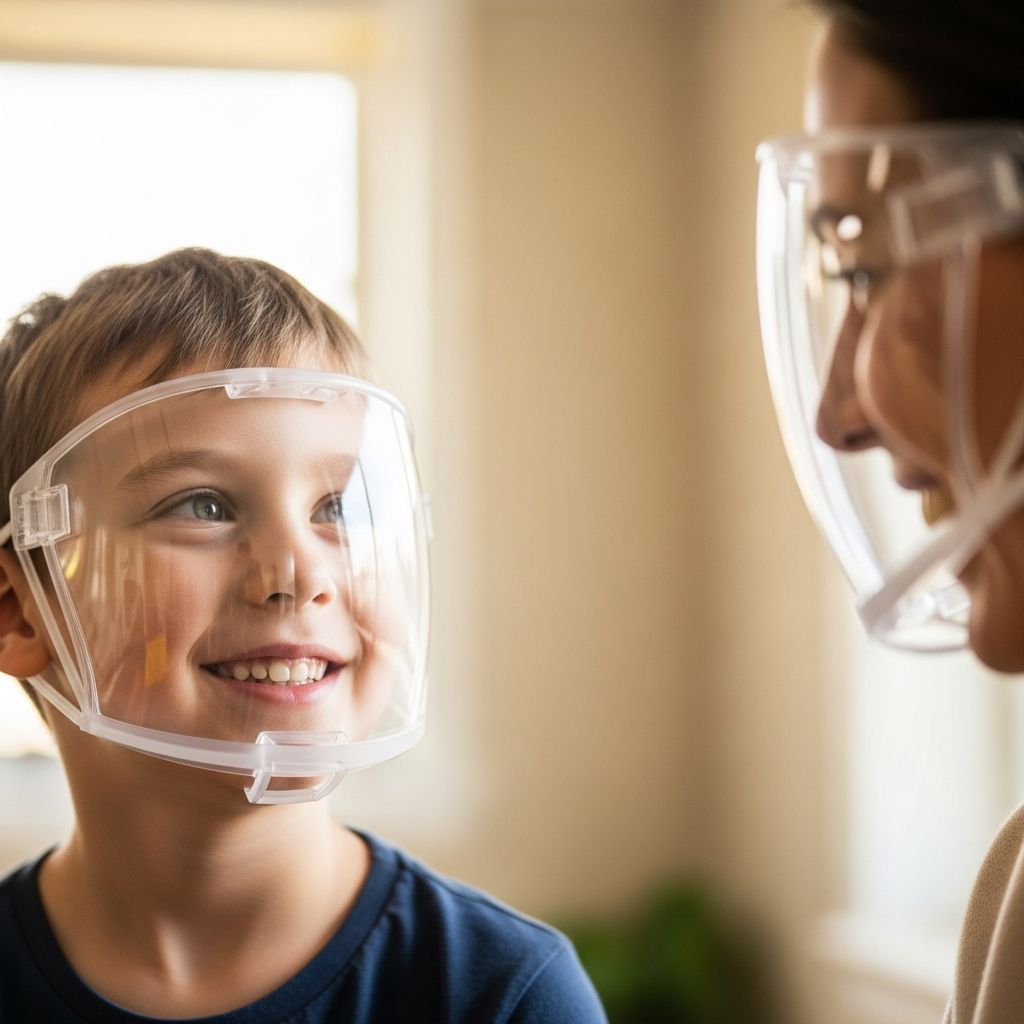
Transparent masks represent a vital innovation in personal protective equipment, particularly for young children who depend heavily on visual cues for learning and social interaction. These masks feature a clear panel over the mouth area, allowing wearers to see facial expressions, lip movements, and smiles while maintaining protection against airborne particles. In settings like schools, daycare centers, and family gatherings, they bridge the gap created by opaque masks, fostering better understanding and connection.
The Critical Role of Facial Expressions in Early Childhood
From infancy, children rely on faces to interpret emotions and language. Studies show that babies as young as a few months old mimic facial gestures, using them to build empathy and vocabulary. When masks obscure these cues, toddlers and preschoolers face challenges in reading subtle expressions like sarcasm or joy, potentially delaying social-emotional growth.
Psychologists emphasize that facial visibility aids in phoneme differentiation—sounds like ‘ba’ versus ‘pa’ become clearer when lips are seen. This is especially true during the rapid language acquisition phase between ages 2 and 5. Without it, children may experience frustration in conversations, leading to reduced participation in group activities.
- Emotional recognition: Seeing smiles reinforces positive feedback loops in parent-child bonds.
- Speech modeling: Adults modeling clear articulation helps kids imitate sounds accurately.
- Non-verbal cues: Eyebrow raises or frowns convey nuances words alone miss.
Challenges Posed by Traditional Masks for Young Learners
Opaque masks, while essential for health safety, create unintended barriers. In classrooms, teachers note increased shyness among students unable to gauge peers’ reactions. For children with autism or social anxiety, the absence of familiar faces heightens discomfort, sometimes resulting in withdrawal.
During the height of respiratory health concerns, parents observed their kids struggling to identify masked voices or match tones to expressions. This disconnect affects playdates, where misunderstandings arise from unseen grins or pouts, turning fun into confusion.
| Issue | Impact on Children | Examples |
|---|---|---|
| Hidden smiles | Reduced sense of warmth | Missed encouragement in learning tasks |
| Obscured lip reading | Communication breakdowns | Harder for hearing-impaired kids |
| Lack of expressions | Social hesitation | Fewer interactions in group settings |
Inclusive Benefits for Children with Hearing Impairments
Transparent masks are game-changers for deaf and hard-of-hearing children who depend on lip-reading and sign language. The clear window ensures they can follow conversations without guessing, promoting equity in education. Families report improved confidence as kids engage more freely in masked environments.
For those using cochlear implants or hearing aids, designs with ear loops accommodate devices comfortably. This accessibility extends to American Sign Language users, where facial grammar—essential for questions versus statements—is fully visible.
Top Features to Look for in Child-Sized Transparent Masks
Selecting the right transparent mask involves balancing protection, comfort, and clarity. Key attributes include anti-fog coatings to prevent breath-induced clouding, adjustable straps for little faces, and compliance with safety standards.
- Anti-fog technology for uninterrupted visibility.
- Fluid-resistant materials meeting high protection levels.
- Lightweight, breathable fabrics to avoid skin irritation.
- Reusable or disposable options based on needs.
Youth models often come in packs, with ear-loop designs suiting active kids. Non-medical versions offer affordability for home use, while medical-grade ones provide rigorous filtration.
Comparing Transparent Mask Types for Kids
| Type | Protection Level | Best For | Key Features |
|---|---|---|---|
| Clear KN95 Insert | High particle filtration | School/youth | Ear loops, hearing aid friendly |
| ASTM Level 3 Surgical | ≥98% filtration, fluid resistant | Medical settings | Anti-fog, FDA-cleared |
| Plastic Face Shield | Basic splash protection | Everyday play | Lightweight, reusable, anti-fog |
| Fabric with Clear Panel | Moderate | Home/crafts | Custom, comfortable |
This comparison highlights how ASTM Level 3 masks excel in high-risk scenarios with superior fluid resistance (160 mmHg) compared to Level 1 (80 mmHg).
Real-World Applications in Education and Play
In preschools, transparent masks enable teachers to convey enthusiasm during storytime, keeping children engaged. Parents use them at pediatric visits, helping shy kids feel at ease with visible reassurances from doctors.
During outdoor play or family events, they preserve the joy of seeing laughter lines crinkle. Caregivers note fewer tantrums as toddlers better understand instructions and emotions.
Health and Safety Standards Explained
Reputable transparent masks adhere to ASTM standards, ensuring efficacy. Level 3 variants offer near-complete bacterial filtration (≥98%) and flammability resistance, suitable for indoor, ventilated spaces. Always check for latex-free construction to prevent allergies.
While not all are FDA-cleared, those with surgical designation provide hospital-grade assurance. Users should replace single-use models after shifts and clean reusables per guidelines.
Parental Tips for Introducing Transparent Masks
Start with short wear times, pairing with favorite activities to build positive associations. Demonstrate by wearing one yourself, exaggerating expressions to highlight the clear view. Involve kids in choosing fun colors or patterns for buy-in.
- Fit check: Ensure snug but comfortable seal around edges.
- Practice sessions: Role-play conversations at home.
- Maintenance routine: Teach cleaning to empower independence.
- Monitor comfort: Watch for red marks or breathing issues.
Future Innovations and Availability
Ongoing research promises even clearer, longer-lasting panels with advanced anti-fog tech. Availability spans online retailers, with youth packs starting affordably. As awareness grows, expect wider adoption in child-focused venues.
Frequently Asked Questions
Are transparent masks as protective as regular ones?
Yes, high-quality models meet or exceed standards like ASTM Level 3 for filtration and fluid resistance.
Do they work well for active kids?
Lightweight designs with secure straps stay in place during play, especially those with anti-fog features.
Can they be used by hearing-impaired children?
Absolutely, clear panels support lip-reading and ASL facial expressions.
How do I prevent fogging?
Choose anti-fog treated options and use in low-humidity settings.
Are there reusable versions for kids?
Yes, plastic shields and fabric panels offer washable, eco-friendly choices.
Transparent masks empower children to thrive amid protective measures, preserving the human connection sight unseen fosters. By prioritizing visibility, parents and educators nurture resilient communicators ready for any challenge.
References
- Youth Clear KN95 Face Mask, 5/Bag — School Health. 2023. https://www.schoolhealth.com/youth-clear-face-mask-5-bag
- Transparent Child Face Mask, Non-Medical — Stauffer Glove & Safety. 2023. https://www.stauffersafety.com/Product/clearmask-cm003ez432-transparent-child-face-mask-non-medical-708912
- Accessible Communication Starts with a Clear Mask — Safe’N’Clear. 2023. https://safenclear.com/accessible-communication-starts-with-a-clear-mask-meet-the-communicator/
- Wancir Clear Plastic Face Shields for Kids — Walmart. 2023. https://www.walmart.com/ip/Wancir-Clear-Plastic-Face-Shields-Kids-Anti-Fog-Lightweight-Reusable-Face-Shield-Mask-Safety-Visor-Cover-Comfortable-Sponge-Elastic-Band-9-8-x-6-7/14666758159
- Clear Face Mask for Kids — Etsy. 2023. https://www.etsy.com/market/clear_face_mask_for_kids