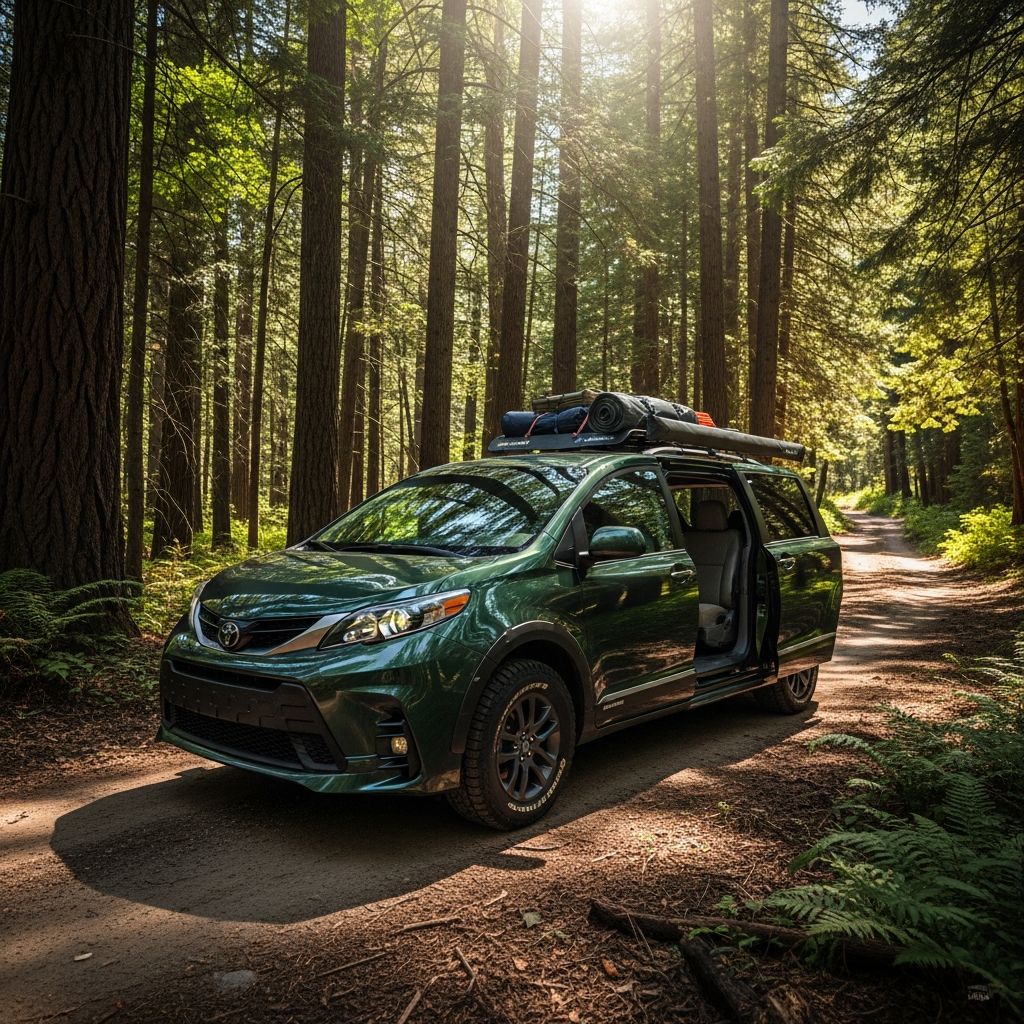
The Toyota Sienna Woodland Edition takes the practicality of a traditional minivan and reshapes it into something far more versatile. It keeps everything parents expect—space, safety, comfort—while adding extra ground clearance, standard all-wheel drive, and adventure-friendly features that make it feel at home on gravel roads, muddy trailheads, and long highway stretches alike.
Why the Woodland Edition Exists in a World of SUVs
Crossovers and SUVs dominate family parking lots, but minivans remain more space-efficient and easier to live with day to day. The Woodland Edition is Toyota’s answer to families who want SUV-like capability without giving up the packaging and comfort advantages of a van.
- Space efficiency: A minivan offers more usable interior room and easier access than similarly priced three-row SUVs.
- Standard hybrid powertrain: The Sienna is hybrid-only, giving families strong fuel economy compared with many gas-only SUVs.
- All-wheel drive and lifted stance: The Woodland Edition adds standard AWD and a modest suspension lift, making it more confident on unpaved or slippery roads.
For parents who spend weekdays in school lanes and weekends on forest roads, the Woodland Edition aims to be the single vehicle that can do everything reasonably well.
The Hybrid Drivetrain: Balancing Power and Efficiency
Every modern Sienna, including the Woodland Edition, uses Toyota’s hybrid system built around a 2.5-liter four-cylinder engine paired with electric motors.
| Key Powertrain Specs (Woodland Edition) | Details |
|---|---|
| Engine type | 2.5 L inline-4 hybrid with dual fuel injection and DOHC |
| Combined output | Approx. 245 hp (gas + electric, net system power) |
| Transmission | Electronically controlled CVT (ECVT) |
| Drive type | Electronic on-demand all-wheel drive (rear motor adds traction) |
| Combined fuel economy | About 35 mpg combined (model-year dependent) |
This setup emphasizes smooth acceleration and low fuel consumption rather than raw speed. Toyota’s hybrid systems have decades of development behind them, and large fleets of Prius and hybrid crossovers have shown strong long-term reliability when maintained properly.
Real-World Benefits for Families
- Lower fuel costs on long trips: A hybrid minivan using roughly 35 mpg combined will generally consume significantly less fuel than a comparable gas-only three-row SUV rated closer to the mid-20s mpg.
- Quieter low-speed driving: At low speeds and in light traffic, the van can run on electric power alone, reducing noise and vibration—helpful when kids are sleeping.
- Reduced tailpipe emissions: Hybrid systems typically emit less CO2 and fewer pollutants per mile than equivalent non-hybrid gasoline vehicles, contributing to lower environmental impact over high-mileage family use.
All-Wheel Drive and Ride Height: Light Trails, Not Rock Crawling
The Woodland Edition’s all-wheel-drive system uses a separate electric motor on the rear axle, which activates when the front wheels lose traction or when extra grip is needed.
- On-demand AWD: The rear motor can send power to the back wheels without a bulky driveshaft, saving space and weight compared with traditional mechanical AWD systems.
- Slightly raised suspension: The Woodland Edition typically offers a modest increase in ground clearance compared with other Sienna trims, helping with rutted roads and snow-packed driveways.
- Independent suspension: Four-wheel independent suspension with front and rear stabilizer bars balances comfort and control when the van is fully loaded.
While it is not built for serious off-roading, this configuration is well-suited for:
- Forest service roads and access to trailheads
- Campgrounds with uneven or gravel surfaces
- Snowy or rainy weather in regions with changing seasons
Cargo, Seating, and Everyday Practicality
Where the Sienna Woodland Edition really earns its keep is in how it moves people and gear. It seats seven with standard captain’s chairs in the second row and a split-folding third row.
| Interior & Utility Metrics | Approximate Values |
|---|---|
| Seating capacity | 7 passengers (2 / 2 / 3 configuration) |
| Cargo behind 3rd row | About 33.5 cu. ft. |
| Maximum cargo volume | Approx. 101 cu. ft. with rear rows folded/stowed |
| Max towing capacity | Up to 3,500 lbs with proper equipment |
With the third row folded into the floor and the second-row seats slid forward, the van can swallow bikes, camping bins, folding cribs, or even flat-pack furniture. The included towing capacity is enough for small utility trailers, lightweight campers, or a pair of personal watercraft, provided the trailer weight stays within Toyota’s limits and the hitch is properly installed.
Family-Friendly Storage Touches
- Multiple cup and bottle holders distributed across all three rows, often exceeding 15 holders in total.
- Overhead console and door pockets for snacks, maps, and small toys.
- Under-console and side storage areas that keep charging cords and small electronics organized.
Cabin Comfort and Tech for Long Road Trips
The Woodland Edition shares many of its comfort features with higher Sienna trims, emphasizing temperature control, quietness, and connectivity across all rows.
Comfort Features That Matter on the Fifth Hour of a Drive
- Four-zone automatic climate control: Separate temperature settings for the driver, front passenger, and rear passengers help reduce squabbles about being too hot or too cold.
- Heated front seats: Standard heated front seats and often SofTex-trimmed upholstery support comfort in cold weather without the maintenance demands of some leather interiors.
- Sunshades and privacy glass: Built-in manual sunshades in the rear rows and tinted windows help keep the cabin cooler and protect kids from glare.
Toyota also equips the Woodland Edition with practical convenience touches such as:
- Hands-free dual power sliding doors for easier loading while carrying children or gear.
- Power liftgate with jam protection, useful when loading in tight parking spots.
- Keyless entry and push-button start, reducing the fumbling for keys with full hands.
In-Car Technology and Connectivity
- Large infotainment display: A modern touchscreen system supports wireless Apple CarPlay and Android Auto on recent model years, so navigation and media from smartphones integrate smoothly.
- Multiple USB ports: Front and rear USB ports and charge points let everyone power devices, important for tablets and phones on long trips.
- Wireless charging pad: A convenient space in the front console to charge compatible phones without cluttering the dash with cables.
- Digital gauge cluster: Select recent Woodland models include a digital instrument cluster that clearly displays hybrid system information, speed, and driver assistance status.
Safety and Driver Assistance: Peace of Mind in a Big Vehicle
The Sienna lineup benefits from Toyota’s focus on active safety systems. Recent Woodland Edition models include a wide set of standard driver-assistance features as part of Toyota Safety Sense, in addition to more traditional safety hardware.
Key Active Safety Features
- Pre-collision system with pedestrian detection: Uses cameras and radar to help detect vehicles or pedestrians ahead and can apply automatic braking in some situations to help reduce or avoid a collision.
- Lane departure alert with lane tracing assist: Warns if the van drifts out of its lane and can provide gentle steering assistance to help keep it centered on marked roads.
- Full-speed adaptive cruise control: Adjusts speed to maintain distance from the vehicle ahead in traffic, reducing fatigue on long highway drives.
- Blind-spot monitoring and rear cross-traffic alert: Helps detect vehicles in adjacent lanes or approaching from the side when reversing out of parking spaces.
- Parking sensors with automatic braking: On many Woodland builds, front and rear parking assist can warn of obstacles and, in certain conditions, automatically apply brakes at low speeds.
In addition, structural safety and passive systems such as multiple airbags, stability control, and four-wheel antilock disc brakes are standard, reflecting modern safety regulations and Toyota’s internal crash-protection goals.
Design Details That Hint at Adventure
The Woodland Edition visually distinguishes itself from other Sienna trims with darker exterior accents and functional equipment.
- Dark-finished wheels: 18-inch alloy wheels with a darker finish give the van a more rugged stance.
- Black exterior badging and trim: Dark emblems and mirror caps offset the body color and visually set it apart from family-oriented chrome-heavy trims.
- Standard roof rails: Black roof rails allow for crossbars and rooftop carriers, making it easier to mount cargo boxes, bikes, or kayaks.
Inside, sport-inspired seat trim and contrasting stitching help the cabin feel less like a basic shuttle and more like a well-equipped tourer.
How the Woodland Edition Fits Different Family Lifestyles
Every family uses their vehicle differently. The Sienna Woodland Edition targets a specific slice of buyers who do not want a body-on-frame SUV but still need confidence beyond city streets.
Ideal Use Cases
- Outdoor-oriented families: Parents who regularly visit national parks, trails, lakes, or campsites and need room for tents, coolers, and sports gear.
- Snow-belt commuters: Households in regions with winter weather where AWD and extra ground clearance make everyday driving less stressful.
- Road-trip enthusiasts: Families who regularly take multi-state drives and prioritize comfort, fuel economy, and space over off-road extremes.
- Multi-purpose household vehicle: Buyers consolidating from an SUV and a smaller car into one do-almost-everything family hauler.
Who Might Prefer a Different Trim or Vehicle
- Primarily urban drivers: Families rarely leaving paved city streets might be fully served by a front-wheel-drive Sienna trim, which can be less expensive.
- Serious off-road hobbyists: Those who regularly tackle rocky terrain or deep mud will be better matched with a dedicated off-road SUV or pickup with low-range gearing.
- Maximum towing needs: Families needing to pull heavier trailers may prefer a vehicle with a higher tow rating and more robust cooling and chassis hardware.
Ownership Considerations: Warranty, Maintenance, and Longevity
The Sienna Woodland Edition shares the same factory warranty structure as the rest of the Sienna line, including basic coverage and hybrid-component warranties. Official Toyota documents describe a standard limited warranty and extended coverage for hybrid batteries in many markets.
- Basic vehicle warranty: Typically around 3 years or 36,000 miles, covering general defects.
- Hybrid-related coverage: Toyota provides longer coverage on hybrid components such as the battery, inverter, and control modules; policy lengths vary by region but are often 8–10 years or more for the battery.
- Corrosion and powertrain: Additional warranties cover rust-through and drivetrain components for longer time or mileage windows.
Routine maintenance—oil changes, filters, brake inspections, tire rotations—remains essential for reliability. Hybrids typically see reduced wear on friction brakes because regenerative braking recovers energy and slows the vehicle, which can extend pad and rotor life under mixed driving.
Frequently Asked Questions (FAQs)
Is the Toyota Sienna Woodland Edition good for camping trips?
Yes. Its combination of standard AWD, slightly higher ground clearance, strong cargo space, roof rails, and efficient hybrid power makes it well-suited for reaching campgrounds, hauling gear, and powering long drives to national or state parks.
How does fuel economy compare to a three-row SUV?
The Sienna hybrid powertrain is rated around the mid-30s mpg combined, which is typically higher than many gas-only three-row SUVs that often fall in the low- to mid-20s mpg combined range, depending on model and drivetrain.
Can the Woodland Edition tow a small camper?
When properly equipped, the Sienna’s towing rating of up to 3,500 pounds can handle many lightweight campers, small cargo trailers, and utility trailers. Always confirm trailer weight, follow Toyota’s towing guidelines, and factor in cargo and passenger load before towing.
Is the Woodland Edition safe for transporting kids?
Yes. It includes multiple airbags, child seat anchors, rear door child safety locks, stability and traction control, and Toyota Safety Sense driver-assistance features such as pre-collision braking, lane-keeping assistance, and adaptive cruise control.
Does the raised suspension make the ride harsh?
The suspension changes are modest, and the Woodland Edition retains a four-wheel independent setup with stabilizer bars. It is tuned more for comfort and security on imperfect roads than for aggressive off-road use, so ride quality remains family-friendly.
References
- 2025 Toyota Sienna XLE Woodland Edition Specs & Features — Edmunds. 2024-10-01. https://www.edmunds.com/toyota/sienna/2025/st-402053236/features-specs/
- New 2026 Toyota Sienna Woodland Edition Vehicle Details — Jim Norton Toyota. 2024-09-15. https://www.jimnortontoyota.com/vehicle/5TDCSKFC5TS230137/
- Why the 2025 Toyota Sienna Woodland Edition Is the Best Trim — Joseph Toyota of Cincinnati. 2024-08-12. https://www.josephtoyota.com/blog/why-the-2025-toyota-sienna-woodland-edition-is-the-best-trim/
- 2026 Toyota Sienna — Toyota USA. 2024-09-20. https://www.toyota.com/sienna/
- 2026 Toyota Sienna Specifications — Toyota USA. 2024-09-20. https://www.toyota.com/sienna/features/
- 2025 Toyota Sienna Hybrid Review, Pricing, and Specs — Car and Driver. 2024-07-10. https://www.caranddriver.com/toyota/sienna
- 2025 Toyota Sienna: Specs, Features, and More — Stephen Wade Toyota. 2024-06-05. https://www.stephenwadetoyota.com/research/sienna/