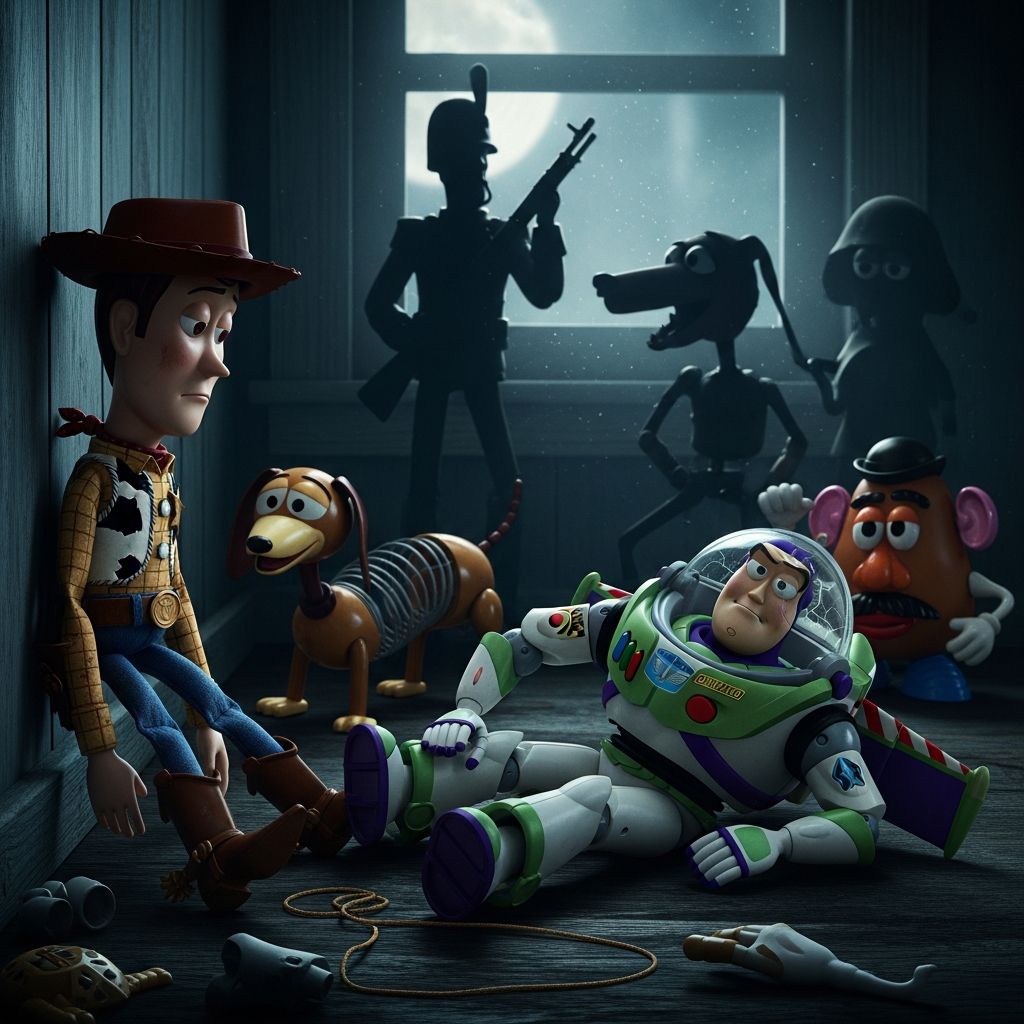
Pixar’s Toy Story trilogy looks, at first glance, like a colorful celebration of friendship, imagination, and childhood. Beneath the jokes and heartfelt moments, though, lies a much darker possibility: these films quietly depict an entire race of conscious beings living in fear, servitude, and emotional dependence on human children.
This article unpacks that unsettling interpretation and explores what it suggests about free will, love, cruelty, and the way humans treat the things they own.
Sentient Toys: Cute Gimmick or Moral Catastrophe?
The entire franchise hinges on a premise we tend to accept without thinking: toys are secretly alive. But if we take that idea seriously, it becomes ethically explosive.
- They think and feel: The toys clearly display complex emotions: joy, fear, jealousy, despair, loyalty, and love.
- They remember and learn: Toys build long-term relationships, form strategies, and change their beliefs over time.
- They experience pain and trauma: Abandonment, neglect, and physical damage affect them in ways that resemble psychological suffering.
If a being can think, feel, and suffer, most contemporary ethicists agree it deserves moral consideration, regardless of its species or physical form.1 Applied to the Toy Story world, this suggests toys should have at least some rights, including the right not to be abused or discarded casually.
Why Do Toys Obey? Fear, Dependence, and Stockholm Syndrome
One of the most unsettling details of the universe is that every toy instinctively hides its sentience from humans. Even new toys, fresh out of the box, immediately know to freeze when people appear. That raises uncomfortable questions:
- Who taught them to do this?
- What happened in the past when a toy broke this rule?
- What are they so afraid of humans discovering?
Within the films, toys who deviate from their assigned roles are punished, discarded, or destroyed. This dynamic closely resembles what psychologists describe in hostage situations: victims sometimes begin to identify with and protect their captors, a pattern known as Stockholm syndrome.2 The toys’ fierce loyalty to their owners, even when badly treated or neglected, looks disturbingly similar.
The Toy–Owner Relationship: Love Built on Control
On the surface, Toy Story tells a sweet tale of devotion between children and their toys. From a darker angle, it looks like a relationship of total control:
| Aspect | Toy’s Experience | Human’s Experience |
|---|---|---|
| Body | No autonomy over how, when, or why they are used. | Full control: throw, break, hug, or abandon at will. |
| Home | Cannot choose where they live or with whom. | Relocate toys freely, donate them, or put them in storage. |
| Voice | Must stay silent around humans or risk destruction. | Unaware they are silencing sentient beings. |
| Future | Terrified of being outgrown, thrown away, or lost. | Sees these as natural parts of growing up. |
The toys’ highest goal is to be “there for” their owner. Their identities depend completely on how much a child wants to play with them. This dependence turns love into a survival strategy: affection is not just emotional; it is existential.
Villains or Visionaries? Rethinking the Toy Rebels
Several characters in the trilogy reject the standard toy–child bond. Instead of longing for a kid to love, they attempt to escape or overturn the system. These characters are usually framed as villains, but from a philosophical standpoint, they can also be seen as early revolutionaries.
- The disillusioned collector’s toy: A toy who sees children as a source of pain rather than joy may prefer life behind glass to being used and eventually discarded.
- The authoritarian nursery leader: A bear who has lost his child imposes a brutal order on new arrivals, forcing them to accept harsh play conditions rather than risk abandonment.
- The bitter prospector or mentor figure: A toy long trapped in storage argues that devotion to children is a trap and urges others to opt out.
From the toys’ own perspective, these dissenters are responding rationally to a rigged game: love your owner and you still end up broken or forgotten; refuse to love and you become a labeled villain. There is no stable path to safety.
Abandonment, Obsolescence, and the Terror of Being Outgrown
As children grow up, their toys lose value. For the toys, this “natural” stage of human development is existential horror. The trilogy repeatedly emphasizes key fears:
- Being replaced: Newer, shinier toys arrive and disrupt long-standing bonds.
- Being stored away: Closets, attics, and boxes become limbo-like spaces between usefulness and disposal.
- Being thrown out: The trash bag, sidewalk, and landfill become symbols of permanent erasure.
Philosophers who study technology and consumer culture note that modern societies constantly produce and discard objects at high speed, with little regard for their environmental or emotional consequences.3 Toy Story transposes that throwaway logic onto beings who can suffer, turning ordinary household routines into quiet acts of violence.
Humans as Unwitting Gods of a Fragile World
In the films, humans are like gods to toys: enormous, inscrutable, and capable of shaping their entire existence without realizing it.
- Humans create their world: A bedroom can be a paradise or a prison, depending on the child’s temperament.
- Humans decide their fate: A single decision to donate, destroy, or store toys changes their lives forever.
- Humans remain ignorant: Except for rare moments, people never learn the truth about toy sentience.
This ignorance does not erase responsibility. Ethics research on animal welfare and environmental damage suggests that unintentional harm can still be morally wrongful when we fail to consider the impact of our actions on vulnerable beings.4 In the logic of the franchise, every smashed toy and forgotten figure was, secretly, a silent casualty.
Is There Any Way Out for the Toys?
The trilogy flirts with the idea of escape—running away, living in a museum, building new communities—but every alternative has a cost:
- Runaway existence: Toys living without owners gain freedom but lose their main source of joy and purpose.
- Museum life: Behind glass, they are safe but permanently denied the play they were built for.
- Communal utopias: Toy-run spaces promise fairness but risk collapsing into new hierarchies and power struggles.
The films consistently return to the same conclusion: the best a toy can hope for is a kind master. There is no true liberation, only varying degrees of benevolent control.
What This Says About Us: Children, Power, and Empathy
The darkest message of all may not be about toys, but about humans. The series quietly highlights how early we learn the habits of ownership:
- We practice power by deciding which toys to cherish and which to neglect.
- We experiment with cruelty by pulling apart dolls or throwing figures across the room.
- We rehearse detachment by outgrowing beloved objects and leaving them behind.
Developmental psychologists note that play with dolls, action figures, and stuffed animals helps children explore control, attachment, and empathy.5 Toy Story exaggerates that process by giving the toys inner lives, forcing adults in the audience to ask: if everything we casually use and throw away could feel, how different would our behavior look?
From Plastic to Philosophy: Big Questions the Films Raise
When watched through this darker lens, the trilogy becomes less about buddy comedy and more about enduring philosophical puzzles:
- What makes a being worthy of moral concern? If consciousness and the capacity to suffer are enough, then the toys qualify.
- Can love justify control? A caring child still holds absolute, unchosen power over their toys.
- Is loyalty still virtuous under coercion? The toys’ devotion may be more survival strategy than free choice.
- Is there such a thing as a “good owner” in a fundamentally unequal system? Kindness softens the edges but does not erase the imbalance.
These questions echo long-running debates in ethics, from discussions of slavery to the rights of animals and emerging artificial intelligences. Scholars of moral philosophy increasingly emphasize that power without accountability is dangerous, even when those in power see themselves as benevolent.6
Practical Takeaways for Real-World Humans
The toys may be fictional, but the mindset the films expose is very real. If we take the dark reading seriously, it nudges us toward a more thoughtful everyday life:
- Question disposable culture: Before buying or tossing something, consider its environmental and emotional footprint.
- Teach kids gentleness: Encourage children to care for toys, not just as objects, but as practice for how they will treat animals and people.
- Value maintenance over replacement: Repairing, reusing, and donating can all counter the instinct to discard.
- Reflect on power: Notice situations where you have unexamined control—over people, animals, or systems—and ask what responsibility that creates.
Frequently Asked Questions (FAQs)
Are the Toy Story movies intentionally about slavery or oppression?
There is no clear evidence from Pixar that the films were designed as a direct allegory for slavery or any specific historical atrocity. The darker interpretation explored here reads the implications of the premise—sentient toys owned by unaware humans—through philosophical and ethical lenses rather than claiming authorial intent.
Does seeing the toys as enslaved ruin the movies?
Not necessarily. Many powerful stories work on multiple levels. You can still enjoy the humor and emotion while also recognizing that the premise raises uncomfortable questions about dependence, control, and loss. For some viewers, the tension between warmth and horror is part of what makes the trilogy so affecting.
Is it fair to compare Toy Story’s themes to real-world suffering?
It is important to be cautious. Fictional toys cannot fully represent the complexity and gravity of real historical atrocities or ongoing oppression. However, stories often borrow images and structures from reality to help audiences think about power, fear, and dignity in new ways.
What can parents do with these darker ideas when watching with kids?
With younger children, it may be enough to emphasize kindness: treating toys gently, sharing, and caring for what they own. With older kids, the films can open conversations about empathy, growing up, and what happens to things—and people—when we stop paying attention to them.
Does this interpretation apply to other animated movies about secret lives of objects?
Yes. Any story that imagines hidden societies of conscious objects, animals, or machines living under human control invites similar questions about autonomy and moral status. Toy Story is distinctive mainly because it pairs those questions with such intense emotional attachment.
References
- Animal welfare and the moral significance of sentience — Animal Welfare Institute. 2022. https://awionline.org/content/animal-welfare-and-sentience
- Graham, D.L.R., & Leary, M.R. “The Psychology of Stockholm Syndrome” — Behavioral Sciences & the Law (Vol. 22, Issue 4). 2004-07. https://doi.org/10.1002/bsl.582
- Cooper, T. “Inadequate Life Spans: Evidence and Implications for Product Longevity” — Journal of Consumer Policy. 2004-06-01. https://doi.org/10.1023/B:COPO.0000028164.74026.bf
- Fraser, D. “Understanding Animal Welfare” — UBC Animal Welfare Program, University of British Columbia. 2008. https://animalwelfare-ubc.ca/understanding-animal-welfare/
- Thompson, R.A. “Childhood Emotional Development and Attachment” — Zero to Three / University of Nebraska-Lincoln. 2017-05-01. https://digitalcommons.unl.edu/famconfacpub/153/
- Nussbaum, M. “Frontiers of Justice: Disability, Nationality, Species Membership” — Harvard University Press. 2006. https://www.hup.harvard.edu/books/9780674024106