Toddler towers, also known as learning towers or kitchen step stools, have surged in popularity among parents seeking to foster independence in young children. These elevated platforms allow toddlers to stand safely beside countertops, participating in cooking, cleaning, or play activities. However, recent rigorous testing by independent experts reveals that many models on the market fall short of basic safety expectations, posing risks of tip-overs, falls, and entrapments.
Why Toddler Towers Appeal to Families
Parents often turn to toddler towers to promote child development. Standing at adult height encourages fine motor skills, hand-eye coordination, and cognitive growth through hands-on involvement in daily routines. Experts note that these tools build confidence and strengthen parent-child bonds during shared tasks like meal preparation.
Despite these benefits, the absence of mandatory federal safety standards in the U.S. leaves consumers vulnerable. Unlike high chairs or cribs, toddler towers operate in a regulatory gray area, allowing manufacturers wide latitude in design and testing protocols.
Breakdown of Recent Safety Evaluations
Consumer Reports conducted comprehensive assessments on 16 leading toddler tower models, focusing on real-world hazards. The evaluation simulated everyday use scenarios to identify vulnerabilities.
Stability Testing Explained
To gauge tip-over risks, testers positioned a weighted beam across the top of each tower, suspending a 35-pound load—equivalent to a typical 2- to 4-year-old—6.5 inches off-center. Units that remained upright for a full minute passed. Shockingly, only three out of 16 withstood this moderate stress. When the weight increased to 59 pounds, every single tower tipped, underscoring widespread instability.
Instability arises from high centers of gravity, narrow bases, and lightweight materials. Toddlers leaning, climbing unevenly, or shifting weight can easily overturn these structures, leading to painful falls.
Entrapment Hazard Assessments
Entrapment tests used specialized probes mimicking a toddler’s torso and head to probe gaps in railings, platforms, and adjustable sections. Safe gaps must either prevent any body part from entering or allow full passage. Dangerous configurations trap the torso while blocking the head, risking strangulation or panic-induced injuries.
Eleven of the 16 towers failed, with problematic openings at multiple heights. Adjustable platforms exacerbated issues, as gaps varied unpredictably.
Labeling and Instructions Shortcomings
Beyond physical tests, five towers lacked clear warnings on packaging, units, or listings. Essential details like maximum age, height, weight limits, and usage risks were often vague or absent, hindering informed parental decisions.
Real-World Injury Data and Recalls
The U.S. Consumer Product Safety Commission (CPSC) documented 16 incidents from 2011 to 2024 via SaferProducts.gov, primarily affecting 1- and 2-year-olds. Reports detail falls from the rear, tip-overs causing rib injuries, concussions, split lips, broken arms, and entrapments of heads or limbs. No fatalities occurred, but emergency visits were common.
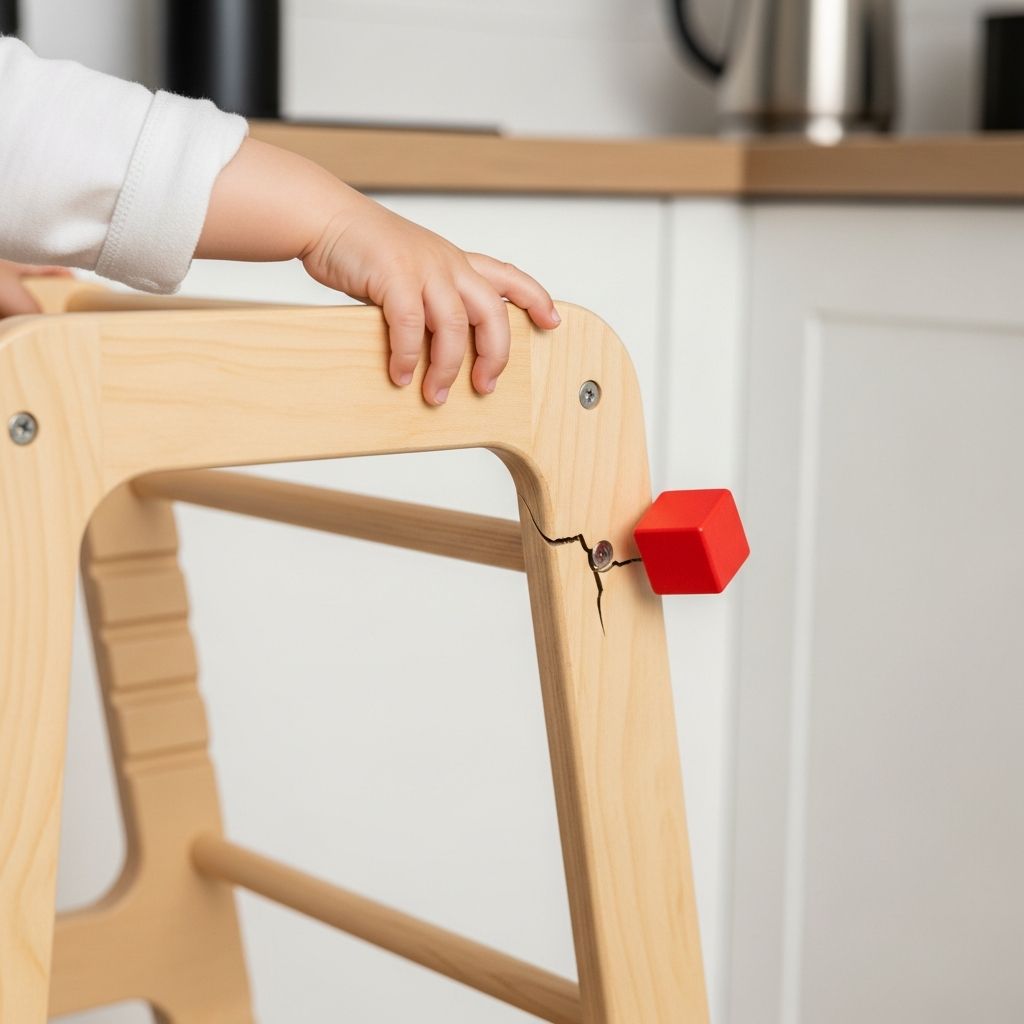
Multiple recalls highlight ongoing problems. For instance, the Cosco 2-Step Kitchen Stepper’s safety bar detached too easily, prompting a full recall. In 2026, Little Partners recalled their Grow ‘N Stow Folding Learning Tower due to platform collapse risks. Split wood, loose screws, and entrapment gaps frequently trigger these actions.
Comparing Top Models: Pass vs. Fail
While specific model names vary, patterns emerge from test data. Here’s a summary table of performance categories:
| Category | Passed | Failed | Key Insight |
|---|---|---|---|
| Stability (35 lbs) | 3/16 | 13/16 | Wider, heavier bases excel |
| Stability (59 lbs) | 0/16 | 16/16 | All vulnerable to heavier loads |
| Entrapment | 5/16 | 11/16 | Test all heights |
| Adequate Labels | 11/16 | 5/16 | Clear limits vital |
Sturdier designs with low centers of gravity, broad footprints, and reinforced joints performed best.
Manufacturer Responses and Industry Pushback
Several brands contested findings. Dadada affirmed their tower’s safety but pledged enhancements. Lalo cited internal rigorous tests and contributed to ASTM draft standards. Harppa and Cosyland announced design tweaks like added brackets for better stability.
The ASTM International committee is developing voluntary standards, recommending lower centers of gravity, wider bases with cross-feet, comprehensive gap testing at all heights, and prominent warnings. Adoption could elevate baseline safety, though mandatory CPSC rules remain elusive.
Essential Tips for Safer Toddler Tower Use
- Supervise Constantly: Remain within arm’s reach. Railings offer false security; prevent leaning, climbing out, or slips.
- Optimal Placement: Position on flat, non-slip surfaces away from edges, windows, stairs, or heat sources.
- Childproof the Environment: Secure knives, glassware, hot appliances. As reach expands, reassess hazards.
- Footwear Matters: Bare feet or grippy shoes beat socks for traction.
- Maintenance Checks: Tighten screws regularly; inspect for wear, cracks, or wobbles.
- Age-Appropriate Fit: Ensure guardrails exceed belly-button height. Use high chairs for smaller kids; step stools for bigger ones.
Spotting Superior Safety Features
When shopping, prioritize these attributes:
- Wide, heavy base with anti-tip crossbars.
- Non-adjustable or fully tested adjustable heights.
- Enclosed gaps preventing partial entrapments.
- Explicit max weight/height/age labels.
- ASTM-compliant or third-party certifications.
Though only a few aced tests, seeking heavier models reduces risks.
Alternatives to Traditional Towers
For wary parents, consider adjustable high chairs with footrests or booster seats with stable platforms. Wall-mounted fold-down steps offer countertop access without floor space use. Simple, weighted step stools suit older toddlers.
Future Outlook: Toward Stronger Standards
Advocacy from groups like Consumer Reports pressures manufacturers and regulators. As data mounts, expect voluntary improvements and potential federal mandates. Parents play a key role by demanding transparency and reporting issues to CPSC.
Frequently Asked Questions About Toddler Towers
What age is best for a toddler tower?
Ideal for children who stand hands-free, typically 18 months to 4-5 years, respecting model limits.
Can toddler towers cause serious injuries?
Yes, CPSC reports include concussions, fractures from falls and tip-overs.
Are all toddler towers unsafe?
No, a minority passed key tests; focus on proven stable designs.
How can I prevent tip-overs at home?
Opt for wide-based models, supervise closely, and avoid uneven loading.
What if my tower was recalled?
Follow CPSC remedies promptly; check SaferProducts.gov regularly.
Should I stop using our toddler tower?
Not necessarily—implement strict safety protocols if it fits guidelines.
References
- Most toddler towers that families buy aren’t safe, study finds — WTOP News. 2025-09-01. https://wtop.com/consumer-news/2025/09/ovn-most-toddler-towers-families-buy-arent-safe-study-finds/
- 16 Toddler Towers Were Tested for Safety, Only 3 Passed — The Bump. 2025. https://www.thebump.com/news/toddler-towers-safety
- Most Toddler Towers We Tested Pose Safety Concerns — Consumer Reports. 2025. https://www.consumerreports.org/babies-kids/child-safety/toddler-towers-safety-standards-a4009948838/
- These toddler tower models might be safest for your children — KVUE (YouTube). 2025. https://www.youtube.com/watch?v=Hq4gLMYqUDE
- Consumer Reports: Toddler tower safety concerns — YouTube. 2025. https://www.youtube.com/watch?v=rHsUFDLlz78
- Little Partners Recalls Children’s Grow ‘N Stow Folding Learning Towers Due to Fall Hazard — U.S. Consumer Product Safety Commission. 2026. https://www.cpsc.gov/Recalls/2026/Little-Partners-Recalls-Childrens-Grow-N-Stow-Folding-Learning-Towers-Due-to-Fall-Hazard