Toddlers between 12 and 36 months experience explosive growth in language abilities, transitioning from babbles to simple sentences. Understanding these stages helps parents support their child’s communication journey effectively.
Understanding the Foundations of Toddler Language Growth
Language development in toddlers builds on early vocalizations and comprehension. From 12 months, children start associating sounds with meanings, rapidly expanding their vocabulary through daily interactions. This period marks a critical window where environmental stimuli and responsive caregiving play pivotal roles in shaping expressive and receptive skills.
Receptive language—understanding words—often precedes expressive language—speaking words. By observing how toddlers respond to instructions or point to objects, parents can gauge progress. Factors like frequent conversations, reading, and play significantly accelerate this process.
Speech Milestones from 12 to 24 Months
During the second year, toddlers shift from single sounds to meaningful words. Key achievements include:
- At 12 months: Responding to name, using gestures like pointing or waving, and saying first words such as ‘mama’ or ‘dada’.
- By 18 months: Vocabulary of 20-50 words, following simple one-step directions like ‘give me the ball’, and imitating sounds or words.
- Pronunciation varies; toddlers may say ‘ta’ for ‘car’ or omit word endings, which is normal.
A ‘word spurt’ often occurs around 18 months, where vocabulary doubles quickly as children fast-map new terms after minimal exposure. They begin combining two words, like ‘more milk’ or ‘big dog’.
| Age Range | Receptive Skills | Expressive Skills |
|---|---|---|
| 12-17 Months | Follows simple phrases with gestures; enjoys books | 2-6 words; labels objects |
| 18-23 Months | Understands action words (clap, jump); points to body parts | 50 words; 2-3 word phrases |
Progressing to 24-36 Months: Building Sentences
By age 2, toddlers use 100-200 words and form 2-3 word sentences like ‘me do it’ or ‘dog run’. They incorporate verbs (‘eat’, ‘go’) and basic adjectives (‘big’, ‘red’).
At 3 years, speech becomes clearer, with 3-4 word sentences, plurals (‘shoes’), and questions (‘my ball?’). Strangers understand most of what they say, though complex sounds lag. Cognitive links emerge, like identifying colors or following two-step commands (‘get shoes and come’).
- Follows two-part directions: ‘Pick up toy and sit down’.
- Uses pronouns: ‘mine’, ‘me’, ‘you’.
- Asks simple questions and names body parts accurately.
Signs That May Indicate Speech Delays
While variation is normal, certain red flags warrant attention. Consult a professional if by 12 months, no babbling or response to name; by 18 months, fewer than 20 words or no two-word combos; by 24 months, no 50 words or limited gestures.
Other concerns: No pointing/waving, inability to follow simple instructions, or speech unintelligible to familiar adults. Early intervention improves outcomes significantly.
| Age | Potential Red Flags |
|---|---|
| 12 Months | No interest in sounds; doesn’t respond to name |
| 18 Months | No single words; can’t point or follow instructions |
| 24 Months | Vocabulary under 50; no two-word phrases |
Everyday Strategies to Encourage Talking
Parents are a child’s first teachers. Respond enthusiastically to attempts, expand on their words (child says ‘dog’, reply ‘yes, big brown dog!’). Limit screen time; prioritize face-to-face talks.
- Read daily: Point to pictures, ask ‘what’s that?’ to build vocabulary.
- Narrate routines: ‘Now we wash hands with soap’ reinforces words.
- Sing and rhyme: Songs aid rhythm and memory.
- Play interactively: Turn-taking games like rolling a ball teach social language.
- Avoid over-correcting: Model correct speech gently.
Use simple language matching their level, maintain eye contact, and pause for responses to foster turn-taking. Diverse experiences like park visits introduce new terms.
Role of Play and Environment in Language Building
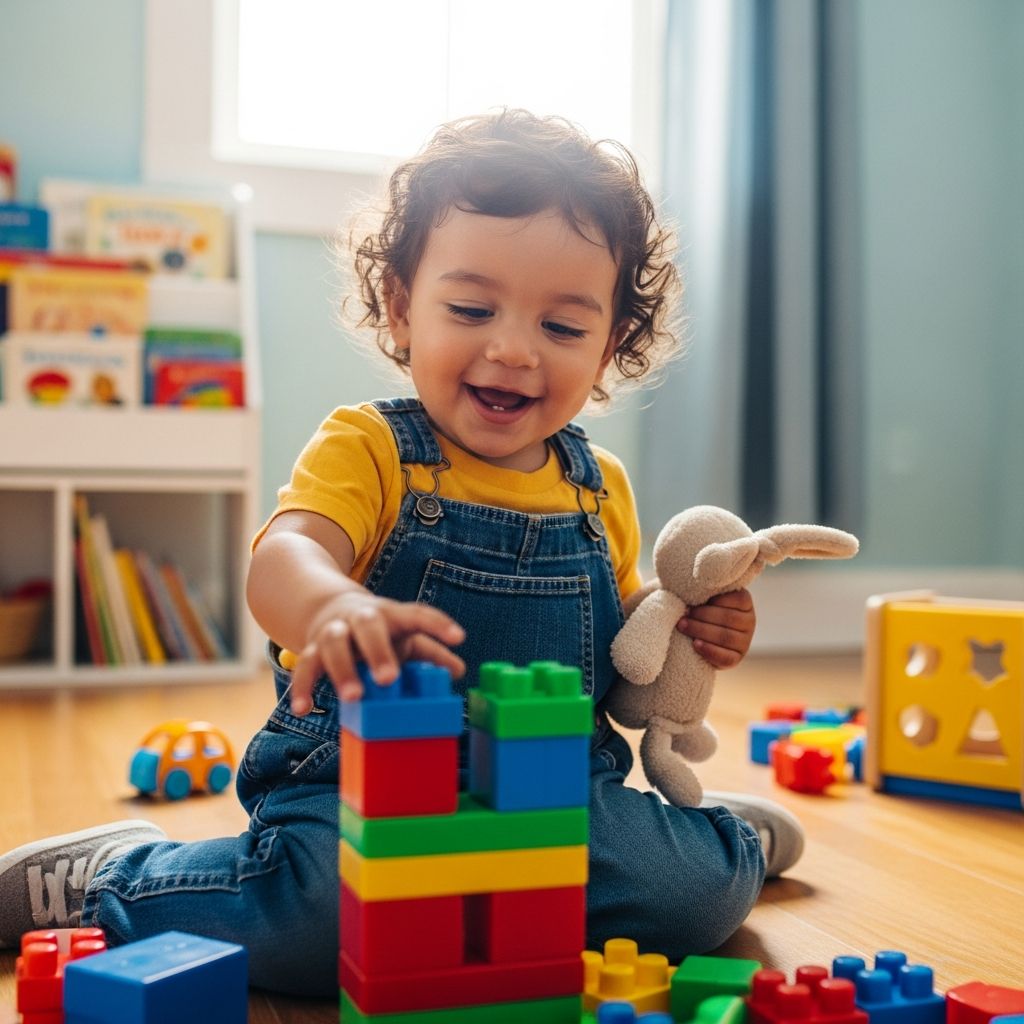
Play is language’s playground. Pretend play with toys encourages narratives: ‘teddy eat apple’. Outdoor time expands descriptors: ‘green grass, fast bird’.
Create a language-rich home: Label objects, discuss emotions (‘you happy?’), and expose to varied speech patterns through family interactions. Consistency across caregivers ensures reinforcement.
When and How to Seek Professional Support
If delays persist, pediatricians can screen and refer to speech-language pathologists. Early services like those from NIH programs target specific needs. Assessments evaluate hearing, cognition, and oral-motor skills.
Therapies include play-based sessions improving articulation and comprehension. Progress is trackable with milestones checklists. Most children catch up with timely help.
Nutrition, Health, and Language Links
Good nutrition supports brain growth; omega-3s and iron aid neural pathways. Address ear infections promptly, as they impact hearing and thus language. Bilingual homes? Children meet milestones similarly, separating languages over time.
Frequently Asked Questions (FAQs)
At what age should my toddler say their first word?
Most say first meaningful words around 12 months, though some start earlier or later. Gestures count as communication steps.
Is it normal if my 2-year-old’s speech is hard to understand?
Yes, strangers may understand 50% at 2 years; clarity improves by 3. Persistent issues beyond that may need evaluation.
How can I help a late talker at home?
Expand utterances, read often, reduce screens, and use simple directives. Track progress monthly.
Should I worry about screen time affecting speech?
Excessive passive screens can delay development; interactive use in moderation is fine post-18 months.
What’s the difference between speech and language delays?
Speech delay affects sound production; language delay impacts word use and comprehension.
Tracking Your Toddler’s Unique Path
Every child develops at their pace. Celebrate small wins like new words or gestures. Regular check-ins with doctors ensure steady progress. Empowering communication builds confidence and connections for life.
References
- Toddler Language Development — University of Nevada, Reno Extension. 2023. https://extension.unr.edu/publication.aspx?PubID=2469
- Language development: 1-2 years — Raising Children Network. 2024. https://raisingchildren.net.au/toddlers/development/language-development/language-1-2-years
- Age-Appropriate Speech and Language Milestones — Children’s Hospital of Philadelphia. 2023. https://www.chop.edu/health-resources/age-appropriate-speech-and-language-milestones
- Speech and Language Developmental Milestones for 2-Year-Olds — TherapyWorks. 2023. https://therapyworks.com/blog/developmental-milestones/speech-and-language-developmental-milestones-two-year-olds/
- Speech and language development (from 12 to 24 months) — Great Ormond Street Hospital. 2024. https://www.gosh.nhs.uk/conditions-and-treatments/procedures-and-treatments/speech-and-language-development-12-24-months/
- Speech and Language Developmental Milestones — National Institute on Deafness and Other Communication Disorders (NIDCD), NIH. 2025. https://www.nidcd.nih.gov/health/speech-and-language
- Communication Milestones: 2 to 3 Years — American Speech-Language-Hearing Association (ASHA). 2024. https://www.asha.org/public/developmental-milestones/communication-milestones-2-to-3-years/