Toddlers between 1 and 3 years old experience rapid growth in multiple areas, including social-emotional skills, language, cognition, and physical abilities. Engaging them in purposeful play supports these milestones, helping 80% of brain development that occurs by age 3. Activities that encourage exploration, imitation, and interaction build memory, reasoning, and independence.
Understanding Toddler Developmental Milestones
By 18 months, most toddlers say single words, walk up steps, run, help undress, and drink from a cup. At 2 years, they form 2-4 word sentences, sort shapes and colors, play simple pretend games, stand on tiptoe, and kick a ball. By 3 years, they follow 2-3 step instructions, name familiar objects, climb well, run easily, and operate toys with buttons or switches. Tracking these via apps like the CDC Milestones Tracker helps parents monitor progress and incorporate targeted activities.
Activities to Boost Cognitive and Problem-Solving Skills
Cognitive growth involves learning, thinking, and problem-solving. Toddlers hold items in one hand while manipulating with the other, use switches on toys, and play with multiple objects simultaneously, like placing toy food on a plate.
- Sorting and Matching Challenges: Use buttons, blocks, or toys to sort by color, shape, or size. This introduces early math concepts and enhances classification skills.
- Memory Pairing Games: Create simple matching cards with animals or shapes. Flipping cards face down builds concentration, memory, and turn-taking.
- Cause-and-Effect Experiments: Roll balls down ramps or pour water between containers to demonstrate action-reaction relationships, sparking curiosity and logical thinking.
- Counting with Objects: Count buttons or toys, grouping them for basic addition/subtraction practice using tangible items.
These games strengthen executive function skills like focus and planning, essential for future learning.
Building Gross and Fine Motor Abilities Through Play
Motor development includes gross skills like running and climbing, and fine skills like grasping small objects. Activities promote hand-eye coordination, balance, and strength.
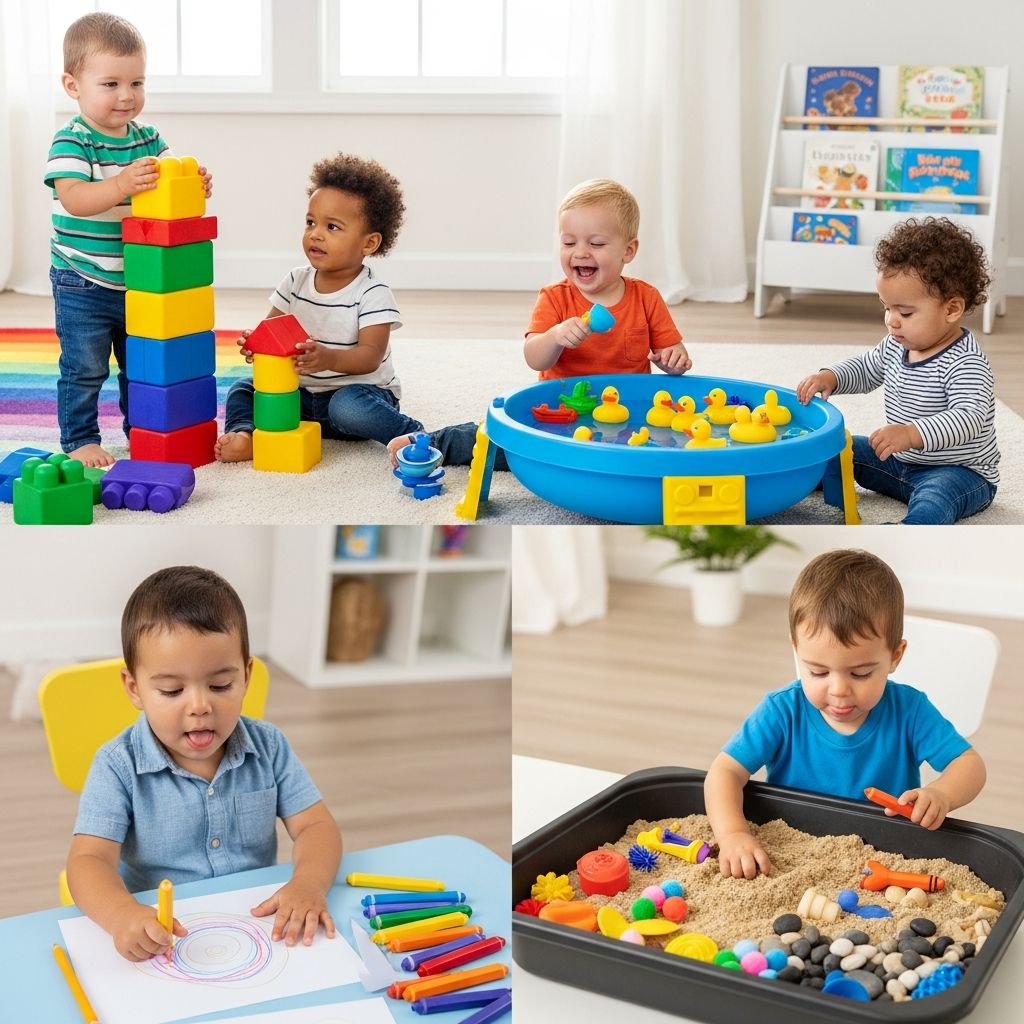
- Block Stacking Adventures: Stack wooden, foam, or magnetic blocks to explore balance, gravity, and spatial awareness, refining fine motor control.
- Obstacle Navigation Courses: Set up cones, tunnels, and cushions for crawling, jumping, and balancing, enhancing gross motor coordination in safe spaces.
- Water Sensory Exploration: In a shallow table or tub, scoop, pour, and observe sinking/floating toys, improving dexterity and discussing physics basics.
- Leaf or Treasure Hunts: Walk outdoors collecting leaves or small items in a basket, combining walking, squatting, and pinching for dual motor practice.
By 2 years, toddlers try knobs and buttons, supporting these hands-on exercises.
Fostering Language and Communication Growth
Language milestones progress from single words at 18 months to sentences by 2 years and multi-step instructions by 3. Play builds vocabulary, memory, and expression.
- Body Part Naming Game: During routines like diaper changes, point to and name feet, toes, belly, or face parts. Repetition embeds new words.
- Simple Counting Chants: Use rhymes while counting fingers or toys, linking words to actions for better recall.
- Storytime Interactions: Read picture books, asking “What’s this?” to name objects, expanding familiarity with everyday items.
These interactions help toddlers follow directions and express needs effectively.
Encouraging Creativity and Imagination
Creative play develops imagination, sensory awareness, emotions, and social skills. Toddlers explore through art, music, dance, and drama.
- Music and Rhythm Sessions: Shake instruments or bang pots while singing simple songs. Adding actions to lyrics boosts word use and memory.
- Freeze Dance Fun: Dance freely to music, freezing when it stops. This hones listening, self-control, and body awareness.
- Pretend Play with Dolls: Use stuffed animals for role-play like feeding or dressing, starting pretend skills around 18 months.
- Sensory Art Experiences: Finger paint or play with dough, exploring textures, colors, and smells to express ideas.
Dance movements like jumping or hopping help process emotions and environments.
Promoting Social and Emotional Development
Socially, toddlers engage in parallel play, enjoying proximity without full interaction. Activities build independence, sharing, and empathy.
- Parallel Play Setups: Place toddlers side-by-side with similar toys, like sandbox digging, fostering interest without pressure.
- Turn-Taking Ball Games: Roll balls back and forth, teaching cooperation and emotional regulation.
- Emotion Charades: Act out happy or sad faces with mirrors, helping recognize and name feelings.
Imitation of adults drives emotional growth during this defiant exploration phase.
Daily Routine Integration and Safety Tips
Blend activities into routines: sensory play during bath time, counting at meals. Balance structured and free play to avoid overstimulation—offer few toys at once. Follow the child’s lead for maximum engagement.
| Age | Key Activity Focus | Expected Milestone |
|---|---|---|
| 18 Months | Sensory sorting, walking games | Says words, runs, self-helps |
| 2 Years | Matching, pretend play | 2-4 word sentences, sorts shapes |
| 3 Years | Obstacle courses, multi-step games | Follows 2-3 steps, climbs well |
Supervise to prevent choking; use age-appropriate, non-toxic materials. Consult doctors if milestones lag.
Frequently Asked Questions (FAQs)
What if my toddler misses a milestone?
Most reach milestones around the same time, but variations occur. Use the CDC app to track; seek pediatric advice if concerned.
How much daily play is ideal?
Aim for 1-3 hours of active play, mixing free and guided, adjusted to energy levels.
Are screens okay for learning?
Limit to high-quality, interactive content under 1 hour/day; prioritize hands-on play.
Can these activities help shy toddlers?
Yes, parallel play builds comfort around peers gradually.
What household items work best?
Pots, spoons, boxes, water—recycle safely for endless fun.
References
- Development and Milestones for Toddlers (1 – 3 Years) — Michigan Department of Education. Accessed 2026. https://www.michigan.gov/mikidsmatter/parents/toddler/milestones
- Creative activities for toddler learning and development — Raising Children Network (Australian Government initiative). Accessed 2026. https://raisingchildren.net.au/toddlers/development/creative-development/toddler-creative-activities
- Learning Activities for Two-Year-Olds — Wake Forest Pediatrics. Accessed 2026. https://wakeforestpediatrics.com/learning-activities-for-two-year-olds/
- Developmental Stages of Play – Toddler — First 5 California. Accessed 2026. https://www.first5california.com/en-us/articles/developmental-stages-of-play-toddler/
- Play Activities for 12 to 24 Months — ZERO TO THREE. Accessed 2026. https://www.zerotothree.org/resource/play-activities-for-12-to-24-months/
- Milestones by 2 Years — Centers for Disease Control and Prevention (CDC). Accessed 2026. https://www.cdc.gov/act-early/milestones/2-years.html