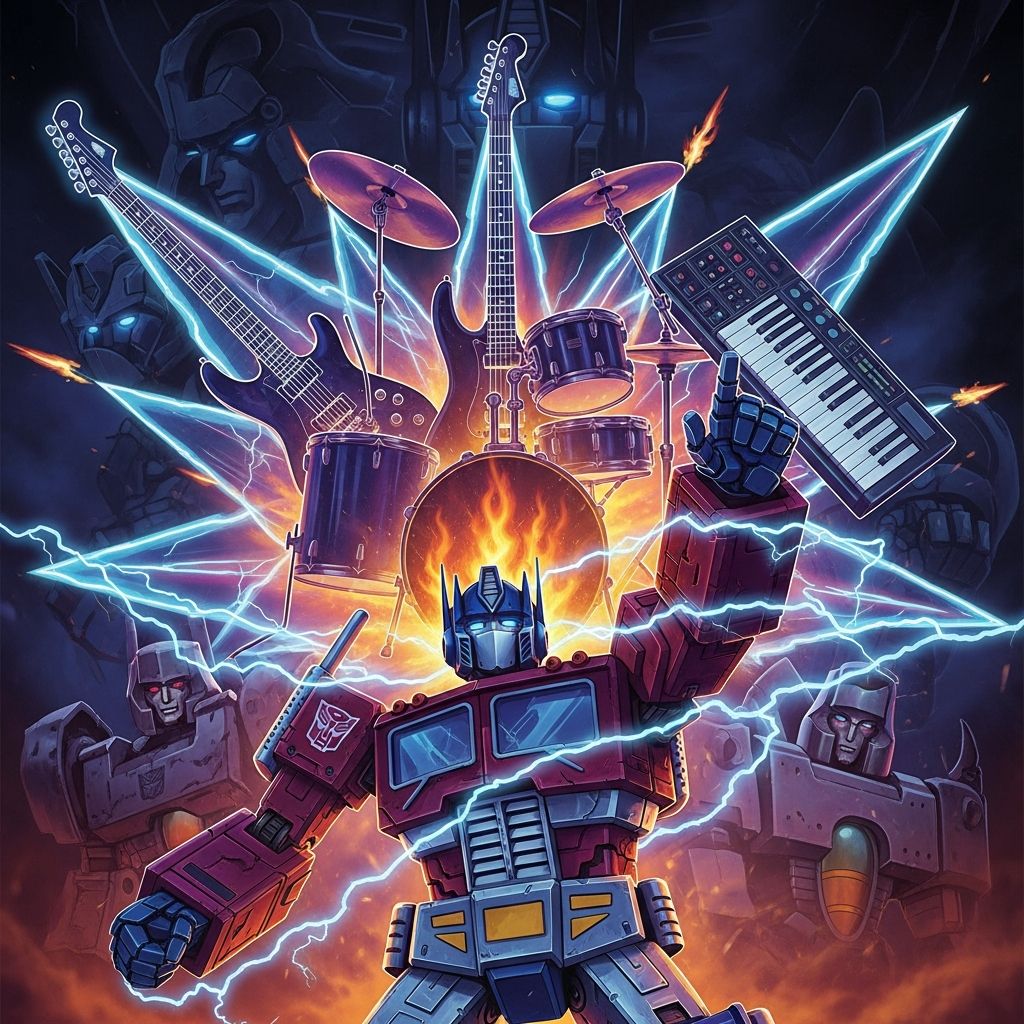
In 1986, an animated film made to sell transforming robot toys ended up with one of the most audacious soundtracks of its decade. Loud arena rock, blazing guitar solos, synth-heavy score, and a full-blown Weird Al parody collided to give The Transformers: The Movie a musical identity that felt closer to a cult rock opera than a simple kids’ cartoon tie-in. This unlikely combination turned a marketing vehicle into a formative experience for an entire generation of young fans.
From Toy Aisles to Turntables: How the Album Came Together
The film’s soundtrack, officially titled The Transformers: The Movie (Original Motion Picture Soundtrack), was released in the U.S. by Scotti Bros. Records in July 1986, just ahead of the movie’s theatrical debut. It arrived first on LP and cassette, like most pop and rock albums of the era, and later saw CD releases in Japan in 1989 and the U.S. in 1992, with additional reissues in the years that followed.
Unlike many animated features of its time, the film did not lean on traditional orchestral scoring or gentle pop ballads. Instead, it fused two bold musical directions:
- High-energy rock and metal songs by artists such as Stan Bush, NRG, and Kick Axe (often credited under aliases for the film).
- Synth-driven instrumental score composed and performed by Vince DiCola, who had recently gained attention for his electronic work on Rocky IV.
The result was a soundtrack that sounded like a concept album about giant space robots rather than a cautious, family-friendly release. Its producers effectively bet that kids could handle – and even love – a full-force rock album paired with their favorite characters.
Key Players: The Voices Behind the Volume
Several musicians became permanently linked with the film thanks to the soundtrack’s cult following.
Stan Bush: The Sound of Robot Heroism
Rock singer and guitarist Stan Bush is best known among fans for two songs that practically define the film’s emotional arc:
- “The Touch” – a soaring power anthem used during a crucial battle and associated with heroism and sacrifice.
- “Dare” – an upbeat motivational track that underscores the coming-of-age of the young Autobot Hot Rod.
Both tracks channel the triumphant, motivational energy common in 1980s sports and action films, comparable in spirit to the anthemic rock songs featured in movies like Top Gun and the Rocky series.
Vince DiCola: Synths in Space
Composer Vince DiCola, coming off his work on Rocky IV, built the film’s instrumental fabric from layers of synthesizers rather than a traditional orchestra. His tracks – including cues like “Autobot/Decepticon Battle” and “Megatron Must Be Stopped” – give the movie a cold, mechanical, yet strangely emotional soundscape that matches its space-faring robot mythology.
In the mid-1980s, synthesizer scores were increasingly common in science fiction and action cinema, reflecting both technological advances in electronic instruments and a broader cultural fascination with futurism and digital sound. DiCola’s contribution placed The Transformers: The Movie firmly in that trend while still feeling idiosyncratic and aggressive.
Weird Al Yankovic and the Junk Planet
One of the film’s most surprising musical moments is the inclusion of “Dare to Be Stupid” by “Weird Al” Yankovic. Originally released on his 1985 album of the same name, the song is a style parody inspired by the band Devo, filled with absurdist lyrics and synthetic riffs. In the film, it accompanies a chaotic battle on a junk planet, matching the fragmented, pop-culture-obsessed nature of its inhabitants.
The choice to drop a full Weird Al track into a dramatic sci-fi story felt bizarre on paper, but it worked precisely because the soundtrack as a whole already embraced maximalism and tonal risk-taking.
The Track List as a Narrative Spine
The soundtrack does more than echo the film; in many scenes, the songs effectively tell the story. Action sequences, character growth, and even grief are punctuated by very specific musical cues that fans continue to associate with those exact moments decades later.
| Song / Cue | Performer / Composer | Role in the Film |
|---|---|---|
| The Touch | Stan Bush | Heroic battle anthem; linked to key moments of courage and sacrifice. |
| Dare | Stan Bush | Underscores Hot Rod’s growth and the spirit of taking risks. |
| Instruments of Destruction | NRG | Brutalizes early battle scenes, amplifying the shock of on-screen destruction. |
| Nothing’s Gonna Stand in Our Way | Kick Axe (credited under pseudonym) | Bolsters the Autobots’ determination during high-stakes conflict. |
| Dare to Be Stupid | “Weird Al” Yankovic | Accompanies the Junkion sequence with zany, off-kilter energy. |
| Instrumental cues (e.g., “Autobot/Decepticon Battle”) | Vince DiCola | Provides thematic continuity and emotional undercurrent through synth score. |
Why It Feels Like a Rock Opera
Although the film is not a sung-through musical, the soundtrack behaves like the backbone of a rock opera. Several characteristics contribute to this effect:
- Leitmotifs and recurring moods in DiCola’s score create continuity between scenes, akin to thematic threads in concept albums.
- Song placement at story pivots ensures that almost every major plot turn is tied to a memorable track.
- Stylistic unity through 1980s rock and synth aesthetics makes the album feel like a coherent listening experience independent of the film.
For many children who saw the movie in theaters or on home video, this soundtrack became their first exposure to the idea that a film’s music could be as narratively important as its visuals or dialogue. The songs gave emotional shape to robot battles, betrayals, sacrifices, and unlikely alliances.
Standing Beside the Big Guns of 1986
1986 was a notable year for blockbuster soundtracks. The same era saw the release of albums like the Top Gun soundtrack, which went on to multi-platinum success and produced chart-topping singles. In that context, The Transformers: The Movie soundtrack was a much smaller commercial entity, yet it carved out a distinct niche.
Where mainstream hits of the time centered around adult-oriented romance or military heroism, the Transformers soundtrack translated those musical tropes into the language of childhood imagination. It gave toy-based action the same sonic gravitas as fighter jets and boxing champions, calling on many of the same production techniques: big hooks, layered vocals, pounding drums, and an almost relentless optimism.
Why It Worked for Kids (Even When It Was Too Intense)
Part of the soundtrack’s enduring cult status comes from how emotionally intense it felt when paired with the film’s unexpectedly serious plot developments. The movie famously killed off major characters, including the long-standing Autobot leader, in scenes that were far more traumatic than most children’s entertainment of the time.
Several musical decisions amplified that impact:
- Placing triumphant songs around moments of loss, giving young viewers a sense that grief and courage could coexist.
- Using high drama in the score, especially in DiCola’s darker, more melancholic passages, to underline the scale of the crisis.
- Ending critical battles with fist-pumping anthems, implying that resilience and hope were as important as victory.
For many viewers, these musical cues helped frame difficult story beats in a way that felt cathartic rather than purely bleak. As a result, the soundtrack is often remembered not only as fun or catchy, but also as a tool that helped children process feelings of loss and change。
From Cult Obsession to Reissues and Covers
Over time, the soundtrack’s reputation only grew. Originally released on LP and cassette, it later returned in multiple CD editions and modern vinyl pressings, including specialty colored variants designed for collectors. Its continued reissue history underscores the way a once-niche album became a nostalgia object。
Fan culture also played a key role in keeping the music alive:
- Cover albums such as the one by The Cybertronic Spree painstakingly re-create and reinterpret the 1986 tracks for modern audiences, often performed in full costume as Transformers characters。
- Convention performances and fan screenings frequently highlight songs like “The Touch” as singalong centerpieces。
- Later media appearances of individual tracks, including new recordings and homages in other films and games, introduced them to people who never saw the original movie in theaters。
Comparing the 1986 Album to Modern Franchise Soundtracks
Modern Transformers films, including more recent entries tied to 1990s settings, often use licensed hip-hop, pop, and contemporary score to ground their stories in recognizable historical moments。Those approaches tend to create a curated playlist feel, where songs function as markers of time and place。
By contrast, the 1986 album operates like a singular, slightly unhinged statement।Rather than carefully blending diverse genres for broad appeal, it doubles down on a specific 1980s rock-and-synth identity।That very narrowness becomes its strength: you may not encounter these songs anywhere else, but together they define the movie’s personality so completely that it is difficult to imagine the images without the music。
Why the 1986 Transformers Soundtrack Still Matters
Decades later, the soundtrack continues to resonate because it represents an era when children’s media occasionally took big, unapologetic swings।It did not try to sound restrained or “safe.” Instead, it treated a story about robots from outer space with the same musical intensity that adult action films reserved for world-saving pilots or underdog athletes。
In doing so, it quietly taught young fans several lessons about what movie music could be:
- It can be loud and emotionally sincere at the same time。
- It can shape how you remember a story as much as the plot itself。
- It can live on independently as an album that tells its own version of the narrative。
For many people now in their thirties and forties, the album is not just a curiosity from childhood; it is one of the first records that made them aware of how soundtracks work and why music matters in visual storytelling。
Frequently Asked Questions (FAQs)
When was The Transformers: The Movie soundtrack originally released?
The original soundtrack for The Transformers: The Movie was released in the United States on July 26, 1986, by Scotti Bros. Records, shortly before the film reached theaters。
Who performs “The Touch” and “Dare” on the album?
Both “The Touch” and “Dare” are performed by rock musician Stan Bush。These tracks became closely associated with the film’s heroic and coming-of-age themes。
Did “Weird Al” Yankovic write “Dare to Be Stupid” specifically for Transformers?
No。”Dare to Be Stupid” was originally released on Yankovic’s 1985 album of the same name as a style parody inspired by the band Devo।The finished track was later licensed for use in the film’s Junkion sequence。
Who composed the instrumental score for the 1986 Transformers movie?
The instrumental score was composed and performed by Vince DiCola,known for his earlier synth-heavy work on the film Rocky IV。His music for Transformers relies extensively on electronic instruments rather than traditional orchestral arrangements。
Has the 1986 soundtrack been reissued or covered in recent years?
Yes。The album has appeared in multiple CD and vinyl reissues, sometimes with bonus tracks or updated artwork, and bands such as The Cybertronic Spree have released full-cover versions of many of its songs, keeping the music active in fan culture。
References
- The Transformers: The Movie (Original Motion Picture Soundtrack) — Various artists, Scotti Bros. / Volcano Entertainment release history and track listing. 1986–2007. https://en.wikipedia.org/wiki/The_Transformers:_The_Movie_(Original_Motion_Picture_Soundtrack)
- 37 Years Later, One Weird Rock Opera Album Made An Animated Transformers Movie Totally Timeless — Fatherly. 2023-06-08. https://www.fatherly.com/entertainment/transformers-the-movie-soundtrack-1986-the-touch-stan-bush-weird-al-kick-axe
- Soundtrack to our Lives: Transformers Animated Movie Soundtrack — The Fwoosh. 2015-08-10. https://thefwoosh.com/2015/08/soundtrack-to-our-lives-transformers-animated-movie-soundtrack/
- Soundtrack – The Transformers (Unicron Marbled Vinyl) — Music On Vinyl. 2020. https://www.musiconvinyl.com/products/transformers
- Transformers 1986 — The Cybertronic Spree (album listing). 2016. https://thecybertronicspree.bandcamp.com/album/transformers-1986