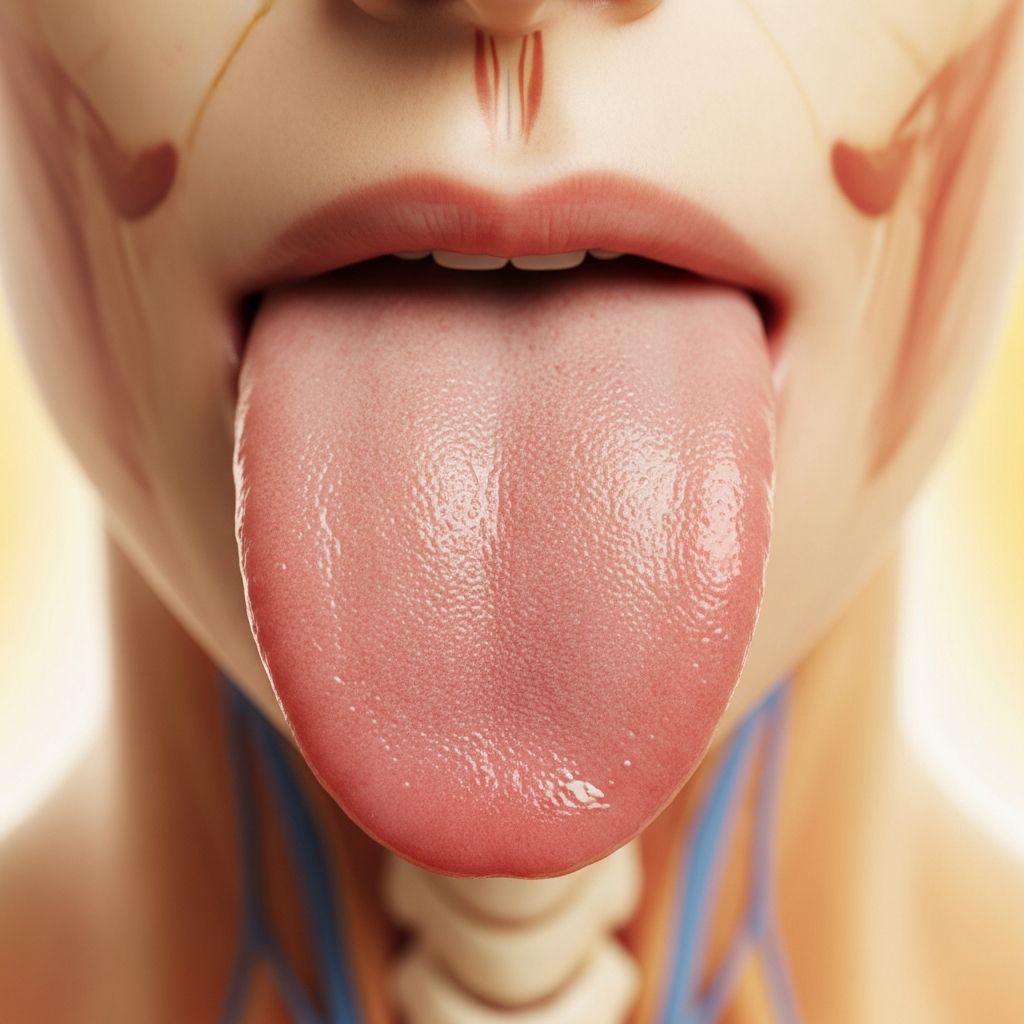
Your tongue is a powerful, flexible bundle of muscles that helps you taste your favorite foods, talk with friends, and move food safely when you eat. Even though it does so much, it usually goes unnoticed until something feels wrong, like a bite or a burn from hot pizza.
Meet Your Tongue: What It Really Is
The tongue is a muscular organ that sits on the floor of your mouth and stretches toward the back of your throat. It is covered by a moist, pink layer called mucosa and dotted with tiny bumps that hold your taste buds.
Doctors and dentists usually divide the tongue into two main areas:
- Front (oral) part – the front two-thirds that you can stick out and move easily
- Back (throat) part – the rear third that sits closer to your throat and helps with swallowing
Underneath, a thin band of tissue called the lingual frenulum connects the bottom of your tongue to the floor of your mouth and helps control its movement.
Parts of the Tongue Explained Simply
You do not need to know every tiny detail to understand the tongue, but a few main parts make it easier to imagine what is happening when you talk or eat.
| Part | Where It Is | What It Helps You Do |
|---|---|---|
| Tip | Very front of the tongue | Touches teeth and gums to make sounds and feel food |
| Body | Middle front area | Presses food against teeth, moves it around while chewing |
| Back (base) | Closer to the throat | Pushes chewed food toward the throat to swallow |
| Papillae | Tiny bumps on the surface | Hold taste buds and help grip food |
| Taste buds | Inside some papillae | Sense flavors like sweet, salty, sour, bitter, and umami |
Inside the tongue are many small muscles that allow it to change shape (like flattening or curving) and move in different directions at the same time. This makes the tongue one of the most flexible structures in your body.
How Taste Buds Let You Enjoy Food
The bumpy surface of your tongue is not just for looks. Many of those bumps are papillae that hold thousands of tiny taste buds. Each taste bud has special cells that send signals through nerves to your brain when they meet food or drinks.
These taste buds work together to sense at least five main taste types:
- Sweet – often found in fruits, desserts, and some drinks
- Salty – found in snacks like chips or salted nuts
- Sour – strong in lemons, limes, and some candies
- Bitter – in some vegetables and dark chocolate
- Umami – a savory taste in foods like cheese, meat, and broth
Scientists once thought that different sections of the tongue could only taste certain flavors, but research now shows that all five tastes can be sensed across most of the tongue’s surface, especially the front part.
Smell also works together with your tongue. The taste buds and your nose team up to create what your brain recognizes as flavor, which is why food can seem bland when you have a stuffy nose.
Helping You Eat, Chew, and Swallow Safely
Every time you take a bite, your tongue plays several important roles to keep you safe and help you enjoy your meal.
- Positioning food – The tongue moves food to your teeth so you can chew it.
- Mixing with saliva – It helps mix food with saliva to make it softer and easier to swallow.
- Forming a food ball – It gathers chewed food into a small ball called a bolus.
- Starting swallowing – The back of the tongue pushes the bolus toward the throat so swallowing can begin.
These steps happen quickly and smoothly when your tongue muscles and the muscles in your throat work together. This careful teamwork helps keep food going down the right tube into your esophagus instead of your windpipe.
The Tongue and Talking
Speaking clearly depends on how well your tongue can move. The tongue touches your teeth, gums, and the roof of your mouth in very precise ways to make different sounds.
For example, the tongue helps with:
- Letter sounds like t, d, l, n, and s, which need the tip of the tongue to touch or come close to the teeth or gums
- Rolling sounds in some languages, where the tongue quickly flips or vibrates
- Changing sounds smoothly from one letter or syllable to another while you talk
If the tongue cannot move freely, it may be harder to say certain words or sounds, and speech may not be as clear.
How the Tongue Helps Keep Your Mouth Clean
Besides tasting and talking, the tongue quietly helps protect your teeth and gums.
- Moving saliva – The tongue spreads saliva around your mouth, which helps wash away food bits and neutralize acids that can harm tooth enamel.
- Brushing food away – Its movements help sweep small pieces of food off your teeth and gums.
- Helping fight germs – The surface of the tongue and the saliva it moves contain helpful substances that support your body’s defenses against some germs.
Even though the tongue helps with cleaning, it can also trap food and bacteria on its surface. That is why brushing or gently scraping your tongue is an important part of good oral hygiene.
Common Tongue Conditions Kids Might Hear About
The tongue is usually healthy and heals quickly, but some problems can affect how it feels or moves. If anything about your tongue worries you, an adult should always check with a dentist or doctor.
Minor Irritations
- Biting the tongue – Often happens by accident while chewing or playing; it can be painful but usually heals on its own.
- Burns from hot food or drinks – Very hot pizza, soup, or cocoa can burn the tongue surface and make it feel sore for a few days.
Tongue-Tie (Ankyloglossia)
Some babies are born with a lingual frenulum that is shorter or tighter than usual. This is called tongue-tie or ankyloglossia. When the tongue cannot lift or move freely, it may cause:
- Difficulty sucking during breastfeeding or bottle feeding
- Trouble moving food around the mouth as a child grows
- Problems pronouncing some sounds clearly, such as l, r, or t
Doctors or dentists can examine the tongue and may suggest a simple procedure, often called a frenotomy or frenectomy, to release the tight tissue so the tongue can move more easily.
Changes in Color or Coating
Sometimes the tongue may look whiter, redder, or have a thicker coating. This can happen for many reasons, including not cleaning the tongue well, mild infections, or other health issues. Any color or texture change that does not go away should be checked by a health professional.
Taking Care of Your Tongue
Caring for your tongue is part of caring for your whole mouth. Simple daily habits can keep it comfortable and healthy.
- Brush your tongue gently from back to front when you brush your teeth to remove food and bacteria.
- Drink water often to help wash away food bits and keep your mouth moist.
- Avoid licking irritants like very salty, spicy, or sour snacks if they make your tongue sore.
- Tell an adult if your tongue hurts, has bumps that do not go away, or feels strange for more than a few days.
- Visit the dentist regularly so they can check your tongue along with your teeth and gums.
Fun and Safe Ways to Explore Your Tongue
You can learn a lot about your own tongue by paying attention to it during everyday activities.
- Notice how your tongue moves when you say your name slowly.
- Try to feel where your tongue touches when you say sounds like t, l, or n.
- With an adult’s help, look in a mirror and gently stick your tongue out to see its shape and bumps.
- Pay attention to how food changes as your tongue and teeth chew it.
Always be gentle and never press or pull on your tongue too hard. If anything feels painful, stop and talk to an adult.
Frequently Asked Questions About the Tongue
Is the tongue the strongest muscle in the body?
The tongue is very strong and extremely flexible, but it is made of several small muscles working together. Different muscles in the body are stronger in different ways, so it is more accurate to say the tongue is one of the most active and flexible muscles rather than the single strongest.
How many taste buds does a person have?
People usually have several thousand taste buds, and they are found mainly on the top and sides of the tongue. These taste buds get replaced regularly throughout life as old ones wear out.
Can all parts of the tongue taste every flavor?
Yes. Modern research shows that all the main taste types—sweet, salty, sour, bitter, and umami—can be detected across most of the tongue, especially on the front portion where many taste buds are located.
Why does food taste dull when I have a cold?
When your nose is blocked, smell signals cannot reach your brain as well, so your brain gets fewer clues about flavor. Your tongue still works, but without help from your nose, tastes can seem weaker or boring.
When should I see a doctor or dentist about my tongue?
You should tell an adult and ask to see a health professional if your tongue hurts for more than a few days, has a sore that does not heal, looks very different in color or texture, or if you have trouble moving it, eating, or speaking.
References
- Tongue: Definition, Location, Anatomy & Function — Cleveland Clinic. 2022-06-23. https://my.clevelandclinic.org/health/body/22845-tongue
- Tongue — Britannica Kids. 2023-01-01. https://kids.britannica.com/kids/article/tongue/400193
- Tongue Functions and the Roles It Plays — Colgate Oral Care Center. 2021-09-15. https://www.colgate.com/en-us/oral-health/mouth-and-teeth-anatomy/tongue-functions-and-the-roles-it-plays
- The Tongue – Muscles, Innervation & Vasculature — TeachMeAnatomy. 2020-05-10. https://teachmeanatomy.info/head/muscles/tongue/
- Functions of the Tongue: Why It’s Essential for Infants and Children — The Kids Dentist of Henderson. 2022-04-01. https://kidsdentistofhenderson.com/functions-of-the-tongue-why-its-essential-for-infants-and-children/
- Tongue Facts & Parts: Lesson for Kids — Study.com. 2021-03-05. https://study.com/academy/lesson/tongue-facts-parts-lesson-for-kids.html