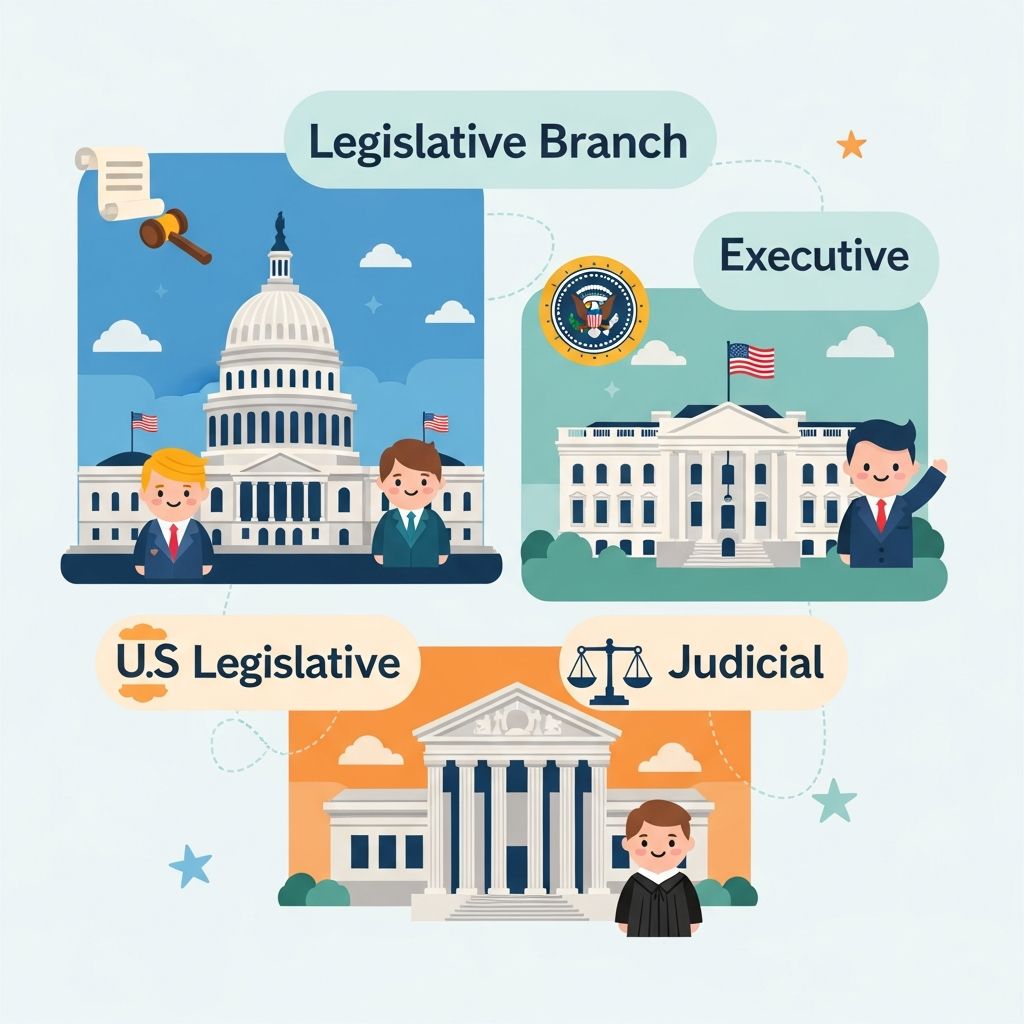
The United States government works like a team of three superheroes, each with a special job to keep our country running smoothly and fairly. These are the **legislative branch** (makes laws), the **executive branch** (carries out laws), and the **judicial branch** (explains laws). This setup, called separation of powers, stops any one group from having too much control.
Why Divide Government into Three Parts?
Imagine if one person decided all the rules, enforced them, and judged if they were broken—that could lead to unfairness! The framers of the Constitution in 1787 created three branches to share power and protect freedom. They learned from history, like problems with kings having too much authority, so they built in balances to keep things fair.
This system ensures laws benefit everyone. Kids, think of it as a classroom: one group suggests rules, another makes sure everyone follows them, and a teacher checks if they’re right.
The Legislative Branch: The Law-Making Team
The legislative branch is Congress, made up of the House of Representatives and the Senate. They create laws about taxes, schools, parks, and more.
- House of Representatives: 435 members based on state population. Bigger states like California have more reps.
- Senate: 100 members, 2 per state, so every state has equal say.
A bill (idea for a law) starts here. Both houses must agree, then it goes to the president. Congress also declares war, approves budgets, and checks other branches by overriding vetoes or impeaching officials.
| Feature | House | Senate |
|---|---|---|
| Members | 435 | 100 |
| Term Length | 2 years | 6 years |
| Leaders | Speaker | Vice President (tie-breaker) |
Congress meets in the Capitol Building in Washington, D.C.
The Executive Branch: Putting Laws into Action
Led by the President, this branch enforces laws with help from the Vice President, Cabinet, and millions of workers in agencies like the FBI or Department of Education. The President is elected every 4 years via the Electoral College.
- Signs or vetoes bills from Congress.
- Commands the military as Commander-in-Chief.
- Makes treaties and appoints judges.
About 5 million people work here, from park rangers to astronauts. The White House is their headquarters.
The Judicial Branch: The Law Interpreters
The Supreme Court and lower federal courts decide if laws follow the Constitution. There are 9 Supreme Court Justices, appointed for life by the President and confirmed by the Senate.
They hear big cases, like if a law is fair or if the president broke rules. Lower courts handle everyday federal issues.
- Supreme Court: Highest court, rules on Constitution.
- District and Appeals Courts: Handle trials and reviews.
This branch checks others by declaring laws or actions unconstitutional.
Checks and Balances: Keeping Power in Check
Each branch watches the others to prevent abuse. Here’s how:
- President vetoes laws, but Congress overrides with 2/3 vote.
- Congress approves presidential appointments and can impeach.
- Courts strike down unconstitutional laws or actions.
- President nominates judges, Senate confirms.
This teamwork keeps democracy strong.
Real-Life Examples Kids Can Relate To
Suppose Congress passes a law for free school lunches (legislative). The President signs it, and the Department of Education distributes funds (executive). If someone sues saying it violates rights, the Supreme Court decides (judicial).
During COVID, Congress funded vaccines, the President led distribution, and courts ruled on restrictions. (Updated context from sources.)
How State Governments Mirror the Federal Ones
States have similar branches: governors (executive), state legislatures, and courts. This keeps power balanced everywhere.
Fun Ways to Teach Kids About the Branches
- Role-Play: Assign kids as president, senator, or judge to act out passing a ‘playground rule’.
- Draw It: Sketch the branches as a tree with roots (checks), trunk (powers), branches (jobs).
- Games: ‘Checks and Balances Bingo’ with vetoes, impeachments.
- Visits: Virtual tours of Capitol, White House, Supreme Court.
These activities make civics exciting!
Frequently Asked Questions (FAQs)
What is the main job of each branch?
Legislative makes laws, executive enforces them, judicial interprets.
Who is in charge of the executive branch?
The President, elected every 4 years.
Can the Supreme Court make laws?
No, they only interpret if laws match the Constitution.
What happens if branches disagree?
Checks and balances resolve it, like veto overrides.
How many Supreme Court justices are there?
Nine, serving for life.
Why Learning This Matters for Kids
Understanding government helps kids become informed citizens who vote and participate. It shows how everyday things like roads and schools come from this system.
Expand learning with official sites or books on the Constitution.
References
- Three Branches of Government — Historical Society of the New York Courts. Accessed 2026. https://history.nycourts.gov/democracy-teacher-toolkit/three-branches-of-government/
- Our Government — The White House. Accessed 2026. https://www.whitehouse.gov/government/
- Branches of Government — United States House of Representatives. Accessed 2026. http://www.house.gov/the-house-explained/branches-of-government
- Three Branches of Government Explained — YouTube (Educational Video). Accessed 2026. https://www.youtube.com/watch?v=DuWRrTVGnRA
- Three Branches of Government — Harry S. Truman Library. Accessed 2026. https://www.trumanlibrary.gov/education/three-branches/three-branches-of-government
- Branches of the U.S. government — USAGov. 2025-09-22. https://www.usa.gov/branches-of-government
- What are the Branches of Government — Ben’s Guide (GPO). Accessed 2026. https://bensguide.gpo.gov/a-what-are-branches
- Separation of Powers in Action — United States Courts. Accessed 2026. https://www.uscourts.gov/about-federal-courts/educational-resources/educational-activities/first-amendment-activities/us-v-alvarez/separation-powers-action-us-v-alvarez