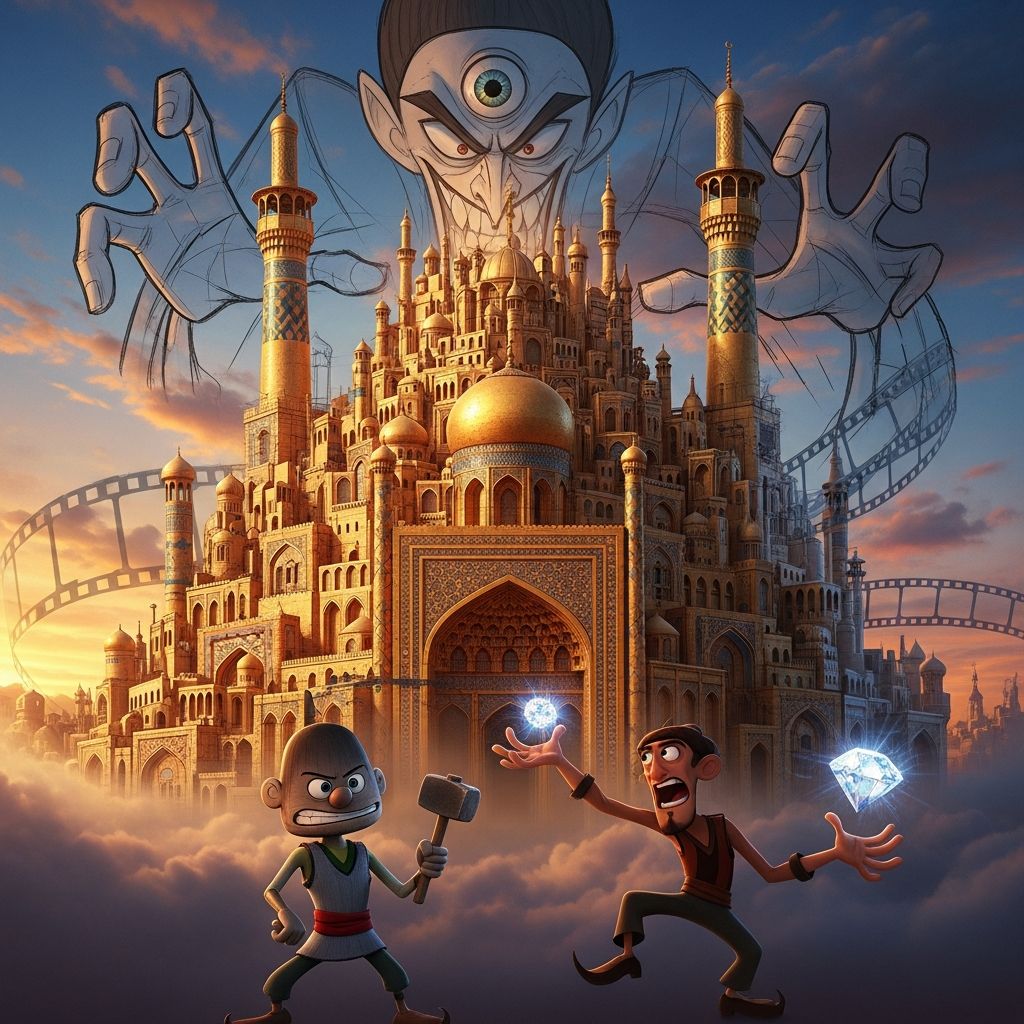
There are successful animated movies, forgotten animated movies, and then there is The Thief and the Cobbler – a film that somehow manages to be both a masterpiece and a cautionary tale at the same time. Instead of existing as a single definitive version, it survives as a patchwork of cuts, workprints, and fan restorations, each one hinting at the movie it might have been.
The Dream Of A Perfect Hand-Drawn Epic
The origins of The Thief and the Cobbler lie in a decades-long ambition to create a hand-drawn feature that would push traditional animation to its absolute limits. Rather than chasing toys, sequels, or marketing tie-ins, the director set out to build a mythic story inspired by Middle Eastern folklore, geometric art, and silent-era visual comedy.
The early concept was simple but bold: a near-wordless fantasy driven by visual gags, intricate background designs, and gravity-defying camera moves that made every frame feel like a moving tapestry. At a time when many studios were embracing shortcuts, this production doubled down on painstakingly detailed, frame-by-frame craftsmanship.
- Extremely long development, stretching across multiple decades.
- Visual style influenced by ornamental patterns, tile work, and miniature painting.
- Story emphasis on physical comedy and visual storytelling over dialogue.
Inside A Story With Almost No Words
At the center of the film is a timid cobbler and a silent, compulsive thief, whose clashing paths accidentally endanger – and ultimately help to save – a fantastical golden city. The cobbler’s humble, almost passive nature contrasts sharply with the thief’s frantic, greedy energy, turning simple chases into elaborate visual set-pieces.
The surrounding cast leans on archetypes familiar from folktales – a brave princess, a scheming vizier, looming invaders from the desert – yet the movie treats them less as vehicles for witty dialogue and more as moving shapes in an art piece. The result feels closer to a surreal pantomime than a conventional family cartoon.
- The thief rarely, if ever, speaks, relying on slapstick timing and reaction.
- The cobbler’s actions are small and precise, mirroring his craft.
- The kingdom’s fate hinges on three golden ornaments, fragile symbols of balance and order.
Visual Ambition On A Dangerous Scale
What makes The Thief and the Cobbler stand apart is not just its story, but the ferocity of its visual ambition. Backgrounds fold into each other through impossible tracking shots, armies march like living patterns, and the camera moves through space as if it is unbound by the limits of traditional cel animation.
Entire sequences were designed as technical showpieces: chains of cause-and-effect gags, dizzying staircases, and colossal war machines animated with a precision that bordered on obsession. These scenes were so time-consuming that they effectively became gravitational wells, pulling years of labor into a few minutes of screen time.
| Element | What It Does | Why It Matters |
|---|---|---|
| Endless geometric backgrounds | Turn the city into a maze of patterns and tiles. | Blurs the line between architecture and abstract design. |
| Long, unbroken camera moves | Float through spaces with no visible cuts. | Showcase what hand-drawn perspective can do without computers. |
| Silent physical comedy | Build jokes out of objects, timing, and movement. | Connects the film to the tradition of silent-film clowns and early cartoons. |
| Hyper-detailed battle imagery | Depict invading forces as rhythmic, almost mechanical masses. | Turns large-scale conflict into a kind of hypnotic visual pattern. |
Money, Control, And The Slow-Motion Collapse
The same perfectionism that gave the film its unique beauty also made it chronically vulnerable to financial pressure. As production costs climbed, investors and distributors grew impatient with a process that seemed to stretch on without a clear end date.
Over time, the balance of power shifted away from the original creative team and toward outside financiers and completion producers brought in to finish the project. What began as a fiercely independent vision was gradually sliced, re-edited, and reshaped to fit commercial expectations it was never designed to meet.
- Budgets expanded as complex scenes took years to complete.
- Studios demanded marketable elements like more dialogue and celebrity voice actors.
- Control passed to new hands once backers lost confidence in the slow production.
How Multiple Versions Changed The Same Story
By the time the film reached theaters in the 1990s, it existed in drastically altered forms that bore only a passing resemblance to the original workprint. New scenes were inserted, songs were added, and narration was layered over previously silent sequences to make the story more conventional.
These released cuts were not disasters so much as compromises: they retained some of the breathtaking visuals, but surrounded them with tonal shifts and added jokes that undercut the minimalist elegance of the original conception. Watching them can feel like looking at a great painting that someone has tried to “improve” with cartoon stickers.
| Version Type | Main Goal | Typical Audience Reaction |
|---|---|---|
| Original workprint | Preserve the director’s near-silent, visually driven vision. | Viewers admire the artistry but notice unfinished shots and rough edges. |
| Studio-recut theatrical release | Make the film more marketable with songs and extra dialogue. | Audiences enjoy individual moments but sense tonal inconsistency. |
| Later fan restorations | Rebuild the intended story using every scrap of surviving material. | Fans treat them as the closest glimpse of the lost masterpiece. |
The Shadow Of Another Desert Fantasy
One reason the story of The Thief and the Cobbler is so frequently retold is its uncanny overlap with another, far more famous animated feature set in a fantastical Middle Eastern city. The two films share superficial elements – a clever street figure, a strong-willed princess, a scheming advisor, and a shimmering palace – but arise from very different creative processes.
Where mainstream studio productions must hit release dates, sell soundtracks, and fit neatly into marketing plans, this doomed passion project evolved in isolation, following the director’s personal obsessions rather than audience testing. The comparison between the two has fueled endless debate about influence, coincidence, and the way ideas circulate through the animation industry.
- Both stories draw on a patchwork of folklore rather than a single written source.
- Each features ornate desert architecture, magic, and palace intrigue.
- Their contrasting fates highlight the tension between risk-taking and commercial safety.
Why Fans Keep Trying To “Finish” It
In the internet age, the story did not stop with the official releases. Home video bootlegs, leaked workprints, and behind-the-scenes materials gave dedicated viewers the raw ingredients to imagine what a more faithful version might look like.
Over time, technically skilled fans began assembling their own edits, combining theatrical footage with unfinished scenes, pencil tests, and rare archival fragments. These unofficial “reconstructions” are acts of love and detective work, built on the belief that even an incomplete masterpiece deserves to be seen in a form closer to its creator’s intentions.
- Fan edits often track down obscure sources, including foreign tapes and rare interviews.
- Digital tools allow color correction, cleanup, and seamless transitions between formats.
- Each new version sparks discussion about what should be included or left out.
Lessons For Modern Animated Filmmakers
For contemporary animators, The Thief and the Cobbler functions both as an inspiration and a warning. On one hand, it proves that hand-drawn animation can reach levels of complexity and fluidity that challenge even digital techniques.
On the other hand, it shows how creative control can evaporate when budgets swell and timelines stretch beyond reason. The project’s fate underscores the importance of clear planning, realistic scope, and healthy communication between artists and financiers.
- Ambition must be balanced with a production schedule that humans can actually maintain.
- Protecting a unique visual style often means setting boundaries with outside partners.
- Leaving some ideas unrealized may be better than risking the loss of the entire project.
How To Watch It Today
Watching The Thief and the Cobbler now is less like seeing a single movie and more like exploring a branching maze of alternate realities. Each cut – theatrical, workprint, or fan-made – reveals a different emphasis: some highlight the slapstick, others the grandeur, others the still-raw experimentation.
The best way to approach it is with curiosity rather than expectations. Treat it as an unfinished mural, focusing on the sections that catch the light: the audacious chase sequences, the near-silent character acting, and the dizzying architectural shots that feel decades ahead of their time.
- Start with a broadly accessible cut to understand the main story beats.
- Then explore a more faithful reconstruction to appreciate the original pacing and tone.
- Seek out documentary material and interviews for insight into abandoned ideas.
Frequently Asked Questions
Is there an official “director’s cut” of The Thief and the Cobbler?
No fully completed director-approved version exists; the project lost its original creative control before final picture lock. What survives are partial workprints, altered theatrical edits, and later restorations that attempt to approximate the intended structure.
Why did the production take so many years?
The film relied on incredibly labor-intensive hand-drawn techniques, constantly evolving story ideas, and a perfectionist approach that rejected shortcuts. Combined with fluctuating financial backing and changes in the animation marketplace, this stretched the schedule far beyond that of a typical feature.
Did other studios really borrow ideas from this project?
Animators often move between studios, and visual ideas migrate with them, but direct influence is difficult to prove. What can be said is that the film’s long gestation and distinctive aesthetic made it part of the broader creative atmosphere surrounding later fantasy cartoons.
Is the movie suitable for kids today?
Children may enjoy the slapstick comedy and bold colors, but the uneven tone of some releases, combined with stretches of near-silence, can feel unusual next to modern animated blockbusters. Adults with an interest in film history often get the most from viewing, especially when they know the backstory.
Why does this unfinished film still matter?
It matters because it captures something rare: the moment when one artist’s uncompromising vision collides with the realities of time, money, and studio power. The resulting fragments invite viewers to imagine the masterpiece that might have been – and to think more critically about what is gained and lost when animation chases perfection.