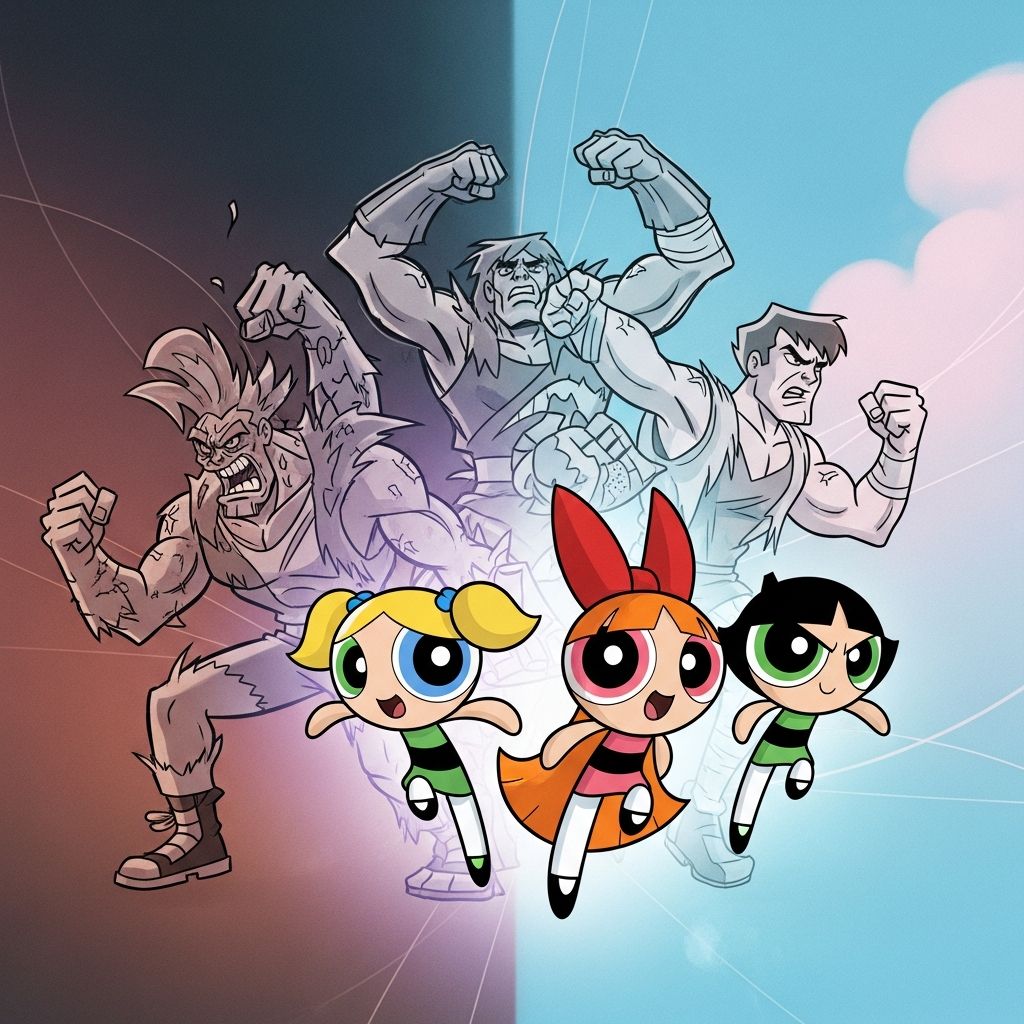
The story of The Powerpuff Girls begins long before the city of Townsville and the familiar chant of “sugar, spice, and everything nice.” It starts with an art student, a no-budget short called Whoopass Stew!, and a wild idea: what if kindergarten girls were the toughest superheroes on television?
This article traces that journey—from underground student film to Cartoon Network headliner—and explains why three round-headed, pastel-colored heroes still matter to animation, representation, and pop culture today.
The Unlikely Origin: Whoopass Stew! in a College Sketchbook
In the early 1990s, animator Craig McCracken was a student at the California Institute of the Arts (CalArts), a school that has produced many major figures in American animation. There, McCracken developed a rough, rebellious short called Whoopass Stew! A Sticky Situation featuring three tiny superheroes powered by a can of “Whoopass.”
Key aspects of that original concept included:
- Minimal budget, maximal attitude – The short was hand-made, fast, and extremely rough around the edges, leaning into cartoon violence and absurd humor.
- Juxtaposition as the core joke – The visual gag of cute, baby-proportioned girls demolishing giant monsters and criminals was the whole point.
- Adult sensibility in a kid-friendly package – The tone skewed older, with edgier gags and a name that obviously could not air unchanged on children’s television.
Although Whoopass Stew! never aired widely, it caught the attention of industry insiders and laid the conceptual foundation for what would become The Powerpuff Girls franchise.
Becoming The Powerpuff Girls: From Can of Whoopass to Chemical X
When McCracken joined Hanna-Barbera and worked with Cartoon Network’s development pipeline, his student film evolved from underground oddity into a polished pitch. To work on TV, the show needed a new name, tone adjustments, and a mythos that fit a broader age range.
The transformation included several key changes:
| Whoopass Stew! Concept | Powerpuff Girls Revision |
|---|---|
| Can of “Whoopass” as origin | Mysterious chemical called Chemical X |
| Adult-leaning gags and title | Kid-friendly branding and network standards compliance |
| Loose backstory | Formal origin: professor creating “the perfect little girl” |
| Experimental, one-off short | Serialized superhero comedy series |
Out of this retooling emerged Blossom, Bubbles, and Buttercup, three kindergarten-age girls whose powers came from a lab experiment gone wrong when Chemical X spilled into a mixture of “sugar, spice, and everything nice.”
Meet the Tiny Titans: Blossom, Bubbles, and Buttercup
Part of the show’s enduring appeal lies in how distinct the three main characters are. Each girl embodies a different archetype, both visually and in personality.
The Trio at a Glance
| Character | Color & Look | Core Traits | Team Role |
|---|---|---|---|
| Blossom | Pink, red hair, bow | Strategic, level-headed, responsible | Leader and tactician |
| Bubbles | Blue, blonde pigtails | Kind, emotional, often underestimated | Heart of the team, emotional anchor |
| Buttercup | Green, black hair | Tough, impatient, combative | Front-line brawler |
Together, they live with their creator and father figure, Professor Utonium, in the fictional metropolis of Townsville, answering calls from the Mayor whenever danger strikes.
Inventing a New Kind of Superhero Cartoon
When The Powerpuff Girls debuted on Cartoon Network in the late 1990s, it immediately stood out. According to Encyclopaedia Britannica, the show ran for six seasons and a feature film, becoming one of the channel’s signature programs.
Its uniqueness came from several layered contrasts:
- Preschoolers as powerhouse heroes – Most superhero teams were adults or teenagers; here, the protagonists were literally kindergarteners balancing nap time and world-saving.
- Ultra-stylized minimalism – The art style used bold outlines, flat colors, and simplified anatomy (no noses, no fingers), making the series instantly recognizable.
- Genre mash-up – Episodes riffed on superhero comics, Japanese tokusatsu (monster-of-the-week shows), sitcoms, and even experimental art films, often in a single half-hour.
- Violence framed as slapstick – City-level destruction was depicted with Looney Tunes energy, leaning on exaggeration rather than realism.
This combination made the show fun for young kids while providing enough parody and intertextuality to keep older viewers engaged.
Villains, Monsters, and the Art of Playing with Tropes
The series’ rogues’ gallery was as memorable as its heroes. Britannica highlights the genius chimp Mojo Jojo, lobster-clawed demon Him, shapeshifting villain Sedusa, and hapless one-celled crooks the Amoeba Boys among many recurring antagonists.
Each villain served a storytelling purpose:
- Mojo Jojo – A classic mad scientist whose over-explained monologues parodied comic-book supervillains.
- Him – A surreal, unsettling figure whose design pushed the boundaries of what could appear in a kids’ cartoon.
- Sedusa – A send-up of femme fatale stereotypes, often weaponizing glamor and manipulation.
- Amoeba Boys – A joke on ineffective criminal masterminds; their schemes rarely worked, and their incompetence drove the humor.
By remixing superhero tropes with absurdity, the show allowed younger viewers to enjoy the spectacle while older audiences caught the genre commentary.
Why the Powerpuff Girls Hit a Cultural Nerve
The late 1990s and early 2000s were a turning point for children’s media, with networks increasingly open to creator-driven animation that didn’t fit traditional formulas. The Powerpuff Girls landed at just the right moment—bold, stylized, and unapologetically weird.
Several factors explain its cultural impact:
- Girl heroes front and center – The trio are not sidekicks or token additions; they are the entire show, and the series treats their power as normal and expected, not a novelty.
- Merchandising and visibility – From backpacks to video games, the brand became a global symbol of “cute but tough,” embedding the characters in everyday kid culture.
- Cross-generational appeal – Parents watching alongside children often caught film parodies, visual in-jokes, and references that kids missed.
- Longevity and reboots – The original run, specials, and later reboot series kept the property in circulation, introducing new cohorts of viewers to Townsville’s defenders.
Representation, Gender, and the Meaning of “Girl Power”
The Powerpuff Girls frequently appears in discussions of female representation in children’s media. While not a didactic feminist text, it quietly shifted expectations about who gets to be a superhero.
Notable elements include:
- Complex personalities – Each girl is both a type and a subversion of that type: the leader who still makes mistakes, the sweet one who can be terrifying in battle, the tough one who has vulnerable moments.
- No apology for strength – The girls never have to justify having powers or joining the fight. Their community depends on them as protectors.
- Emotions as a feature, not a flaw – Bubbles’ sensitivity, for example, is occasionally exploited by enemies but is also portrayed as empathy and emotional intelligence.
Media scholars and critics often place the series alongside other late-90s works that expanded gender roles in genre storytelling. Academic analyses of children’s television note that such portrayals can influence young audiences’ beliefs about what girls and boys can do, though they also emphasize that representation must be paired with broader social change to shift real-world outcomes.
Behind the Scenes: How Network TV Shaped the Show
Transitioning from a raw student short to a global brand required compromises and collaboration. Network standards influenced language, violence, and certain design choices, but Cartoon Network’s then-emerging strategy of promoting creator-driven series gave McCracken unusual latitude to maintain his sensibility.
Industry histories of Cartoon Network describe the late 1990s as a period of rapid experimentation, during which shows like Dexter’s Laboratory, Johnny Bravo, and The Powerpuff Girls defined the channel’s voice. The network’s willingness to let individual creators put strong stylistic stamps on their shows helped push American TV animation beyond safe, formulaic sitcom structures.
The Franchise Beyond the Original Series
Over time, The Powerpuff Girls became more than a single show. The franchise broadened into films, reboots, and crossovers.
Major expansions include:
- Feature film – An origin-story movie that delved deeper into the girls’ creation and Townsville’s fear of their powers.
- Anniversary specials and shorts – Celebrations that revisited the classic style while tweaking designs or format.
- 2010s reboot – A modern version presented updated visuals and storylines for a new generation, illustrating how long-running IPs are frequently refreshed in contemporary television.
- Crossovers and references – Appearances in games, promos, and other shows kept the trio active in broader Cartoon Network branding.
These iterations show how a once-niche CalArts project transformed into a flexible, multi-platform property.
Lessons from Townsville: What the Show Quietly Teaches Kids
Underneath the explosions and monster battles, The Powerpuff Girls delivers recurring themes that parents, teachers, and child-development experts often find valuable when evaluating kids’ media.
Common takeaways include:
- Teamwork – The girls succeed when they coordinate, and episodes frequently highlight the costs of ego and miscommunication.
- Responsibility – They juggle everyday childhood life—school, chores, friendships—with a duty to protect their city.
- Ethical choices – The show occasionally explores forgiveness, second chances, and the line between justice and revenge.
- Resilience – Townsville is often destroyed, only to be rebuilt; setbacks are temporary, and the heroes keep showing up.
These themes align with broader findings in educational media research: when children identify with characters, they can absorb social and emotional lessons through story rather than direct instruction.
From Cult Short to Canon: Why the Origin Story Matters
Knowing that The Powerpuff Girls began life as Whoopass Stew! changes how we read the finished series. It reveals how much of mainstream children’s media can originate in small, personal, experimental work.
The journey demonstrates several broader truths about animation:
- Risk and originality often start in schools and shorts – Many iconic TV properties were born as student films or pilot shorts created outside strict commercial constraints.
- Networks act as translators – Executives and standards departments reshape raw artistic ideas into broadcast-ready formats, for better and worse.
- Audience memory is selective – Most viewers know the polished Cartoon Network version, not the rough-hewn Whoopass prototype, even though both share the same creative DNA.
Seeing the full arc—from can of whoopass to Chemical X—highlights how much negotiation lies behind even the most seemingly straightforward children’s cartoons.
Frequently Asked Questions (FAQs)
Q: Who created The Powerpuff Girls?
A: The franchise was created by animator Craig McCracken, who first developed the concept in his CalArts student short Whoopass Stew! before adapting it for Cartoon Network.
Q: What is Chemical X supposed to be?
A: Chemical X is never fully defined in scientific terms; it functions as a mysterious plot device that explains how the girls gained their wide range of powers, including flight, super strength, and near-invulnerability.
Q: Are The Powerpuff Girls considered a kids’ show or an all-ages cartoon?
A: Officially, it is a children’s animated series, but its genre parodies, stylized violence, and layered jokes were deliberately designed to appeal to older siblings and adults as well, placing it closer to an all-ages cartoon in practice.
Q: How many episodes and seasons did the original series have?
A: The original Cartoon Network run produced six seasons and dozens of episodes, along with several specials and a theatrical film, making it one of the network’s longest-running original properties of its era.
Q: Why is the show still discussed in conversations about representation?
A: Because it placed three young girls at the center of a superhero narrative without framing their power as unusual or secondary, it is frequently cited in discussions about how children’s media can expand gender roles and normalize diverse forms of strength.
References
- The Powerpuff Girls (TV Series) (2016) – Review & Educational Value — The Parenting Patch. 2016-04-04. https://parentingpatch.com/tv-shows/the-powerpuff-girls-2016/
- The Powerpuff Girls — Cartoon Network / Series Overview via Encyclopaedic Entry. Encyclopaedia Britannica. 2024-01-01 (approx. latest update). https://www.britannica.com/topic/Powerpuff-Girls
- The Powerpuff Girls (franchise) — Franchise Overview. 2023-10-01 (approx. latest update). https://en.wikipedia.org/wiki/The_Powerpuff_Girls_(franchise)
- The Powerpuff Girls (1998) — Series Tropes & Stylistic Analysis. TV Tropes. 2023-06-15. https://tvtropes.org/pmwiki/pmwiki.php/WesternAnimation/ThePowerpuffGirls1998
- The Powerpuff Girls — Series Overview & Premise. 2023-09-20 (approx. latest update). https://en.wikipedia.org/wiki/The_Powerpuff_Girls