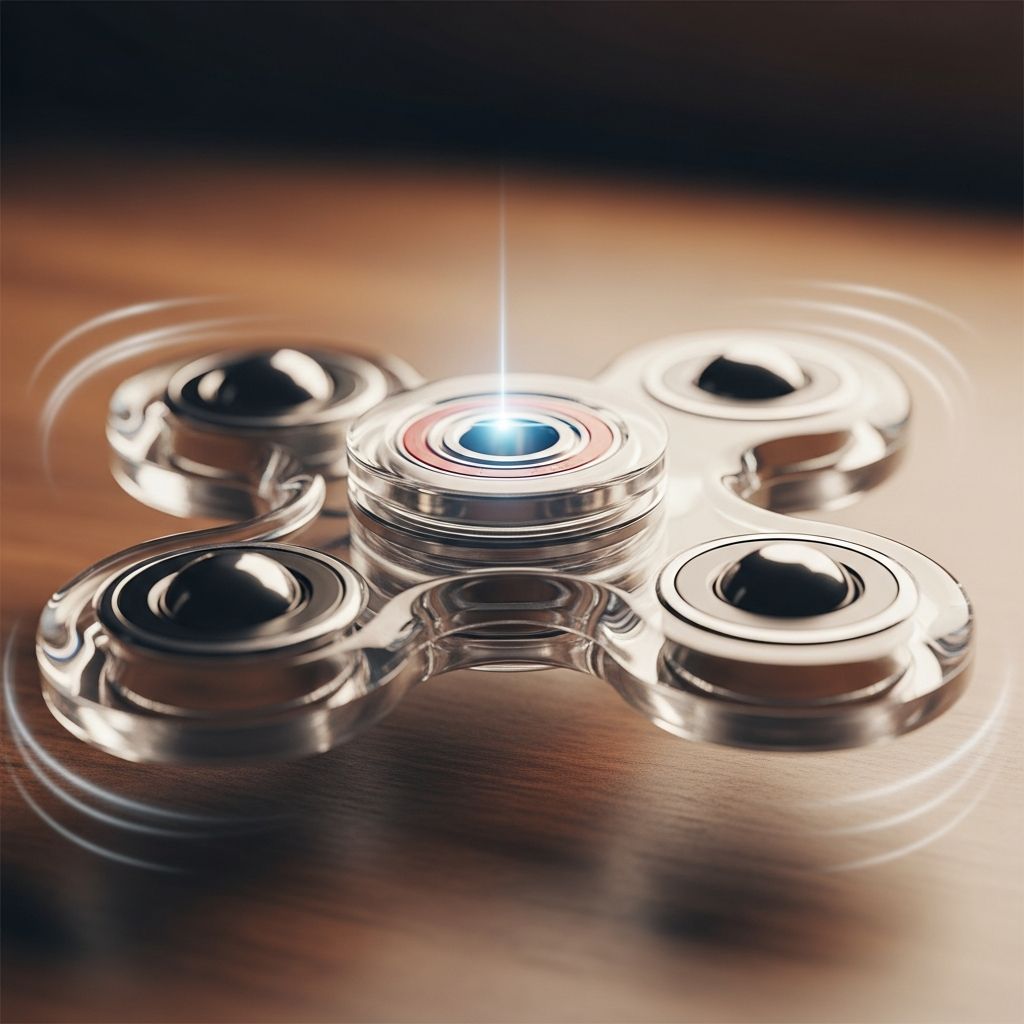
At first glance, a fidget spinner looks like the simplest toy in the world: a plastic or metal shape with three arms and a bearing in the center. Yet hidden inside that small gadget is a perfect demonstration of several big ideas in physics, from friction and rotation to energy and stability. This article walks through those ideas in clear language, using the spinner as a miniature laboratory you can hold in one hand.
Meet the Modern Pocket Gyroscope
A typical fidget spinner has three main parts: a central bearing that you pinch between your fingers, a frame or body that holds everything together, and weights or bearings at the tips of the arms. When you flick it, the arms whirl around the center, turning the toy into a tiny gyroscope. The central bearing lets the outer part turn smoothly while the part under your fingers hardly moves at all.
This layout gives the spinner two key advantages: it reduces friction where motion happens, and it concentrates mass away from the center. Those two features, low friction and mass near the edges, work together to keep the spinner rotating long after your fingers let go.
The Role of Bearings: Tiny Balls, Big Effect
The real star of the spinner story is the bearing in the middle. Instead of letting two solid surfaces scrape directly against each other, the bearing adds a ring of tiny steel or ceramic balls between two smooth metal tracks. The balls roll rather than slide, which cuts down on energy loss and allows the spinner to rotate freely.
What a Bearing Actually Does
- It supports the spinner body while allowing it to rotate independently of your fingers.
- It converts sliding contact into rolling contact, which dramatically reduces friction.
- It holds the parts in alignment so the spinner does not wobble excessively as it turns.
Different bearings can change how a spinner feels. Heavier steel bearings may start more easily and feel robust, while ceramic bearings can be lighter, smoother, and resist corrosion. Some people clean out the thick grease used in manufacturing and replace it with a lighter oil, trading a bit of protection for lower resistance and longer spin time.
Friction: The Invisible Brake
Friction is the main reason a spinner eventually stops, no matter how hard it is flicked. Whenever two surfaces touch, even if they appear smooth, microscopic bumps and valleys catch on each other. As the spinner rotates, these irregularities rub and scrape, converting some of the spinner’s energy into heat and sound.
Types of Friction Inside a Spinner
- Rolling friction: The resistance that acts on the tiny balls in the bearing as they roll between their tracks.
- Sliding friction: The rubbing that occurs if the bearing is dirty, damaged, or pressed too tightly, causing parts to skid instead of roll.
- Air resistance: The drag from air molecules bumping into the moving arms, especially at higher speeds.
Rolling friction is much weaker than sliding friction, which is why the bearing is so important. By letting the balls roll, the spinner wastes less energy on rubbing and more of the initial flick goes into smooth rotation instead of heat.
Energy In, Energy Out
Every spin begins with a simple energy transfer. Your fingers supply energy when you flick the spinner, giving it rotational kinetic energy. That energy is stored in the motion of the arms as they whirl around the center. Over time, friction and air drag take some of that energy away, converting it to heat in the bearing and tiny swirls of air around the moving arms.
If you flick two spinners with equal effort but one stops earlier, it means more of its energy is leaking away faster, usually because of greater friction or a less efficient shape. The goal in designing or tuning a spinner is to reduce those energy leaks so that a single flick keeps it turning for as long as possible.
Angular Momentum: Why It “Wants” to Keep Spinning
Linear motion describes objects moving in straight lines, but a fidget spinner rotates. Instead of linear momentum, it has angular momentum. Angular momentum depends on two main factors: how fast the spinner is turning and how its mass is distributed around the center.
- Spin faster, and the spinner has more angular momentum.
- Move more mass to the outer edges, and the spinner gains even more angular momentum for the same speed.
Angular momentum is a quantity that tends to stay the same unless an external torque (a twisting force) acts on the spinner. As long as friction and air resistance are small, the spinner resists changes to its spinning state, which is why it can keep rotating steadily for many seconds with no further effort from your hand.
Why Heavier Edges Make a Better Spin
If you compare a spinner with solid arms to one with metal weights at the tips, the weighted version often spins longer. The reason is the way mass is distributed. The farther the mass is from the center, the greater the spinner’s moment of inertia. That is the property that measures how resistant an object is to changes in its rotational speed.
Design Choices That Affect Spin Time
- Adding weights near the edges increases moment of inertia, helping the spinner resist slowing down.
- Using denser materials (like brass or steel) in the outer portions amplifies the effect.
- Slim, aerodynamic arms reduce the air drag that otherwise eats away at spin time.
This is why many premium spinners focus on two things at once: high-quality bearings to reduce friction and smart mass distribution so that the toy stores as much angular momentum as possible for each flick.
Stability and Gyroscopic Effects in Your Hand
Once the spinner is humming along, it acts like a small gyroscope. A spinning object tends to maintain the orientation of its rotation axis. If you try to tilt the spinner while it is rotating, you may feel a subtle twisting resistance. That sensation comes from gyroscopic effects and the way the spinner reacts to forces that try to change its direction.
This stability is why moving the spinner around feels so different when it is motionless compared to when it is spinning. In the spinning case, the angular momentum resists sudden changes, giving the toy a surprising feeling of firmness and balance in your fingers.
Simple Experiments You Can Try
One reason spinners became so popular in classrooms is that they offer a set of easy, hands-on physics experiments. With just a stopwatch and a curious mindset, you can turn basic play into meaningful observations about motion and forces.
Experiment Ideas
- Friction test: Spin your spinner and time how long it takes to stop. Then carefully clean the bearing, let it dry thoroughly, and test again to see whether the spin time changes.
- Mass distribution test: Compare a spinner with heavy metal tips to a lightweight plastic spinner. Give them both similar flicks and record which one spins longer on average.
- Orientation test: Spin the toy while holding it flat, then tilt it upright or angle it as it spins. Notice how it feels in your hand and whether it resists certain motions.
Repeating each test several times and averaging your results helps smooth out random variations in how hard you flick. This turns simple play into a mini science project, suitable for kids and adults alike.
Key Design Factors at a Glance
The table below summarizes how various design choices influence performance and feel. Use it as a quick reference when comparing different spinners or thinking about how to build or modify one.
| Design Feature | Physical Principle | Typical Effect on Spin |
|---|---|---|
| High-quality central bearing | Reduces rolling and sliding friction in the rotating parts. | Longer, smoother spins with less noise. |
| Heavy weights at arm tips | Increases moment of inertia by placing mass far from the center. | Greater angular momentum and better resistance to slowing down. |
| Slim, rounded arm shapes | Minimizes air resistance as the spinner moves through air. | Less drag, especially at higher spin speeds. |
| Balanced construction | Keeps mass evenly distributed around the axis of rotation. | Reduces wobble and vibrations, improving comfort and spin time. |
| Lubrication and cleanliness | Limits debris and reduces internal rubbing between bearing parts. | Prevents premature slowdown and grinding sensations. |
Everyday Analogies: Spinners, Wheels, and More
The same physical ideas that make a fidget spinner work also show up in many familiar machines. The bearings in your spinner have cousins in bicycle wheels, skateboards, computer fans, and car engines. In each case, designers want parts to rotate smoothly while supporting a load, so they use rolling elements instead of letting surfaces scrape directly.
Likewise, the notion of concentrating mass near the edges is shared with flywheels and some energy storage systems. These devices rely on high angular momentum to keep rotating and provide stable, steady output, much like a well-designed spinner maintains its motion after a quick push.
Building a Better Spinner: Practical Tips
Anyone interested in tweaking or creating their own spinner can use physics as a guide. Rather than guessing which changes will help, you can make decisions based on how each modification affects friction, mass distribution, and air resistance.
- Select bearings known for low friction and smooth rolling, and keep them clean and free of dust.
- Add or upgrade weights at the tips using dense materials, but ensure the arms remain balanced.
- Shape the arms to be narrow and rounded so they slice through air instead of pushing it.
- Test each change with simple spin-time experiments to see whether performance truly improves.
By observing how each adjustment affects behavior, you transform a toy into a personal engineering project and gain a deeper feel for real-world physics.
Frequently Asked Questions About Fidget Spinner Physics
Why does my spinner slow down so quickly?
Short spin times usually come from higher friction or unbalanced parts. Dirt in the bearing, thick grease, or slightly bent arms can all cause extra rubbing and wobbling. Cleaning, carefully re-seating the bearing, or replacing damaged components often restores smoother motion.
Is a heavier spinner always better?
Heavier is not automatically better. What matters more is where the weight is placed. Extra mass at the tips helps, but unnecessary weight near the center can make the spinner feel sluggish without providing much gain in angular momentum.
Why does it feel weird when I twist a spinning spinner in my hand?
That strange, almost resistant feeling comes from gyroscopic effects. The spinner’s angular momentum resists sudden changes in direction, so when you twist it, the toy responds in a way that may feel like it is pushing back against your hand.
Can I make a spinner that never stops?
No mechanical spinner can rotate forever. Even in the best designs, friction inside the bearing and drag from the air slowly remove energy from the system. Reducing these losses can extend spin time, but they cannot be eliminated completely.
Why do some spinners make noise while others are quiet?
Noise usually signals that the internal surfaces are rubbing or that the bearings are rough, dirty, or poorly aligned. Quieter spinners often have smoother bearings, better lubrication, and more precise construction, which all reduce jarring vibrations that might otherwise produce sound.
Turning Play Into a Physics Lesson
Fidget spinners may be simple toys, but they offer a rich set of lessons about motion, energy, and design. By paying attention to how they feel when you flick them, how long they spin, and how they react when you tilt them, you are informally exploring the same principles that govern more complex machines.
Next time a spinner buzzes between your fingers, treat it as a pocket-sized experiment. Hidden in that whirling blur are the same ideas that make bikes ride smoothly, turbines spin efficiently, and spacecraft stabilize in flight—a reminder that even the most basic gadgets can reveal deep truths about the physical world.