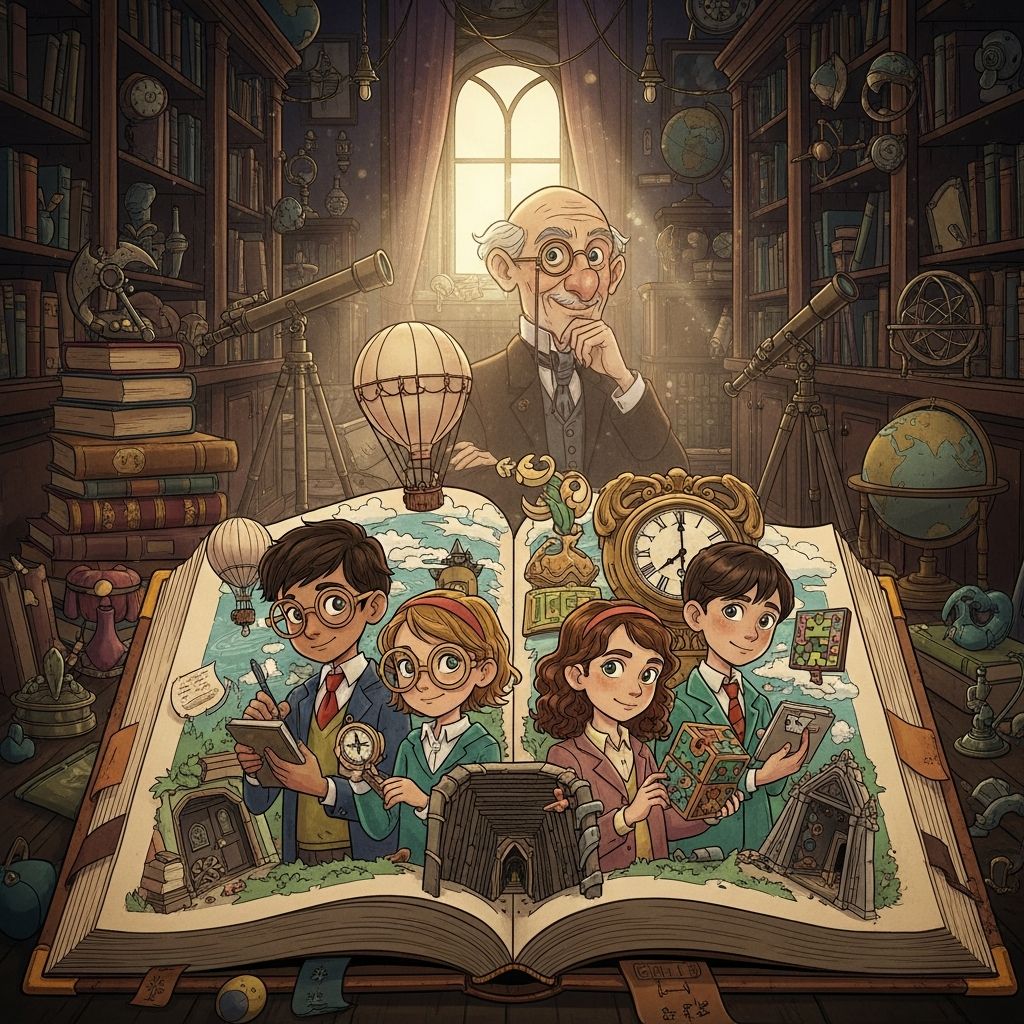
The Mysterious Benedict Society is a quirky mystery-adventure about four gifted children recruited by an eccentric genius to stop a sinister mind-control scheme. It blends puzzles, spycraft, and emotional depth in a way that appeals to older kids, tweens, and many adults who watch along.
This guide walks you through what the story is about, why kids love it, and what parents might want to know about themes, tension, and age suitability before hitting play or handing over the book.
Quick Overview for Busy Parents
- Type of story: Mystery, adventure, light sci-fi, found-family.
- Main characters: Four unusually talented children and one sleepy but brilliant mentor.
- Core conflict: A villain uses subliminal messages and a strange machine to influence the world through children.
- Primary themes: Critical thinking, friendship, ethics in technology, found families, courage.
- Biggest concerns for parents: Suspense, implied mind-control, emotional tension around orphans and abandonment, mild peril but little on-screen violence.
- Ideal audience: Typically ages 9–13 and up, depending on sensitivity and reading/viewing level (details below).
What Is the Story About?
The story centers on four children who answer a strange newspaper advertisement looking for “gifted” kids. After a series of unusual tests, they are chosen by a reclusive scientist, Mr. Benedict, to infiltrate a remote school and uncover the source of bizarre messages that are quietly influencing the world.
Undercover as students, they discover that the head of the school is secretly transmitting subliminal instructions with the help of a powerful device that uses children’s minds as a conduit. The kids must rely on their wits, their unique talents, and each other to expose the truth and shut the operation down before the world is permanently changed.
Meet the Core Characters (Kid-Friendly Archetypes)
Each child in the group represents a different kind of intelligence or strength, which can be affirming for kids who don’t fit a single “smart” mold.
| Character | Strength | What Kids See |
|---|---|---|
| Reynie | Logical thinking, empathy, leadership | A thoughtful kid who solves puzzles and worries about doing the right thing. |
| Sticky | Photographic memory, broad knowledge | The shy brainiac who remembers everything but doubts himself. |
| Kate | Physical courage, improvisation, practicality | A fearless, athletic problem-solver who can turn anything into a tool. |
| Constance | Stubbornness, emotional resilience, hidden mental gifts | A tiny contrarian whose grumpiness hides deep strength. |
| Mr. Benedict | Genius inventor, moral compass | An odd, kind adult who truly listens to children and trusts them. |
Parents may appreciate how the story explicitly values different abilities: logic, memory, physical skill, creativity, and emotional tenacity all matter, and no one child is portrayed as “the” hero.
Key Themes Parents Should Know About
1. Critical Thinking and Media Messages
The central plot device is a machine that sends hidden messages through everyday broadcasts, quietly shaping people’s fears and opinions. This creates a natural entry point to talk about:
- How advertising, social media, and news can influence feelings and choices.
- Why fact-checking and skepticism are important skills.
- The difference between healthy persuasion and manipulation.
Media literacy experts consistently emphasize teaching kids to analyze media rather than passively absorb it, and narrative-based discussions can support that process.
2. Ethics of Technology and Mind Control
The villain’s machine is capable of “sweeping away” memories and amplifying his messages directly into people’s minds. While it is fictional, it mirrors real-world debates about:
- How far technology should be allowed to go in accessing people’s personal data and inner lives.
- Who should control powerful communication tools.
- The moral responsibility of inventors and scientists.
Stories like this can serve as kid-friendly starting points for considering why democratic societies set limits on surveillance, data use, and psychological influence.
3. Found Family and Belonging
All four protagonists are effectively alone in the world—orphans or runaways—and slowly build a family out of friendship and mutual loyalty. The narrative gently explores:
- The hurt of abandonment and neglect.
- The idea that family can be chosen as well as biological.
- How trust is built through shared hardship and honesty.
Children who have experienced family changes may find these dynamics resonant; others may simply find them moving.
4. Courage, Fear, and Making Hard Choices
The children face moral dilemmas: whether to cheat, to lie for a larger cause, or to risk themselves to help others. The story raises age-appropriate questions such as:
- Is it ever acceptable to bend rules for a greater good?
- What does bravery look like for someone who is scared but acts anyway?
- How much responsibility should kids carry, and when should adults step in?
Intensity, Scares, and Sensitive Content
There is no gore, and physical violence stays low-key, but the tension and concepts can feel intense for some children.
- Emotional tension: Scenes involving separation, the fear of losing memories, and adults not believing the truth can be unsettling.
- Implied mind control: Kids are hooked up to devices, and characters talk about having their minds or memories altered, which can sound scary.
- Peril and chases: The group sneaks around, is pursued by adult enforcers, and faces capture.
- Narcolepsy portrayal: Mr. Benedict frequently falls asleep due to a neurological condition, sometimes at inconvenient or dangerous moments, but it is treated with empathy rather than ridicule.
Children’s media guidelines often highlight the difference between violence with consequences and casual or comedic harm; this story tends to show that risky actions have emotional weight and aftermath, which can help kids process rather than dismiss danger.
Suggested Age Range and Readiness Signs
Every child is different, but parents often find this story best suited for confident readers or viewers in upper elementary and middle grades.
- Approximate sweet spot: Ages 9–13, with older or advanced readers going younger, and sensitive kids going older.
- Good readiness signs:
- Enjoys complex plots with multiple characters and secrets.
- Can follow stories where not every mystery is explained immediately.
- Is curious about puzzles, logic, or spy-themed adventures.
- Handles light suspense in other shows or books without nightmares.
Parents who follow developmental guidance from child health organizations often look at both chronological age and emotional maturity when choosing media for kids, especially content with suspense and themes of manipulation.
Why Kids (and Many Parents) Enjoy It
Several elements make The Mysterious Benedict Society particularly appealing family entertainment:
- Child-led problem-solving: Adults support, but the kids drive the action and come up with many of the key ideas.
- Puzzles and codes: Riddles, logic challenges, and secret messages give kids something to think about between chapters or episodes.
- Stylized worldbuilding: The setting mixes old-fashioned details with slightly futuristic technology, creating a timeless feel.
- Visual and tonal whimsy: Eccentric costumes, unusual gadgets, and offbeat adult characters keep things from feeling too bleak.
- Emotional payoff: The conclusion emphasizes friendship, found family, and the idea that small people can make a big difference.
Conversation Starters for Families
Used thoughtfully, this story can become a springboard for deeper family conversations.
Questions about Media and Influence
- “How would you feel if you found out a show was trying to change how you think without telling you?”
- “What are some ways we can tell if information is designed to scare us?”
- “Have you ever noticed a commercial or post trying to make you feel a certain way?”
Questions about Friendship and Teamwork
- “Which character do you relate to most—Reynie, Sticky, Kate, or Constance—and why?”
- “What makes their group work, even though they’re all so different?”
- “Was there a time they had to trust each other even when it was scary?”
Questions about Doing the Right Thing
- “Was there a moment when a character did something wrong for a good reason?”
- “Do you think that was okay? Why or why not?”
- “If you were in their place, what would you have done differently?”
Tips for Different Age Groups
Families often adjust how they experience the story depending on a child’s age and temperament.
- For younger or sensitive kids:
- Consider reading the book aloud and pausing to check in during tense sections.
- Explain ahead of time that the children will be scared but will get help and work together.
- Skip or shorten particularly intense scenes on a first viewing.
- For tweens and teens:
- Invite them to predict twists and decode clues before the characters do.
- Talk about parallels to social media, misinformation, or peer pressure they see in real life.
- Let them lead a family discussion about what “being gifted” really means.
Frequently Asked Questions (FAQs)
Is The Mysterious Benedict Society too scary for younger kids?
The story is suspenseful and involves mind control, chases, and the threat of memory loss, but very little direct violence or gore. Many kids around 9–10 handle it well, while more sensitive children may prefer to wait or experience it with an adult who can pause and explain.
Are there any inappropriate language or romance concerns?
Strong language and romantic content are minimal to non-existent in the core story. The focus remains on adventure, friendship, and mystery rather than dating or edgy humor.
Does the story have a happy ending?
The main conflict is resolved, the villain’s plan is stopped, and the children find safer, more loving home situations. However, the antagonist survives and escapes, leaving room for sequels and underscoring that the struggle against manipulation and control is ongoing.
Is it better to start with the book or the screen adaptation?
Confident readers may enjoy starting with the book to savor the puzzles and internal monologues, while more visual learners might prefer the adaptation first. Both tell the same basic story, so it often comes down to your child’s interests and patience for reading.
What kinds of kids tend to love this story most?
Kids who like clever plots, brainteasers, spy gadgets, and ensemble casts usually connect strongly with it. It can be especially affirming for children who see themselves as “different,” whether because of intellect, personality, or family background.
References
- The Mysterious Benedict Society (novel) — Trenton Lee Stewart / Little, Brown and Company, via Wikipedia summary (plot and character details cross-checked against publisher copy). 2007-03-01. https://en.wikipedia.org/wiki/The_Mysterious_Benedict_Society_(novel)
- The Mysterious Benedict Society Summary — LitCharts. 2024-01-01 (last updated, approximate). https://www.litcharts.com/lit/the-mysterious-benedict-society/summary
- Media and Young Minds — American Academy of Pediatrics. 2016-11-01. https://publications.aap.org/pediatrics/article/138/5/e20162591/60325/Media-and-Young-Minds
- The Mysterious Benedict Society Summary — Shmoop. 2020-01-01 (approximate educational resource date). https://www.shmoop.com/study-guides/the-mysterious-benedict-society/summary
- The Mysterious Benedict Society | Summary, Analysis, FAQ — SoBrief. 2023-05-01 (approximate). https://sobrief.com/books/the-mysterious-benedict-society
- Guidelines on Digital Advertising to Children — UNICEF. 2023-09-01. https://www.unicef.org/globalinsight/stories/digital-advertising-and-marketing-children