Holiday movies usually promise cozy lights, heartfelt reunions, and gentle lessons about kindness. The Mean One, a 2022 low-budget Christmas slasher, takes that familiar comfort and gleefully feeds it to a snarling, green monster. Drawing unmistakable inspiration from a certain classic Dr. Seuss creation—without ever naming him—the film turns tinsel and candy canes into tools of terror, offering a strange mix of parody, gore, and holiday nostalgia.
This article explores how The Mean One works as a parody, why it fits into a growing trend of Christmas horror, what makes its monster memorable, and how audiences and critics have reacted. While the movie is divisive, it captures a broader cultural fascination with twisting childhood stories into something far more sinister.
The Movie at a Glance
The Mean One is a 2022 American Christmas slasher directed by Steven LaMorte. It follows a young woman, Cindy, whose family is attacked by a green, Santa-suited creature on Christmas Eve. Twenty years later, she returns to her hometown to confront the monster that ruined her life—and discovers that the holiday itself has essentially been outlawed in a desperate attempt to keep the killings at bay.
| Element | Details |
|---|---|
| Release year | 2022 |
| Genre | Christmas horror, slasher, parody |
| Director | Steven LaMorte |
| Main concept | A legally distinct, Grinch-like creature terrorizes a small town that dares to celebrate Christmas. |
| Monster actor | David Howard Thornton, known for Art the Clown in the Terrifier films |
Because Dr. Seuss’s original story and later screen adaptations are tightly controlled intellectual property, the film never uses the name “Grinch” or “Whoville.” Instead, it leans into deliberate near-references—Cindy You-Know-Who, a town called Newville, and a murderous creature only ever called the Mean One—to signal its inspiration while avoiding explicit infringement.
Rewriting a Childhood Tale as a Slasher
Understanding the appeal of The Mean One starts with the cultural shadow of the story it riffs on. In Dr. Seuss’s classic book and the beloved 1966 animated special, the misanthropic green creature famously tries to steal Christmas from a joyful town. After he is confronted with sincere kindness, his heart grows, he has a change of conscience, and he returns the stolen gifts—one of children’s literature’s most enduring redemptions.
The Mean One twists that emotional beat into something far darker:
- On Christmas Eve, a young Cindy catches the green creature in her home.
- She offers him a gentle token of kindness—a small necklace.
- Her mother intervenes to protect her; in the struggle, the creature accidentally causes the mother’s death.
- Traumatized, Cindy calls him a monster, the word that defines him from then on.
In place of a story of compassion healing bitterness, the film imagines a creature permanently warped by being labeled a monster. Each year afterward, the Mean One descends on the town to butcher anyone bold enough to celebrate Christmas.
A Time-Skip to Trauma and Revenge
The film then jumps forward two decades. Cindy, now an adult, returns to Newville seeking closure on the trauma that has shaped her life. Her therapist has encouraged her to confront the past; her father hopes they can reclaim Christmas together. But Newville has transformed into a fearful, joyless place:
- Public Christmas decorations are banned.
- Law enforcement discourages any talk of a monster.
- The town leadership appears more worried about panic and reputation than truth.
When the creature returns to kill again—this time striking within Cindy’s own home—she finally decides to fight back. What follows is a montage of horror clichés reframed as holiday jokes: weapons fashioned from festive items, training sequences that feel almost like a Christmas-themed revenge cartoon, and a vengeful final confrontation on the creature’s home mountain.
The Mean One as a Horror Villain
The film’s monster is its biggest selling point. The Mean One is not just a costumed joke; he is portrayed by David Howard Thornton, the same actor who brought the silent, sadistic Art the Clown to life in the Terrifier series—films known for their extreme gore and grindhouse energy.
That casting choice does several things at once:
- Connects to modern splatter horror: Fans of brutal, low-budget slashers immediately recognize Thornton as a cult favorite performer.
- Emphasizes physical performance: Like Art the Clown, the Mean One relies heavily on exaggerated movement, facial expressions, and body language rather than dialogue.
- Highlights the creature’s dual nature: The design evokes the playful, fuzzy outline of a children’s character, but the behavior is relentlessly predatory.
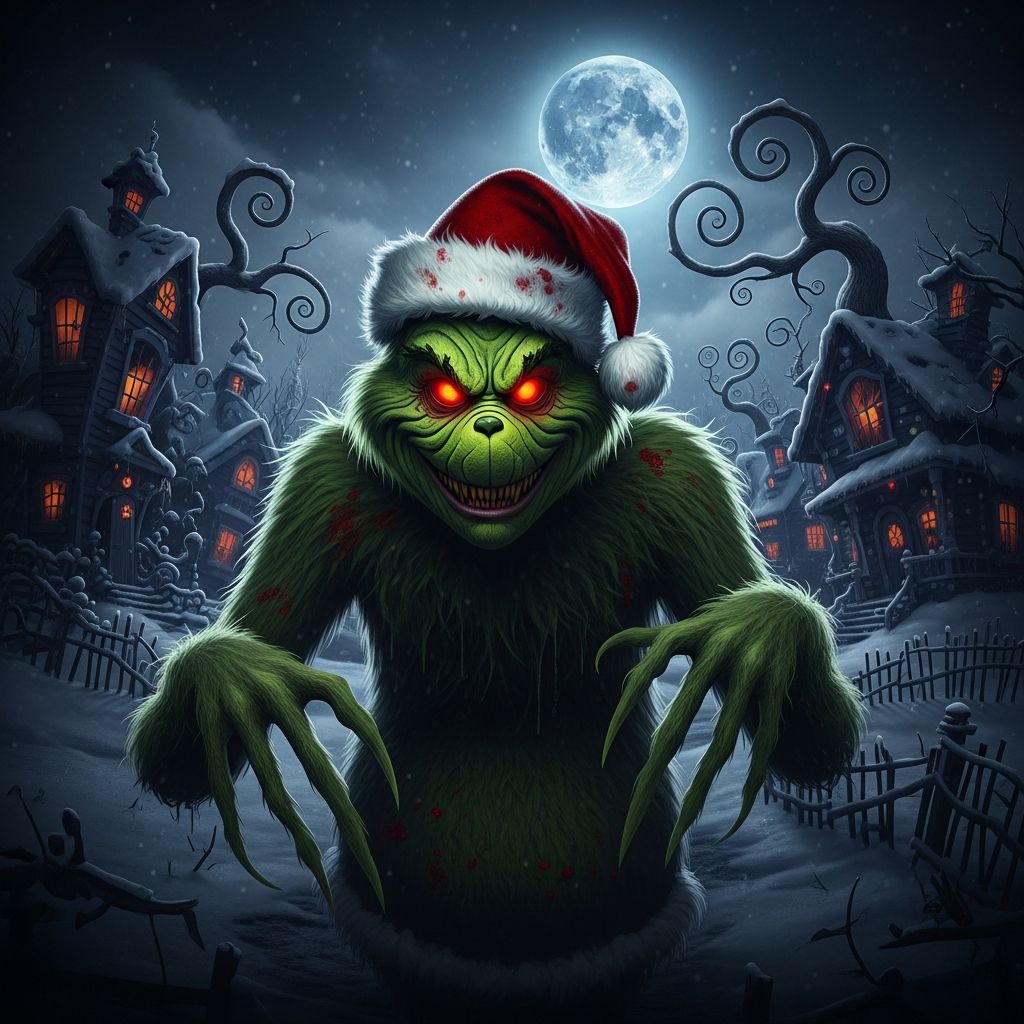
Visually, the Mean One is a pointed inversion of Christmas cheer:
- A Santa-style red outfit smeared with grime and blood.
- Green, furred skin and elongated features recalling the infamous holiday grouch.
- Weapons improvised from seasonal materials, including oversized candy canes and decorations.
Killing With Candy Canes
Part of the film’s appeal lies in its willingness to treat Christmas props as tools of slaughter. As a slasher, The Mean One checks many expected boxes:
- Bar massacres featuring unlucky Santa cosplayers.
- Tourists lured into the monster’s territory, only to be picked off.
- A growing pile of missing persons connected to the snowy mountain lair.
Fans of traditional horror may recognize a formula similar to 1980s slashers but re-dressed in ugly Christmas sweaters. The movie treats the holiday aesthetic as something to be splattered, punctured, and torn apart.
The Town That Tried to Bury Christmas
One of the film’s more intriguing choices is how it portrays civic denial and complicity. Newville is not just terrified of the Mean One—it is structurally organized around refusing to acknowledge him.
Key elements of the town’s response include:
- De facto ban on Christmas: Decorations in public spaces are eliminated, and locals are discouraged from celebrating openly.
- Political cover-ups: The mayor and sheriff quietly redirect responsibility and fear, shielding the town’s reputation while people die.
- Moral compromise: In the film’s darker twist, local leaders create a website that deliberately leads outsiders into the creature’s hunting grounds, turning tourists into sacrificial victims in the hope of sparing residents.
This civic cowardice sets up Cindy as the only person willing to break the unspoken pact. While the movie is mainly a pulpy horror parody, it gestures at ideas about how communities handle trauma: burying the problem, redirecting harm to outsiders, and silencing those who insist on naming the threat.
From Victim to Final Girl: Cindy’s Transformation
Cindy’s arc aligns her with a long tradition of horror “final girls”—the resilient survivor who endures loss, trains, and ultimately confronts the monster. Genre scholars have noted that such characters often embody a mix of vulnerability and moral resolve, forced into heroism by circumstance.
Over the course of The Mean One, Cindy:
- Witnesses her mother’s death as a child and is disbelieved by most adults.
- Returns as an adult trying to heal, only to lose her father as well.
- Refuses to comply with “no Christmas” rules, reigniting the creature’s ire.
- Trains with an eccentric local who also lost a loved one to the monster, gearing up for a showdown.
- Moves from scared witness to active hunter, deliberately drawing the creature out.
Yet the climax does not end with a simple act of revenge. In a twisted echo of the original children’s tale, Cindy’s final decision hinges on empathy. When she defeats the creature and is poised to kill him, she notices he is still wearing the necklace she gave him as a child.
This moment reframes their history: his rampages began not with inherent evil, but when he internalized her word “monster.” Choosing forgiveness over fury, she offers him a kiss on the cheek—causing his heart to grow explosively, literally bursting in a grotesque parody of the original story’s emotional payoff.
Parody, Fair Use, and the Line Between Tribute and Exploitation
Because The Mean One operates as an unofficial riff on famous characters, it effectively functions as a live case study in how modern filmmakers navigate copyright and parody. U.S. copyright law allows some unlicensed use of protected material if it is sufficiently “transformative,” often in the form of parody or commentary.
The film’s strategies include:
- Changing names and setting (Cindy You-Know-Who, Newville, The Mean One) while preserving clear visual and tonal references.
- Shifting genre from children’s fantasy to adult splatter horror—an extreme transformation of tone and audience.
- Exaggerating key elements (the heart growing, Christmas theft, hatred of cheer) to absurd and violent extremes, which aligns with parody’s requirement to “comment” on or distort the original.
This approach is similar to other modern horror projects that remix well-known public-domain or culturally embedded characters into slashers, such as Winnie-the-Pooh: Blood and Honey. In these cases, the creative and legal challenge is the same: how far can you go in evoking the original while claiming you have made something new?
Reception: Cult Curiosity More Than Critical Darling
Critical response to The Mean One has been mixed to negative. Reviewers from mainstream outlets noted that, despite a clever premise, the film often struggles to deliver either sharp comedy or genuinely effective horror. One prominent critic described it as a parody “only by legal definition,” arguing that it lacks the bite to fully embrace its own outrageous concept.
Common points in reviews include:
- Uneven tone, wavering between goofy joke and serious slasher without fully committing to either.
- Limited budget affecting visual polish and special effects.
- Moments of inventive absurdity, especially in kills and creature performance, that hint at a more daring film underneath.
Audience reactions are more divided. Some viewers appreciate the movie as a late-night, “so-bad-it’s-fun” seasonal watch with friends; others see it as a missed opportunity that never quite capitalizes on its wild premise. Regardless of opinion, the film has succeeded in one key area: it has been widely discussed online, shared in horror communities, and slotted into holiday viewing lists by fans of offbeat cinema.
Why Christmas Horror Keeps Coming Back
The Mean One is part of a broader tradition of horror films set at Christmas, a trend that has existed for decades. Movies like Black Christmas (1974), Gremlins (1984), and Krampus (2015) all tap into the same idea: the comforting, brightly lit season is an ideal backdrop for intrusions of chaos and fear.
Several factors help explain why Christmas horror remains popular:
- Emotional contrast: The clash between warm, sentimental holiday imagery and sudden violence makes scares more jarring.
- Cultural saturation: Because Christmas symbols are universally recognizable in many countries, filmmakers can subvert them quickly without heavy exposition.
- Nostalgia with a twist: Adults who grew up with certain stories enjoy seeing them reimagined for a more cynical or playful sensibility.
- Seasonal tradition: Just as families revisit cozy holiday movies each year, horror fans build their own rotation of dark seasonal staples.
The Mean One slots into that cycle as a kind of dare: What if the sweet story you loved as a kid had gone terribly wrong?
Who Is This Movie Really For?
Because it bridges parody and gore, The Mean One occupies a narrow niche. It is aimed less at casual holiday viewers and more at genre fans who enjoy risky mash-ups.
The film is likely to appeal to:
- Viewers who already like low-budget slashers with outrageous concepts.
- Fans of David Howard Thornton’s performance style in Terrifier and similar cult horror franchises.
- People who enjoy meta, referential cinema that plays with well-known stories.
- Groups looking for an ironic or darkly humorous Christmas watch rather than a serious thriller.
It will probably frustrate those expecting either a polished studio horror film or a purely comedic spoof. Its scrappy production value and tonal swings are part of its identity—for better or worse.
Frequently Asked Questions (FAQs)
Q: Is The Mean One an official Grinch movie?
A: No. The Mean One is an unauthorized parody that uses legally distinct names and designs while clearly referencing the famous green Christmas-hating character. It is not produced or endorsed by the rights holders of Dr. Seuss’s works.
Q: How violent is The Mean One?
A: The film is a slasher, so it includes multiple on-screen killings, blood, and stylized gore. Many deaths use Christmas-themed props or settings, which are played for dark humor as much as shock.
Q: Do I need to know the original story to enjoy it?
A: While you can follow the plot without prior knowledge, much of the movie’s humor and commentary depends on recognizing how it twists key beats from the classic holiday tale, especially the idea of a hateful recluse whose heart “grows” after an act of kindness.
Q: Is The Mean One more funny or more scary?
A: That depends on your expectations. Critics have argued that it rarely becomes genuinely frightening, leaning more toward absurdity and camp. Fans tend to watch it as a tongue-in-cheek seasonal curiosity rather than a deeply unsettling horror film.
Q: Could there be a sequel?
A: The movie’s ending hints playfully that the creature’s story may not be over, with a final roar suggesting a possible return. Whether that becomes an actual sequel will depend on audience interest, rights considerations, and the creators’ future plans.
References
- The Mean One – Plot Summary — IMDb. 2022. https://www.imdb.com/title/tt20853816/plotsummary/
- The Mean One — Wikipedia / Production & Plot overview. 2022. https://en.wikipedia.org/wiki/The_Mean_One
- The Grinch becomes a horror movie villain in “The Mean One” — Fantastic Pavilion. 2022-11-30. https://fantasticpavilion.com/the-grinch-becomes-a-horror-movie-villain-in-the-mean-one/
- The Mean One – Movie Review — RogerEbert.com. 2022-12-09. https://www.rogerebert.com/reviews/the-mean-one-movie-review-2022
- Copyright and Fair Use — U.S. Copyright Office. 2021-03-01. https://www.copyright.gov/fair-use/
- Why Horror Films Speak to Anxiety and Fear — American Psychological Association. 2020-10-01. https://www.apa.org/news/press/releases/2020/10/horror-movies-anxiety