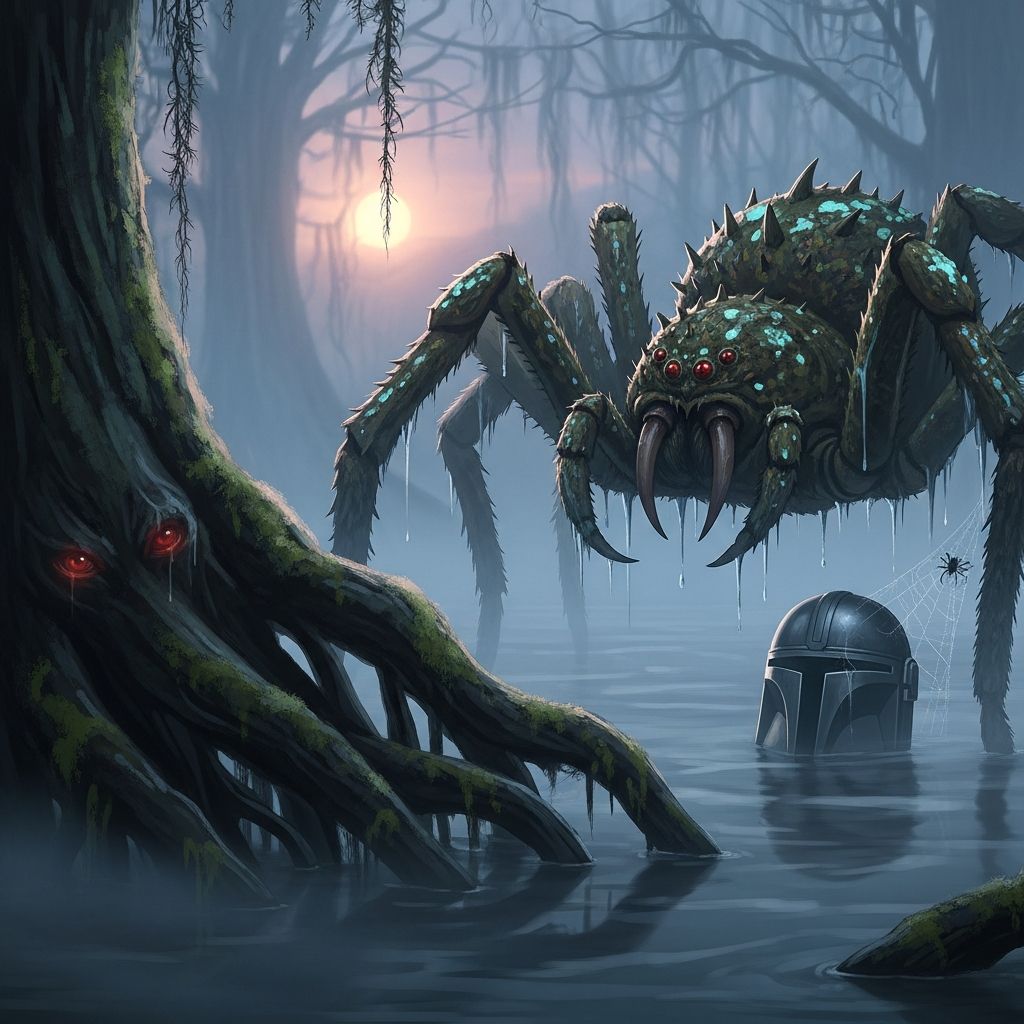
The spider-like monsters that ambush Din Djarin and his allies in The Mandalorian are not just random nightmare fuel; they are the latest form of an idea that has been lurking in the shadows of Star Wars since the era of the original trilogy.
These creatures draw on decades-old concept art, animated storytelling, and expanded universe lore to turn a simple monster attack into a rich intertextual moment for long-time fans.
The Long Shadow of a “What If” Monster
In the late 1970s, Star Wars concept artist Ralph McQuarrie developed designs for a hulking white spider intended for use on the swamp world of Dagobah in The Empire Strikes Back, but the scene was never filmed.
That unrealized creature, often referred to as a “knobby white spider,” remained a kind of phantom presence in the franchise, surfacing in art books, expanded universe lore, and fan discussions long before it ever appeared in live action.
From Concept Sketch to Living Lore
Over time, storytellers used McQuarrie’s unused spider design as a creative seed, reimagining it as part of the ecology of Dagobah and giving it a lifecycle linked to gnarled, twisted trees in certain expanded universe texts.
This approach turned the monster into something more nuanced than a simple predator, suggesting a bizarre symbiosis between the spider-like form and the swamp’s vegetation, an idea that helped cement its place in Star Wars deep lore.
Rebels, Krykna, and the Road to Live Action
The first major on-screen evolution of McQuarrie’s spider arrived in the animated series Star Wars Rebels, where similar creatures appeared under the name “krykna” on the planet Atollon.
These krykna echoed the silhouette of the old concept art while adding new traits, such as resistance to blaster fire and a distinctive sensitivity to fear and certain kinds of technology, which made them more than just background monsters.
The Mandalorian’s Ice Cavern Horror
When The Mandalorian introduced its own brood of pale, many-legged spiders in a frigid cave setting, the sequence deliberately evoked both McQuarrie’s original vision and the animated krykna, while still presenting a slightly different species tailored to the show’s needs.
These ice-dwelling arachnids, encountered on the planet Maldo Kreis, burst from egg-like pods and attack in swarming waves, playing into classic creature-feature tropes while also paying homage to Star Wars’ long-running fascination with hostile alien ecosystems.
How These Spiders Differ Across Star Wars
Although all of these creatures share a visual lineage, they behave differently depending on the story, reflecting varied ecological and narrative roles.
Some versions are nearly impervious to blasters and difficult to tame, while the ice spiders in The Mandalorian can be destroyed by concentrated firepower and seem more like a traditional swarm predator than a mystical guardian.
Key Spider Variants in Star Wars
| Creature | First Major Appearance | Habitat | Notable Traits |
|---|---|---|---|
| Knobby white spider | Concept art for The Empire Strikes Back; later described in expanded universe material | Dagobah swamps, linked to gnarled trees in certain sources | Root-like legs, possible symbiosis with trees, large size |
| Krykna | Star Wars Rebels on the planet Atollon | Rocky, semi-arid terrain; often near rebel bases | Resistant to blasters, sensitive to fear and specific sensors, difficult to control with the Force |
| Maldo Kreis ice spiders | The Mandalorian, Chapter 10, in frozen cave systems | Ice caves and surface snowfields on Maldo Kreis | Explosive hatchings from egg clusters, vulnerable to blasters and fire, highly aggressive swarm behavior |
Why Star Wars Keeps Coming Back to Spiders
Star Wars storytellers repeatedly use spider-like creatures because they tap into a nearly universal fear response: many-legged predators evoke real-world arachnophobia while still feeling alien enough to fit the galaxy far, far away.
At the same time, their exaggerated size and strange biology give artists and writers a flexible tool for representing dangerous wilderness, spiritual trials, or the consequences of trespassing into the unknown.
Visual Storytelling: From Painting to Practical Effects
The journey from McQuarrie’s painting to digital and practical realizations in modern productions shows how concept art can shape a franchise’s visual language for decades.
By echoing the angular legs, bulbous bodies, and eerie egg structures of the original illustration, the modern design teams create instant visual continuity that rewards sharp-eyed fans without requiring prior knowledge.
Ecology and Worldbuilding in a Single Scene
The ice spider encounter in The Mandalorian also functions as a quick course in planetary ecology, implying an entire food web beneath the ice, from dormant egg clusters to apex predators.
Details such as varying spider sizes, clustered egg sacs, and the protective behavior of the largest individual hint at a complex life cycle, even though the episode never pauses to explain these elements outright.
Character Development Through Monster Encounters
Confrontations with hostile creatures in Star Wars, including these spiders, are often less about the monsters themselves and more about revealing something new about the heroes under pressure.
In The Mandalorian, the spider attack underscores the challenges of traveling with vulnerable passengers, highlights the consequences of small mischief like tampering with eggs, and forces characters to rely on quick improvisation rather than perfect planning.
Fan Reactions: From Fear to Fascination
When the episode featuring the ice spiders first aired, viewers quickly split into two informal camps: those who loved the intense horror tone and those who found the arachnid imagery almost too unsettling to watch.
Despite the discomfort, the sequence sparked widespread discussion about continuity, concept art, and lore connections, demonstrating how a well-executed creature feature can energize fan communities.
Where These Creatures Might Crawl Next
Because similar spider-like species now exist on multiple worlds in both animated and live-action stories, there is ample room for future appearances in games, comics, or other Star Wars series.
Storytellers can revisit these designs to explore new environments, such as dense forests or derelict starships, allowing the same basic creature archetype to feel fresh in each new context.
What Makes a Good Star Wars Monster?
The enduring popularity of the spider concept helps illustrate what separates a memorable Star Wars creature from a forgettable one: strong visual identity, implied history, and a clear emotional impact on both characters and audience.
By drawing on recognizable fears while grounding the monster in a believable ecosystem, these spiders achieve the same balance of the mythic and the biological that defines many of the saga’s most iconic beasts.
Quick Facts About Star Wars’ Giant Spiders
- They originate from unused concept art developed during the production of The Empire Strikes Back.
- The name “krykna” is associated primarily with the animated series Star Wars Rebels.
- The ice spiders seen in The Mandalorian inhabit the planet Maldo Kreis and emerge from egg clusters in icy caves.
- Different versions of these creatures vary in their resistance to blasters and other weapons, depending on the story.
- Fans often link them back to concept artist Ralph McQuarrie, whose designs continue to shape new Star Wars projects.
FAQs About The Mandalorian’s Spiders
Are the ice spiders in The Mandalorian called krykna?
The creatures in The Mandalorian closely resemble krykna from Star Wars Rebels, but they are typically described as a related species inspired by the same original concept art rather than being explicitly identified on screen with the same name.
Did these spiders originally appear in The Empire Strikes Back?
No, the spider design was created for The Empire Strikes Back but never used in the final film; instead, it later found life in art books, legends material, animation, and eventually in live-action television.
Why are some versions of these spiders resistant to blasters?
In Star Wars Rebels, krykna are depicted with tough exoskeletons that deflect most blaster shots, a trait that emphasizes their role as a persistent, nearly unkillable threat and encourages characters to find creative non-lethal solutions.
On which planets do these creatures live?
Different iterations appear on various worlds: expanded universe sources tie the knobby white spider to Dagobah, krykna are native to Atollon, and the ice spiders in The Mandalorian dwell on Maldo Kreis.
Will these spiders return in future Star Wars stories?
There is no definitive confirmation about future appearances, but their strong connection to classic concept art and their prominent roles in recent series make them likely candidates for further use in comics, games, and additional shows.