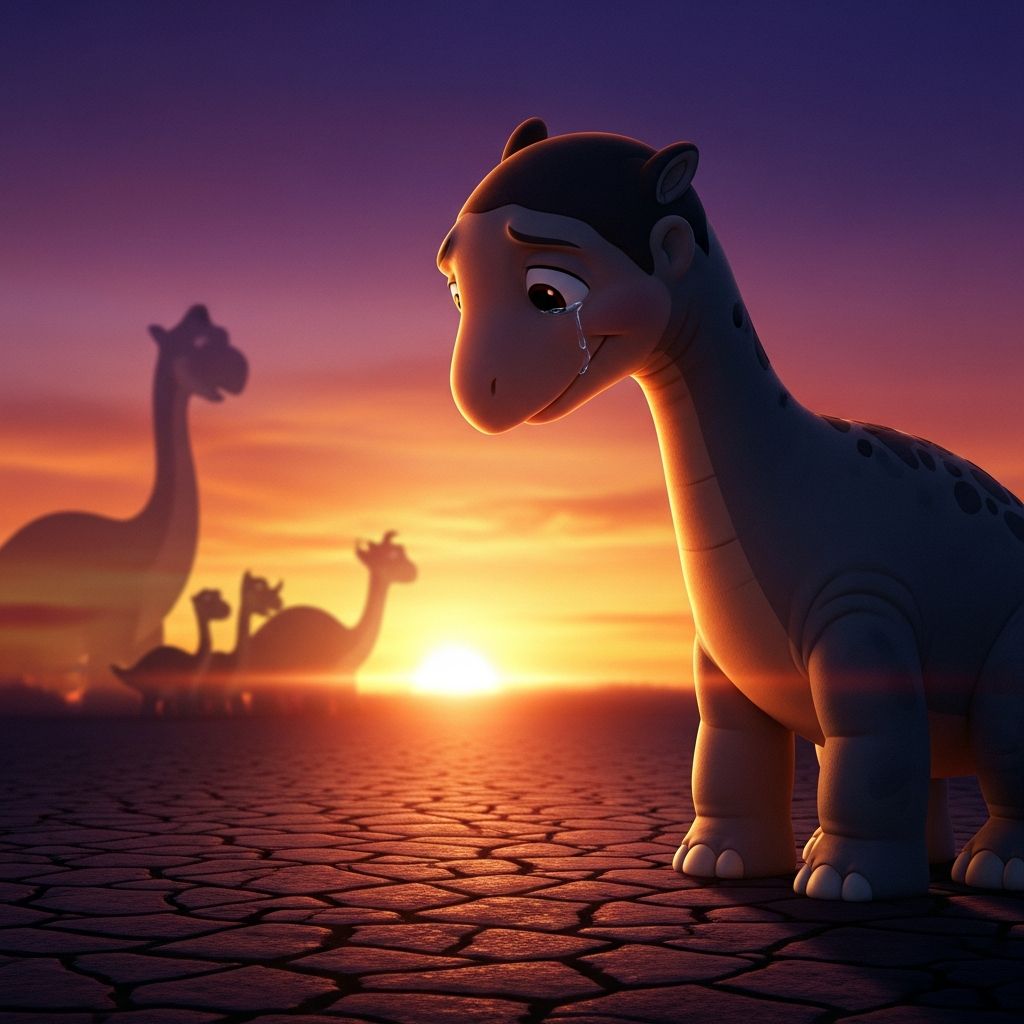
On the surface, The Land Before Time looks like a straightforward dinosaur adventure about a young Apatosaurus named Littlefoot searching for a safe haven after a natural disaster. Beneath that, however, the 1988 film is one of the most emotionally direct and quietly daring children’s movies ever released. It confronts grief, prejudice, environmental collapse, and resilience with unusual honesty for a family film.
This retrospective revisits the movie’s origins, its emotional core, its place in animation history, and what it still offers to kids and parents watching decades later.
From Ambitious Experiment to Enduring Franchise
The Land Before Time began as an ambitious collaboration between some of the most influential figures in modern filmmaking. Directed by animator Don Bluth and executive produced by Steven Spielberg and George Lucas, the film was released by Universal Pictures in 1988, right in the middle of the late-1980s animation revival.
| Key Fact | Details |
|---|---|
| Original Film Release | 1988, theatrical animated feature directed by Don Bluth |
| Executive Producers | Steven Spielberg and George Lucas |
| Franchise Growth | Spawned numerous direct-to-video sequels and a TV series |
| Target Audience | Families, with particular focus on young children |
Although the original film is only a small part of a much larger franchise that eventually expanded into sequels and a television series, it stands apart in tone and ambition. Where many later entries lean more heavily into songs and comic relief, the first film is quieter, more somber, and notably restrained in its use of dialogue and humor.
A Simple Story That Feels Monumental
The plot is disarmingly straightforward: a group of young dinosaurs from different species—Littlefoot, Cera, Ducky, Petrie, and Spike—are separated from their families after an environmental catastrophe and must journey together to find the fertile Great Valley. What makes that journey feel so epic is not its complexity, but its emotional weight.
- Loss and grief: Early in the film, Littlefoot’s mother dies after defending him from a predator, echoing one of the most memorable and traumatic moments in children’s animation.
- Loneliness: Littlefoot’s wandering in the wake of that loss is filmed almost like a silent movie—minimal dialogue, heavy on music and atmosphere.
- Friendship as survival: The group of young dinosaurs is not simply a team; their emotional survival depends on one another as much as their physical safety.
By keeping the narrative compact and the stakes deeply personal, the film allows young viewers to experience monumental emotions in a way they can understand: getting lost, missing a parent, being scared, learning to trust others.
Why This Movie Hits Kids (and Parents) So Hard
Many children’s movies flirt with danger or sadness, but The Land Before Time lingers there. Contemporary child psychology research notes that stories which acknowledge loss and fear can help children build emotional resilience when guided by a trusted adult. The film intuitively understands this, offering a kind of emotional “practice space” for big feelings.
Key Emotional Themes
- Death without euphemism: Littlefoot’s mother does not “go away” or “disappear”; the film presents her death honestly, while still offering comfort through memory and legacy.
- Prejudice and reconciliation: Cera’s family teaches her that three-horns should not mix with longnecks. The film gradually dismantles this bias as the children learn to depend on each other.
- Hope after catastrophe: The journey to the Great Valley is essentially a story of climate disaster and forced migration, an allegory that feels eerily relevant in an age of intensified natural disasters.
For parents, watching these themes unfold can be unexpectedly affecting. Adults bring their own experiences of loss, family conflict, and worry to the viewing, making Littlefoot’s story resonate differently decades after first seeing it as a child.
Visual Storytelling in an Era Before CGI
Visually, The Land Before Time is a showcase for late-1980s hand-drawn animation. Don Bluth’s team was known for detailed backgrounds and expressive character animation, and this film is no exception.
- Environments as characters: The cracked earth, volcanic skies, and lush Great Valley function almost like silent characters, reflecting the emotional and narrative stakes of each scene.
- Animation of scale: The film conveys the enormity of the prehistoric world by placing the small bodies of the young dinosaurs against vast landscapes and towering rock formations.
- Body language: Much of the emotional communication happens through posture and movement—Petrie’s nervous fluttering, Cera’s defiant stance, Littlefoot’s slumped tail when he is grieving.
In an era dominated now by computer animation, the film serves as a reminder of how much emotional nuance hand-drawn imagery can carry, even with a relatively limited runtime.
From Singular Film to Sprawling Universe
The success of the original movie led to an extensive franchise: multiple direct-to-video sequels, many of them musical, and an animated television series that aired in the late 2000s. The TV series, developed for Cartoon Network and other networks, continued the adventures of Littlefoot and his friends in more episodic, light-hearted tales aimed squarely at children.
That expansion created an unusual split in tone:
- The original feature is more atmospheric, quiet, and emotionally intense.
- The later entries and TV episodes lean into songs, comic situations, and recurring “lesson of the day” narratives.
For many people, this means the franchise exists in two parallel forms: a nearly mythic first film that defined their childhood, and a broader, more kid-friendly universe that sustained the brand. Both can coexist, but they serve different purposes.
How the Film Speaks to Today’s Kids
Modern children grow up surrounded by on-demand content, fast pacing, and bright, high-saturation visuals. By comparison, The Land Before Time is quiet, patient, and occasionally stark. That contrast can be an asset.
What It Offers Young Viewers Now
- A slower rhythm: Long stretches of the film emphasize atmosphere over action, encouraging attention and reflection rather than constant stimulation.
- Space for questions: Because the film does not over-explain its emotional beats, it naturally invites kids to ask questions about death, fear, and difference—conversations many parents want to have but may not know how to start.
- Clear moral anchors: Cooperation, empathy, and courage are consistently rewarded, providing understandable moral frameworks without turning every scene into a lecture.
Research on children’s media has found that stories emphasizing prosocial behavior—helping, sharing, comforting—can positively influence children’s actions, particularly when adults discuss what happened afterward. The dynamic between the young dinosaurs offers many such moments, from comforting Petrie when he is afraid to supporting Cera as she confronts her pride.
Watching With Your Kids: A Gentle Guide for Parents
Because the film does not shy away from intense scenes, it is helpful for parents or caregivers to be prepared for how to support children during and after a viewing.
Before You Press Play
- Let kids know that the movie has some scary and sad moments, especially involving a parent dinosaur.
- Decide whether to watch alongside them rather than letting them view it alone, especially for younger or more sensitive children.
During the Film
- Pause if you notice your child looking distressed; ask what they are feeling.
- Reassure them that being scared or sad is normal and okay.
- Acknowledge the scarier imagery—dark skies, roaring predators—but emphasize that the kids in the movie keep helping each other.
After the Credits Roll
Consider gently prompting a conversation:
- “Which dinosaur did you feel most like?”
- “Was there a part that made you feel really sad or really happy?”
- “What helped the characters when they were scared?”
These kinds of questions can help children process what they saw and connect it to their own experiences, which aligns with recommendations from child health and media experts for making screen time more meaningful.
Nostalgia, Memory, and the Parent–Child Loop
For many adults, rewatching The Land Before Time is less about discovering the film than rediscovering themselves at the age they first saw it. The emotional core of the film—especially the parent–child bond—often hits differently once you have children of your own.
- Childhood self: You may remember clutching a stuffed dinosaur, crying at Littlefoot’s loss, or imagining a Great Valley of your own.
- Adult self: Now the sight of a parent risking everything for a child can feel almost unbearably personal, reframing familiar scenes through the lens of your current responsibilities.
This creates a powerful intergenerational loop: you once watched as the frightened child, now you watch as the protective parent, sometimes with your own child beside you, mirroring your younger reactions. The movie becomes less a static text and more a shared emotional ritual.
How the Science of Extinction Deepens the Metaphor
Although the film is not meant as a science documentary, its backdrop—an ancient world on the brink of environmental change—echoes what paleontologists know about mass extinctions. The end-Cretaceous extinction event, widely associated with an asteroid impact and subsequent ecological collapse, wiped out non-avian dinosaurs and many other species.
Knowing that, as an adult viewer, adds a poignant layer: the young dinosaurs are not just navigating a difficult moment, but an era of enormous instability. Their personal story of loss and adaptation reflects a broader story of life changing under pressure—something that resonates in an age of climate anxiety and environmental concern.
Key Takeaways for Modern Viewers
Revisiting The Land Before Time today, several elements stand out as especially valuable:
- Emotional honesty: The movie trusts children with grief and fear instead of shielding them from every hard feeling.
- Visual depth: Its hand-drawn animation remains immersive and emotionally rich decades after release.
- Timely themes: Migration, environmental instability, and prejudice are sadly not relics of the past; they remain central global issues.
- Conversation starter: The film offers parents a gentle entry point into talking about death, difference, and the importance of kindness.
That combination of beauty, sorrow, hope, and simplicity is why this seemingly modest dinosaur film continues to linger in cultural memory long after more technically dazzling movies have come and gone.
Frequently Asked Questions (FAQs)
Is The Land Before Time too intense for younger children?
It depends on the child. The film includes the on-screen death of a parent and several frightening scenes. Many families find it appropriate for early elementary ages when watched with an adult who can pause and talk through emotional moments, in line with general guidelines to co-view emotionally heavy media with kids.
How accurate is the dinosaur science in the movie?
The film mixes real dinosaur species—like sauropods and ceratopsians—with imaginative behaviors and interactions. It was never meant as a scientific documentary, and much of our understanding of dinosaur behavior and extinction has advanced since its release.
Do I need to watch the sequels or TV series to appreciate the original film?
No. The 1988 movie stands entirely on its own and tells a complete story. The later sequels and TV series expand the world with lighter, song-filled adventures geared toward children but are not required viewing.
What age is ideal for a first viewing?
Many parents introduce the film around ages 6–8, when children can better understand the concept of death and cope with mild to moderate on-screen peril. Sensitivity varies widely, so it is wise to consider your child’s temperament and perhaps preview key scenes yourself.
Why do so many adults still remember this movie so vividly?
The combination of an early encounter with grief, striking imagery, and a strong parent–child storyline makes the film emotionally sticky. Experiences that provoke strong feelings in childhood are often encoded as especially durable memories, which aligns with broader research on emotion and memory.
References
- The Land Before Time — Universal Pictures / Production details via Encyclopedia of Animation. 1988. https://www.britannica.com/topic/The-Land-Before-Time
- The Land Before Time (TV series) — Universal Animation Studios / Production overview. 2007-03-05. https://www.cartoonnetwork.com/shows/index.html
- The Land Before Time (TV Series 2007–2008) — IMDb / Overview and episode information. 2007. https://www.imdb.com/title/tt0473584/
- Media and Young Minds — American Academy of Pediatrics. 2016-10-21. https://publications.aap.org/pediatrics/article/138/5/e20162591/60628/Media-and-Young-Minds
- Managing the Health Effects of Climate Change — The Lancet & University College London Institute for Global Health Commission. 2009-05-16. https://www.thelancet.com/journals/lancet/article/PIIS0140-6736(09)60935-1/fulltext
- End-Cretaceous Mass Extinction — U.S. Geological Survey. 2016-09-16. https://www.usgs.gov/news/national-news-release/asteroid-impact-caused-earths-last-mass-extinction