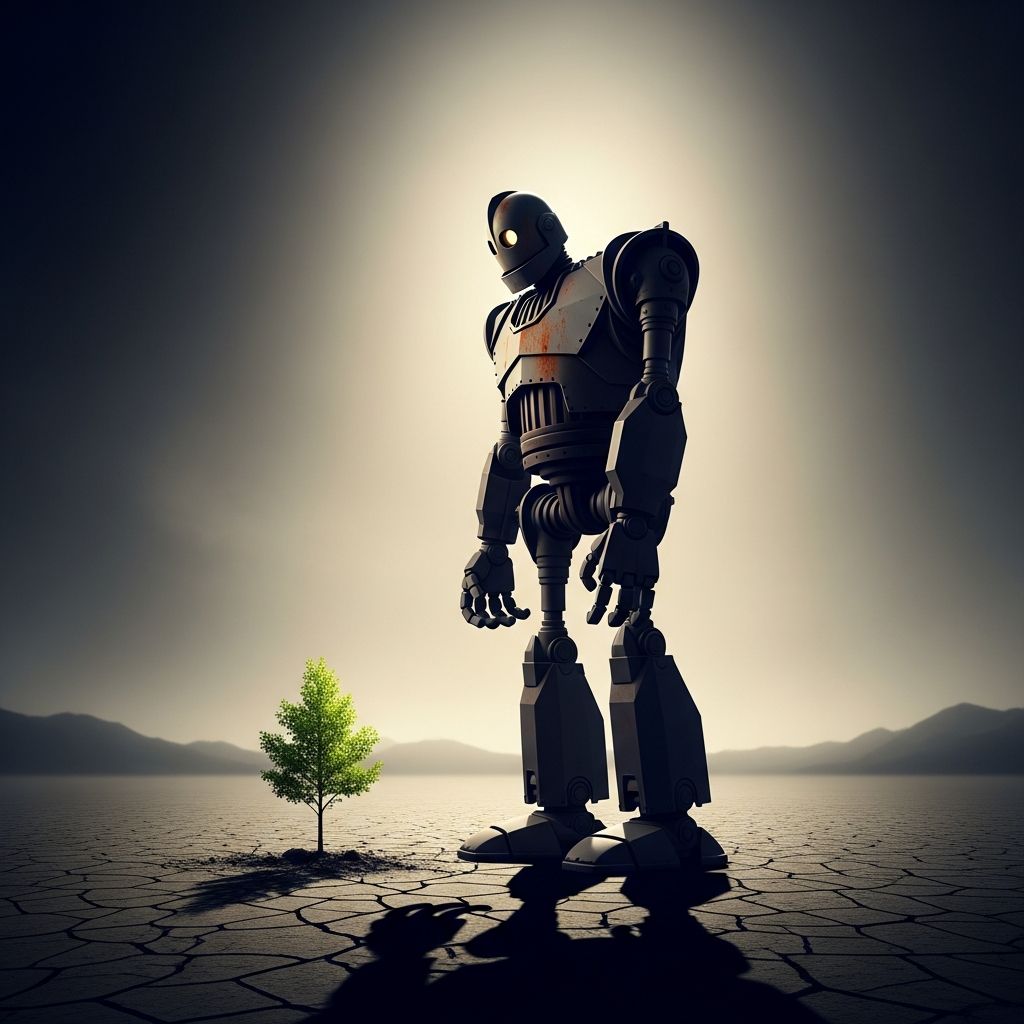
When The Iron Giant arrived in 1999, it did not dominate the box office or transform its studio overnight. Yet over the years, this modest hand-drawn feature has grown into one of the most deeply cherished animated films of its era, praised for its emotional power, visual craft, and disarmingly simple message: you are what you choose to be.
Set in the late 1950s against the backdrop of the Cold War and nuclear anxiety, the story of a lonely boy and a mysterious robot from space has become a touchstone for parents, animation fans, and filmmakers alike.
From Modest Release to Modern Classic
On its initial release, The Iron Giant earned critical acclaim but underperformed commercially, partly due to limited marketing and competition from better-known franchises. Over time, home video, cable broadcasts, and later streaming helped the film find the audience it always deserved.
Several factors explain its transformation into a cult and then canonical classic:
- Critical enthusiasm: Reviewers highlighted its emotional depth, nuanced themes, and restraint compared to louder contemporaries.
- Word of mouth: Families and animation fans passed it along as a personal recommendation, not a studio mandate.
- Director pedigree: Brad Bird would later direct hits like The Incredibles and Ratatouille, driving renewed interest in his earlier work.
- Timely themes: Ideas about fear, militarization, and identity have only grown more relevant.
1957: A Boy, A Robot, and a Nation on Edge
The film’s setting—small-town Maine in 1957—is not casual nostalgia. It taps directly into a specific historical moment: the launch of Sputnik, nuclear weapons testing, and government-sponsored civil defense campaigns that reminded Americans daily of existential threats.
In this environment, a giant robot from space is not just wondrous; it is terrifying. The story uses this tension in several key ways:
- Paranoia as default: Adults, especially government figures, assume the Giant must be a weapon or an enemy.
- Children as moral counterweight: The young protagonist, largely free of Cold War ideology, is able to see the Giant as a person rather than a target.
- Media and propaganda: Period-style educational films and radio broadcasts echo real “Duck and Cover” campaigns promoted to children during the 1950s as guidance for nuclear attack preparedness.
| Story Element | Historical Parallel |
|---|---|
| Sputnik overhead | First artificial satellite launched by the USSR in 1957, intensifying U.S. space and arms competition. |
| Duck-and-cover school films | Real civil defense films promoted under U.S. federal guidance to teach nuclear survival tactics. |
| Trigger-happy military response | Policy debates over first-strike capability and massive retaliation in early Cold War strategy. |
The Emotional Core: A Child’s-Eye View
At its heart, The Iron Giant is less about geopolitics and more about a boy dealing with loneliness, fear, and the desire to protect something fragile and special. The emotional spine of the film rests on a few key relationships.
The Bond Between Boy and Giant
The friendship at the center of the film works because it is built not on spectacle but on small, human moments:
- Teaching language and empathy through comics, play, and shared meals.
- The boy’s mixed motives—part wonder, part wish for a companion—are instantly recognizable to children and adults.
- The Giant’s childlike curiosity, contrasted with his immense size and latent power, creates constant tension between innocence and danger.
This relationship mirrors classic stories like E.T. the Extra-Terrestrial, where a child’s capacity for trust allows an alien figure to become a mirror for human goodness rather than human fear.
Single Parenthood and Everyday Struggle
The boy’s mother is not simply a background figure; she grounds the story in economic and emotional reality. She works long shifts, juggles parenting alone, and tries to maintain boundaries in a world that keeps presenting new, unpredictable threats. Her fatigue, worry, and resilience provide a quiet counterpoint to the film’s fantastical elements.
Fear Personified: The Overzealous Agent
The government investigator who pursues the Giant embodies Cold War paranoia at its most corrosive. He is not a strategic villain so much as a man terrified of being wrong, desperate to control a situation he barely understands. In him, the film suggests that:
- Fear can be more dangerous than the thing we fear.
- Individuals under institutional pressure may escalate conflict rather than defuse it.
- Ideology and career anxiety can outweigh evidence and compassion.
“You Are What You Choose To Be”: Ethics in a Kid’s Movie
The film’s most quoted idea—that identity is a matter of choice, not programming—carries unusual weight for a family feature. The Giant is revealed to be capable of extraordinary destruction when threatened, but his moral journey is not about discovering his “true” nature. It is about refusing the role he was built for.
Free Will Versus Design
Through the Giant, the story poses a quiet philosophical question: if something is built as a weapon, is it forever bound to that purpose? The film’s answer is a firm no. The robot’s experiences with kindness, storytelling, and play give him alternate models of being in the world, allowing him to assert a new identity.
This resonates with broader human questions:
- Can cycles of violence be broken, even when they seem “baked in” to a person’s history?
- How much do upbringing and environment determine who we become?
- What does it mean to reject a role others have written for you?
Nonviolence in the Shadow of Nukes
The climax of the story contrasts two possible responses to fear:
- Retaliation and escalation: Military leaders and the anxious agent default to overwhelming force, even when the situation is uncertain.
- Sacrifice and restraint: The Giant ultimately chooses to protect rather than destroy, rejecting the logic of mutually assured destruction that defined the nuclear age.
By framing this in a child’s story, the film makes an abstract geopolitical doctrine deeply personal: pressing the button will not just destroy “the enemy”; it will wipe out communities, families, and friendships.
Animation Craft: Hand-Drawn Humanity, Digital Steel
One of the most striking aspects of The Iron Giant is its visual language. Released at a time when 3D animation was on the rise, it combines traditional hand-drawn techniques with computer-generated imagery in a way that supports—not overshadows—the story.
Designing a Gentle Colossus
The Giant himself is rendered as a computer model, while the world and human characters are largely hand-drawn. This choice emphasizes his otherworldliness: he moves with a slightly different rhythm, his metallic form contrasting with the softer lines of the environment.
Key visual strategies include:
- Scale and perspective: Shots positioning the Giant framed by trees, buildings, or clouds underline his size without constant exposition.
- Expressive mechanics: Subtle changes in eye aperture, head tilt, and posture convey emotion even though his face is mostly rigid metal.
- Limited dialogue: Long stretches rely on pantomime and body language, reinforcing the universality of the character.
A restrained aesthetic in a loud era
Compared with many late-1990s animated features, The Iron Giant is notably quiet. There are no musical numbers, few pop-culture gags, and a relatively short runtime. This restraint allows moments of action and emotion to land more forcefully, because they are not competing with constant noise.
Guns, Responsibility, and the Audience
The film is often described as anti-gun, but its treatment of weapons is more nuanced than simple condemnation. Several elements complicate the picture:
- Comic books and toy ray guns appeal to the boy’s imagination; the problem arises when fantasy collides with the Giant’s defensive programming.
- Local hunters and soldiers are depicted as recognizable people, not faceless “bad guys.” The film suggests empathy for those who fear rather than simple vilification.
- The real danger is unexamined fear and uncritical obedience, not any single technology.
For parents and educators, this opens conversations not only about firearms but about power in general: who has it, how they use it, and how we respond when we feel threatened.
Legacy: Influence Beyond Its Running Time
Over two decades after its release, The Iron Giant continues to influence filmmakers, animators, and audiences. Its legacy is visible in several areas:
- Storytelling standards: It is frequently cited in discussions of how to balance family accessibility with serious themes.
- Animation education: Schools and workshops use it as a case study in mixed media, character design, and economical direction.
- Pop culture appearances: References and cameos in later media, including large-scale action films, signal its enduring symbolic power as a gentle giant.
Perhaps most importantly, it has become a film handed down between generations—not as an obligation, but as a gift. Parents who discovered it on VHS or DVD now share it with their children, who see in the Giant not an artifact of the 1990s but a living character with something urgently relevant to say.
How Parents Can Use The Film Today
For families, The Iron Giant can be more than an evening’s entertainment. It offers rich material for age-appropriate conversations. After a viewing, you might explore questions like:
- What does it mean to “choose who you want to be” in real life?
- Have you ever been afraid of something new, only to change your mind later?
- How should people in power act when they are scared or uncertain?
- What makes someone a hero in this story—and do you agree?
These conversations can connect the film’s 1950s setting to contemporary concerns about technology, conflict, and empathy, helping kids understand that history is not just dates and names but patterns of fear and courage that repeat in new forms.
Frequently Asked Questions (FAQs)
Q: Is The Iron Giant appropriate for young children?
A: The film contains moments of peril, military conflict, and emotional intensity, including discussions of death and weapons. Many families find it suitable for elementary-age children and up, especially when an adult is present to answer questions and provide context.
Q: How historically accurate is the Cold War backdrop?
A: While the story is fictional, elements like Sputnik orbiting overhead, civil defense films, and nuclear anxiety reflect documented features of U.S. life in the late 1950s. The film simplifies complex politics but captures the era’s mood of fear and uncertainty.
Q: What makes The Iron Giant different from other animated movies of its time?
A: It avoids musical numbers and rapid-fire jokes, focusing instead on character development, atmosphere, and moral questions. Its blend of hand-drawn animation with a digitally animated central character was also distinctive at the time.
Q: Is the movie based on a book?
A: Yes. The film is loosely inspired by The Iron Man (published in the U.S. as The Iron Giant), a 1968 novel by British poet Ted Hughes, though the plot, characters, and setting differ significantly from the original text.
Q: Why do so many adults respond so strongly to this movie?
A: For many viewers, the film connects childhood memories—of fear, imagination, and friendship—with adult awareness of war, politics, and responsibility. Its final sequences, in particular, balance hope and grief in a way that resonates long after the credits roll.
References
- The Iron Giant movie review & film summary (1999) — Roger Ebert. 1999-08-06. https://www.rogerebert.com/reviews/the-iron-giant-1999
- The Iron Giant — Warner Bros. / Various production notes compiled via official documentation and historical summaries. 1999. https://www.warnerbros.com/movies/iron-giant
- The Iron Giant — Turner Classic Movies (TCM) Film Article. 2016-10-25. https://www.tcm.com/tcmdb/title/330512/the-iron-giant#articles-reviews
- The Iron Giant — American Film Institute Catalog. Accessed 2024. https://catalog.afi.com/Film/61041-THE-IRON-GIANT
- Duck and Cover (1951) — U.S. Federal Civil Defense Administration, via National Archives. 1951-01-01. https://catalog.archives.gov/id/541368
- The Cold War International History Project — Woodrow Wilson International Center for Scholars. Various dates. https://www.wilsoncenter.org/program/cold-war-international-history-project
- Sputnik and The Dawn of the Space Age — NASA History. 2007-10-03. https://history.nasa.gov/sputnik.html