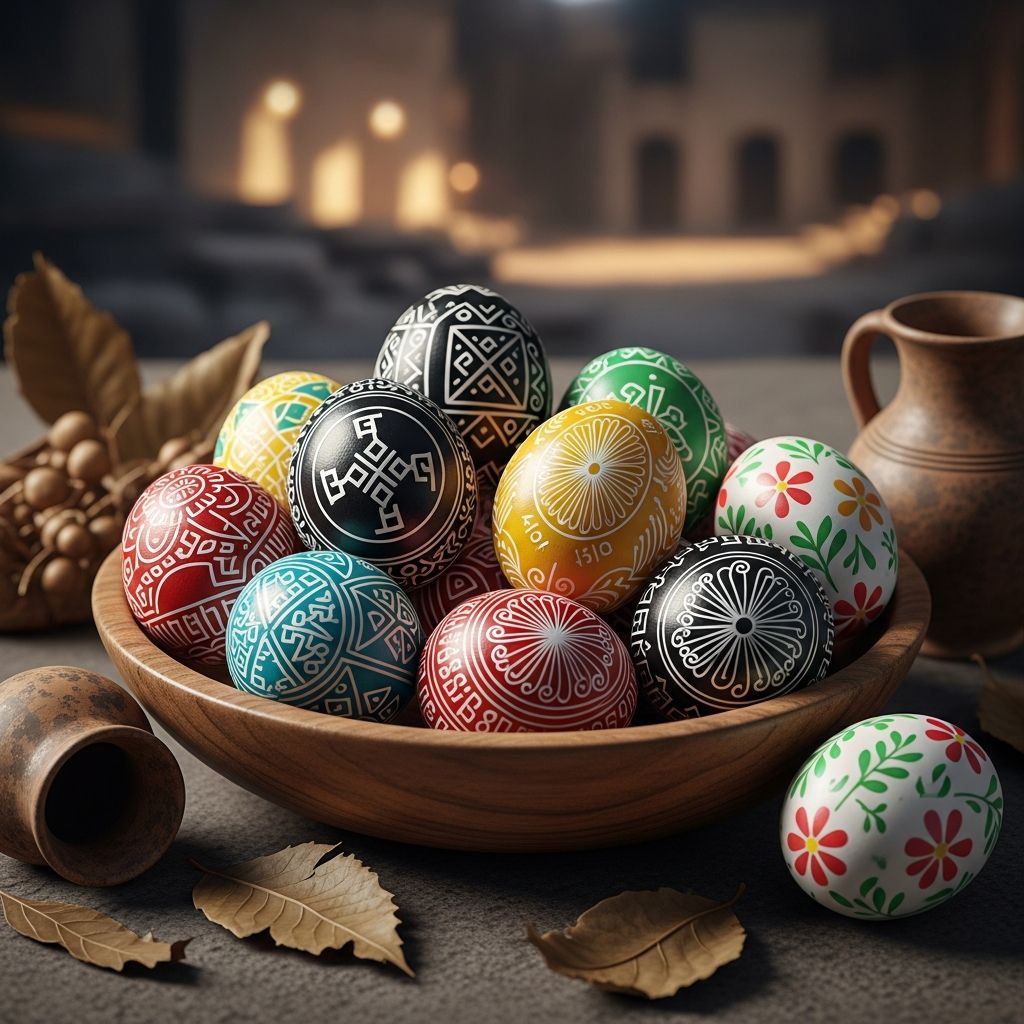
Egg dyeing for Easter blends ancient symbols of life with Christian theology, originating in Mesopotamia where early believers stained eggs red to honor Christ’s blood, evolving into a global tradition of renewal and celebration.
From Fertility Icons to Sacred Symbols
Eggs have symbolized **new life** and fertility across civilizations long before Easter. Ancient Romans dyed eggs with vegetable colors to gift during spring festivals, marking rebirth amid nature’s awakening. Persians exchanged decorated eggs during Nowruz, their New Year, tying into Zoroastrian beliefs of cosmic origins from a primordial egg. These practices reflected seasonal renewal, with eggs’ hard shells hiding vibrant life inside, mirroring earth’s mysteries.
When Christianity emerged, these pagan customs merged with biblical narratives. In Mesopotamia, early Christians adapted egg staining, choosing red dye to represent Jesus’ sacrificial blood on the cross. The shell evoked the sealed tomb, cracked open at resurrection, transforming eggs into emblems of hope and eternal life. This fusion allowed seamless integration into Lenten observances, where fasting prohibited egg consumption, leading families to preserve and color them for Easter feasting.
Colors and Their Profound Meanings
Early dyeing focused on **red**, sourced from onion skins or plants, symbolizing blood and passion in Orthodox traditions across Armenia, Bulgaria, and Russia. Over centuries, palettes expanded: yellow for resurrection’s light, blue for divine love, green for life’s renewal. Missionaries painted biblical scenes, embedding stories of salvation directly on shells, an early precursor to egg hunts where hidden eggs taught faith through play.
| Color | Symbolism | Cultural Origin |
|---|---|---|
| Red | Blood of Christ, sacrifice | Mesopotamia, Orthodox Churches |
| Yellow | Resurrection, light | Early Christian missionaries |
| Blue | Love, heaven | Eastern traditions |
| Green | New life, spring | Persian and Eurasian influences |
These hues weren’t random; they drew from natural sources like walnut hulls for browns, hickory for yellows, creating mottled effects through prolonged boiling. In Pennsylvania Dutch communities, onion skins yielded warm oranges to deep reds, varying by egg breed—white, brown, or blue-shelled hens adding diversity.
Techniques Evolving Through Eras
The art of egg decoration predates Christianity, with scratched designs on shells from Europe’s Middle Stone Age and a 4th-century tomb in Worms, Germany. By the 13th century, written records from Slavic and German sources describe painted eggs in playful contexts, suggesting widespread normalcy.
- Scratching: Etching designs on brown or pre-dyed white eggs, the simplest method tracing to antiquity.
- Batik/Pysanky: Wax-resist techniques from Eastern Europe, layering colors by drawing intricate patterns like florals, crowns, and hearts.
- Natural Dye Boiling: Immersing eggs in strained plant brews for uniform shades or leaving shreds for speckled looks.
- Modern Twists: Pennsylvania Dutch gifted durable, logwood-crimson eggs as love tokens, toughened by long boils for egg-cracking games.
Archaeological finds, like ceramic eggs from 320 CE Germany and 1000 CE Poland, confirm pre-Christian roots among Germanic and Slavic peoples. Kurdish Yazidis continue dyeing for ‘Red Wednesday,’ placing them on graves, echoing ancient egg cosmogonies.
Regional Twists on a Universal Custom
Easter eggs transcend denominations. Orthodox Churches crack red eggs post-midnight service, the first unbroken shell bearer deemed blessed. In Eurasia, onion-peel dyeing creates golden tones in Ukraine, Lithuania, and beyond. Pennsylvania Dutch categorized eggs: plain white for Good Friday preservation, dyed for Saturday feasts or ornate gifts.
Europeans extended to goose, duck, and peahen eggs, broadening artistic scope. Russian Orthodox perpetuated red traditions, while Persian Nowruz persists secularly. Even Jews, Greeks, Chinese, and Persians historically dyed red eggs for rituals, predating Christian adoption.
Preservation and Play in Early America
Immigrants brought techniques stateside. Pennsylvania Dutch boiled eggs in vinegar-bound onion dyes, producing spectrum from pale orange to mahogany. Games ensued: youth struck eggs, winners claiming losers’—a courtship ritual with crimson logwood eggs as tokens. Museums hold artifacts like a wax-resist egg with hearts and initials, blurring European and local lines.
These weren’t mere crafts; they preserved culture amid Lent’s austerity. Eggs laid during fasts accumulated, dyed post-fast to signify joy’s return. Children learned faith through handling, hiding, and hunting, embedding theology in tactile fun.
Modern Celebrations and Family Bonding
Today, Easter egg dyeing unites families, echoing millennia-old renewal themes. Kits simplify with food coloring, but natural methods revive history—beets for pink, turmeric for gold. Hunts mimic ancient hiding of inscribed eggs, turning backyards into treasure maps of symbolism.
Adapt for kids: use blown-out shells for crafts, avoiding waste. Themes inspire—pastels for spring, neons for fun—while stories of red Mesopotamian origins add depth. In a fast world, this ritual fosters patience, creativity, and shared heritage.
Frequently Asked Questions About Easter Egg Traditions
Why are Easter eggs traditionally dyed red?
Red symbolizes Christ’s blood shed on the cross, a practice starting with Mesopotamian Christians and persisting in Orthodox customs.
What do other egg colors represent?
Yellow stands for resurrection, blue for love, green for new life, as introduced by early missionaries.
Did egg decorating begin with Christianity?
No, it dates to ancient Persia, Rome, and Stone Age scratches, later adapted by Christians.
How were natural dyes made historically?
From onion skins (red/orange), walnuts (brown), hickory (yellow), boiled with vinegar to set on shells.
What’s the origin of Easter egg hunts?
Missionaries hid painted eggs with biblical scenes, an early teaching tool evolving into modern games.
References
- The Origin of Easter Eggs – The History Behind The Tradition — PureFlix. 2023. https://www.pureflix.com/insider/easter-egg-history-and-tradition
- Easter Eggs: What Is the History Behind This Tradition? — Chase Oaks. 2023. https://www.chaseoaks.org/articles/easter-eggs-what-is-the-history-behind-this-tradition/
- The History of Coloring Easter Eggs — Bordas Law. 2023. https://www.bordaslaw.com/blog-posts/the-history-of-coloring-easter-eggs/
- Easter Eggs: Symbols of Rebirth and Renewal — Glencairn Museum. 2024-03-13. https://www.glencairnmuseum.org/newsletter/2024/3/13/easter-eggs-symbols-of-rebirth-and-renewal
- Easter egg – Wikipedia — Wikipedia. 2025. https://en.wikipedia.org/wiki/Easter_egg
- How did a bunny and colored eggs become Easter symbols? — Virginia Tech News. 2025-04. https://news.vt.edu/articles/2025/04/easter-history.html
- The Ancient Art of Decorating Eggs — Library of Congress Folklife Today. 2017-04. https://blogs.loc.gov/folklife/2017/04/decorating-eggs/