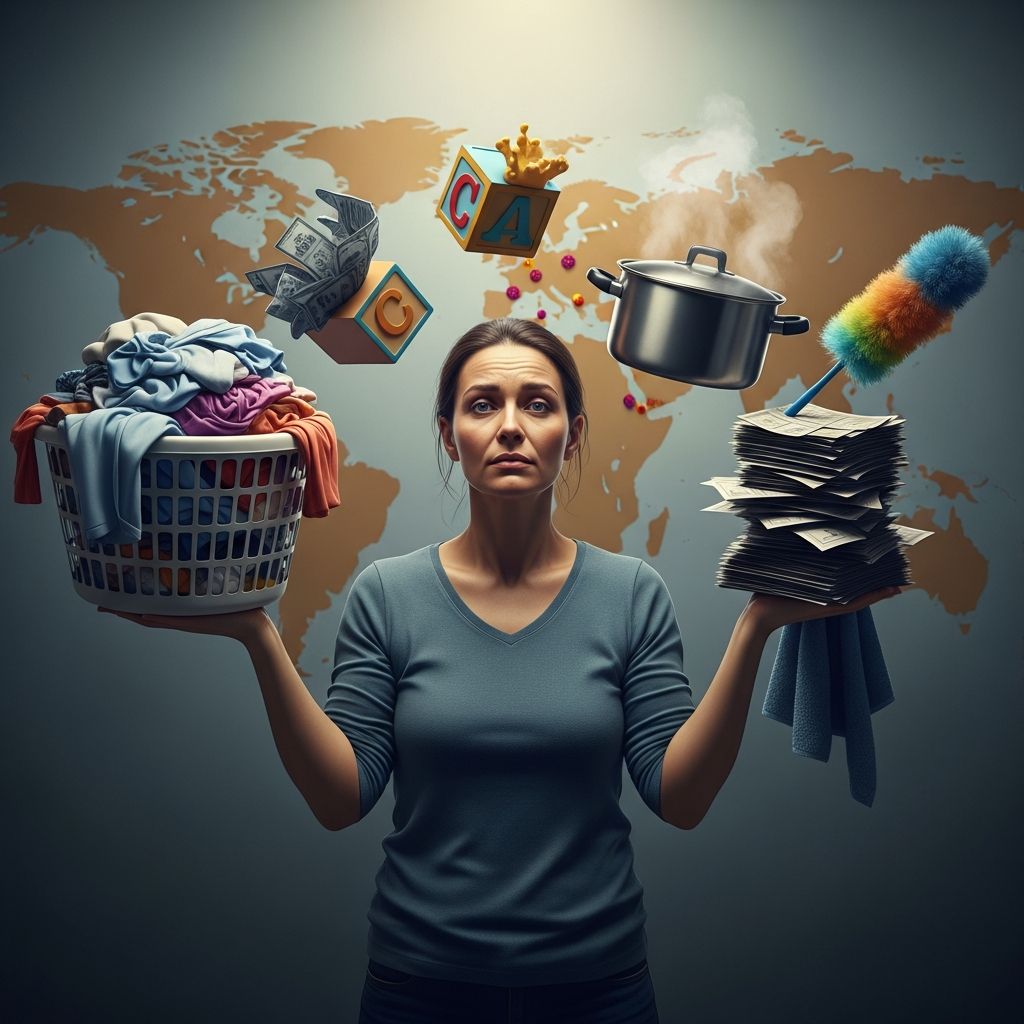
Across the globe, women perform the vast majority of unpaid domestic and care work, a hidden economy that sustains families, communities, and nations but remains invisible in official statistics. This labor, encompassing childcare, eldercare, household chores, and emotional support, is valued at trillions of dollars annually yet disproportionately burdens women, limiting their economic opportunities and perpetuating gender disparities.
The Scale of Unpaid Care: A Trillion-Dollar Shadow Economy
Unpaid care work represents a massive, unrecognized contribution to global and national economies. In the United States, recent analysis shows that Americans collectively provide over $1 trillion in unpaid care each year, with women accounting for $643 billion of this total. Globally, the International Labour Organization (ILO) estimates that 16.4 billion hours are devoted daily to such tasks, equivalent to 2 billion full-time workers laboring without pay—about 25% of the world’s population.
When monetized at minimum wage rates, this work constitutes around 9% of global GDP, totaling $11 trillion, or in low-income countries, it can exceed 40% of GDP. In Latin America and the Caribbean, unpaid care equates to 21.4% of regional GDP, far above the OECD average of 15%. These figures underscore how essential yet undervalued this labor is, forming the backbone of societal functioning.
Gender Disparities: Women Do the Heavy Lifting
Women perform three-quarters (76.2%) of unpaid care work worldwide, averaging 4 hours and 25 minutes daily compared to men’s 1 hour and 23 minutes—equivalent to 201 working days per year for women versus 63 for men. In the US, women spend 17 more minutes daily on family care than men, with Asian women and Latinas dedicating the most time per capita, about one hour daily.
| Group | Per Capita Value (USD) | Total Annual Value (USD) |
|---|---|---|
| White Women | 4,540 | 476 billion |
| Black Women | 4,250 | 80 billion |
| Asian Women | – | 55 billion |
| Latinas | – | 133 billion |
| Men (Overall) | 3,040 | 403 billion |
This table, derived from 2023 American Time Use Survey data, highlights the disproportionate load on women, particularly women of color who often manage multigenerational households.
Racial and Ethnic Dimensions of the Care Burden
Disparities extend across racial lines. In the US, Asian women contribute 3.5 billion hours annually, while Latinas provide 8.4 billion hours, reflecting higher rates of multigenerational living arrangements. Black women average significant time caring for non-household members, totaling $80 billion in value, while white women lead in per capita terms at $476 billion.
These patterns reveal how cultural norms and family structures amplify the workload for women of color, who balance extensive caregiving with other demands. Globally, in low-income rural areas, women may spend up to 14 hours daily on unpaid tasks.
Impact on Women’s Economic Participation and Health
The time-intensive nature of unpaid care directly hinders women’s entry into paid labor markets. Worldwide, 42% of women cannot secure jobs due to caregiving duties, compared to just 6% of men. In the US, this gap narrows slightly as more women work and men share tasks, but demographic factors like age, marital status, employment, and education still shape unequal distributions.
- Married women and mothers face heightened burdens, reducing time for career advancement.
- Lower-income and less-educated women spend more hours on unpaid work, exacerbating poverty cycles.
- Immigrant women often juggle cultural expectations with limited support networks.
This “double shift” affects health and well-being, leading to burnout, stress, and lower lifetime earnings. Unpaid work limits career choices, perpetuating economic inequality.
Global Perspectives: From Latin America to Low-Income Nations
In Latin America, women handle 74% of unpaid care, mirroring global trends and amplified by the COVID-19 pandemic, which deepened disparities. Oxfam reports that women and girls perform 12.5 billion hours of unpaid care daily, valued at $10.8 trillion yearly—three times the global tech industry’s size.
Additionally, women dominate the paid care workforce (two-thirds globally), yet 80% of 67 million domestic workers—mostly women—lack social security, with over half facing unlimited hours. As populations age, demand will surge, disproportionately impacting women unless policies intervene.
Policy Solutions: Recognizing and Redistributing Care Work
Addressing this imbalance requires systemic changes. Governments must invest in care infrastructure like affordable childcare, paid family leave, and eldercare services to free women’s time. Public policies promoting equitable distribution—such as paternity leave mandates—can shift norms.
- Universal childcare to reduce daily care hours.
- Valuing unpaid work in GDP calculations for better recognition.
- Flexible work arrangements and remote options post-pandemic.
- Targeted support for women of color and low-income families.
Time-use surveys, like the US Bureau of Labor Statistics’ American Time Use Survey and ILO’s modules, are vital for tracking progress and informing equitable policies.
The Road to Equity: Measuring Progress
Quantifying unpaid domestic and care work (UDCW) is now integral to labor statistics, highlighting under-utilization and gender inequalities. Nations adopting “light time-use modules” in labor force surveys gain insights to foster social justice.
Progress demands cultural shifts alongside policy. Encouraging men’s involvement and challenging stereotypes can balance loads, boosting women’s empowerment and economic growth.
Frequently Asked Questions (FAQs)
What percentage of unpaid care work do women perform globally?
Women perform about 76.2% of unpaid care work worldwide, averaging over four hours daily.
How much is unpaid care worth in the US economy?
It totals over $1 trillion annually, with women’s share at $643 billion.
Why do Asian women and Latinas spend more time on care?
They often live in multigenerational households, increasing daily caregiving demands.
How does unpaid work affect women’s employment?
42% of women worldwide can’t get jobs due to caregiving, versus 6% of men.
What policies can reduce the gender care gap?
Affordable childcare, paid leave, and paternity mandates promote equity.
References
- New Analysis Shows Unpaid Care Work in the U.S. is Worth More Than $1 Trillion Each Year — National Partnership for Women & Families. 2024-06-27. https://nationalpartnership.org/news_post/new-analysis-americans-unpaid-care-work-worth-more-than-1-trillion-each-year/
- The Missing Piece: Valuing women’s unrecognized contribution to the economy — United Nations Development Programme (UNDP). N/A. https://www.undp.org/latin-america/blog/missing-piece-valuing-womens-unrecognized-contribution-economy
- Providing Unpaid Household and Care Work in the United States: Uncovering Inequality — Institute for Women’s Policy Research (IWPR). N/A. https://iwpr.org/providing-unpaid-household-and-care-work-in-the-united-states-uncovering-inequality/
- Not all gaps are created equal: the true value of care work — Oxfam. N/A. https://www.oxfam.org/en/not-all-gaps-are-created-equal-true-value-care-work
- Measuring unpaid domestic and care work — ILOSTAT (International Labour Organization). N/A. https://ilostat.ilo.org/topics/unpaid-work/measuring-unpaid-domestic-and-care-work/