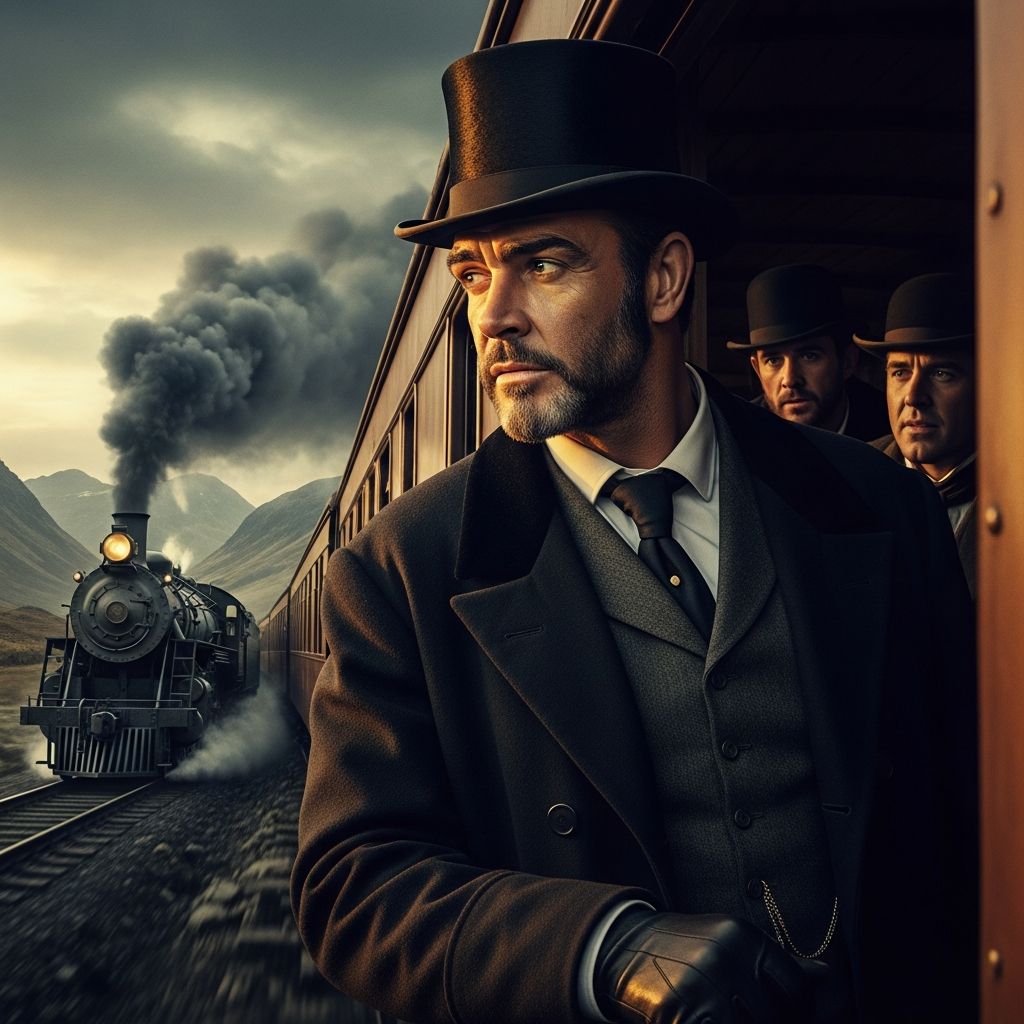
When movie fans talk about Sean Connery, the conversation usually jumps straight to James Bond, The Untouchables, or Indiana Jones and the Last Crusade. Hidden in that towering legacy is a witty, meticulously crafted Victorian heist film that many viewers either missed or only vaguely remember: Michael Crichton’s 1978 caper The First Great Train Robbery (released in the U.S. as The Great Train Robbery).
This film combines Connery’s light comic touch, Donald Sutherland’s eccentric charm, and Michael Crichton’s fascination with process and detail into a compact, stylish robbery story set in the 1850s. It is not just a curiosity from the late 1970s; it is a surprisingly modern-feeling heist movie wrapped in top hats, steam, and Victorian scandal.
Why This Train Heist Deserves Another Look
On the surface, The First Great Train Robbery follows a familiar playbook: assemble a crew, study the target, solve impossible logistical problems, and then attempt a daring theft. But dig a bit deeper, and several elements make it stand out from both Connery’s other work and from heist films in general.
- A charismatic, playful Connery showcasing his underrated comedic timing as a gentleman thief.
- Unusually detailed Victorian world-building, from slang to social rituals, rooted in Michael Crichton’s research.
- A focus on preparation and problem-solving rather than just action spectacle.
- Real physical stunt work on top of a moving train, performed largely by Connery himself.
- A blend of suspense and dry humor that feels closer to a caper comedy than a grim crime drama.
These ingredients help explain why critics at the time appreciated it as a clever genre piece, even if it never became a cultural touchstone on the scale of Bond.
The True-Event Inspiration and Crichton’s Novel
The film is adapted from Michael Crichton’s own 1975 novel The Great Train Robbery, which fictionalized an actual gold bullion heist from a moving train in 1855 England. Crichton, better known today for Jurassic Park and Westworld, was fascinated by the intersection of technology, institutions, and human ingenuity — themes that surface here in a period setting rather than science fiction.
Crichton’s historical approach mirrors how he later wove technical or scientific detail into thrillers. He immersed himself in Victorian social customs, criminal slang, and railway logistics, then translated that research into both the novel and screenplay. The result is a heist that depends not only on clever criminals but on understanding the bureaucratic systems and social pressures of mid-19th-century Britain.
Story at a Glance: Gold, Keys, and Victorian Respectability
The core premise of the film is simple but elegant. A shipment of gold destined for British troops in the Crimean War travels regularly by train. Its security system relies on multiple layers of respectability:
- The gold is locked in a secure safe on the train.
- Four separate keys are required to open the safe, each held by a different trusted authority figure.
- Procedures and social status are assumed to be enough to deter any serious attempt at theft.
Enter Connery’s character, a polished mastermind who sees the system not as impregnable, but as a series of solvable problems. With the help of:
- a skilled pickpocket and cracksman (played by Donald Sutherland), and
- a resourceful, quick-witted accomplice (Lesley-Anne Down),
he sets out to obtain copies of all four keys and then pull off the robbery in motion. Each key must be captured without scandal, preferably in situations that the dignified owners would be reluctant to explain to the police.
The Heist Blueprint: Step-by-Step Tension
One of the film’s chief pleasures is watching the crew move from concept to execution. Crichton structures the movie almost like a case study in project management, but with dogfights, brothels, and railway offices instead of spreadsheets.
| Heist Phase | What Makes It Distinctive |
|---|---|
| Intelligence Gathering | Observing schedules, routines, and social habits of key holders; understanding class-based blind spots. |
| Key Acquisition | Staging morally compromising or embarrassing scenarios around upper-class men so they will not report thefts. |
| Rehearsals and Timing | Multiple dry runs of an office break-in with stopwatches, emphasizing precision over brute force. |
| Onboard Robbery | Smuggling Connery’s character into a locked carriage and navigating the roof of a moving train. |
| Aftermath | Dealing with investigation, public spectacle, and the Victorian justice system once the crime is uncovered. |
This procedural emphasis mirrors the kinds of technical breakdowns Crichton later applied to genetic engineering or amusement park systems, only here the “technology” is an industrial-age railway network backed by Victorian bureaucracy.
Performances: Connery, Sutherland, and Down
The film’s tone depends heavily on its three leads, each bringing a different energy to the crime.
Sean Connery: A Gentleman Scoundrel
Critic Roger Ebert argued that Connery’s Bond was always, at heart, a light comic creation dressed up as an action hero. The First Great Train Robbery makes that side of him explicit. His character moves effortlessly between elite drawing rooms and seedy back alleys, using charm as much as strategy.
- He underplays the danger with dry wit rather than bravado.
- He presents crime less as cruelty and more as daring improvisation.
- His performance here helps bridge the gap between his 1960s Bond persona and his later, more mature roles.
Donald Sutherland: The Specialist
Sutherland’s role as a gifted pickpocket and safe expert adds nervous, slightly eccentric energy to the team.
- He punctuates scenes with odd little gestures and rhythms, such as finger snaps and whistles.
- His character embodies the technical skill and precise timing that the plan demands.
- He balances Connery’s polish with a more openly anxious, fidgety presence.
Lesley-Anne Down: More Than a Moll
While the film uses Down’s character in traditionally glamorous ways, it also gives her agency within the con.
- She participates in elaborate deceptions, disguise work, and social manipulation.
- She navigates both respectable and disreputable spaces with equal ease.
- She contributes directly to key moments in the acquisition of the safe keys, not just as a passive love interest.
Crichton as Director: Precision Over Bombast
Michael Crichton’s film directing career was brief compared with his writing, but this movie shows his strengths behind the camera.
- Clear geography and cause-and-effect in the heist sequences, so viewers can follow each problem and solution.
- Measured pacing that allows the audience to enjoy anticipation and preparation, not just payoff.
- Respect for practical effects, including building an operational train for the climactic robbery.
The train-top sequence is especially notable. Connery actually worked on the roof of a moving train, which reportedly traveled at around 40–50 mph, faster than he had been told. The production team added a gritty surface to the roofs and had Connery wear rubber-soled shoes, but he still slipped during one jump and had to fight off smoke and cinders while performing the stunt. That physical risk contributes to the visceral edge of the final act.
Victorian England as a Character
Beyond the plot, the film functions as a compact tour of mid-19th-century British society. It does not claim to be a documentary, but it does draw on real historical research about class divides, public punishment, and early industrial infrastructure.
Key aspects of the setting include:
- Rigid class hierarchy separating bankers, officials, and military officers from working-class urban spaces.
- Public entertainments like dogfights and executions that reveal a rougher side of Victorian life.
- Railways as symbols of national power and logistical complexity, moving money, troops, and information.
Crichton incorporates period slang and underworld jargon into the dialogue, which critics have noted adds texture without overwhelming the viewer. The production design, from costumes to interiors, reinforces the sense that crime here is as much about exploiting social customs as defeating locks.
How It Fits in the Heist Movie Tradition
By contemporary standards, The First Great Train Robbery is a relatively small-scale thriller: there are no massive explosions or sprawling ensemble casts. Instead, it aligns more closely with classic caper films that emphasize ingenuity and style.
Compared with modern heist franchises like Ocean’s Eleven or Mission: Impossible, Crichton’s movie:
- Relies almost entirely on analog tricks and social engineering.
- Treats technology (locks, schedules, safes) as puzzles rather than weapons.
- Keeps the moral stakes ambiguous — the thieves are charming, but not noble revolutionaries.
This focus on problem-solving over spectacle has helped the film age more gracefully than some of its contemporaries; its set-pieces hinge on timing and body language rather than special effects that may look dated decades later.
Reception Then and Now
On release, critics generally praised the film as an entertaining, well-made caper with standout performances from Connery and Sutherland. Reviewers highlighted:
- Its faithful sense of period detail and atmosphere.
- The chemistry between the three leads.
- The gripping, inventive train sequence that caps the story.
Over time, however, it slipped into the background of Connery’s career, overshadowed by more iconic roles and by the explosion of high-tech action cinema in the 1980s and 1990s. Modern viewers who discover it often do so through film retrospectives, streaming libraries, or Connory-focused watchlists rather than mainstream nostalgia.
Why Modern Audiences Might Appreciate It More
In an era saturated with CGI-heavy blockbusters, The First Great Train Robbery offers a different flavor of entertainment that can feel refreshing:
- Authentic physical stunts create real tension that does not depend on visual effects.
- A tight runtime pushes the story forward without sprawling subplots.
- Complex but readable schemes invite the audience to think along with the criminals rather than simply watch passively.
- Connery in transitional mode, bridging his Bond past and his later character-actor gravitas.
For viewers interested in the evolution of heist cinema, it also acts as a bridge between earlier, more straightforward capers and the slick, self-aware heist films of the 21st century.
How to Watch It: Tips for New Viewers
If you are coming to The First Great Train Robbery for the first time, a few viewing strategies can enhance the experience:
- Pay attention to routine details early in the film — schedules, habits, and social rules are all clues.
- Listen for the humor: many of the best jokes are understated, playing off class expectations and Victorian propriety.
- Watch Connery’s body language during the train sequence to appreciate the physical risk he was taking.
- Compare its structure to more recent heist movies you know; you will see echoes in planning montages and timing-based suspense.
Frequently Asked Questions (FAQs)
Q: Is The First Great Train Robbery based on a real crime?
A: Yes. The film is adapted from Michael Crichton’s novel, which in turn is inspired by an 1855 robbery of gold from a train in England, though names and many details are fictionalized for dramatic effect.
Q: Did Sean Connery really do his own stunts on the train?
A: Connery performed most of his own stunt work on top of a moving train. Production records note that the train was actually traveling around 40–50 mph, faster than he had been told, and he nearly slipped during one jump despite safety precautions.
Q: Is the movie more of a comedy or a thriller?
A: It is best described as a heist caper — a blend of suspenseful planning and execution with a strong thread of dry humor and playful character interactions, rather than a dark crime drama.
Q: How does it compare to Connery’s James Bond films?
A: You still get Connery’s charm and physical presence, but his character here is less of a government agent and more of an elegant rogue. Critics like Roger Ebert have noted that the film highlights the comic undercurrent that was always part of Connery’s Bond but gives it more room to breathe.
Q: Is the film suitable for family viewing?
A: The movie contains some violence, suggestive situations, and depictions of gambling and criminal activity characteristic of Victorian underworld life. It originally carried a PG rating, but parents may want to preview it to judge appropriateness for younger children.
References
- The Great Train Robbery (1978) – Plot & Details — IMDb. 2024-01-01 (last updated). https://www.imdb.com/title/tt0079240/
- The First Great Train Robbery — Wikipedia summary citing Michael Crichton sources and production notes. 2024-01-10 (last updated). https://en.wikipedia.org/wiki/The_First_Great_Train_Robbery
- The Great Train Robbery (1979) – Review — Roger Ebert / Chicago Sun-Times. 1979-02-09. https://www.rogerebert.com/reviews/the-great-train-robbery-1979
- The Great Train Robbery — Rotten Tomatoes. 2024-05-01 (page metadata updated). https://www.rottentomatoes.com/m/the_great_train_robbery_1979
- TBT: The Great Train Robbery (1978) — Frock Flicks. 2017-02-16. https://frockflicks.com/tbt-the-great-train-robbery-1978/