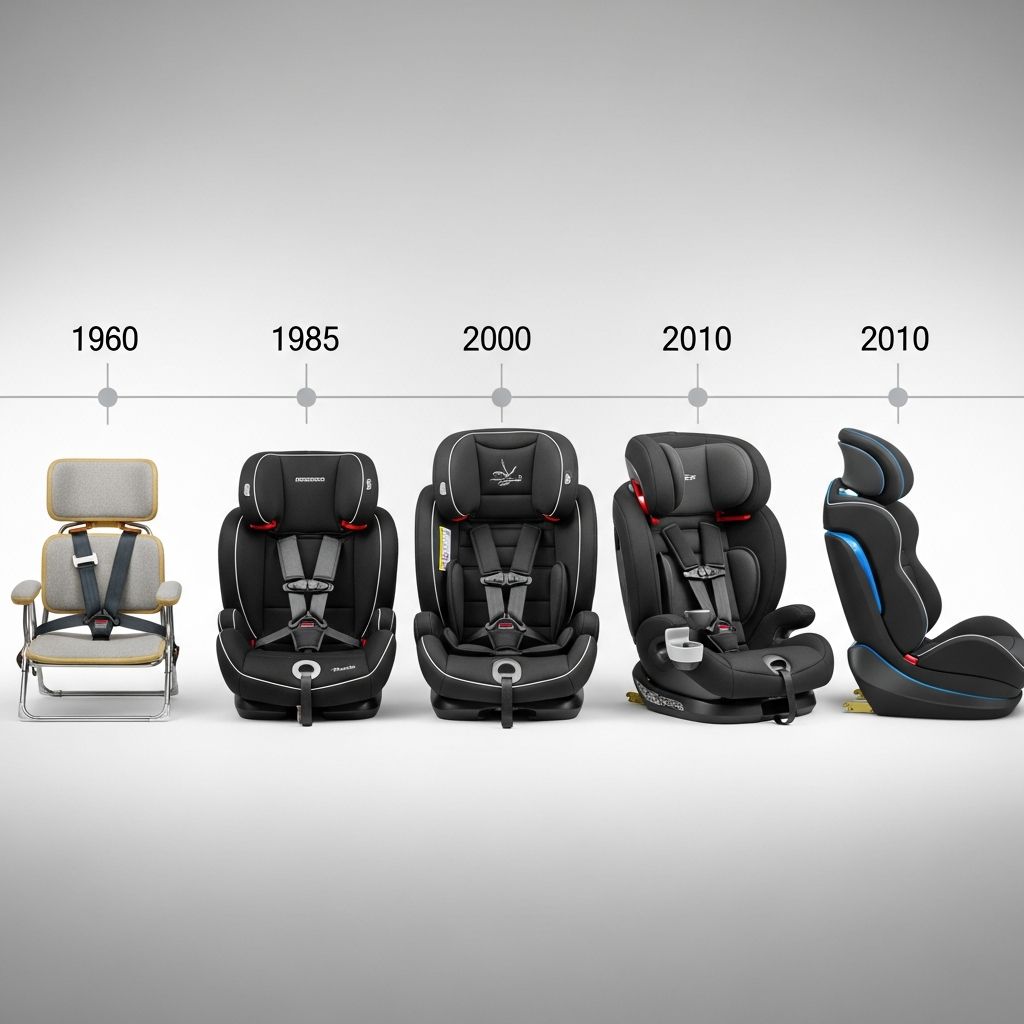
Child car seats have undergone a remarkable transformation since their inception, evolving from mere convenience accessories to critical safety equipment that saves lives daily. This journey reflects advances in engineering, rigorous testing, and legislative action, significantly reducing child injury rates in vehicular accidents.
Early Beginnings: Convenience Over Protection
In the 1930s, the automotive landscape was vastly different, with children often unrestrained or free to roam inside vehicles. The Bunny Bear Booster Seat, introduced in 1933 by the Bunny Bear Company, marked the first commercial child car seat. Constructed from metal and leather, it functioned primarily as a raised platform in the front passenger seat, secured by a basic belt. Its purpose was not crash protection but to elevate children for better visibility out the windshield and easier parental supervision during drives.
Throughout the 1940s and 1950s, similar products proliferated in catalogs like Sears, emphasizing comfort and positioning rather than impact resistance. These seats lacked padding, harnesses, or structural integrity to withstand collisions, mirroring the era’s limited understanding of vehicular crash dynamics. Parents viewed cars as extensions of home spaces, allowing lap-sitting or back-seat freedom, which exposed children to severe risks in even minor accidents.
Pioneering Innovations in the 1960s
The 1960s heralded a paradigm shift, driven by growing awareness of automobile dangers. Influential works like Ralph Nader’s 1965 book Unsafe at Any Speed exposed systemic vehicle safety flaws, catalyzing the establishment of the U.S. Department of Transportation (DOT) and the National Highway Traffic Safety Administration (NHTSA) in 1966.
British journalist Jean Ames launched the Jeenay Car Seat in 1962, pioneering rear-facing orientation and a three-point harness system. Positioned in the back seat and using the vehicle’s seatbelt, it represented the first intentional safety-focused design. Concurrently, American inventor Leonard Rivkin, motivated by a personal accident involving his child, created the Guys and Dolls Safety Car Seat in 1963. This metal-framed restraint offered rudimentary crash protection, introducing concepts like harnesses and protective shells.
In Sweden, Professor Beril Aldmann drew inspiration from NASA’s Gemini space capsules, developing a rear-facing seat in 1964. This led to the T-standard, advocating prolonged rear-facing positions up to age four—a practice still standard in Sweden today. By the late 1960s, automakers entered the fray: Ford’s 1968 Tot-Guard featured a shielding shell over the child, while General Motors’ Love Seat provided rear-facing crash protection akin to modern infant seats.
Regulatory Foundations in the 1970s
The 1970s solidified car seats’ role in safety through federal mandates. In 1971, NHTSA introduced the first U.S. standard, requiring seats to secure via vehicle safety belts—standardized in cars since 1968—and incorporate three-point harnesses. However, crash testing remained absent, limiting efficacy.
State-level action began with Tennessee’s 1977 law, mandating seats for children under four, spearheaded by advocate Kay Sanders Hulsey. Facing cost concerns, she argued seats’ expense paled against medical bills, paving the way for subsidized programs. This precedent spread rapidly, emphasizing the ‘three Es’: education, engineering, and enforcement.
1980s: Crash Testing and Universal Laws
The early 1980s brought transformative regulations. Federal Motor Vehicle Safety Standard 213 (FMVSS 213), effective 1981, imposed crash testing protocols, ensuring seats could withstand simulated frontal impacts at specified speeds. This addressed prior designs’ inadequacies in force absorption and ejection prevention.
By 1985, all 50 states enacted child passenger safety laws, requiring restraints for young children. Usage surged from low teens to 46% nationally by 1984, a 500% increase, thanks to public campaigns and market responses. Despite this, challenges persisted: 20% non-compliance and 65% misuse highlighted needs for better education and user-friendly designs. Booster seats gained traction for older toddlers transitioning from harnessed seats.
Advancements Through the 1990s and 2000s
The 1990s focused on refinement. NHTSA enhanced FMVSS 213 with stricter side-impact considerations, five-point harness mandates, and dynamic crash testing across age groups. Seats became adjustable, with improved padding and energy-absorbing materials.
The 2000s introduced the LATCH (Lower Anchors and Tethers for Children) system in 2002, mandating attachment points in vehicles and compatible hardware in seats. This simplified installation, reducing errors—a primary injury cause—and enhanced stability. Convertible seats supporting rear- and forward-facing modes proliferated, alongside all-in-one models extending usability to booster stages.
| Decade | Key Development | Impact |
|---|---|---|
| 1930s-1950s | Booster seats for visibility | No crash protection; convenience only |
| 1960s | Rear-facing, harness designs | Safety awareness emerges |
| 1970s | First federal standards | Harness requirements; state laws begin |
| 1980s | FMVSS 213 crash testing | Universal laws; usage boom |
| 1990s-2000s | 5-point harnesses, LATCH | Improved installation, versatility |
Modern Era: Smart Tech and Extended Protection
Today, car seats integrate sensors for fit checks, Bluetooth connectivity for usage reminders, and materials mimicking aircraft-grade composites. Rear-facing recommendations now extend to age two or longer, supported by data showing superior neck protection. NHTSA’s ongoing updates to FMVSS 213 include side-impact testing since 2014 and automatic belt routing.
Usage exceeds 90% in the U.S., with child fatality rates dropping 71% from 1975-2020, attributable to seats, laws, and vehicle improvements. Yet, misuse lingers at 46%, underscoring inspection stations’ role.
Types of Car Seats and Usage Guidelines
- Infant-Only: Rear-facing, birth to 9-35 lbs; cradles newborn head.
- Convertible: Rear-facing (4-40 lbs) to forward-facing (20-65 lbs).
- All-in-One: Rear/forward-facing to booster (up to 120 lbs).
- Booster: Belt-positioning for 40-120 lbs, ages 4-12.
Key rule: Rear-face until maximum height/weight; forward-face with harness till limits; boost till adult belt fits (5’9″, shoulder belt midline).
Installation Best Practices
80% of seats are misused. Prioritize LATCH for infants/toddlers; belts for boosters. Achieve <1-inch movement at belt path. Register for recalls; replace post-crash. Professional checks at fire stations ensure correctness.
Frequently Asked Questions
Why rear-facing longer?
Rear-facing distributes crash forces across shell/back, safeguarding undeveloped neck/head better than forward-facing.
When to switch to booster?
After outgrowing forward harness (typically 40-65 lbs); use till seat belt fits properly, around 10-12 years.
Are all seats equal?
No; choose NHTSA-certified (FMVSS 213 label). Higher crash test scores (IIHS) indicate superior performance, though not mandated.
LATCH vs. seat belt?
LATCH for lighter seats; belts equally safe if tight. Follow manufacturer limits.
Airbags and seats?
Never front-seat; rear-facing incompatible. Back seat safest.
References
- The Evolution of Child Car Seats in America — Maggiano Law. 2023. https://www.maggianolaw.com/blog/evolution-of-child-car-seats/
- The History of Car Seats — Safe in the Seat. 2023. https://www.safeintheseat.com/post/the-history-of-car-seats
- The History of How the Car Seat Made American Kids Safer — TIME Magazine. 2024-10-15. https://time.com/7306364/history-car-seat-made-kids-safer/
- A Look Back: The History of Car Seats — WAYB. 2023. https://wayb.com/blogs/news/a-look-back-the-history-of-car-seats
- Children’s Car Seats — The Henry Ford Museum. N/A. https://www.thehenryford.org/collections-and-research/digital-collections/expert-sets/101263/
- Child Safety Seat — Wikipedia (citing NHTSA). 2024. https://en.wikipedia.org/wiki/Child_safety_seat