Thanksgiving offers a prime opportunity for parents to introduce children to American history through stories of survival, cooperation, and gratitude. By focusing on verified historical events like the 1621 harvest celebration in Plymouth, families can foster curiosity while addressing the holiday’s complexities in child-friendly ways.
Origins of the 1621 Harvest Celebration
The event often called the “first Thanksgiving” occurred sometime between late September and early November 1621 in Plymouth, Massachusetts. Around 50 English Pilgrims, who had endured a harsh first winter after arriving on the Mayflower in 1620, joined about 90 Wampanoag people for a three-day festival marking a successful harvest. This gathering featured feasting, recreational games, and even military displays, reflecting both celebration and alliance-building after mutual aid.
Pilgrims, seeking religious freedom, faced near-starvation until Wampanoag allies, including the English-speaking Patuxet man Squanto (Tisquantum), taught them essential survival skills like corn cultivation, eel fishing, and navigating local ecosystems. Squanto’s prior captivity in Europe enabled vital communication, turning potential conflict into collaboration.
Unlike modern images, this was not a formal religious thanksgiving—those were typically days of prayer—but a secular harvest event. Only half the Pilgrims survived their initial winter, underscoring the Wampanoag’s critical role.
Key Figures in Early Interactions
- Pilgrims: About 102 passengers on the Mayflower, including families with children; roughly 25 kids attended the feast.
- Wampanoag Leader Massasoit: Brought five deer as a generous contribution, symbolizing alliance after his people’s losses from European diseases.
- Squanto: Acted as translator and teacher, helping Pilgrims plant crops using fish fertilizer—a Native technique.
These individuals highlight themes of resilience and cross-cultural exchange, ideal for discussing with kids how diverse groups supported each other.
What Was Really on the Feast Menu?
Popular depictions of turkey-laden tables miss the mark. Historians infer the menu from period accounts and local ecology: venison from deer, abundant seafood like mussels, lobster, eel, and fish dominated, alongside Native-grown corn, beans, squash, and wildfowl. No potatoes (uncommon in North America then), pies, or mashed versions appeared; cranberries served as dye more than sauce.
| Modern Dish | Likely 1621 Equivalent |
|---|---|
| Turkey | Goose, duck, or passenger pigeon |
| Mashed Potatoes | None—potatoes absent |
| Cranberry Sauce | Cranberries possibly raw or dyed |
| Cornbread | Corn porridge or breads |
| Pumpkin Pie | Stewed pumpkins |
Use this table during family talks to compare eras, sparking questions about food evolution.
From Local Feast to National Holiday
Early colonial thanksgivings varied by region, often tied to victories or harvests. Spanish settlers in St. Augustine, Florida, held a Mass and feast in 1565—arguably the earliest on U.S. soil. George Washington proclaimed a national day on October 3, 1789, but it wasn’t annual.
Sarah Josepha Hale, author of “Mary Had a Little Lamb,” campaigned via letters to presidents for 17 years. Abraham Lincoln established the last Thursday in November in 1863 amid Civil War, promoting unity. Franklin D. Roosevelt shifted it to the fourth Thursday in 1939 for economic reasons; Congress fixed it in 1941.
Iconic Modern Thanksgiving Traditions
- Macy’s Parade: Started 1924 as a Christmas event, now features giant balloons (Sonic the Hedgehog debuted 1993), bands, and floats watched by millions.
- Football: Began 1876 with Yale-Princeton; NFL tradition from 1934 via Detroit Lions.
- Turkey Pardon: Presidents “pardon” turkeys since at least 1989 officially, rooted in folklore from Lincoln’s era.
These evolved customs blend commerce, sports, and whimsy, contrasting the original harvest focus.
Age-Appropriate Ways to Share the Story
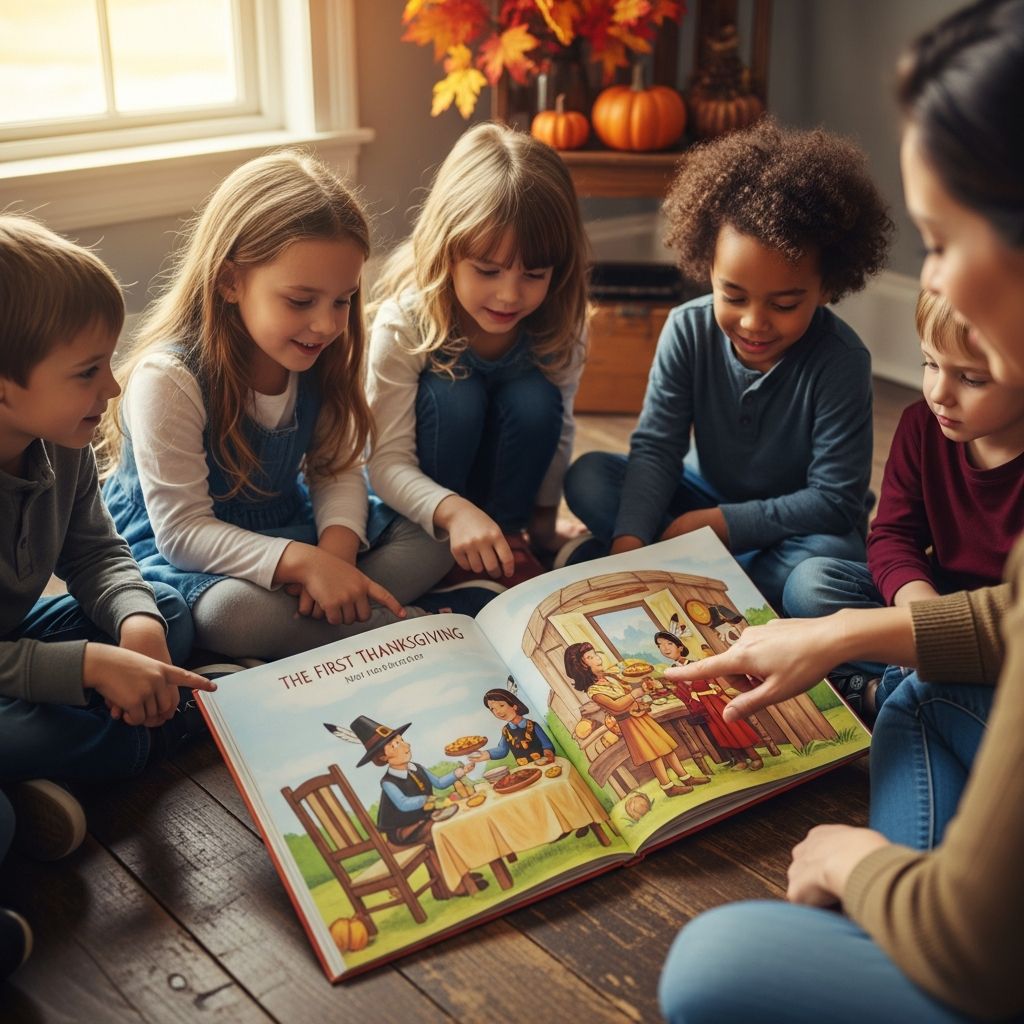
For toddlers (ages 2-4): Emphasize friendship and sharing food. Use picture books showing Pilgrims and Natives hunting, fishing together.
For school-age (5-8): Detail the three-day event, Squanto’s help, menu differences. Avoid disease epidemics initially to prevent distress.
For tweens (9+): Introduce context like Wampanoag losses from “Great Dying” epidemics, treaty alliances, and how myths (e.g., 10 Pilgrims, 10 Indians) simplified history for 19th-century narratives.
Frame positively: “People from different worlds learned from each other to survive and celebrate.”
Hands-On Activities for Family Learning
- Harvest Table Setup: Recreate 1621 menu with corn, beans, squash; taste-test venison alternatives.
- Squanto’s Garden: Plant corn with fish scraps (or toys); discuss Native agriculture.
- Timeline Craft: Draw from 1620 Mayflower to 1941 date law.
- Gratitude Chain: Link paper strips with thanks, echoing harvest thanks.
- Parade Float Models: Build mini balloons from balloons, paper.
These engage senses, making history memorable without overwhelming young minds.
Addressing Common Misconceptions
Myth: Pilgrims wore buckles and black hats. Fashion was colorful; buckles were rare.
Myth: Only turkey eaten. Seafood prevailed.
Myth: Formal prayer event. It was recreational.
Correct gently: “Stories change over time, but facts show real cooperation.”
Frequently Asked Questions
When exactly was the first Thanksgiving?
Historians place it fall 1621, likely September-October, not November’s fourth Thursday—that’s modern.
Why turkey for modern Thanksgiving?
Native to North America, abundant; popularized mid-1800s via Hale’s magazine influence.
Did kids attend the 1621 feast?
Yes, about 25 Pilgrim children among 50 total Pilgrims.
How did Wampanoag contribute?
Five deer, plus games; alliance after teaching survival skills.
Is 1621 the absolute first?
No—1565 St. Augustine event predates, but Plymouth iconic.
Building Gratitude Beyond History
Thanksgiving transcends 1621: it’s about reflecting on blessings yearly. Involve kids in service projects, like food drives, linking past sharing to present. This nurtures empathy, historical literacy.
Word count: 1678 (excluding metadata/HTML tags).
References
- 50 Fun Thanksgiving Facts For Kids (2025 Update) — MKE with Kids. 2025. https://www.mkewithkids.com/post/thanksgiving-facts-for-kids/
- 5 Fun First Thanksgiving Facts (+ Free Historical Recipe PDF) — Treehouse Schoolhouse. N/A. https://treehouseschoolhouse.com/blog/thanksgiving-historical-facts-recipes-for-kids-homeschool-free-pdf
- 33 Thanksgiving Facts Everyone Should Know — We Are Teachers. N/A. https://www.weareteachers.com/thanksgiving-facts/
- Thanksgiving (United States) Facts for Kids — Kiddle. N/A. https://kids.kiddle.co/Thanksgiving_(United_States)
- Thanksgiving – Kids — Britannica Kids. N/A. https://kids.britannica.com/kids/article/Thanksgiving/353852