Understanding Hygiene Challenges in Children with Autism Spectrum Disorder
Children with autism spectrum disorder (ASD) often face unique challenges when learning personal hygiene skills. Unlike neurotypical children who may naturally acquire these behaviors through observation and social cues, many autistic children require explicit, structured instruction to develop and maintain hygiene routines. The reasons for these difficulties are multifaceted and require caregivers to adopt specialized approaches tailored to each child’s individual needs and abilities.
One of the primary obstacles involves sensory processing differences. Children with ASD frequently experience heightened sensory awareness or, conversely, diminished sensory perception in various domains. These variations can make routine hygiene activities feel uncomfortable, overwhelming, or confusing. Understanding these neurological differences forms the foundation for developing effective teaching strategies that respect the child’s unique sensory profile while promoting essential self-care habits.
The Role of Sensory Processing in Hygiene Learning
Sensory sensitivities play a central role in how children with autism approach personal hygiene tasks. A child may experience water temperature as painfully extreme when it would feel pleasant to peers. Similarly, the texture of certain soaps, the sound of running water, or the smell of common hygiene products can trigger genuine distress rather than indifference. These are not behavioral problems but neurological realities that require accommodation and understanding.
Touch sensitivities may make toothbrushing feel invasive or uncomfortable. Auditory sensitivities might cause a child to react negatively to the sound of water flowing or the whir of an electric toothbrush. Olfactory sensitivities can make strongly scented soaps or shampoos intolerable. Recognizing these patterns in your child’s responses is crucial for developing solutions that work.
Beyond negative sensory experiences, some children with autism may have reduced sensory awareness, meaning they don’t perceive dirt, sweat, or the need for hygiene as readily as others. These children may require external cues and reminders to understand when hygiene tasks are necessary, rather than developing the internal motivation neurotypical children develop naturally.
Creating Predictable Structures Through Routines
Children with autism typically thrive with predictability and structure. Establishing consistent daily hygiene routines provides multiple benefits: they reduce anxiety by eliminating uncertainty, they create muscle memory for sequences of actions, and they help children develop a sense of mastery and accomplishment. A predictable morning routine might progress from waking, to washing the face, brushing teeth, combing hair, dressing, and then moving to breakfast—the same sequence every single day.
The consistency of routine serves as an external organizational system that compensates for executive function differences common in autism. Rather than requiring the child to remember which task comes next or to plan a sequence of steps, the routine does this work. Over time, this external structure can be gradually reduced as the child internalizes the sequence.
Timing and location consistency also matter. Designating specific times for hygiene activities—always brushing teeth after breakfast, always showering on particular days at particular times—helps the child anticipate and prepare for these tasks mentally. Performing hygiene activities in the same location and in the same order further reinforces the routine and reduces decision-making demands.
Visual Supports: Making Instructions Concrete and Accessible
Many children with autism are visual learners who struggle with verbal instructions alone. Visual supports transform abstract concepts into concrete, observable information that children can reference independently. These supports include picture sequences, written step-by-step instructions, color-coded charts, and social stories customized to the individual child.
A handwashing visual support might display six sequential images: wet hands with water, apply soap, rub hands together, rinse thoroughly, dry with towel, and done. The child can refer to this sequence independently, reducing their reliance on verbal reminders. Some families laminate these visuals and place them near relevant locations—bathroom mirrors, shower areas, or bedroom walls.
Social stories—personalized narratives written in the child’s perspective—can explain why hygiene matters and what to expect during each task. Rather than simply stating “you need to shower,” a social story might read: “On Tuesday and Thursday evenings, I take a warm shower. The water feels nice on my skin. I use my soft washcloth and mild soap. After five minutes, I rinse off and feel clean.” This narrative approach helps children understand not just what to do, but why and what sensations to expect.
Breaking Complex Tasks Into Manageable Steps
What adults accomplish automatically—showering—actually involves numerous distinct steps and decisions. Children with autism often benefit from having these complex tasks deconstructed into smaller, discrete components. Rather than the instruction “take a shower,” break this into: enter bathroom, remove clothes, adjust water temperature, wet body, apply soap to arms, rinse arms, apply soap to torso, rinse torso, and so forth.
This task analysis serves multiple purposes. It makes the overall goal less overwhelming by presenting one small step at a time. It clarifies expectations so the child understands exactly what to do without ambiguity. It allows caregivers to identify the specific step where a child struggles and target instruction accordingly. Some children may manage most shower steps independently but need assistance adjusting water temperature safely.
As children demonstrate mastery of smaller steps, these can be gradually combined into larger sequences. A child might first learn each individual component with full support, then perform steps with reminders, then perform steps with gesture prompts only, and finally perform the entire sequence independently while a caregiver supervises from a distance.
Selecting Sensory-Friendly Hygiene Products
Standard hygiene products available in most stores are not necessarily suitable for children with sensory sensitivities. Experimentation is often necessary to find products that the individual child can tolerate and use comfortably. Water temperature preferences vary widely—some children prefer lukewarm water while others tolerate only cooler or warmer temperatures. Discovering the child’s preference and consistently providing water at that temperature can dramatically reduce resistance.
Soap selection involves considering both scent and texture. Unscented or lightly scented options are often better tolerated than heavily fragmented products. Some children prefer liquid soap while others find bar soap more manageable. Similarly, soft-bristled toothbrushes may be essential for children who experience oral hypersensitivity, and electric toothbrushes should be tested since their vibration and sound affect different children variably.
Towel selection might seem trivial but significantly impacts the child’s willingness to complete hygiene tasks. Soft, smooth towels made from cotton or microfiber are often preferred to rough textures. Some families find that allowing the child to select preferred towels—perhaps in a favorite color—increases buy-in and reduces resistance. Hair washing products, deodorants, and other personal care items should similarly be selected based on individual tolerance.
Modeling and Demonstrating Desired Behaviors
Children learn substantially through observation and imitation. Caregivers can demonstrate each hygiene task while narrating the steps in simple language, then inviting the child to imitate. “Watch me wash my hands. I wet my hands. I put soap on my hands. I rub them together. I rinse the soap off. I dry them.” Then, with physical or gestural support, guide the child through the same sequence.
Demonstrating tasks allows children to see the actual performance of activities they may find abstract or confusing through verbal description alone. A child may not understand what “brush your teeth” means, but observing a caregiver performing this action with narration provides concrete information about the desired behavior, the tools involved, and the sequence of movements.
Modeling is particularly effective when combined with physical prompting, where caregivers gently guide the child’s hands through the motions while narrating. Over time, physical prompts can be reduced to gestural prompts (pointing or miming actions), then to verbal reminders, and eventually removed entirely as the child internalizes the sequence.
Encouraging Independence While Maintaining Support
A fundamental goal of teaching hygiene skills is to develop independence—the child’s ability to complete tasks with minimal or no adult involvement. However, this independence develops gradually through a process of fading support. A child who initially requires full physical assistance may progress to needing only verbal reminders, then gestural cues, then perhaps an occasional prompt, and eventually complete tasks independently with periodic caregiver supervision.
Caregivers should strategically reduce their involvement as the child demonstrates mastery. This fading of prompts and assistance must occur gradually to avoid overwhelming the child or causing regression. Premature reduction of support can result in the child refusing the task or performing it incompletely. Conversely, maintaining unnecessary support beyond the child’s need prevents development of true independence.
Positive reinforcement during this process is important. Praising specific behaviors—”You brushed your teeth without me asking today!”—reinforces the desired action. Some children benefit from visual systems that track completion of tasks, such as sticker charts where each completed task earns a sticker toward a predetermined reward. These systems work best when the reward is meaningful to the child and when the connection between task completion and reward is clear and immediate.
Addressing Specific Hygiene Skills
Handwashing Competence
Handwashing is both a fundamental hygiene skill and an important health practice that prevents illness transmission. Teaching handwashing to children with autism can be approached through multiple strategies. Visual guides showing each step, songs that cue hand movements with music, and fun elements like colored or foamy soap can make this task more engaging. Encouraging frequent handwashing at natural transition points—before meals, after using the bathroom, after outdoor play—establishes the behavior as a routine habit rather than an isolated task.
Bathing and Showering
For many children with autism, bathing or showering presents significant challenges due to multiple sensory inputs occurring simultaneously. The visual change of environment, water sounds, water temperature and pressure, water in the eyes, soap smells, and the feel of water on skin all combine to create an overwhelming sensory experience. Breaking showering into extremely small steps, selecting comfortable water temperature, using minimal soap products, and allowing the child to control water flow when possible can reduce resistance.
Tooth Brushing
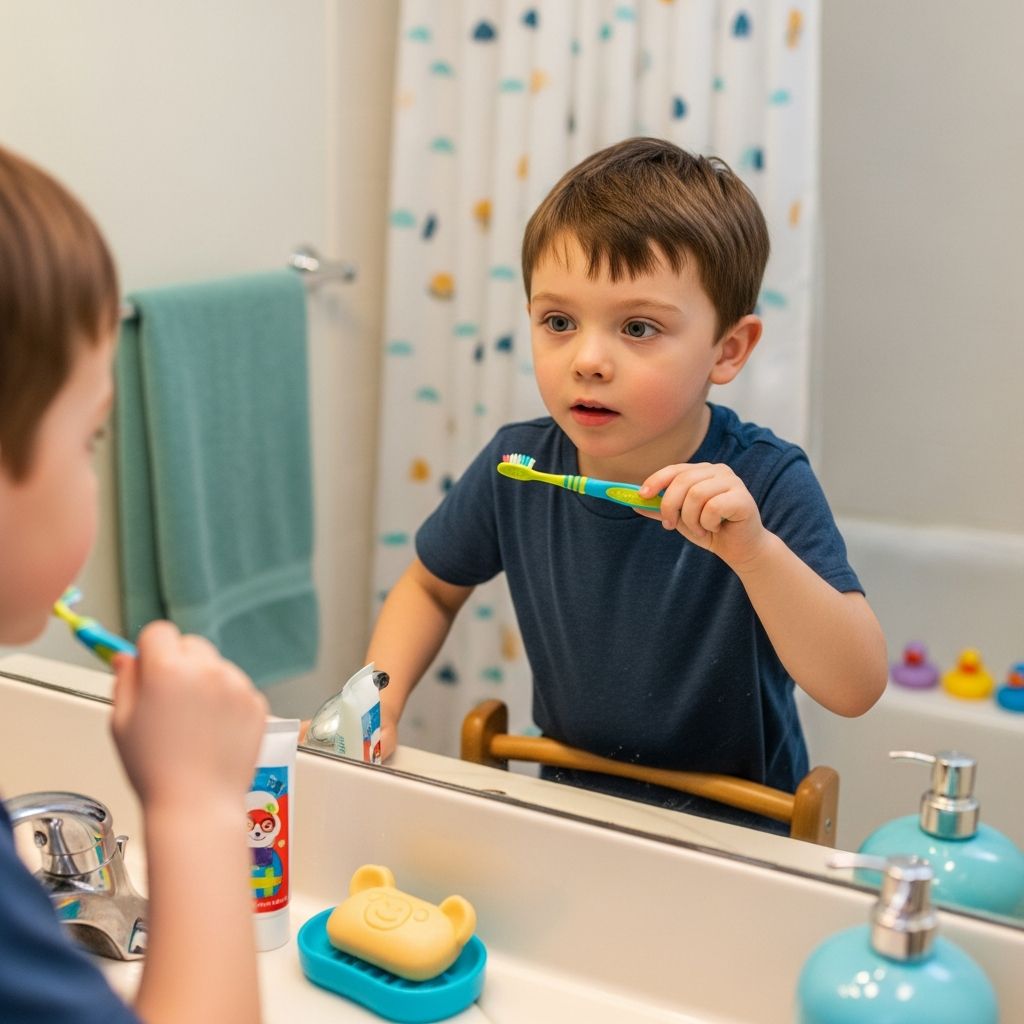
Oral hygiene tasks require the child to tolerate having hands or objects in their mouth—an area many children with autism find uncomfortable. Soft-bristled toothbrushes, child-friendly toothpaste flavors that the child actually enjoys, and allowing the child to control the toothbrush or at least participate actively rather than passively can improve cooperation. Electric toothbrushes work well for some children but overwhelm others with vibration and sound.
Hair Care and Management
Hair washing often triggers strong resistance due to sensory sensitivities. Water in the eyes and ears, shampoo scent, and the sensation of fingers in the hair can all be problematic. Using water cups to control where water flows, avoiding getting water in the eyes by tilting the head differently, using mild or unscented shampoos, or even exploring dry shampoo alternatives might be necessary accommodations.
Addressing Resistance and Challenging Behaviors
When children with autism resist hygiene tasks, caregivers should investigate the underlying cause rather than interpreting resistance as defiance or opposition. Resistance typically stems from sensory discomfort, anxiety about unpredictability, lack of understanding about the task, or fear of something in the hygiene process. Once the cause is identified, targeted solutions can address the root issue.
If a child resists tooth brushing, consider whether the problem is the taste of toothpaste, the sensation of the brush in the mouth, the taste of water, or anxiety about the task. Each of these identifies different solutions: different toothpaste flavors, different brush types or sizes, alternative rinsing methods, or additional preparation and reassurance about what to expect.
Building in transition time before hygiene tasks helps prepare the child mentally. A verbal warning ten minutes before a scheduled shower, a visual reminder using a timer showing how much time remains before bath time, or a brief social story about what will happen reduces the shock of sudden demands and provides psychological preparation time.
Hygiene Learning Across the Lifespan
Hygiene skill development doesn’t end in childhood but continues into adolescence and adulthood, with new challenges emerging at each developmental stage. As children approach puberty, new hygiene practices become relevant: use of deodorant, management of increased perspiration, menstrual hygiene for girls, grooming needs related to body hair growth, and acne management. These new skills should be introduced thoughtfully using the same systematic teaching strategies that worked for earlier hygiene learning.
The transition to adolescence often brings both challenges and opportunities. Some children with autism achieve greater independence during this period as executive function skills improve. Others struggle with the increased social awareness of hygiene—peer commentary about appearance and body odor can motivate some children to participate in hygiene routines but cause anxiety for others. Caregivers should proactively address upcoming developmental changes rather than waiting for problems to emerge.
Frequently Asked Questions About Teaching Hygiene to Children with Autism
How long does it typically take to teach a child with autism a new hygiene skill?
Timeline varies significantly based on the individual child’s learning style, the complexity of the skill, and the consistency of instruction. Some children master a skill in weeks with daily practice, while others require months of consistent teaching. Progress should be measured individually rather than compared to developmental norms.
What should I do if my child refuses to bathe or shower despite my efforts?
Investigate the specific aspect causing resistance—water temperature, soap smell, getting water in eyes, or something else. Address that specific sensory or anxiety trigger. Consider alternative approaches like sponge baths, dry shampoo, or wipes. Consult an occupational therapist if sensory issues are severe.
Can I use reward systems or bribes to motivate hygiene compliance?
Short-term reward systems can support learning if the reward is meaningful to the child and clearly connected to the desired behavior. However, these work best as temporary scaffolds during skill development. The goal is eventually for hygiene to become routine regardless of rewards as the child internalizes the importance and develops the habit.
Should I involve my child’s teacher or school in hygiene skill development?
Yes, consistency across environments supports skill development. Share successful strategies with teachers and related service providers. Hygiene skills can be incorporated into school IEPs (Individualized Education Programs) and practiced during the school day, reinforcing learning initiated at home.
How do I know when my child is ready to perform a hygiene task independently?
When a child demonstrates consistent ability to perform a task with minimal prompting and shows understanding of when the task is needed, they’re ready for increased independence. Trial periods of reduced support, with caregiver supervision from a distance, help confirm readiness before full independence.
References
- Sensory Sensitivities and Autism Hygiene — Mastermind Behavior. 2024. https://www.mastermindbehavior.com/post/children-autism-hygiene
- Establishing Consistent Routines for Children with Autism — Aim Higher ABA. 2024. https://aimhigheraba.com/10-strategies-for-teaching-personal-hygiene-skills-to-kids-with-autism/
- Teaching Hygiene to Students with Autism: Your Trusted Guide — Rise Up For Autism. 2024. https://riseupforautism.com/blog/autism-hygiene-checklist
- Visual Supports and Hygiene Tasks for Children with Autism — National Autistic Society. 2024. https://www.autism.org.uk/advice-and-guidance/topics/physical-health/keeping-healthy
- A Guide to Teaching Kids With Autism Hygiene Skills — Spectrum of Hope. 2024. https://spectrumofhope.com/blog/a-guide-to-teaching-kids-with-autism-hygiene-skills/
- Personal Hygiene for Autistic Pre-teens and Teenagers — Raising Children Australia. 2024. https://raisingchildren.net.au/autism/health-wellbeing/toileting-hygiene/personal-hygiene-autistic-teens