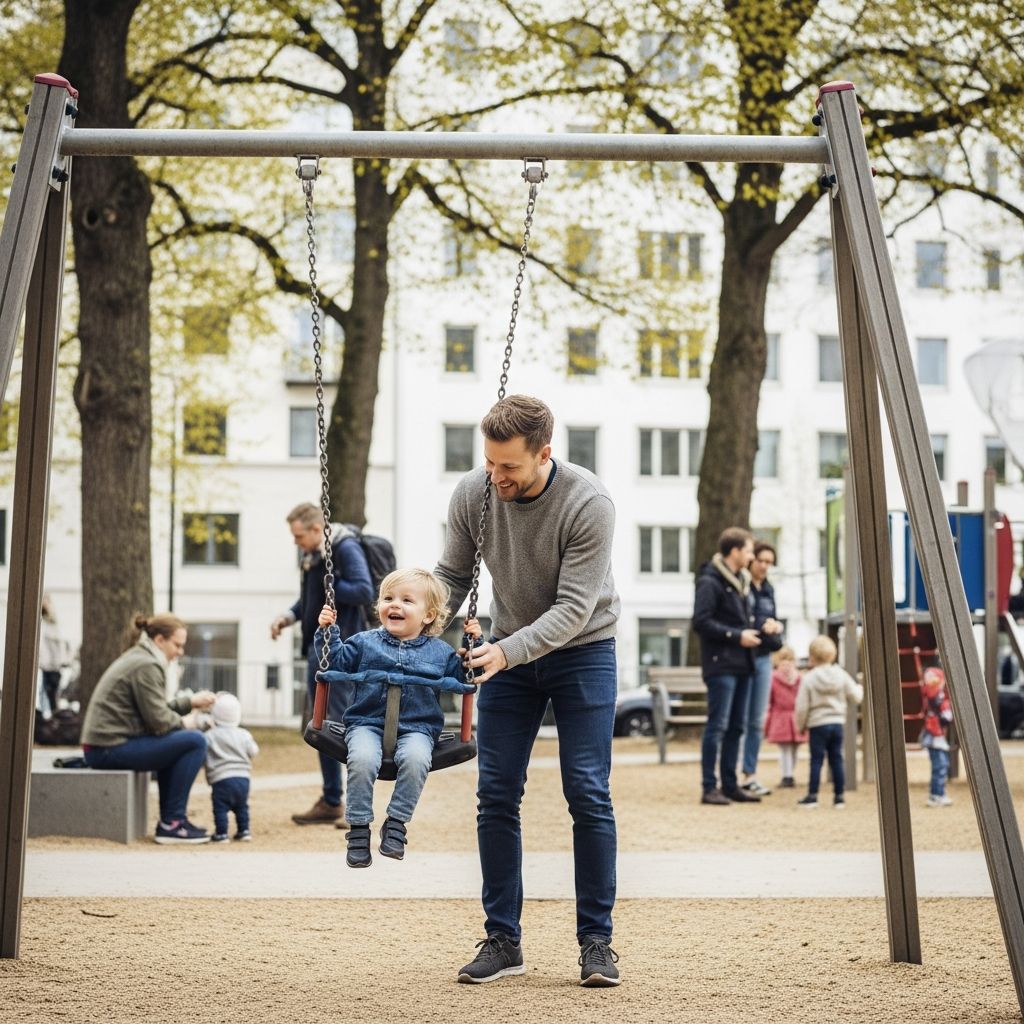
In Swedish cities, it is common to see fathers pushing strollers, warming bottles in cafés, and swapping baby tips on weekday mornings. This everyday scene reflects a deeper transformation: a generous, gender-neutral parental leave system that expects and enables fathers to be present from the start of their child’s life. Sweden’s approach has helped normalize stay-at-home days for men and inspired the stereotype of the relaxed, stroller-pushing “latte papa.”
This article looks at how Sweden’s policies work, how they shape daily life for families, why fathers are so visible with their children, and what other countries can learn from this experiment in shared caregiving.
From Maternity to Shared Parenthood: How Sweden Rewrote the Rules
Sweden was among the first countries to shift from traditional “maternity leave” to gender-neutral parental leave, framing caregiving as the responsibility of both parents rather than only mothers.
Today, Swedish parental leave is built around flexibility, long duration, and equal rights for both parents.
Core Features of Swedish Parental Leave
- Generous length: Parents are entitled to a total of 480 days of paid parental benefit per child.
- Shared entitlement: In principle, each parent is entitled to 240 days of this leave.
- Income-related compensation: For 390 of the 480 days, compensation is based on the parent’s previous income up to a ceiling.
- Flat-rate days: The remaining 90 days are paid at a low, fixed daily rate.
- Right to time off: Parents have the right to take leave from work for up to 18 months after childbirth, regardless of whether they collect benefits every day.
| Feature | Swedish Approach |
|---|---|
| Total paid parental benefit days | 480 days per child for both parents together |
| Allocation between parents | Typically 240 days each, with transfer options |
| Income-based days | 390 days tied to previous income (with ceiling) |
| Flat-rate days | 90 days at minimum daily level |
| Time window to use days | Up to around the child’s 8–12th birthday, depending on rules |
The Power of “Daddy Quotas” and Reserved Days
One of the most influential features of Sweden’s system is the introduction of non-transferable days, often called “daddy quotas.” These are parental benefit days reserved for each parent that cannot be given to the other.
How Reserved Days Work
- 90 days at the income-based level are earmarked for each parent and cannot be transferred.
- If a parent does not use their reserved days, those days are simply lost rather than handed to the other parent.
- This design creates a financial and practical incentive for fathers to take leave, since skipping leave means forfeiting a portion of the total benefits.
Over time, these reserved days have contributed to a rising share of total leave days taken by fathers. According to organizations tracking European family policy, new fathers in Sweden now take around 30% of all parental leave days, compared with almost none when the system was first created. That change has helped move involved fatherhood from a niche choice to a mainstream expectation.
What Everyday Life Looks Like for Swedish Dads on Leave
Policies alone cannot explain the “latte papa” phenomenon; culture and everyday routines fill in the picture. Swedish cities are designed for families, and weekday mornings often belong to parents on leave.
Cafés, Strollers, and Social Networks
During parental leave, many Swedish fathers build a daily rhythm that combines childcare, errands, and social time with other parents.
- Stroller-friendly environments: Public transport, sidewalks, and public buildings are designed to accommodate strollers, making it easy to move around with babies.
- Café meetups: Groups of parents on leave, including many fathers, often meet in cafés for coffee while their children nap in strollers parked outside or next to tables.
- Open preschools: Many municipalities offer drop-in “open preschool” centers where adults can meet and children can play, providing an important social anchor during leave.
- Supportive workplaces: Because fathers’ leave is normalized, many employers expect men to take extended time off after a child is born.
Typical Day for a Swedish Father on Leave (Example Pattern)
- Morning: Breakfast with partner, change of clothes, stroller walk to a play park.
- Late morning: Coffee meetup with other parents at a local café.
- Midday: Child naps while the parent reads, answers a few personal emails, or plans errands.
- Afternoon: Visit to an open preschool or library story time.
- Early evening: Partner arrives home; household tasks and childcare are shared.
These routines help fathers gain confidence in solo caregiving, from soothing a sick baby to handling nap refusals and public meltdowns. Over time, this daily practice reshapes couples’ sense of who is “the primary parent.”
Legal Framework: Rights, Money, and Flexibility
Behind every stroller in a café line is a detailed legal system that guarantees income replacement and job protection.
Income Protection and Benefit Levels
Parental benefits in Sweden are administered by the national Social Insurance Agency, Försäkringskassan.
- Sickness benefit level: For 390 days, parents receive compensation tied to their previous income up to a set ceiling.
- Minimum level: For 90 days, a lower fixed daily rate is paid, regardless of income.
- Basic right: Even parents with low or no income may be eligible for benefits at a minimum level, ensuring that time at home is not limited to high-earning families.
Flexibility in How Parents Use Leave
- Part-time leave: Parents may combine part-time work with part-time benefits, allowing a gradual return to work.
- Split days: Leave can often be taken in whole, half, quarter, or even smaller fractions of days, enabling fine-tuned schedules.
- Extended window: Parents can typically use days until the child reaches school age, meaning leave can be saved for later years, for example during school holidays.
- Double days: For a limited number of days, both parents can draw parental benefit on the same day, allowing them to be at home together with the child.
New Frontiers: Grandparents and Friends in the Care Network
Recently, Sweden has gone a step further by allowing parents to transfer a portion of their paid leave to other caregivers. Under new rules, parents can transfer up to 45 days of their parental benefit to someone who is not the child’s legal guardian, such as a grandparent or close friend, provided that person is insured under the Swedish system.
- Standard families: Up to 45 days can be transferred.
- Single parents: Can transfer up to 90 days, recognizing their additional need for support.
This innovation acknowledges that caregiving is often a shared effort beyond the two legal parents. Grandparents who want to help with early childcare, for instance, can now receive some income replacement for their time. It also reflects a broader Swedish principle: families should have flexibility to organize care in the way that suits them best.
How Swedish Leave Shapes Gender Equality at Home and Work
Extensive research in the Nordic region shows that when fathers take substantial parental leave, family and labor market patterns shift in measurable ways.
Effects in the Labor Market
- More equal career disruption: When both parents take leave, the long-term career impact of childbirth is more evenly distributed, rather than falling mainly on mothers.
- Higher female labor force participation: Nordic countries, including Sweden, pair generous leave with high female employment rates, partly because mothers are not expected to stay home indefinitely.
- Stronger attachment to work: Guaranteed jobs and income replacement help both parents remain connected to the labor market during and after leave.
Effects Inside the Home
- More shared housework: Studies in Sweden indicate that when fathers take longer leave, they continue to perform more domestic and childcare tasks years later.
- Bonding and competence: Solo time with infants builds parenting confidence and emotional closeness for fathers, making them more likely to stay highly involved.
- Modeling equality for children: Children who grow up seeing both parents cook, clean, and nurture are more likely to view equality as normal.
Lessons for Other Countries
Many countries are revisiting how they design maternity, paternity, and parental leave. Sweden’s experience offers several practical lessons.
Key Design Principles to Adapt
- Make leave gender-neutral: Frame benefits as parental rather than solely maternal to signal that both parents are expected to care.
- Reserve non-transferable days: Earmarking days for each parent is one of the strongest levers to increase fathers’ participation.
- Combine income-based and flat-rate days: Income-related benefits make leave feasible for main earners, while flat-rate days ensure universal access.
- Guarantee job protection: Time at home must not mean losing one’s job; this security encourages both parents to take leave.
- Encourage cultural change: Policies work best when paired with public messaging, visible role models, and family-friendly workplaces.
Common Challenges and Ongoing Debates
Even in Sweden, the system is not perfect. Policymakers and families continually debate how to make parental leave fairer and more sustainable.
Persistent Gaps
- Unequal uptake: While fathers now take around 30% of leave days, mothers still use the majority, especially in the child’s first year.
- Income inequality: Parents with unstable or low earnings may struggle more, even with basic-level benefits.
- Workplace variation: Some sectors or small employers may still create informal pressure against long leaves for men.
Future Directions
- Debates over whether to expand the number of reserved days for each parent.
- Proposals to raise minimum benefit levels to better support low-income families.
- Continued adjustments, such as expanding the number of days that both parents can be home simultaneously.
Practical Tips for Expectant Parents Considering Sweden
For families moving to or working in Sweden, understanding the basics of the system can help them make the most of their rights.
Before the Baby Arrives
- Confirm you are covered by Swedish social insurance through work or residence.
- Register with Försäkringskassan and learn how to apply for parental benefit.
- Discuss with your partner how you want to divide the 480 days, including reserved and transferable days.
After Birth
- Remember that the non-birthing parent has the right to take leave around the birth, often up to a set number of days near the homecoming.
- Explore part-time work options to extend the period you are home with your child while keeping one foot in the workplace.
- Look for local parent groups, open preschools, and family centers to build a social network.
Frequently Asked Questions (FAQs)
How long can parents in Sweden stay home with their child using parental benefits?
Parents can share a total of 480 days of paid parental benefit per child. For 390 of those days, compensation is generally based on previous income, while 90 days are paid at a lower fixed rate.
Do Swedish fathers have their own dedicated leave?
Yes. Each parent has 90 income-based days that cannot be transferred to the other parent, effectively creating a father-specific portion of leave. Additionally, the non-birthing parent has the right to a short leave period around the birth.
Can parents be off work at the same time in Sweden?
For a limited number of double days, both parents can receive parental benefit at the same time and be home together with the child. This is often used in the early months or during transitions, such as starting preschool.
Is it possible to work part-time and still use Swedish parental leave?
Yes. Parents can combine part-time work with partial benefits, taking parental leave in fractions of days. This flexibility enables gradual returns to work and smoother coordination between parents.
Can grandparents or other relatives use Swedish parental leave days?
Recent reforms allow parents to transfer up to 45 days of paid leave to another insured caregiver, such as a grandparent or a close friend. Single parents can transfer up to 90 days.
References
- Sweden expands parental leave to grandparents and friends — COFACE Families Europe. 2024-07-01. https://coface-eu.org/sweden-expands-parental-leave-to-grandparents-and-friends/
- Parental leave in Sweden — Øresunddirekt. 2023-05-15. https://www.oresunddirekt.dk/en/working-in-sweden/family-parenting/parental-leave-in-sweden/
- Parental benefit — Försäkringskassan (Swedish Social Insurance Agency). 2024-09-10. https://www.forsakringskassan.se/english/parents/when-the-child-is-born/parental-benefit
- Parental leave in Sweden — Nordic Council of Ministers (TemaNord 2025:547). 2025-01-15. https://pub.norden.org/temanord2025-547/parental-leave-in-sweden-.html
- Work–life balance in Sweden — Government of Sweden / sweden.se. 2023-06-20. https://sweden.se/work-business/working-in-sweden/work-life-balance