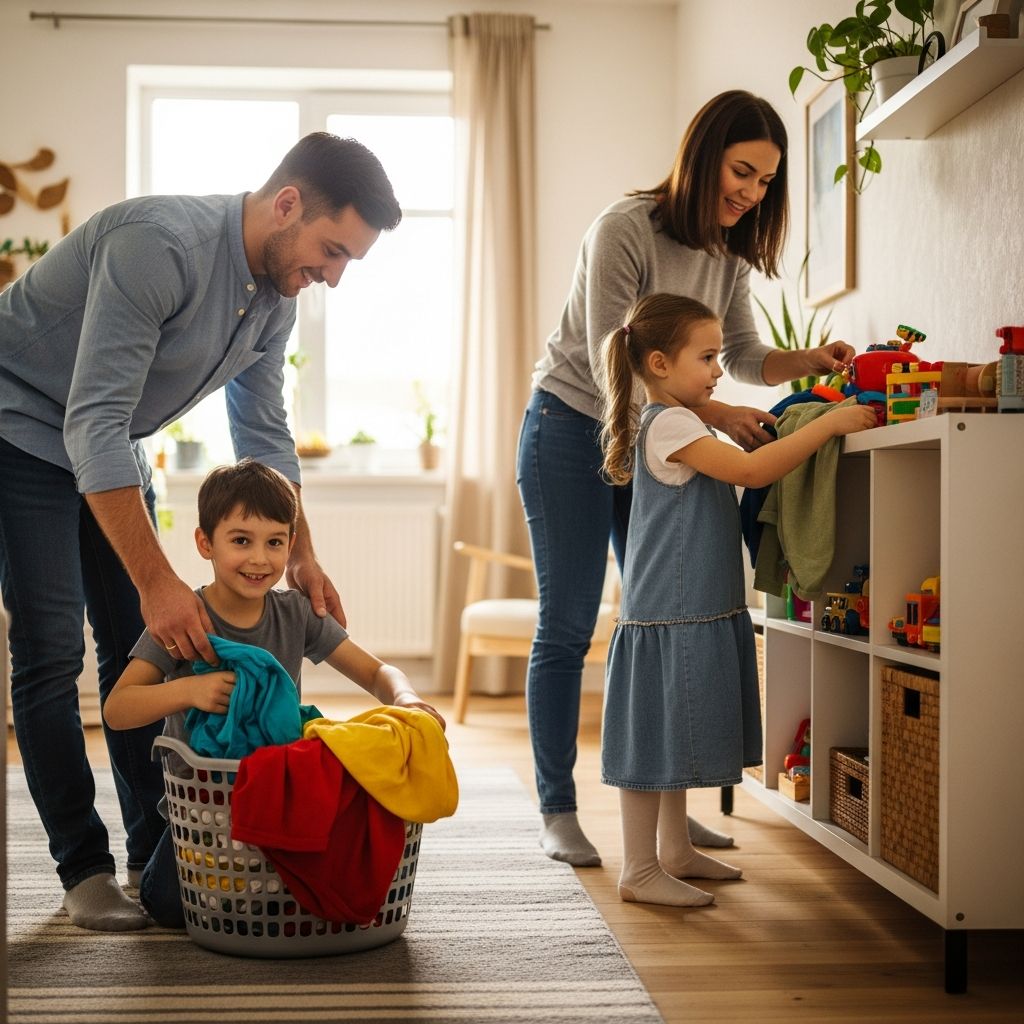
Effective parenting often involves teaching children responsibility through everyday tasks like chores, paired with consistent guidance. This approach builds skills for life while avoiding the pitfalls of overly rigid methods.
Why Household Tasks Matter for Child Growth
Assigning age-appropriate chores helps children develop a sense of duty and self-reliance from an early age. Research shows that kids who participate in family duties tend to exhibit better organizational skills and higher self-esteem. For instance, routines such as tidying rooms or helping with meals reinforce the idea that everyone contributes to the household.
Psychological studies indicate that consistent involvement in chores correlates with improved academic performance and emotional regulation. Children learn time management and the value of effort when tasks are integrated into daily life. Parents who emphasize these responsibilities without overwhelming demands create a foundation for long-term success.
Exploring Common Parenting Approaches
Parenting styles vary widely, with some emphasizing strict oversight and others favoring flexibility. High-expectation methods, often linked to cultural traditions, push for excellence but can sometimes overlook emotional needs. Supportive strategies, however, combine clear rules with warmth, leading to optimal outcomes.
Studies on diverse families reveal four main profiles: supportive, which is most common and effective; lenient; demanding; and negative. Supportive parenting, high in positivity and low in criticism, yields the best results in grades and mental health. Demanding styles, while promoting discipline, often result in stress and lower achievement.
Integrating Chores into Family Routines
To make chores effective, parents should match tasks to a child’s age and abilities. Young children can sort laundry or set the table, while teens handle cooking or yard work. Consistency is key—daily or weekly schedules prevent resistance.
- Start small to build habits without frustration.
- Use positive reinforcement like praise over punishment.
- Involve the family in planning to foster ownership.
- Link chores to privileges, teaching cause and effect.
This method mirrors findings from longitudinal research where balanced involvement leads to better adjustment than purely directive approaches. Families that share responsibilities report stronger bonds and fewer conflicts.
The Risks of Overly Strict Guidance
Intense parenting that prioritizes achievement through pressure can backfire. Children may experience heightened anxiety, depression, and feelings of isolation. Data from over 400 families tracked for years shows that such methods link to lower GPAs and poorer emotional health compared to supportive alternatives.
| Parenting Style | Key Traits | Child Outcomes |
|---|---|---|
| Supportive | Warm, explanatory, low negativity | Highest GPA, low depression, strong family ties |
| Demanding | High expectations, some criticism | High pressure, moderate achievement, alienation |
| Lenient | Low structure | Better than demanding in emotions, average grades |
| Negative | High criticism, low warmth | Lowest outcomes across metrics |
This table summarizes profiles from empirical studies, highlighting why balance matters.
Real-Life Examples of Balanced Parenting
Consider a father who sets firm rules but rewards chore completion with family time. His children, accustomed to contributing, show initiative in school and hobbies. Unlike extreme cases, this avoids burnout while instilling work ethic.
Research debunks myths that harshness alone drives success. In fact, supportive families with chore routines produce resilient kids who excel without resentment. Parents adapting cultural emphases on duty to modern contexts often see the best results.
Age-Specific Chore Recommendations
Tailoring tasks ensures engagement. For ages 2-4: picking up toys. Ages 5-7: making beds, feeding pets. Ages 8-10: loading dishwashers, simple cooking. Teens: laundry, budgeting help.
- Assess readiness to avoid overwhelm.
- Demonstrate tasks first.
- Rotate duties for variety.
- Review progress weekly.
These steps, grounded in developmental psychology, promote growth without the emotional toll of unbalanced styles.
Building Emotional Resilience Through Responsibilities
Chores teach perseverance and accountability, key to resilience. When paired with encouragement, children handle setbacks better. Studies link this to reduced depressive symptoms and higher family obligation.
Parents should discuss the ‘why’ behind tasks, fostering understanding over blind obedience. This supportive frame outperforms rigid enforcement, as evidenced by better socio-emotional adjustment.
Cultural Perspectives on Discipline and Duty
While some traditions stress rigorous training for success, evidence favors nuance. Not all high-achieving families use extremes; many blend duty with empathy. Immigrant parents often adapt, prioritizing chores as life skills over pure academics.
Global research shows supportive methods transcend cultures, yielding top outcomes universally.
Common Challenges and Solutions
Resistance is normal. Solutions include fun competitions, visual charts, or tying to allowances. If motivation lags, reflect on expectations—overloading mirrors pitfalls of intense styles.
- Procrastination: Set timers.
- Complaints: Empathize then redirect.
- Forgetting: Gentle reminders.
Long-Term Benefits for Adulthood
Kids raised with chore-integrated discipline enter adulthood prepared. They manage homes, careers, and relationships effectively. Research confirms lower maladjustment and higher attainment.
Benefits include strong work ethic, independence, and gratitude—traits employers value.
Frequently Asked Questions
What age should kids start chores?
From toddlerhood with simple tasks like putting away toys, scaling up by school age for complex duties.
Should chores be paid?
Optional; focus on intrinsic value, using pay for advanced tasks to teach finance.
How to handle refusal?
Stay calm, enforce natural consequences, and model participation.
Does this differ by culture?
Core principles apply universally, though emphases vary; adapt to family values.
Can chores improve grades?
Yes, by building discipline and reducing stress, per studies on balanced routines.
Practical Tips for Implementation
Create a family chore chart. Hold meetings to adjust. Celebrate milestones. Consistency with flexibility yields results.
Monitor well-being; if stress rises, ease up—support trumps rigidity.
References
- “Tiger parenting” doesn’t create child prodigies, finds new research — American Psychological Association. 2013-09-01. https://www.apa.org/monitor/2013/09/tiger-parenting
- “Tiger” parenting | Social Sciences and Humanities | Research Starters — EBSCO. N/A. https://www.ebsco.com/research-starters/social-sciences-and-humanities/tiger-parenting
- Beyond the Battle Hymn to Empirical Research on Tiger Parenting — Society for Research on Adolescence. N/A. https://www.s-r-a.org/index.php?option=com_dailyplanetblog&view=entry&category=teachingadolescence&id=77%3Abeyond-the-battle-hymn-to-empirical-research-on-tiger-parenting
- What is “tiger” parenting? How does it affect children? — APA Divisions. 2013-07. https://www.apadivisions.org/division-7/publications/newsletters/developmental/2013/07/tiger-parenting
- Does “Tiger Parenting” Exist? Parenting Profiles of Chinese… — National Institutes of Health (PMC). 2013. https://pmc.ncbi.nlm.nih.gov/articles/PMC3641860/
- Tiger Parenting: Is It All Worth It? — The Science Survey. 2024-07-03. https://thesciencesurvey.com/editorial/2024/07/03/tiger-parenting-is-it-all-worth-it/
- Mental toll of tiger parenting — University of California. N/A. https://www.universityofcalifornia.edu/news/mental-toll-tiger-parenting