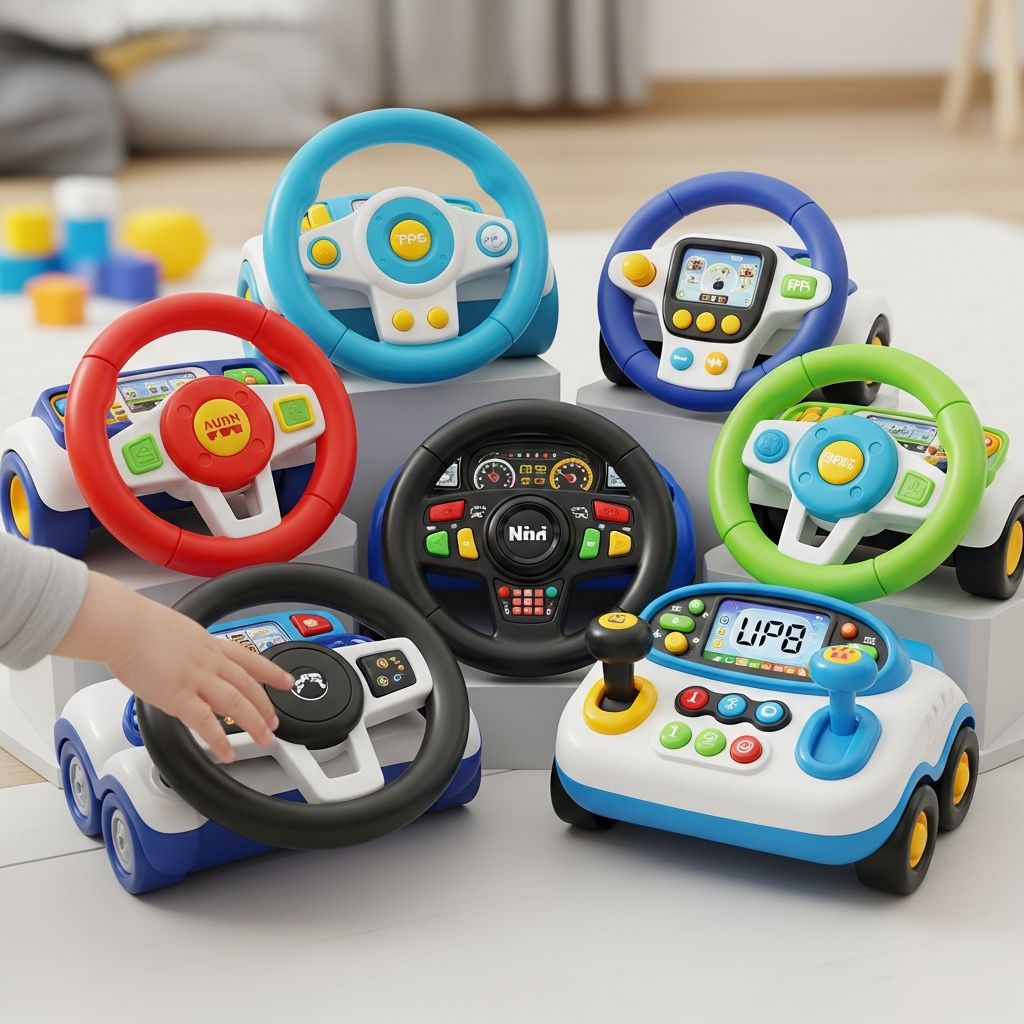
Steering wheel toys are more than cute miniature dashboards. When chosen well and used safely, they help babies and toddlers practice movement, coordination, and early problem-solving while giving them a thrilling sense of control over their pretend journeys.
This guide walks you through the benefits, types, safety checks, and practical tips so you can confidently pick the right steering wheel toy for your child.
Why Steering Wheel Toys Matter for Development
Turning a toy wheel, pressing buttons, and watching lights flash may look simple, but these actions support multiple areas of early development.
Physical Skills: From Grasping to Coordinated Driving
Steering wheel toys encourage both gross and fine motor skills, especially when they’re attached to ride-on vehicles or larger activity centers.
- Fine motor practice: Gripping the wheel, pushing small buttons, sliding levers, and flicking switches strengthen finger and hand muscles and improve dexterity.
- Grip strength: Repeatedly turning and holding the wheel helps develop a stronger grasp, which later supports skills like drawing and using utensils.
- Hand-eye coordination: Matching hand movements with what children see (for example, turning the wheel to “follow” a road picture) boosts coordination.
- Whole-body movement: On ride-on toys with steering wheels, kids coordinate legs, arms, and trunk as they move and steer, strengthening balance and core stability.
Cognitive and Sensory Learning
Steering wheel toys often include lights, sounds, and simple cause-and-effect features that support early thinking skills.
- Cause and effect: Children learn that turning the key makes a sound or pressing the horn triggers a beep, which teaches them that their actions have predictable outcomes.
- Early problem-solving: Figuring out how to “park,” avoid pretend obstacles, or follow a route involves trial and error and flexible thinking.
- Concepts like direction and speed: Parents can talk about left/right, fast/slow, and stop/go, building early spatial and STEM-related understanding.
- Multi-sensory play: Lights, sounds, and textures engage multiple senses, which can help keep younger children focused and interested.
Social and Emotional Growth
Driving play is naturally social and can be very empowering.
- Confidence and independence: Successfully steering a toy or navigating a pretend road builds a sense of competence and autonomy.
- Role play: Children love pretending to be a parent driving to work, a bus driver, or a race car driver. This type of imitation play supports language, empathy, and understanding of everyday routines.
- Sharing and turn-taking: Multiple children can take turns “driving” while others act as passengers, traffic police, or pedestrians, practicing cooperation and communication.
Types of Steering Wheel Toys
Not all steering wheel toys look or work the same. Understanding the main categories will help you narrow your search.
| Type | Typical Age Range | Main Features | Best For |
|---|---|---|---|
| Lap or tabletop steering wheels | 6–24 months (with supervision) | Standalone wheel, buttons, lights, music, sometimes simple driving scenes | High chairs, strollers, floor play |
| Dashboard-style activity centers | 9–36 months | Larger panel with gear shifters, keys, knobs, sounds, and sometimes language or counting modes | Playroom setups, longer play sessions |
| Ride-on toys with steering wheels | 12 months–5 years | Foot-to-floor cars, push cars, or pedal vehicles with a working wheel and horn | Active indoor and outdoor play, gross motor practice |
| Electronic driving simulators for kids | 3–7 years | More realistic dashboards, screen displays or interactive roads, multiple buttons and modes | Older toddlers and preschoolers who enjoy pretend driving |
Age-by-Age Guide to Steering Wheel Toys
Children’s needs and abilities change quickly. Use this age guide as a starting point, then adjust for your child’s unique development.
For Babies: 6–12 Months
At this stage, babies are still exploring how their bodies and the world work.
- Choose simple, sturdy wheels with a few large buttons or levers.
- Look for soft or rounded edges and lightweight designs that won’t hurt if dropped.
- Limit sound complexity to a few gentle tunes or effects so babies are not overwhelmed.
- Use the toy during tummy time or when sitting with support to encourage reaching and rotating.
For Young Toddlers: 12–24 Months
Toddlers are eager to imitate adults and test their mobility.
- Consider ride-on toys with steering wheels for those who are walking steadily; they help refine balance and coordination.
- Choose dashboards with clear cause-and-effect features, such as a key that starts a sound or a lever that changes a light.
- Encourage early language development by naming buttons, colors, and directions during play.
- Keep sessions supervised to prevent falls or collisions, especially around furniture.
For Older Toddlers and Preschoolers: 2–5 Years
Children in this age range benefit from more complex pretend play and greater physical challenges.
- Look for steering wheels on pedal cars, ride-on trucks, or larger vehicles that require coordinated leg and arm use, improving strength and endurance.
- Choose toys that introduce rules and traffic concepts, such as stop signs, traffic lights, or basic road layouts.
- Encourage kids to invent games: obstacle courses, delivery missions, or races (with clear safety rules).
- Use driving play to talk about real-world safety like seat belts, crossing the street, and following signals.
Key Safety Considerations
Steering wheel toys should support learning, not introduce unnecessary risk. A few simple checks go a long way.
Check Age and Size Suitability
- Always follow the manufacturer’s age and weight recommendations.
- Make sure your child’s feet can touch the ground on ride-on toys to help with balance and stopping.
- If the toy attaches to a stroller, crib, or car seat, ensure it does not interfere with straps or create entanglement hazards.
Inspect Construction and Materials
- Avoid toys with small detachable parts that could pose a choking risk, especially for children under three.
- Check that the wheel, levers, and buttons are firmly fixed and not cracking or wobbling.
- Look for smooth finishes and no sharp edges, splinters, or exposed screws.
- For outdoor ride-ons, examine the wheels and steering mechanism regularly to ensure they still move smoothly and are not loose.
Manage Sound and Screen Exposure
- Prefer toys with adjustable volume or an off switch for sound effects to protect hearing.
- If the toy includes a screen, balance driving play with offline physical activity, as recommended by pediatric guidelines on screen time.
Set Safe Play Rules
- Keep ride-on toys away from stairs, pools, and driveways.
- Use them on flat, even surfaces whenever possible to reduce tipping risk.
- Teach basic rules early: no crashing into people, slowing down near others, and stopping when an adult says so.
How to Choose the Right Steering Wheel Toy
With so many options, focus on features that match your child’s stage and your family’s space.
Core Features to Consider
- Durability: Thick plastic, strong joints, and well-secured electronic components are better for daily toddler use.
- Interactivity: A good mix of sounds, lights, and moving parts keeps kids engaged without overwhelming them.
- Learning content: Some toys introduce numbers, letters, or colors through audio prompts and labels, supporting early academic skills in a playful way.
- Portability: Compact lap wheels are great for travel or stroller rides, while bulkier dashboards suit home playrooms.
- Cleanability: Smooth surfaces and minimal fabric parts make it easier to wipe down drool and snack residue.
Questions to Ask Before Buying
- Does my child enjoy vehicle play (cars, trucks, buses)?
- Do we have safe space for a ride-on, or would a tabletop wheel suit us better?
- Is the toy too noisy for our home or for shared spaces like apartments?
- Can this toy grow with my child, offering different ways to play as they get older?
Encouraging Meaningful Play with Steering Wheel Toys
The way you join in can transform a steering wheel toy from a simple gadget into a powerful learning tool.
Ideas to Enrich Play
- Talk through actions: Say things like “You’re turning left,” or “Now you stopped at the red light,” to connect words with movements and visual cues.
- Create simple missions: Ask your child to “drive” to pick up pretend groceries, bring a toy friend home, or deliver a package.
- Use props: Cardboard boxes can become tunnels or garages; pillows can mark parking spots or boundaries.
- Switch roles: Let your child be the driving instructor while you pretend not to know how to steer, prompting explanations and instructions.
Linking to Real-Life Skills
- Use the toy to talk about road safety: stop signs, crosswalks, and why we wear seat belts.
- Compare the toy’s wheel to the real car steering wheel while parked, pointing out similarities and differences.
- Practice patience with turn-taking when siblings or friends share a single toy, reinforcing sharing routines.
Frequently Asked Questions (FAQs)
From what age can my baby use a steering wheel toy?
Many babies can begin exploring a simple, non-ride-on steering wheel toy around 6 months, once they can sit with support and reach out for objects. Always follow the manufacturer’s age guide and supervise closely, especially if the toy has moving parts.
Are steering wheel toys safe for toddlers?
Steering wheel toys are generally safe when they match the child’s age, are well-constructed, and are used in a safe environment. Check for small parts, sharp edges, and tipping risks, and use ride-on toys away from stairs, pools, and vehicles.
Do these toys actually help with motor skills?
Yes. Grasping the wheel, pushing buttons, and coordinating steering with movement support both fine and gross motor development, as well as hand-eye coordination.
Should I choose a toy with lots of sounds and lights?
Interactive features can keep kids engaged and support learning, but too many loud or constant sounds may be overstimulating. Look for toys with adjustable volume and a balance of quiet mechanical features like knobs and levers.
How long will my child use a steering wheel toy?
Younger babies might use simple wheels for a few months, while older toddlers and preschoolers may enjoy more advanced dashboards and ride-ons for several years. Choosing a toy with multiple play modes or adjustable settings can extend its usefulness.
References
- Key Benefits of Ride-On Toys — Step2. 2022-03-15. https://www.step2.com/blogs/blog/key-benefits-of-ride-on-toys
- Fun and Learning: How Kids’ Ride-On Toys Enhance Motor Skills — Kids Auto Zone. 2023-07-10. https://www.kidsautozone.com.au/blogs/news/fun-and-learning-how-kids-ride-on-toys-enhance-motor-skills
- How Playing With Cars and Construction Toys Can Benefit Your Child — Le Toy Van. 2021-05-05. https://letoyvan.com/blogs/news/how-playing-with-cars-and-construction-toys-can-benefit-your-child
- How Ride On Trucks Enhance Motor Skills in Children — Tough Trucks for Kids. 2023-04-18. https://toughtrucksforkids.com/blogs/ride-on-toys/how-power-wheels-trucks-enhance-motor-skills-in-children
- Musical Driving Wheel | Toy Steering Wheel — B. toys. 2022-08-01. https://mybtoys.com/shop/musical-driving-wheel/