Every child develops at their own pace, but recognizing when speech and language skills lag behind typical milestones can make a significant difference. Parents often wonder if their little one’s quiet nature signals a delay or just a unique timeline. This guide outlines normal communication progress from infancy through preschool years, highlights warning signs, and offers actionable strategies to foster growth.
Understanding Normal Speech and Language Growth
Speech and language development begins at birth and accelerates rapidly in the early years. The brain’s first three years form a critical window for absorbing sounds, words, and meanings, thriving in environments rich with interaction. Newborns recognize caregiver voices and cry to communicate needs, evolving into coos, babbles, and eventually full sentences.
Key factors influencing progress include consistent exposure to spoken language, responsive caregiving, and opportunities for back-and-forth exchanges. Genetic predispositions, hearing health, and overall development also play roles. Tracking milestones helps parents gauge if support is needed.
Communication Milestones: Birth to 12 Months
In the first year, babies shift from reflexive cries to intentional sounds and gestures. Here’s what to expect:
- Birth to 3 months: Quiets to familiar voices, startles at loud noises, coos, smiles, and differentiates pleasure cries from distress.
- 4 to 6 months: Turns toward sounds, responds to ‘no,’ repeats syllables like ‘ba-ba,’ enjoys toys with noises, and vocalizes during talks.
- 7 to 11 months: Recognizes name, babbles chains like ‘ma-ma-da-da,’ points to objects, imitates gestures, and follows simple directions with cues.
- 12 months: Says 1-3 words meaningfully, understands 10+ words, follows instructions like ‘give me the ball,’ and points to show interest.
By year’s end, most infants engage in ‘conversations’ via babble, waving bye-bye, and enjoying peek-a-boo. Interaction amplifies these skills—respond enthusiastically to encourage more attempts.
Toddler Talk: 1 to 3 Years Milestones
The toddler phase explodes with vocabulary and simple phrases. Children experiment with sounds, mimicking adults to build 50-200 words by age 3.
| Age Range | Understanding Skills | Expression Skills |
|---|---|---|
| 12-18 months | Follows simple commands like ‘get teddy’; understands 50 words | Points, babbles conversationally; 4-6 words like ‘mama,’ ‘ball’ |
| 18-24 months | Points to body parts; grasps ‘big/little,’ action words like ‘clap’ | 50+ words; 2-3 word phrases (‘more milk’); animal sounds |
| 2-3 years | Follows 2-step directions (‘shoes then door’); knows spatial terms ‘in/on’ | 100-200 words; 3-4 word sentences; plurals like ‘shoes’; question inflection |
Strangers may understand half of 2-year-old speech, improving to near-clarity by 3. Praise efforts and expand: if they say ‘ball,’ reply ‘Yes, big red ball!’
Preschool Progress: 3 to 5 Years
By preschool, children weave stories, ask ‘why,’ and handle complex ideas. Speech becomes mostly intelligible, supporting school readiness.
- 3-4 years: 4-5 word sentences; names colors/shapes; follows multi-step instructions; tells simple stories.
- 4-5 years: Answers ‘why’; categorizes (e.g., animals); uses ‘behind/next to’; 5+ word sentences with past tense.
- 5 years: 8+ word sentences; understands sequences (first/second); rhymes; converses fluidly.
This stage refines grammar, expands vocabulary to thousands, and sparks imagination through pretend play.
Red Flags: Signs It’s Time to Act
Not all quiet children have delays, but certain patterns warrant attention. Consult a pediatrician if:
- By 12 months: No babbling, gestures, or response to name.
- 18 months: Fewer than 20 words or no pointing.
- 2 years: No 2-word phrases or imitation of actions.
- 3 years: Speech unclear to strangers; trouble following directions.
- Any age: Loss of previously gained skills, limited eye contact, or no interest in communication.
Other risks include frequent ear infections, premature birth, or family history of delays. Early screening via tools like CDC checklists is vital—acting before age 3 maximizes outcomes.
Boosting Language at Home: Proven Strategies
Daily interactions turbocharge development. Create a language-rich world:
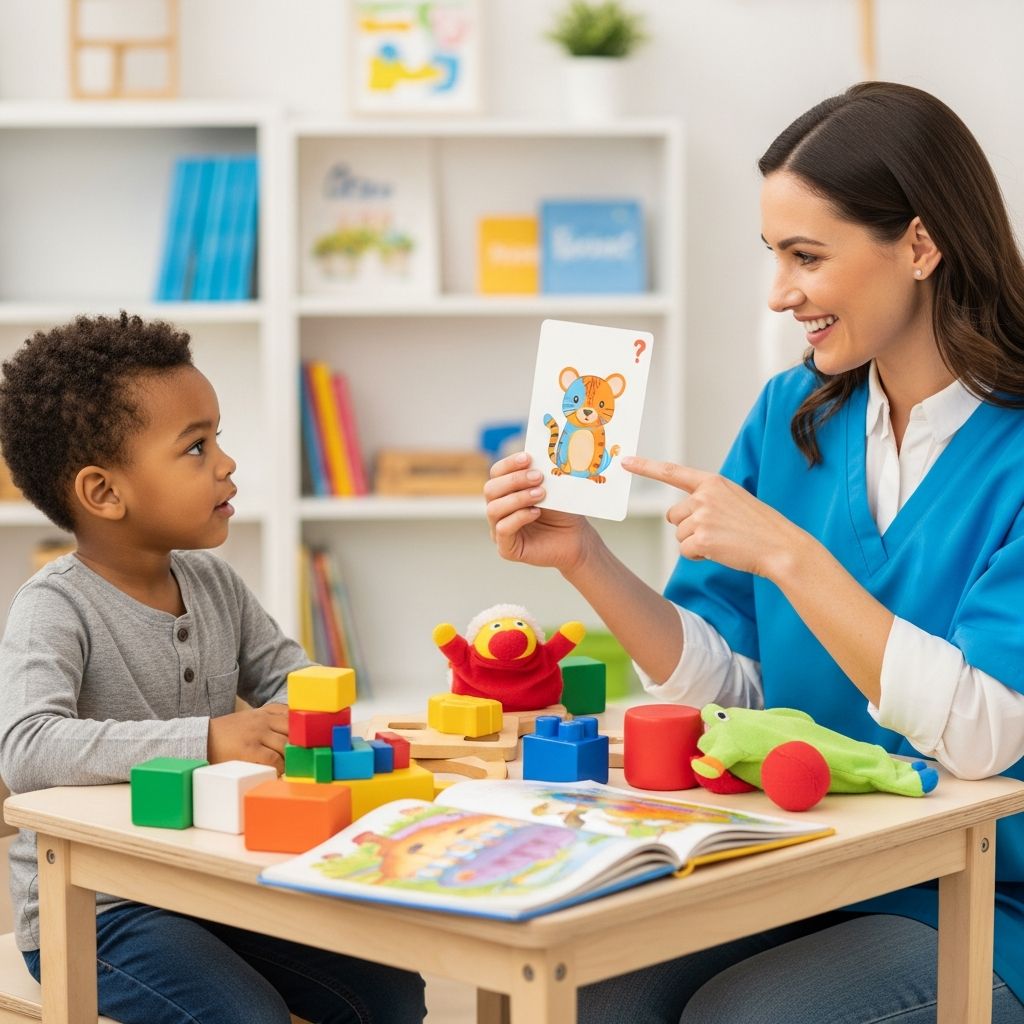
- Read daily: Point to pictures, ask ‘What’s this?’—enjoyment drives learning.
- Narrate routines: ‘Now we wash hands with soap.’
- Respond and expand: Echo sounds, add words.
- Sing songs, play turn-taking games like pat-a-cake.
- Limit screens; prioritize face-to-face talk.
Table of Quick Daily Activities:
| Age | Activity | Benefit |
|---|---|---|
| 0-12 mo | Mirror play, peek-a-boo | Builds turn-taking, sounds |
| 1-2 yrs | Picture books, naming objects | Grows vocabulary |
| 2-3 yrs | Simple stories, ‘why’ chats | Enhances sentences |
| 3-5 yrs | Board games, describe events | Refines complex talk |
When and How to Seek Professional Help
If red flags appear, start with your pediatrician for hearing tests and referrals. Speech-language pathologists (SLPs) assess and tailor therapy. Early intervention programs (birth-3 years) are often free via state services. Private therapy or apps may supplement. Track progress with milestone apps from trusted sources like ASHA. Consistency yields results—many children catch up fully with support.
Common Myths About Speech Delays
Myth 1: Boys always talk later. Fact: Gender differences exist but don’t excuse significant lags.
Myth 2: They’ll outgrow it. Fact: Early help prevents long-term issues like reading struggles.
Myth 3: Bilingual homes cause delays. Fact: Bilingual kids may mix languages temporarily but hit milestones similarly.
Frequently Asked Questions (FAQs)
What if my 2-year-old only says a few words?
Monitor closely; under 50 words or no phrases signals potential delay. Schedule a check-up.
Does screen time help or hurt speech?
It often hinders—prioritize interactive talk over passive viewing.
How do I know if it’s hearing loss?
No response to sounds, loud speech, or turning up TV volume are clues. Get tested promptly.
Can therapy really make a difference?
Yes, especially before 3; 70-80% show substantial gains with early intervention.
Is stuttering normal?
Temporary repetition at 2-5 years often resolves; persistent cases need SLP evaluation.
Empowering parents with knowledge turns worry into action. Celebrate every coo and word—your engagement lays the foundation for lifelong communication success.
References
- Communication Milestones — Just One Norfolk, NHS. 2023. https://www.justonenorfolk.nhs.uk/child-development-additional-needs/talk-and-play/communication-milestones/
- Age-Appropriate Speech and Language Milestones — Children’s Hospital of Philadelphia (CHOP). 2024-10-15. https://www.chop.edu/health-resources/age-appropriate-speech-and-language-milestones
- Speech and Language Development from Birth to 12 Months — Great Ormond Street Hospital (GOSH), NHS. 2023. https://www.gosh.nhs.uk/conditions-and-treatments/procedures-and-treatments/speech-and-language-development-birth-12-months/
- Speech and Language Developmental Milestones — National Institute on Deafness and Other Communication Disorders (NIDCD), NIH. 2024-08-20. https://www.nidcd.nih.gov/health/speech-and-language
- Communication Milestones: Age Ranges — American Speech-Language-Hearing Association (ASHA). 2024. https://www.asha.org/public/developmental-milestones/communication-milestones/
- CDC’s Developmental Milestones — Centers for Disease Control and Prevention (CDC). 2025-01-10. https://www.cdc.gov/act-early/milestones/index.html