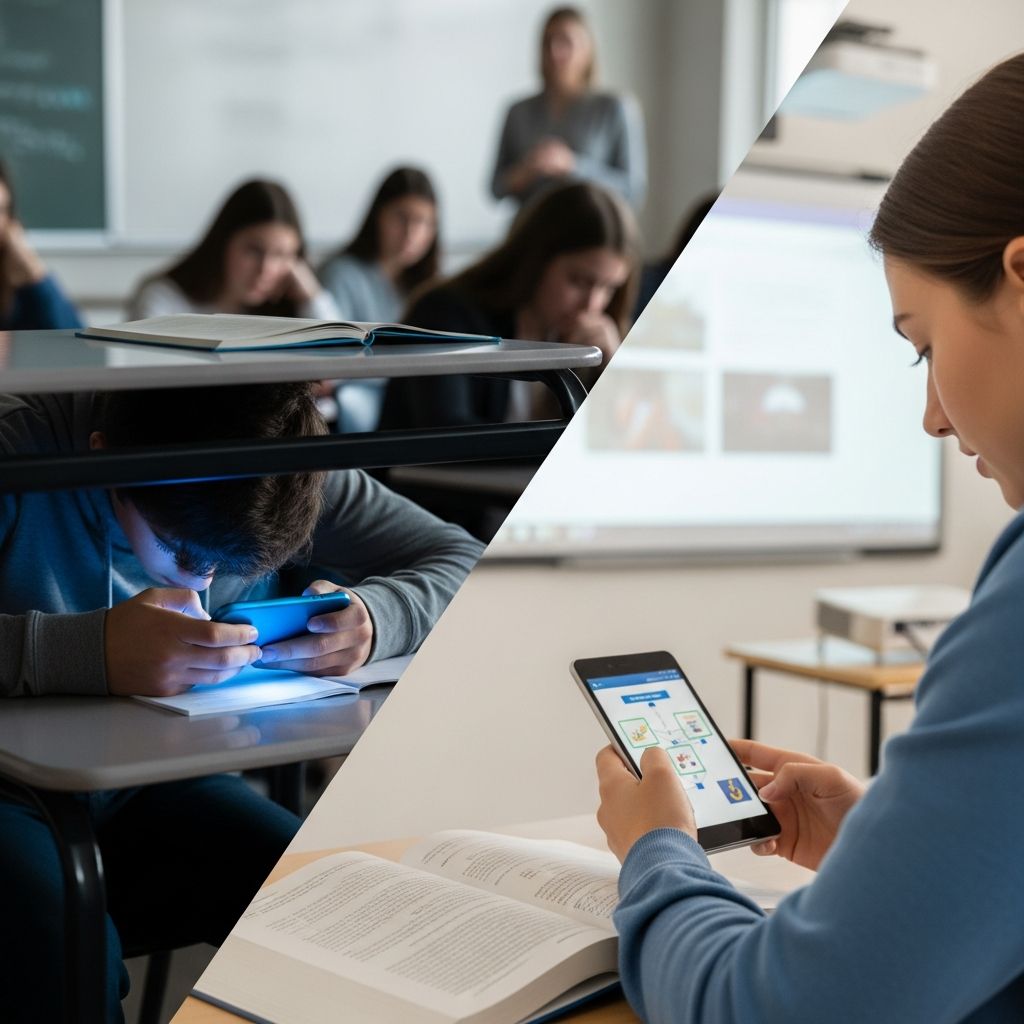
Mobile devices have become ubiquitous among students, but their presence in classrooms often leads to significant disruptions. Recent data reveals that a vast majority of educators view smartphones as major hindrances to learning, with usage correlating to poorer academic outcomes and heightened mental health issues.
The Scope of Smartphone Usage During School Hours
Students spend considerable time on their phones even during instructional time. A 2025 study published in JAMA Pediatrics found that adolescents averaged 1.5 hours of smartphone use over a typical 6.5-hour school day. Similarly, the Global Education Monitoring Report indicates that 97% of students aged 11 to 17 use their phones during school, with a median of 43 minutes per day.
These patterns persist across educational levels. In college settings, long-term measurements show students engaging with phones for over 25% of class time, with distractions occurring every three to four minutes and lasting more than a minute each time. Such frequent interruptions fragment attention and reduce overall engagement.
Educator Perspectives on Classroom Disruptions
Teachers consistently report smartphones as a primary challenge. A Pew Research Center survey found that 72% of U.S. high school teachers consider cellphone distractions a major problem in their classrooms, compared to 33% in middle schools and just 6% in elementary schools. Over 76% of surveyed teachers echo this sentiment, labeling phones as distractions.
Public school leaders agree: 53% report negative impacts on academic performance from cell phone use, while 72% and 73% note harms to mental health and attention spans, respectively. High school educators face the brunt, observing multitasking, diminished collaboration, and eroded classroom authority.
Key Statistics on Teacher Views
- 72% of high school teachers: Major problem
- 76.19% of teachers overall: Distracting
- 53% of school leaders: Hurts academics
- 73% of leaders: Reduces attention span
Academic Consequences of Digital Distractions
Empirical research links phone use to diminished learning. The 2022 Program for International Student Assessment (PISA) by the OECD revealed that two-thirds of U.S. students get distracted by digital devices during math lessons, and 54% by peers’ use—mirroring global averages of 65% and 59%. Students distracted by others scored 15 points lower in math on average.
Controlled studies confirm causality. Allowing smartphones without guidance reduced performance gains by 32% in one experiment. Multitasking with phones during lectures correlates with lower exam scores, as shown in a 2013 Communication Education study. Frequent users exhibit lower GPAs, per research in the Journal of Educational Psychology.
| Study/Source | Key Finding | Impact Magnitude |
|---|---|---|
| PISA 2022 (OECD) | Distraction by devices/peers | 15-point math score drop |
| INFORMS Experiment | No guidance phone use | 32% lower performance gain |
| Kuznekoff et al. (2013) | Phone use in lectures | Lower exam scores |
| Lepp et al. (2014) | Frequent class phone use | Lower GPAs |
Peer distractions amplify issues. Students using phones disrupt classmates, as noted in a 2011 study. Notifications exacerbate this: teens receive a median 273 daily, with nearly 25% during school hours.
Mental Health and Cognitive Effects
Beyond grades, phones affect well-being. The Journal of Educational Psychology links frequent use to increased anxiety and depression. School leaders report 72% negative mental health impacts. Cognitive load from notifications reduces focus capacity.
Reduced retention and engagement follow. A Computers and Human Behavior study found college students with in-class phone use had lower grades and poorer material recall. Shorter attention spans, noted by 73% of leaders, hinder deep learning.
Parental Attitudes and Safety Concerns
Parents often prioritize safety, providing phones at ages 11-13. While 46.4% want more educational integration, 45.1% have caught inappropriate use. This disconnect with teachers—who rank inappropriate use as the top challenge—highlights monitoring gaps.
Current Policies and Restrictions
Schools respond with bans. 30% prohibit phones during all classes and breaks. U.S. districts require phones off or surrendered. States legislate restrictions, informed by stakeholder input for nuanced rules. PISA urges effective limits.
Teachers limit use to calculators (52.95%) or basic searches, but 49.48% seek support for educational apps. Harvard’s Bok Center advises against permitting devices, citing consistent learning drops.
Strategies for Managing Devices Effectively
Balanced approaches exist:
- Clear Policies: Designated storage (pouches, lockers) during class.
- Educational Integration: Guided apps for research, with teacher oversight.
- Digital Literacy: Teach self-regulation and notification management.
- Tech Tools: Signal blockers or app limiters during lessons.
- Stakeholder Buy-In: Parent-teacher agreements on usage norms.
Training educators on resources bridges gaps. Policies fostering engagement while curbing off-task use are key.
Potential Benefits When Properly Harnessed
Phones aren’t inherently negative. With guidance, they enable QR scans, class sites, and interactive lessons. Calculator and camera functions aid learning. The challenge: maximizing assets while minimizing distractions.
Frequently Asked Questions (FAQs)
What percentage of teachers see phones as a major distraction?
72% of high school teachers and 76.19% overall report significant distractions.
How much time do students spend on phones at school?
Median 43 minutes daily; up to 1.5 hours average in some studies.
Do phones affect grades?
Yes, correlated with lower scores, GPAs, and 32% reduced gains without guidance.
What do school leaders say about mental health impacts?
72% report negative effects from phone use.
Are bans effective?
Many schools implement them successfully; nuanced policies with input work best.
Future Directions for Schools
As technology evolves, schools must adapt. Ongoing research, like NCES School Pulse data, informs policies. Prioritizing evidence-based strategies ensures devices support, rather than sabotage, education. Collaboration among educators, parents, and students will define success.
References
- Cell Phones Are A Distraction In School: Statistics and How Parents… — SlickText. 2019-09. https://www.slicktext.com/blog/2019/09/survey-smartphones-in-school-statistics/
- Digital Distractions in Class Linked to Lower Academic Performance — Education Week. 2023-12. https://www.edweek.org/leadership/digital-distractions-in-class-linked-to-lower-academic-performance/2023/12
- Academic Impact Studies — Away For The Day. N/A. https://www.awayfortheday.org/studies-academics
- 72 percent of U.S. high school teachers say cellphone distraction is a major problem — Pew Research Center. 2024-06-12. https://www.pewresearch.org/short-reads/2024/06/12/72-percent-of-us-high-school-teachers-say-cellphone-distraction-is-a-major-problem-in-the-classroom/
- More than Half of Public School Leaders Say Cell Phones Hurt Academic Performance — Institute of Education Sciences (IES). N/A. https://ies.ed.gov/learn/press-release/more-half-public-school-leaders-say-cell-phones-hurt-academic-performance
- Curbing Cell Phone Use in Classrooms — National Association of State Boards of Education (NASBE). 2025-09. https://www.nasbe.org/curbing-cell-phone-use-in-classrooms/
- Technology Policies — Derek Bok Center for Teaching and Learning, Harvard University. N/A. https://bokcenter.harvard.edu/technology-policies
- From Smartphones to Smart Students: Learning vs. Distraction — INFORMS. N/A. https://pubsonline.informs.org/doi/10.1287/isre.2022.0078