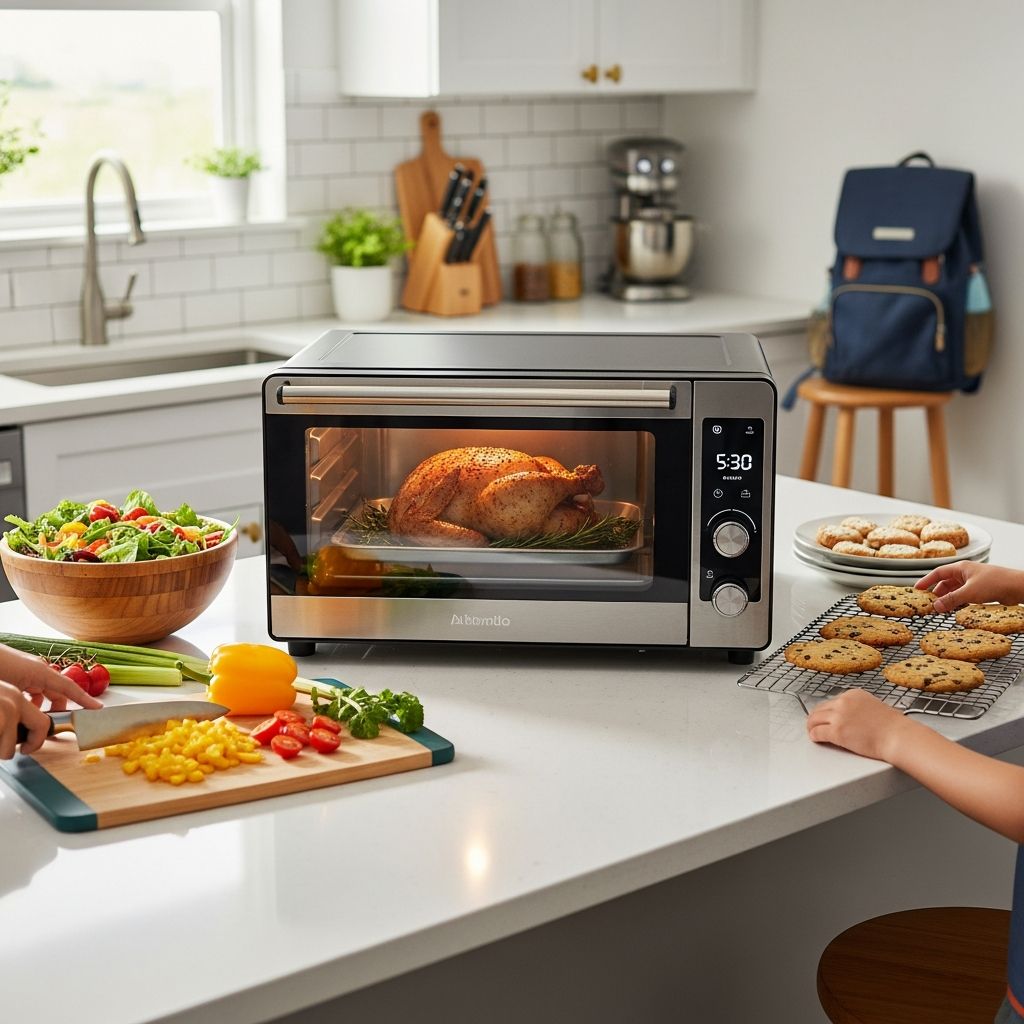
In many homes, dinner prep happens at the exact same time as homework questions, toddler meltdowns, and last-minute emails. A smart countertop oven, similar in spirit to the Breville Smart Oven, can be the quiet helper that keeps meals on track without demanding constant attention. Instead of being just a toaster oven, this type of appliance becomes a compact, efficient second oven that families lean on every single day.
This article explores what makes a smart countertop oven so transformative, how it fits into real family life, and why it often ends up being the most-used appliance in the kitchen. You will find tips for choosing the right model, ideas for weekly routines, and answers to common questions, all organized for search-friendly reading.
What Is a Smart Countertop Oven?
A smart countertop oven is a compact electric oven designed to sit on your counter while delivering many of the functions of a full-size oven. Unlike old-fashioned toaster ovens that simply blast heat, modern smart ovens use sensors and algorithms to direct heat precisely and evenly, often through multiple quartz heating elements and, in many models, a convection fan. These systems help eliminate hot and cold spots so food browns and bakes more predictably.
Most smart ovens include preset cooking modes such as toast, bagel, bake, roast, broil, pizza, and cookies, with higher-end models adding options like slow cook, warm, air fry, dehydrate, or proof. Rather than forcing you to guess at temperature and time, these modes give you a reliable starting point that you can quickly adjust.
Why Busy Families Fall in Love With Smart Ovens
Parents often discover that a smart oven quietly removes friction from their evenings. It heats faster than a big wall oven, handles small portions more efficiently, and makes it easy for older kids to prepare simple meals safely. Over time, what starts as an extra gadget becomes the default way to cook most weekday meals.
- It preheats quickly, so last-minute dinners do not feel like a punishment.
- It uses less energy than firing up a full-sized oven for a small amount of food.
- It keeps the kitchen cooler, which matters in small apartments or warm climates.
- It gives families a true second oven during holidays or parties.
Key Features to Look For in a Smart Countertop Oven
Not all countertop ovens are created equal. When choosing one for a family kitchen, prioritize features that genuinely simplify everyday cooking rather than flashy extras you will never use. Paying attention to a few core details will help you select an appliance that earns its space on your counter for years.
Essential Core Functions
At minimum, a family-friendly smart oven should cover the basics: even toasting, reliable baking, and decent broiling performance. Modes like toast, bagel, bake, roast, and broil will handle a surprising amount of your weekly menu. If your household loves pizza or frozen snacks, a dedicated pizza or reheat setting often gives better results because it balances bottom crisping with top browning.
For more cooking flexibility, consider models that add slow cook, warm, or air fry modes. These functions let you handle long braises, keep weekend brunch dishes warm, or prepare crisp fries and nuggets with less oil than deep frying, all in the same footprint.
Heating Technology and Convection
Look for multiple quartz heating elements paired with a smart heat control system that redistributes power depending on the mode you choose. In practice, this means the oven can prioritize top heat for broiling, surround food with more even heat when baking, or combine both for fast roasting. The technology behind these decisions is what separates a premium smart oven from a basic toaster oven.
A convection fan is another key upgrade. When engaged, convection circulates hot air, reducing cook times and promoting crisp textures. This is particularly valuable for roasted vegetables, sheet-pan dinners, and baked goods that benefit from consistent temperature throughout the cavity.
Capacity and Interior Layout
Before falling for sleek stainless-steel designs, check whether the interior supports the way you actually cook. Many popular smart ovens are sized to fit a 12-inch pizza, a small chicken, or a standard 9 x 13-inch pan. Think about your favorite recipes and confirm that the pans you already own will fit.
Interior racks that can slide to multiple positions, and especially auto-eject racks that pull forward when you open the door, make it safer and easier for kids and multitasking parents to check on food. Nonstick or enamel interiors also streamline cleanup when cheese, sauces, or oils inevitably spill.
User Interface and Everyday Usability
An intuitive control panel matters more than you might expect. A backlit display that changes color or clearly signals when preheating is complete removes guesswork and lets you walk away with confidence. Clearly labeled knobs or buttons for time, temperature, and function help everyone in the household use the oven without constant supervision.
Little touches such as an interior light, a pause or cancel button, and audible but not jarring beeps make the oven feel more approachable and less intimidating for younger or older family members.
How a Smart Oven Fits Into Real Life
The true value of a smart countertop oven appears in daily use, not on a spec sheet. Once it is plugged in, families quickly notice how many small tasks shift from the main oven to this compact workhorse. Below are some everyday scenarios where a smart oven shines.
Weeknight Dinners Without Drama
On busy evenings, the smart oven excels at handling single-sheet or single-dish meals. You can slide in chicken thighs and vegetables, set the roast and convection modes, and walk away to help with homework while the oven manages heat distribution. Because preheating is quick and the cavity is smaller, food often reaches the table sooner than if you heated the full oven.
- Sheet-pan chicken and vegetables cooked on convection for faster browning.
- Salmon fillets baked quickly without filling the entire house with strong aromas.
- Stuffed peppers or casseroles baked in smaller dishes that fit perfectly in the compact interior.
Snacks and After-School Hunger
For families with children, the smart oven is the snack station. Frozen snacks, quesadillas, mini pizzas, and garlic bread all benefit from crisp, even heat that a microwave cannot provide. Older kids can safely learn to operate basic modes with clear guidelines, gaining independence while keeping mess and risk under control.
Because the oven is accessible on the counter and does not require bending or lifting heavy pans from floor-level racks, it is also convenient for grandparents or caregivers who may struggle with traditional ovens.
Breakfast Rush and Weekend Brunch
When mornings are hectic, being able to toast several slices of bread, bagels, and pastries evenly in a single batch helps keep the line moving. Dedicated toast and bagel settings usually control both temperature and time to give repeatable results without endless fiddling.
On weekends, the oven shines for baked oatmeal, breakfast pizzas, and frittatas that need gentle, even baking but do not justify heating the full oven. The warm setting keeps extra portions at serving temperature without drying them out while everyone slowly wanders to the table.
Smart Countertop Oven vs Traditional Toaster Oven
If you are wondering whether a smart oven is truly different from a basic toaster oven, it helps to compare them side by side. The table below highlights key differences that impact daily use in a family setting.
| Aspect | Traditional Toaster Oven | Modern Smart Countertop Oven |
|---|---|---|
| Heating control | Simple, often uneven coils with basic thermostats | Multiple quartz elements with smart heat distribution for more even cooking |
| Cooking modes | Usually toast, bake, broil only | Toast, bagel, bake, roast, broil, pizza, cookies, reheat, and sometimes slow cook, air fry, or warm |
| Preheat speed | Moderate; not optimized for rapid heating | Designed for fast preheating to typical baking and roasting temperatures |
| Precision | Wider temperature swings and more guesswork | More stable temperatures and presets tuned for common foods |
| Family usefulness | Mostly used for toast or reheating | Used daily as a second oven for full meals, snacks, and special occasions |
Getting the Most From Your Smart Countertop Oven
Owning a capable oven is helpful, but small habit changes can unlock even more value. By planning a few flexible recipes and keeping the right accessories nearby, you can make this appliance central to your weekly routine. Over time, you will learn which settings pair best with your go-to dishes.
Smart Weekly Routine Ideas
- Monday: Roast vegetables and chicken thighs together on convection for a minimal clean-up meal.
- Tuesday: Use the pizza setting for flatbreads with pre-cut toppings that kids can assemble themselves.
- Wednesday: Bake a small pan of lasagna or enchiladas while your main oven handles bread or dessert.
- Thursday: Reheat leftovers on a reheat setting for better texture than the microwave.
- Friday: Air fry or crisp frozen snacks for movie night without deep frying.
Helpful Accessories to Keep Nearby
Many smart ovens ship with a baking pan, broiling rack, and sometimes a dedicated pizza pan or air fry basket. You can expand their usefulness with a few inexpensive additions that fit the interior dimensions of your particular model. Matching your cookware to the oven size also encourages better airflow and more even results.
- Quarter-sheet pans and small roasting pans that fit comfortably on the rack.
- Silicone baking mats or parchment sheets cut to size for cleaner baking.
- Low-profile casserole dishes that allow heat to circulate around food.
- Heatproof trivets so hot trays can move directly from oven to table.
Safety and Maintenance Tips
A smart countertop oven is still an oven, so basic safety practices apply. Always provide adequate clearance around the appliance, follow the manufacturer’s venting guidelines, and avoid placing it directly under low cabinets that might be damaged by rising heat. Teach children to use oven mitts and to keep faces and hands away from the door when opening.
Cleaning is simpler if done regularly. Wipe the interior once it has cooled to remove crumbs and splatters before they bake on. Remove and wash crumb trays and racks as needed. For the exterior, a soft damp cloth and a mild cleaner typically keep stainless steel looking fresh without scratching the surface.
Frequently Asked Questions (FAQs)
Can a smart countertop oven replace a full-size oven?
For small households or apartment living, a smart oven can handle most everyday cooking tasks, including baking, roasting, and reheating. However, large holiday meals or multi-dish entertaining still benefit from having a full-size oven available. Many families use the smart oven as their daily workhorse and save the big oven for oversized or high-capacity occasions.
Is a smart oven worth it if I already own a microwave?
A microwave excels at speed but usually compromises texture, leaving foods soft when you want crispness. A smart oven, by contrast, delivers browning and crunch on pizzas, fries, roasted vegetables, and baked goods. The two appliances complement each other rather than compete, with the smart oven handling foods where texture matters most.
How much counter space does a typical smart oven require?
Most family-sized smart ovens are roughly the width of a standard microwave but not as deep, making them manageable on typical kitchen counters. Before buying, measure your space, including depth under cabinets and clearance behind the unit for ventilation. Comparing these measurements to the product dimensions ensures you will not feel crowded once the oven is in place.
Are smart ovens energy efficient?
While exact energy use varies by model and cooking time, smart ovens are generally more efficient for small to medium dishes because they heat a smaller space more quickly. Instead of wasting energy heating a large cavity for a single pan of food, you target heat where it is needed. Over a year of frequent use, that efficiency can translate to noticeable savings and a cooler kitchen.
Can kids safely use a smart countertop oven?
With supervision and clear rules, many families find that older children can safely use preset functions to make simple meals or snacks. Features like auto-eject racks, interior lights, and clearly labeled controls help minimize risk. As with any heat-producing appliance, set firm boundaries about what ages may use it alone and which recipes require an adult present.
Making the Smart Oven the Heart of Your Kitchen
A well-chosen smart countertop oven does more than toast bread. It quietly streamlines hectic evenings, opens the door to simpler sheet-pan dinners, and gives every member of the household a way to participate in cooking at an accessible height. By treating it as a true second oven rather than a niche gadget, you unlock its full potential.
When you find a routine that works—like using it for weeknight mains, children’s snacks, and small-batch baking—you may realize that your full-size oven stays off more often than not. For many families, that shift alone justifies the investment and turns this compact appliance into the most beloved tool in the kitchen.