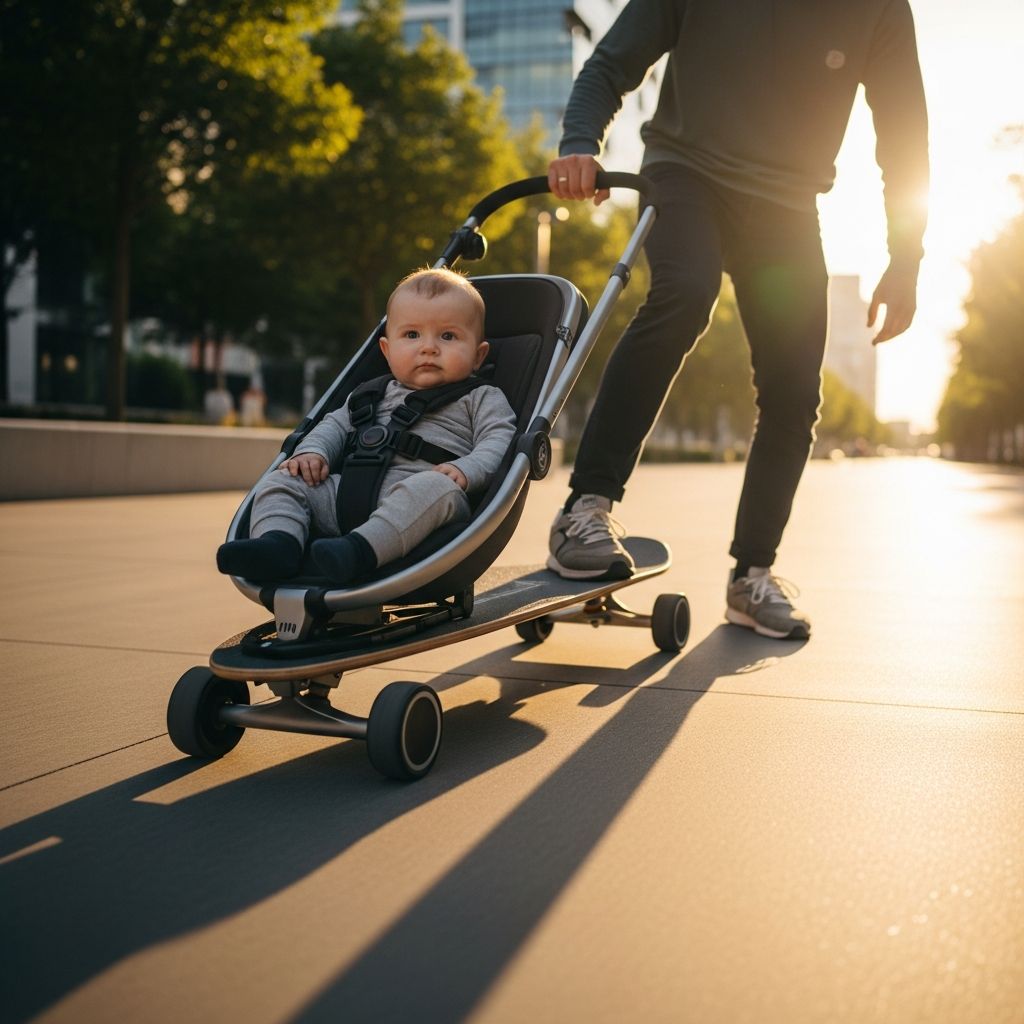
Parenting gear has come a long way from basic prams and clunky pushchairs. One of the most eye-catching inventions to hit sidewalks and skate paths is the skateboard stroller: a hybrid that lets adults ride a board while pushing their child in a front-mounted seat or stroller pod. This concept blends mobility, fun, and style for families who want to move a little faster while still keeping safety front and center.
What Exactly Is a Skateboard Stroller?
A skateboard stroller is a piece of baby gear that combines a stable longboard-style deck for the parent with a stroller seat or shell mounted toward the front for the child. Instead of walking behind a traditional stroller, the adult stands on the board and propels themselves much like riding a longboard, using a handle or integrated frame for control and steering.
Most designs target older babies and toddlers rather than newborns, focusing on kids who can sit upright with good head and neck control. The goal is less about replacing an everyday stroller for every situation, and more about providing a fun, alternative way to move around parks, promenades, and smooth city paths.
Key Components and How They Work
Although models vary, most skateboard strollers share a few core elements that distinguish them from both regular boards and standard strollers.
- Longboard-style deck: A wide, stable platform for the adult rider, often with grippy surfacing for traction.
- Front-mounted child seat: A stroller pod or seat positioned at the front so the parent can maintain visual contact at all times.
- Handlebars or support frame: A structural frame that connects the deck and the seat and gives the rider a point of contact for balance and steering.
- Braking system: Usually a hand or foot brake designed to slow and stop the board safely on flat terrain.
- Large wheels and trucks: Oversized wheels can help navigate small bumps and cracks better than a standard skateboard.
Who Is the Skateboard Stroller For?
This type of stroller is not intended for every family. It sits in a niche between serious skating gear and everyday baby transport, appealing most strongly to parents who already feel comfortable on wheels.
- Confident riders: Adults with experience on skateboards, longboards, rollerblades, or similar gear will likely adapt fastest.
- Urban and suburban families: Households living near smooth sidewalks, waterfront paths, or park trails gain the most benefit.
- Parents of toddlers and preschoolers: Children who like motion and mild thrills often enjoy the ride and the front-row view.
Conversely, people who are uncomfortable balancing on wheels, live in very hilly areas, or frequently use crowded sidewalks may find a conventional stroller or bike trailer more practical day to day.
Benefits: Why Parents Are Curious
The skateboard stroller is more than just a visual statement. It offers specific advantages that explain why some families are excited to experiment with it.
- Faster movement on flat ground: When mastered, pushing off and rolling is usually quicker than walking, especially over longer distances.
- Fun for both parent and child: Parents get a taste of board-sport excitement while kids enjoy the sensation of gliding and the unobstructed view.
- Active lifestyle support: It encourages adults to stay physically engaged during outings rather than simply strolling.
- Conversation starter: This type of stroller tends to attract attention, which can lead to social interaction with other families and passersby.
- Compact profile: Many designs are narrower than a traditional stroller, which can help on single-width paths and crowded promenades.
Safety First: Essential Considerations
Because a skateboard stroller introduces speed and balance into the equation, safety must be a top priority. Thoughtful planning and consistent habits can make the experience much safer and more enjoyable.
- Protective gear: A helmet for the child is non-negotiable, and many parents choose to wear a helmet and wrist guards themselves.
- Age and weight limits: Follow the manufacturer’s guidelines on minimum age, maximum weight, and height to avoid overloading the system.
- Terrain choice: Stick to smooth, dry, relatively flat surfaces with good visibility on all sides.
- Speed control: Keep speeds low, especially near intersections, driveways, playgrounds, or any zone with unpredictable traffic.
- Weather awareness: Wet or sandy surfaces increase stopping distance and decrease traction for both wheels and shoes.
Learning Curve: How to Start Safely
Transitioning from walking to rolling with a stroller takes practice. A gradual approach helps both parent and child gain confidence.
- Begin without your child: Practice mounting, dismounting, steering, and braking while the seat is empty.
- Use a controlled environment: Start in a quiet parking lot, closed street, or empty park path at off-peak times.
- Introduce short rides: After you feel steady, add your child for very slow, straight-line glides with frequent stops.
- Teach a safety routine: Create a pre-ride ritual: helmet check, harness check, brake test, and quick path scan.
- Build gradually: Extend distance and introduce gentle turns only as everyone feels comfortable.
Practical Pros and Cons
Because this product lives somewhere between toy and transport, families should weigh the everyday pros and cons before purchasing.
| Aspect | Skateboard Stroller | Traditional Stroller |
|---|---|---|
| Speed | Can move faster on flat, open paths when used by an experienced rider. | Steady walking pace; easier to control speed in tight areas. |
| Learning curve | Requires balance, practice, and confidence on wheels. | Intuitive: most people can use one safely with minimal instruction. |
| Everyday practicality | Best as a secondary, fun option for specific routes. | Designed to be an all-purpose solution for most outings. |
| Storage capacity | Typically minimal storage; some models may add small compartments. | Often includes baskets, cup holders, and accessory options. |
| Portability | Longer footprint; can be bulkier to transport in small cars. | Many fold compactly and fit in trunks or closets easily. |
| Terrain flexibility | Performs best on smooth, predictable surfaces. | Better adapted to varied sidewalks, grass, and uneven ground. |
| Fun factor | High; adds playfulness and novelty to family outings. | Moderate; more functional than thrilling. |
Choosing the Right Environment
The experience of using a skateboard stroller changes dramatically depending on where you ride. The right routes can make it smooth and joyful, while the wrong ones can be stressful or even unsafe.
- Ideal places: Waterfront promenades, wide park paths, and low-traffic neighborhood streets closed to cars.
- Areas to avoid: Steep hills, busy downtown sidewalks, rough cobblestones, and any route with frequent road crossings.
- Time of day: Early mornings or late afternoons often provide quieter, cooler, and more relaxed riding conditions.
How It Fits Into Everyday Family Life
Few families will rely exclusively on a skateboard stroller. Instead, it usually becomes part of a broader mobility toolkit that might also include a car seat-compatible stroller, a baby carrier, a bike seat, or a scooter board attachment.
Many parents reserve the skateboard stroller for special outings: Sunday park rides, waterfront trips, or quick jaunts to a nearby café. It can also be a creative way to make daily errands more engaging for a restless toddler who resists sitting still in a standard stroller seat.
Tips for Getting the Most Out of It
A few practical strategies can help families maximize both fun and safety.
- Plan routes in advance so you know the surface quality, traffic levels, and any tricky spots.
- Pack light and keep bags secure so nothing dangles near wheels or interferes with balance.
- Use clear verbal communication with your child, describing stops, turns, and any surprises ahead.
- Set personal rules around maximum speed and no-phone zones to avoid distractions.
- Regularly inspect wheels, trucks, brakes, and the child’s harness for wear and tear.
Common Concerns and Misconceptions
Because the concept looks unconventional, it often raises strong opinions. Some concerns stem from valid questions, while others come from assumptions about skate culture in general.
- “Is it just a toy?” While it looks playful, serious designs treat it as regulated child-transport equipment, with testing and safety standards similar to other strollers.
- “Do you have to be a pro skater?” Prior board experience helps, but many models are engineered for stability and moderate speeds rather than tricks.
- “Is it irresponsible?” Responsibility comes down to how and where it is used: slow speeds, proper gear, and appropriate environments make a major difference.
FAQs About Skateboard Strollers
1. From what age can a child ride in a skateboard stroller?
Age guidelines vary by brand, but most skateboard strollers are designed for children who can sit unassisted and have strong head and neck control. This typically means late infancy or toddlerhood rather than newborns. Always check the manufacturer’s minimum age and weight recommendations before use.
2. Do both parent and child need helmets?
The child should always wear a properly fitted helmet, just as they would on a bike or scooter. Many parents also choose to wear helmets and basic protective gear themselves, especially while learning or riding on slightly busier paths.
3. Can a skateboard stroller replace a regular stroller?
For most families, it works best as a supplement rather than a full replacement. Traditional strollers often offer more storage, better performance on rough terrain, and easier handling in crowded shops and public transport.
4. Is it legal to use on sidewalks and bike paths?
Local regulations differ from place to place. Some regions classify it similarly to a stroller, while others might treat it more like a personal mobility device. Before purchasing, it is wise to check local rules regarding wheeled devices on sidewalks, cycle lanes, and shared-use paths.
5. How much practice does it usually take to feel comfortable?
The learning period depends heavily on previous board experience and overall balance. Some adults feel comfortable after a few short practice sessions without a child, while others may need several days of brief rides to develop the reflexes to brake, turn, and dismount smoothly.
Is a Skateboard Stroller Right for Your Family?
Choosing a skateboard stroller is ultimately about lifestyle fit and comfort level. Parents who love movement, already enjoy wheels-based activities, and have access to safe, smooth routes may find it transforms ordinary walks into something more energizing and engaging. Families who prefer slower, more traditional outings—or who mostly navigate crowded, uneven sidewalks—may be better served by a conventional stroller and perhaps a ride-on board for older siblings.
Used thoughtfully, this hybrid of stroller and skateboard can turn everyday parenting logistics into a shared adventure, giving both adults and kids a new way to experience the simple act of getting from A to B.