Sippy cups can feel like a small purchase, but they sit at the crossover of several big milestones: starting solids, moving away from bottles, and learning to drink more independently. This guide walks you through when to introduce a sippy cup, how it compares with straw and open cups, and how to use these tools in ways that support healthy development.
Why the Transition from Bottle Matters
Most pediatric and dental organizations recommend weaning from bottles around the first birthday to protect oral health and encourage more mature oral motor skills. Extended bottle use, especially with sugary drinks, is linked with early childhood tooth decay and can interfere with normal bite development. Sippy, straw, and open cups help bridge this transition by:
- Reducing prolonged sucking on bottle nipples
- Encouraging new tongue and jaw movements involved in sipping
- Letting babies practice self-feeding and independent drinking
When to Start Offering a Cup
There is no single “perfect” age, but many experts suggest starting cup practice sometime around 6 months, when babies are beginning solids and can sit with support. At this stage, you are not replacing breast or bottle feeds; you are just letting your baby explore.
| Age Range (Approx.) | What Many Babies Can Work On | Useful Cup Options |
|---|---|---|
| Around 6 months | Sitting with support, starting solids, exploring holding objects | Parent-held open cup sips, soft-spout sippy, training straw cup |
| 6–9 months | Grasping handles, bringing items to mouth, imitating adults | Sippy cups with handles, short straw cups, small open cups with help |
| 9–12 months | Improved hand-eye coordination, stronger trunk control | Less spill-proof sippy cups, practice with open and straw cups |
| 12–24 months | More independent drinking, walking and carrying objects | Primarily straw or open cups; phase out sippy cups |
These age ranges are approximate. Always follow your baby’s cues and your pediatrician’s guidance, especially if your child was born prematurely or has medical or developmental concerns.
Types of Cups: Sippy vs. Straw vs. Open
Not all “toddler cups” work the same way. Understanding the differences will help you choose tools that fit your child’s stage and your family’s priorities.
Traditional Sippy Cups
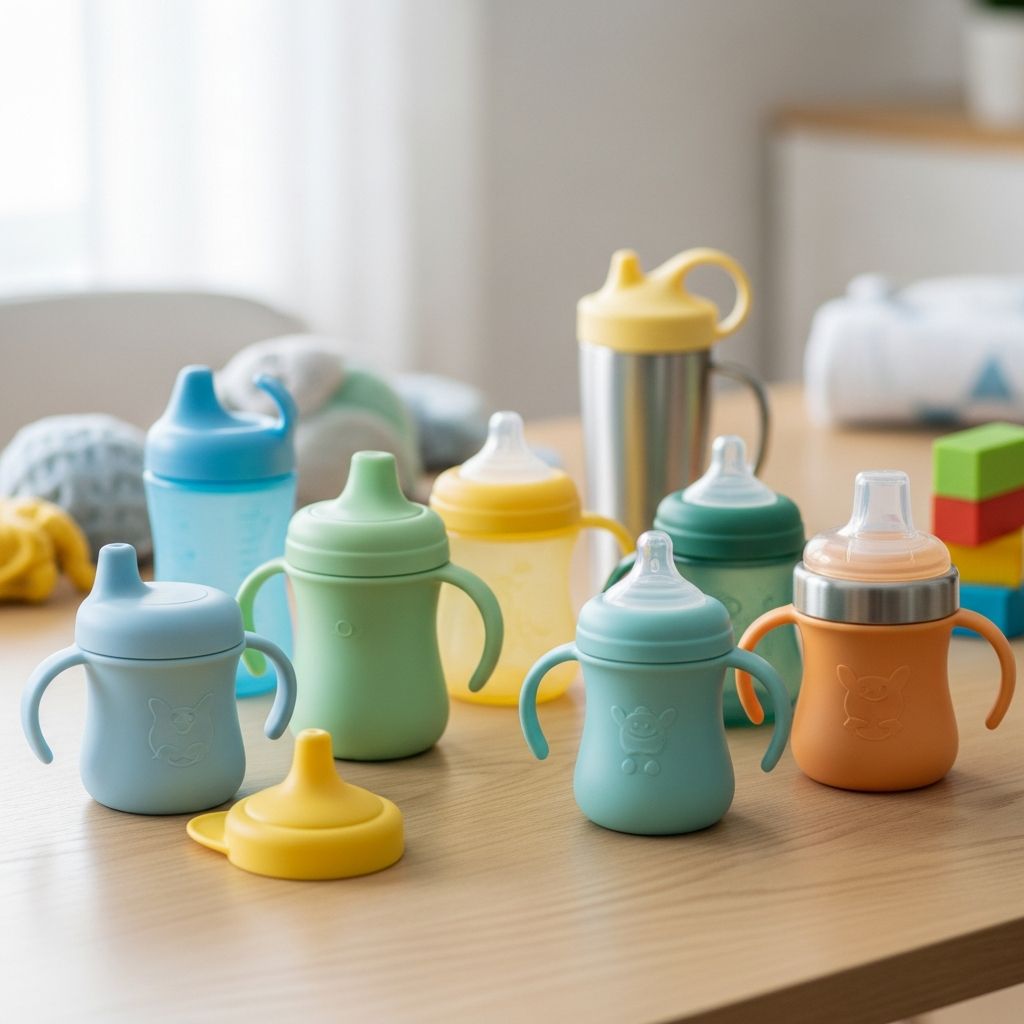
Classic sippy cups usually have a spout and often a valve that limits spills. They encourage a tilt-and-sip motion, but in many models the mouth pattern is still quite similar to bottle sucking.
- Pros
- Help contain messes while babies practice holding a cup
- Useful in the car, stroller, or on carpets
- Can be a familiar-feeling bridge from bottle to cup
- Cons
- Hard spouts and strong valves may reinforce immature sucking patterns instead of true sipping
- Heavy reliance on sippy cups may delay skills needed for open-cup drinking
- Long-term use with sugary drinks can contribute to tooth decay
Straw Cups
Straw cups require babies to use their lips and tongue differently than they do with bottles. These patterns are closer to those used for speech and for safe chewing and swallowing.
- Pros
- Encourage lip closure, tongue retraction, and more mature swallowing
- Often recommended by speech-language pathologists and feeding therapists
- Work well when you are out of the house, because they can be fairly spill-resistant
- Cons
- Some babies need practice to learn straw sucking
- Complex valves can make sucking harder for young infants
- Still not a substitute for learning to drink from an open cup
Open Cups
Open cups are simply small, rimmed cups without lids. Occupational and feeding therapists increasingly encourage offering open cups from about 6 months with adult support, because the movement is most similar to lifelong drinking skills.
- Pros
- Promote mature jaw and tongue movements and healthy facial growth
- Help babies learn pacing and swallowing with gravity and flow more similar to adult drinking
- No valves or spouts to clean or replace
- Cons
- Messier; expect spills during learning
- Require close supervision to prevent choking and big gulps
- Less convenient in the car or stroller
How to Choose a First Cup
You do not need a cupboard full of different cups. Two or three thoughtfully chosen options usually cover most situations.
Features to Look For
- Soft or flexible spout (if using a sippy): Softer materials can be gentler on gums and may feel more familiar than a hard plastic spout for new learners.
- Easy-to-grip handles: Double handles help babies around 6–9 months bring the cup to their mouth with more control.
- Minimal or removable valves: Strong valves make cups less messy, but they also require a lot of suction and can mimic bottle feeding. For skill-building at home, a simple flow is usually more helpful.
- Small size: A tiny open cup or short straw cup is easier for small hands and limits how much can spill at once.
- Safe materials: Choose cups that are free from BPA and meet current safety standards. Check product labels and your country’s consumer safety guidance for details.
Step-by-Step: Introducing a Sippy Cup
Think of this as a low-pressure experiment rather than a test your baby needs to pass on a schedule. Keep sessions short and relaxed.
1. Start With Familiar Liquids
- Offer small amounts of breast milk, formula, or water in the cup.
- Water is usually recommended only in small amounts under age 1, because it can displace breast milk or formula and, in excess, can be unsafe.
2. Demonstrate and Support
- Hold the cup with your baby’s hands on it so they feel the movement.
- Tip it gently so a small amount of liquid touches the spout or rim.
- Let your baby mouth the spout or rim without pressure to drink; early on, this is sensory exploration.
3. Offer During Calm Moments
- Try cup practice when your baby is alert but not ravenous (for example, mid-meal or shortly after a bottle or nursing).
- A frantic, very hungry baby is more likely to get frustrated with a new skill.
4. Keep Expectations Modest
- At first, a “successful” session might be a couple of sips and a lot of dribbles.
- Over weeks, you’ll see better lip closure, less coughing, and more efficient swallowing.
5. Gradually Use the Cup More Often
- Around 9–12 months, many families begin shifting one daytime bottle or nursing session to a cup, often the midday feed.
- By around 12–18 months, many children can take most or all drinks from a cup, with bottles phased out in line with pediatric advice.
Health and Safety Considerations
Protecting Teeth and Jaws
Pediatric dental groups advise avoiding prolonged, frequent sipping of sugary drinks—even from spill-proof cups—because this bathes teeth in sugar and raises cavity risk.
- Reserve juice for rare occasions, if at all. Water and plain milk are generally preferred beverages beyond infancy, following your pediatrician’s advice.
- Do not let children walk around all day with a sippy cup of milk or juice. Offer drinks at meals and snack times instead.
- If your child uses a pacifier or still has bottles, discuss timing of weaning from these with your pediatrician or pediatric dentist.
Supporting Speech and Feeding Skills
Therapists emphasize that the way children drink can affect how their tongue and jaw move for chewing and speaking later on.
- Try to include both straw and open cup practice alongside, or instead of, traditional sippy cups when you can supervise closely.
- If your child has a history of reflux, choking, or feeding difficulty, ask your pediatrician for a referral to a feeding or speech-language specialist before making large changes.
General Safety Tips
- Always supervise babies and toddlers while they drink, regardless of cup type.
- Have children sit while drinking to lower the risk of choking or falls.
- Check cup parts regularly for cracks, mold in valves, or loose pieces that could become choking hazards. Replace damaged components.
Phasing Out Sippy Cups
Although sippy cups are convenient, many professionals recommend using them as a short-term stepping stone, not a long-term solution.
- Limit daily use: Use sippy cups when you truly need spill resistance (car rides, stroller, daycare rules), and emphasize open or straw cups at home.
- Introduce open or straw cups early: By the second year of life, many children can increasingly drink from open or straw cups with fewer spills.
- Follow your child’s pace: Some children move quickly from bottle to open cup, others benefit from a brief sippy cup phase. The overall direction—toward more mature drinking skills—matters more than the exact timeline.
Common Challenges and Gentle Solutions
Baby Refuses the Cup
- Try different temperatures (slightly cool vs. room temperature).
- Offer when your child is in a good mood and not overly hungry or tired.
- Sit face-to-face and drink from your own cup; babies love to imitate adults.
Lots of Spills and Coughing
- Reduce the amount in the cup so less comes out at once.
- Check that the flow is not too fast for your baby’s stage.
- Pause frequently and watch for swallowing before offering more sips.
Strong Bottle Attachment
- Begin with keeping bottles at predictable times, and offer the cup between those times for practice.
- Over days or weeks, gradually reduce one bottle feeding and offer more in the cup instead, with extra comfort and attention.
Frequently Asked Questions About Sippy Cups
What is a good first drink for my baby’s cup?
For most babies starting solids, small amounts of water or their usual breast milk or formula in the cup are typical first choices. Under 1 year, water should usually be limited and not displace milk intake; ask your pediatrician for amounts that fit your baby’s needs.
Are sippy cups bad for my baby’s teeth?
Sippy cups themselves are not inherently harmful, but frequent sipping of sugary drinks (including juice and sweetened milk) from any cup or bottle can promote cavities. Limiting sugary drinks and avoiding all-day sipping is more important than the cup style alone.
Should I skip sippy cups and go straight to straw or open cups?
Many therapists now favor straw and open cups because they encourage more mature oral motor skills. However, some families find a short period of sippy cup use helpful for convenience and confidence. You can combine approaches: use sippy cups strategically while still regularly offering straw and open cups.
When should my child be fully off bottles?
Pediatric organizations often recommend starting to wean from bottles around 12 months and finishing during the second year of life to support dental and nutritional health. Your pediatrician can help you tailor this timeline to your child.
How many cups do we really need?
For most families, one or two everyday cups (such as a straw cup and a tiny open cup) plus one spill-resistant option for travel is enough. You can always adjust once you see what works best for your child.
References
- From Bottle to Cup: Helping Your Child Make a Healthy Transition — American Academy of Pediatrics. 2022-01-01. https://www.healthychildren.org/English/ages-stages/baby/feeding-nutrition/Pages/Discontinuing-the-Bottle.aspx
- Sippy Cups, Bottles, and Your Child’s Teeth — American Academy of Pediatric Dentistry. 2020-01-01. https://www.mychildrensteeth.org/assets/2/7/Sippy_Cups.pdf
- Pros and Cons of Sippy Cups — Ready, Set, Food! 2022-06-15. https://readysetfood.com/blogs/community/sippy-cups-pros-and-cons
- Why Therapists Recommend Open Cups for Babies 6 Months & Up — Hallie Bulkin, MA, CCC-SLP. 2023-02-10. https://halliebulkin.com/open-cup-drinking-for-babies/
- Why You Should Teach Your Baby to Use a Straw and Skip the Sippy Cup — My Fruitful Body. 2023-07-01. https://www.myfruitfulbody.com/blog/why-you-should-teach-your-baby-to-use-a-straw-and-skip-the-sippy-cup
- Baby Bottles, Nipples, and Pacifiers — U.S. Food and Drug Administration. 2022-09-14. https://www.fda.gov/consumers/consumer-updates/baby-bottles-nipples-and-pacifiers
- Water: How Much Should You Drink Every Day? — Mayo Clinic. 2022-10-12. https://www.mayoclinic.org/healthy-lifestyle/nutrition-and-healthy-eating/expert-answers/water/faq-20058444