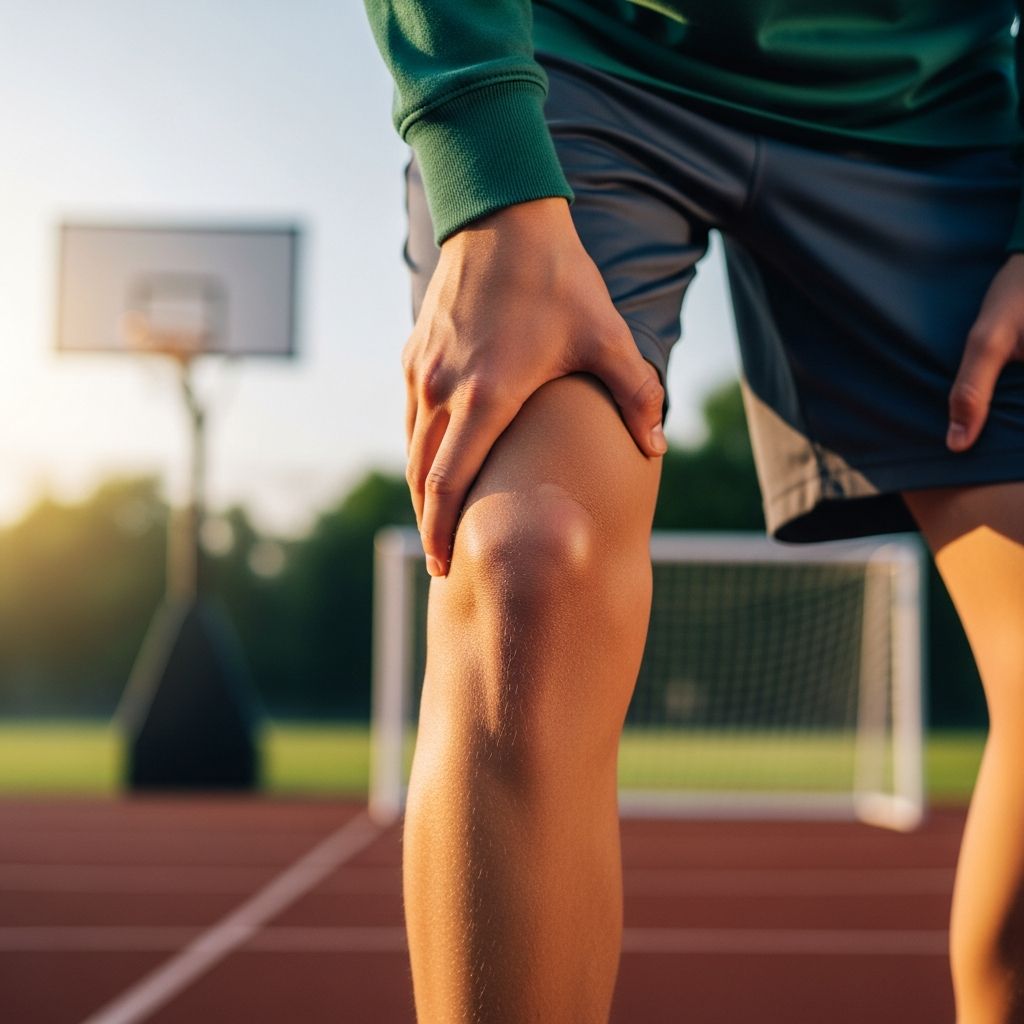
Sinding-Larsen-Johansson syndrome, often shortened to SLJ, is a common cause of pain at the front of the knee where the patellar tendon meets the lower part of the kneecap. It tends to show up in growing kids and teens, especially those who run, jump, and play sports a lot.
This guide explains SLJ in simple language, walks through symptoms and treatment, and offers practical tips to manage pain while protecting long-term knee health. It is designed for teens, parents, and coaches who want clear, reliable information without medical jargon.
What Is Sinding-Larsen-Johansson Syndrome?
SLJ is an overuse injury that affects the growth area at the bottom of the kneecap, where the patellar tendon attaches. In growing kids and teens, this area is softer than regular bone, which makes it more sensitive to repeated pulling and stress from the thigh muscles.
When you run, jump, or kick, your quadriceps muscle in the front of your thigh pulls on the patellar tendon. That tendon pulls on the lower part of the kneecap. If this happens over and over, faster than your body can adapt, the growth area becomes irritated and painful. That irritation and swelling is what doctors call Sinding-Larsen-Johansson syndrome.
Who Usually Gets SLJ?
SLJ almost always appears in kids and teens who are still growing, typically around the early to mid-teen years. It is especially common during growth spurts, when bones get longer quickly and the muscles and tendons have to catch up.
- Most often affects kids roughly between ages 10 and 15.
- Common in sports with lots of running, jumping, and sudden direction changes.
- Can affect any gender, though it may be spotted more often in those who participate heavily in organized sports.
SLJ usually affects just one knee, but some teens feel it in both knees at different times or at the same time. It is not a sign that something is “wrong” with your body; it mostly reflects growing tissues being stressed faster than they can adapt.
Why Does SLJ Happen?
SLJ is mainly caused by repetitive stress, not a single accident. The knee’s extensor system – the quadriceps muscle, kneecap, and patellar tendon – works hard every time you straighten your leg, jump, or sprint. When the load on this system is high and frequent, it can overwhelm the growing tissues at the lower edge of the kneecap.
Several factors often combine to trigger SLJ:
- Rapid growth: Bones lengthen quickly, but muscles and tendons stay relatively tight for a while, putting extra pull on the kneecap.
- High training volume: Lots of practices, games, and extra training sessions without enough rest days in between.
- Jumping and sprinting sports: Activities like basketball, soccer, volleyball, track, and gymnastics stress the front of the knee repeatedly.
- Muscle tightness: Stiff quadriceps, hamstrings, or calf muscles increase tension across the knee joint.
- Hard or uneven playing surfaces: Practicing on concrete or very hard ground adds extra impact forces to each landing.
In most teens with SLJ, there is no serious structural damage such as a big fracture. Instead, tiny amounts of micro-injury accumulate in the growth area until it becomes sore and inflamed.
Common Signs and Symptoms
SLJ usually develops gradually rather than suddenly. The pain tends to start as a mild annoyance and can become more noticeable if activity levels stay high.
- Pain or tenderness right at the lower edge of the kneecap, not deep inside the knee joint.
- Discomfort that gets worse with running, jumping, kneeling, squatting, or going up and down stairs.
- Relief with rest or when you sit, lie down, or avoid putting stress on the knee.
- Mild swelling or a sensitive bump at the bottom of the kneecap.
- Occasional limping after intense activity.
- Stiffness or tightness around the front of the thigh or in the knee area.
The pain may be sharp during jumps or sprints and then turn into a dull ache afterward. Many teens notice that both pain and stiffness feel worse at the end of the day or after a big practice or tournament.
How SLJ Differs from Other Knee Problems
Many conditions can cause knee pain, so it helps to understand how SLJ stands out. The key feature is the location of the pain – at the lower border of the kneecap, where the tendon attaches – and its close link to overuse in a growing teen.
| Condition | Main Pain Location | Typical Age Group | Common Triggers |
|---|---|---|---|
| Sinding-Larsen-Johansson syndrome | Bottom edge of kneecap where tendon attaches | Growing kids and teens | Running, jumping, kneeling, squatting |
| Osgood–Schlatter disease | Bony bump on top of shinbone just below knee | Growing kids and teens | Jumping sports, sudden growth spurts |
| Patellar tendonitis (“jumper’s knee”) | Along the tendon below the kneecap | Older teens and adults | Intense jumping, overtraining, poor recovery |
| Patellofemoral pain syndrome | Behind or around the kneecap | Teens and adults | Running, stairs, prolonged sitting |
Only a healthcare professional can confirm exactly which condition is responsible, so persistent knee pain should always be checked rather than ignored or self-diagnosed.
When to See a Doctor or Sports Medicine Professional
Mild soreness that improves quickly with a few days of rest and simple home care might not require a doctor’s visit. However, some warning signs mean it is safer to get a professional opinion.
- Pain that lasts more than a couple of weeks, even with reduced activity.
- Pain so strong that it causes limping or makes it hard to participate in daily tasks at school or home.
- Swelling, redness, or warmth that is significant or getting worse.
- Locking, catching, or a feeling that the knee is going to give way.
- Pain that follows a single, clear injury like a fall, collision, or twist.
A doctor, sports medicine specialist, or pediatric orthopedist can usually diagnose SLJ through questions about your symptoms, a physical exam, and sometimes imaging tests to rule out other problems.
How SLJ Is Diagnosed
The diagnostic process typically begins with a detailed conversation about your activity level, sports participation, and when the pain started. The clinician will ask which movements make the pain worse and whether anything relieves it.
During the physical exam, the healthcare provider may:
- Press gently around the front of the knee to locate the most tender spot.
- Check how far the knee can bend and straighten.
- Ask you to tighten your thigh muscles or perform a small squat to see when the pain appears.
- Look for swelling, a bony bump, or changes in the way you walk or run.
In many cases, this exam is enough to identify SLJ. Sometimes, an X-ray or other images may be ordered to confirm that the growth area at the lower kneecap is irritated and to rule out more serious injuries like fractures.
Treatment: Rest, Recovery, and Smart Movement
The good news is that SLJ is usually temporary and responds well to simple, conservative treatments. The main goals are to reduce pain, calm down irritation at the kneecap, and gradually rebuild strength and flexibility.
Activity Changes
Rest does not always mean staying completely inactive. Instead, it means avoiding or cutting back on the actions that trigger pain the most, especially high-impact movements.
- Reduce or pause sports that involve a lot of jumping, sprinting, or hard landings.
- Ask your coach if you can modify drills or skip certain parts of practice while your knee heals.
- Keep up with low-impact options like swimming or cycling if they do not cause pain.
Early on, some teens may need crutches or a brief period of bracing if putting weight on the leg is very painful. This is usually short-term and guided by a healthcare professional.
Managing Pain and Swelling
Simple home strategies can make a big difference in comfort and recovery. Always follow your doctor’s instructions and, for any medication, check with a parent or guardian first.
- Use a cold pack wrapped in a thin cloth on the sore area for about 15–20 minutes at a time, especially after activity.
- Prop the leg up on a pillow when resting to promote comfort.
- Over-the-counter pain relievers or anti-inflammatory medicines may be recommended by your doctor for short-term use.
Pain is a useful signal, not something to ignore. If an activity makes the pain shoot up or linger for hours afterward, the knee is probably not ready for that level of stress yet.
Stretching and Strengthening
Once the worst pain settles down, targeted exercises help support the knee and reduce the chance of symptoms returning. A physical therapist or athletic trainer can tailor a program to your sport and your body.
- Quadriceps stretching: Gentle stretches for the front of the thigh ease tension on the patellar tendon.
- Hamstring and calf stretches: Flexible muscles at the back of the leg help the knee move smoothly.
- Hip and core strengthening: Strong hips and trunk reduce the load that ends up on the knees.
- Gradual leg strengthening: Exercises like straight-leg raises or mini-squats (when pain allows) rebuild control without overloading the kneecap.
The key is progression: start with pain-free movements, then slowly increase intensity and complexity as strength improves and pain stays low.
Returning to Sports Safely
Many teens are eager to know when they can get back to full competition. The timeline is different for everyone, but a safe return depends more on symptoms and function than on a specific number of days or weeks.
Signs that you may be ready to return include:
- Walking, climbing stairs, and squatting without significant pain.
- Good strength in the thigh muscles compared with the other leg.
- Ability to jog, then run, without limping or a surge in pain afterward.
- No sharp pain when jumping or landing from a moderate height.
A typical progression might involve light jogging, then adding short sprints, then controlled jumping drills, and finally full practices and games. Coaches, parents, and healthcare providers should work together to pace this progression.
Long-Term Outlook
SLJ is usually a self-limited condition, which means it tends to improve as growth slows and with sensible management of activity. Most teens recover fully and return to their usual sports without long-term problems.
In a small number of cases, symptoms can linger for months, especially if the knee keeps being pushed through high-intensity activity despite pain. Rarely, if symptoms do not improve with rest, therapy, and time, a specialist might discuss additional options, but surgery is uncommon.
Preventing SLJ and Similar Knee Issues
Not every case of SLJ can be prevented, particularly during big growth spurts. However, healthy training habits can reduce risk and may help flare-ups settle faster.
- Balance training and rest: Avoid sudden jumps in training volume. Build up gradually and schedule regular rest days.
- Warm up properly: Use 5–10 minutes of light activity and dynamic stretches before practices and games.
- Stretch consistently: Gently stretch the thighs, calves, and hips after activity when muscles are warm.
- Strengthen the whole lower body: Include exercises for hips, glutes, and core, not just the knees.
- Use appropriate footwear: Wear shoes that fit well and provide adequate support for your sport and playing surface.
- Listen to pain signals: Do not push through strong or persistent pain at the front of the knee.
Open communication among players, parents, trainers, and coaches is important. When everyone takes pain complaints seriously instead of dismissing them, teens are more likely to get help early and avoid more significant problems.
Practical Tips for Teens Living with SLJ
Dealing with knee pain can be frustrating, especially if sports are a big part of your life. A few mindset and lifestyle strategies can make the experience easier to handle.
- Focus on what you can do – like upper-body workouts, core training, or low-impact cardio – instead of only what you have to skip.
- Set small goals, such as “walk without limping” or “do my stretches every day this week.”
- Use your recovery time to learn more about training, nutrition, and injury prevention.
- Talk openly with your coach about your pain and progress so you can stay part of the team in ways that fit your current abilities.
Remember that SLJ is almost always temporary. With patience, smart choices, and support, most teens come back stronger and more aware of how to care for their bodies.
Frequently Asked Questions About SLJIs SLJ a serious condition?
SLJ is usually not dangerous or permanently damaging, but it does deserve attention. Ignoring the pain and pushing through intense activity can extend recovery time and make daily life uncomfortable. With proper care, most teens recover fully.
Will SLJ go away on its own?
Symptoms often improve as growth slows, but they are more likely to settle quickly if you reduce painful activities, follow a stretching and strengthening plan, and use pain-relief strategies recommended by your healthcare provider. Doing nothing and continuing to overload the knee may prolong the problem.
Can I keep playing sports if I have SLJ?
In some cases, you may be able to keep participating at a lower intensity or with certain modifications. This decision should be made with guidance from a healthcare professional who understands your sport and your specific symptoms. Pain should be your guide; if activity consistently worsens it, more rest or change is needed.
Will I need surgery?
Surgery for SLJ is rare. Most teens improve with activity changes, physical therapy, and time. Only in unusual cases where symptoms remain severe for a long period, despite careful conservative treatment, might a specialist discuss more invasive options.
Does SLJ mean I will have knee problems as an adult?
Most people who had SLJ as teens do not have major long-term issues once the condition resolves, especially if they learned to train smart, stretch regularly, and respect pain signals. Building good habits now can support healthy knees for years to come.