When Shakira and Jennifer Lopez took the Super Bowl LIV halftime stage in Miami, the show was designed to be a celebration of Latin music, dance, and culture. It quickly became something else too: an instant comedy and meme factory that dominated timelines for days.
This article explores why that performance became such a rich source of jokes, reaction posts, and think-pieces, and how social media turned a 15-minute show into a full-blown cultural event.
The Night Shakira and J.Lo Took Over Everything
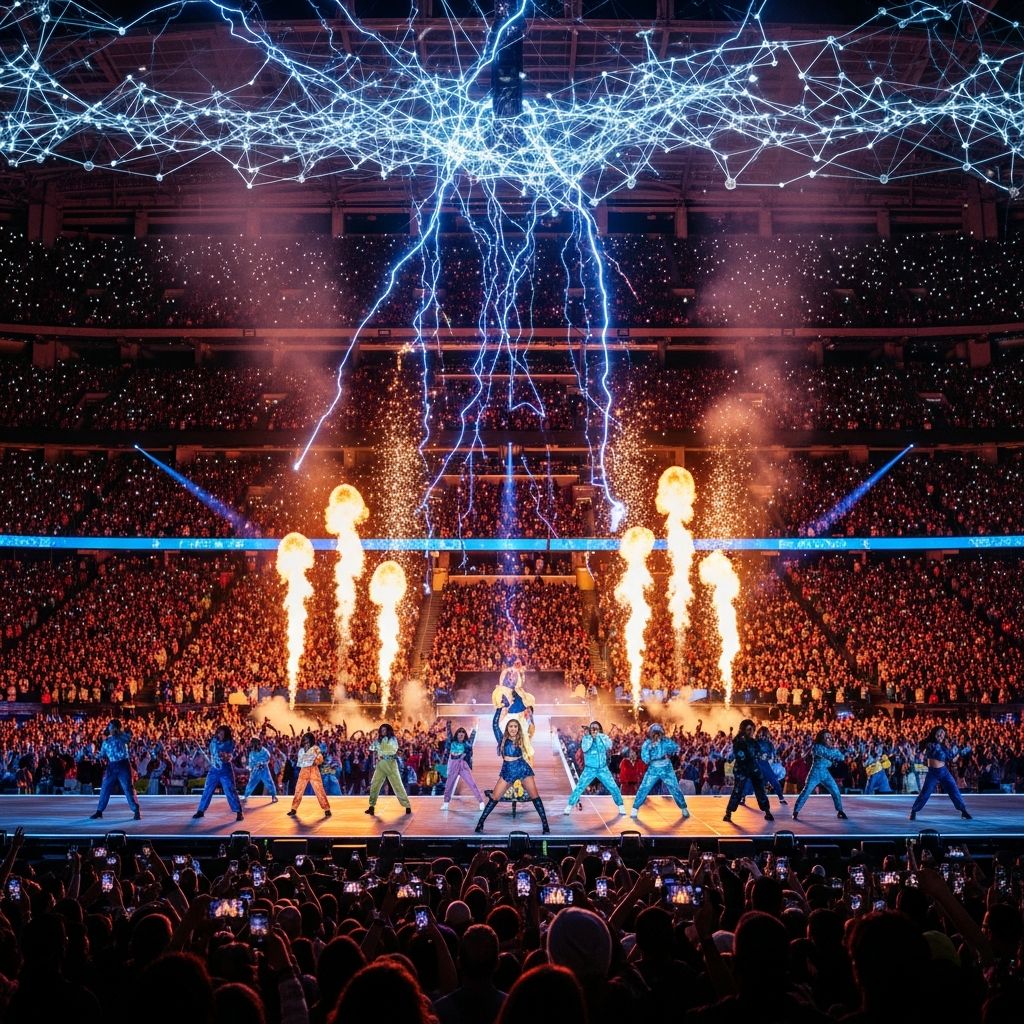
Super Bowl LIV, played between the Kansas City Chiefs and the San Francisco 49ers, already carried high stakes on the field, but the halftime show introduced a different kind of drama: a joint performance by global superstars Shakira and Jennifer Lopez at Miami’s Hard Rock Stadium. They delivered a fast-paced medley of hits, backed by extravagant choreography, pyrotechnics, and surprise cameos.
Shakira opened with songs like She Wolf, Whenever, Wherever, and Hips Don’t Lie, blending rock guitar, belly dancing, and crowd-surfing. Bad Bunny joined her for a remix of I Like It and Chantaje, nodding to reggaeton’s mainstream influence. Lopez followed with classics such as Jenny from the Block, Love Don’t Cost a Thing, and On the Floor, adding high-impact pole work inspired by her role in Hustlers.
Later, J Balvin appeared with Mi Gente, and Lopez’s daughter Emme led a children’s chorus on Let’s Get Loud, underlining themes of family and generational pride. Visual statements including a Puerto Rican and U.S. flag cape, and children in illuminated cages, echoed debates about Puerto Rico’s status and U.S. immigration policy. The show closed with Shakira’s Waka Waka (This Time for Africa), turning the stadium into a football-and-footwork finale.
Why This Halftime Show Became a Meme Goldmine
Not every halftime show becomes a global joke machine. Several factors made Super Bowl LIV uniquely meme-ready:
- Two iconic headliners from different corners of Latin pop joining forces.
- Visual moments that worked perfectly in GIF form, like Shakira’s close-up tongue trill or J.Lo’s pole spins.
- Clear political imagery that sparked commentary and parody at the same time.
- Cross-generational appeal, from nostalgia for early-2000s hits to kids seeing Emme Lopez on stage.
Because the show mixed high-concept staging with very simple, repeatable visuals, viewers could transform single frames into jokes understood even by people who never saw the full performance.
Shakira: The Meme Queen of the Night
Within seconds, Shakira unintentionally supplied one of the most replayed clips of the year: a direct-to-camera tongue trill and ululation that instantly went viral. While rooted in traditional vocal expressions from parts of the Middle East and North Africa, the split-second close-up was so exaggerated and unexpected that it invited endless comedic reinterpretation.
Online reactions tended to fall into a few playful categories:
- The “what did I just see?” crowd: People screen-grabbed the moment and captioned it as the universal face of awkward excitement.
- The cultural explainers: Others used the moment to explain the regional traditions behind the sound, blending education with humor.
- The crossover jokers: Many mashed up the clip with scenes from movies, video games, or sports commentary for maximum absurdity.
Beyond that single meme, Shakira’s entire segment—the red outfit, guitar solo, belly dancing, and crowd-surfing—generated nostalgic jokes about early-2000s MTV, New Year’s resolutions to get in shape, and the painful realization that she was turning 43 and still outdancing everyone at the watch party.
J.Lo: Fitness Aspirations, Pole Dancing, and Parental Group Chats
Jennifer Lopez’s half of the performance spawned a different flavor of humor. Having trained as a pole performer for Hustlers, she used the halftime show to prove those skills on the biggest live stage in American sports. The result: a flood of reactions about core strength, gym regrets, and the sudden need to stretch before walking up the stairs.
Common comedic themes included:
- Age-defying awe: At 50 during the performance, Lopez’s athleticism sparked posts comparing viewers’ winded trips from couch to fridge to her gravity-defying spins.
- Unexpectedly spicy halftime: Parents joked about fielding questions from kids asking why the Super Bowl suddenly looked like a music video.
- Latina auntie energy: Many framed her performance as the ultimate “cool aunt” moment—simultaneously glamorous, in charge, and not here for anyone’s disapproval.
When Lopez donned a dramatic cape combining the Puerto Rican and U.S. flags, the tone shifted. Commenters mixed humor with appreciation, calling it the most stylish civics lesson ever delivered in sequins.
Latin Pride, Politics, and Punchlines
The halftime show was more than spectacle; it was a carefully curated celebration of Latin identity. Shakira (Colombian-Lebanese) and Lopez (Puerto Rican-American) brought artists like Bad Bunny and J Balvin, both central figures in reggaeton’s global rise, signaling how deeply Latin genres have penetrated mainstream pop.
Narratives that emerged online included:
- Representation jubilation: Many viewers expressed emotional pride at hearing Spanish lyrics and seeing Latin dance styles leading the biggest U.S. sports broadcast.
- Political applause: Jokes celebrated how the show managed to critique immigration policies and highlight Puerto Rico’s struggles, all while keeping the party going.
- Confused-but-amused viewers: Some posts came from people who didn’t understand the lyrics but appreciated the energy, comparing it to singing along phonetically to songs they love but don’t fully grasp.
Images of children inside illuminated “cages,” followed by the chorus singing Born in the U.S.A., invited both serious commentary and sharp satirical takes on U.S. immigration debates. Social media users leaned into dark humor, observing that only at the Super Bowl could one move from confetti to critique in a single camera cut.
How Twitter Turned a Show into a Shared Comedy Event
Major live broadcasts increasingly function as synchronized social media experiences. Research on second-screen behavior shows that viewers often watch with a phone in hand, posting reactions in real time while following trending hashtags. The Super Bowl, with its massive and diverse audience, supercharges that effect every year.
During Super Bowl LIV, that dynamic played out in several predictable—and hilarious—ways:
- Live-caption culture: Users posted screenshots with instant captions, often beating professional media recaps to the punch.
- Relatable self-roasting: Many viewers turned their own lack of athleticism, rhythm, or fitness into the butt of the joke, using Shakira and J.Lo as aspirational foils.
- Cross-fandom mashups: Memes remixed the show with references to other fandoms—superheroes, anime, reality TV—making jokes legible to multiple communities at once.
- Brand participation: Companies piggybacked on trending moments with sponsored jokes or image edits, trying to feel “in on it” rather than like commercials intruding on the conversation.
Comedy Split-Screen: Praise, Critique, and Culture Wars
Not all humor was celebratory. Some reactions framed the performance as too risqué for a family event, while others mocked that very criticism as out-of-touch. This split mirrored larger debates about gender norms, sexuality, and double standards in entertainment coverage.
| Reaction Type | Typical Tone | Common Targets |
|---|---|---|
| Body-positive praise | Admiring, funny, self-deprecating | Own laziness, New Year’s resolutions, aging anxieties |
| Conservative backlash jokes | Mocking moral panic | Complaints about modesty, calls to “protect the children” |
| Culture-nerd analysis memes | Wry, reference-heavy | Media coverage, political subtext, performance theory |
| Good-natured confusion | Light, curious | Spanish lyrics, symbolic staging, regional dance moves |
In between the serious opinion pieces published by major outlets, memes worked as a parallel form of commentary—short, shareable, and plugged into cultural debates without always naming them directly.
How Halftime Shows Became Meme Engines
Modern Super Bowl halftime shows are designed with global broadcasting, streaming, and replay in mind. The NFL has explicitly pursued major pop acts to keep viewers engaged. Official highlight reels and full-show uploads help performances reach audiences beyond live TV, as seen with the league posting the entire Shakira and J.Lo show online.
Several broader trends explain why halftime shows like this one reliably produce viral moments:
- Built-in spectacle: High budgets, complex staging, and surprise guests quickly yield stand-out visuals.
- Short, dense format: Around 12–15 minutes of wall-to-wall performance condenses multiple potential meme moments into a tight window.
- Massive shared audience: The Super Bowl remains one of the most-watched broadcasts in the U.S., creating near-universal reference points.
- Instant replay culture: Official and unofficial clips circulate within seconds, allowing jokes to spread while the game is still underway.
Super Bowl LIV fit that template while also offering something new: a halftime headlined by two Latina women, built on a foundation of Spanish-language songs and explicitly political imagery, all while still functioning as pop spectacle.
Lessons From the Funniest Reactions
Looking across jokes and memes about the Super Bowl LIV halftime show, a few themes stand out—not just about comedy, but about contemporary culture:
- Representation can be joyful and funny: People used humor to celebrate seeing themselves—language, dance, or heritage—reflected on a massive stage.
- Physical excellence inspires self-mockery: Viewers processed awe at the performers’ athleticism by making themselves the punchline, lowering the stakes of comparison.
- Political art doesn’t kill the vibe: The show wove in commentary on Puerto Rico and immigration without abandoning its party atmosphere, and audiences responded with a mix of earnest appreciation and jokes.
- Memes double as memory: For many, the show is remembered less as a set list and more as specific memeable frames—Shakira’s close-up, J.Lo’s spins, the flag cape, the kids’ chorus.
Practical Takeaways for Future Halftime Shows
Producers and performers planning future Super Bowl halftimes—or any massive live performance—can infer several unofficial “rules” from how audiences reacted to Super Bowl LIV:
- Design at least one intentional GIF moment: A distinctive camera shot or move can anchor the entire social media conversation.
- Lean into authenticity: When artists showcase their cultural roots with confidence, audiences respond strongly, whether through heartfelt posts or playful memes.
- Embrace multi-layered staging: Visual symbolism gives commentators substance, while pure spectacle keeps casual viewers entertained.
- Accept that the internet will remix everything: No matter how carefully planned the performance, viewers will find their own favorite freeze-frames and punchlines.
Frequently Asked Questions (FAQs)
Who performed at the Super Bowl LIV halftime show?
Shakira and Jennifer Lopez co-headlined the Super Bowl LIV halftime show in Miami, with guest appearances from Bad Bunny, J Balvin, and Lopez’s daughter Emme.
Why did the Super Bowl LIV halftime show generate so many memes?
The show combined bold visuals, intricate choreography, political symbolism, and instantly recognizable stars. Moments like Shakira’s close-up ululation and J.Lo’s pole routine were perfectly suited to short clips and screenshots, which social media users turned into jokes and reaction images.
What political messages were included in the halftime show?
Symbolic elements included children inside illuminated structures resembling cages, a chorus singing Born in the U.S.A., and Lopez wearing a cape featuring both the Puerto Rican and U.S. flags. Commentators interpreted these as references to immigration policy and to Puerto Rico’s relationship with the United States.
How does the NFL support the spread of halftime show content online?
The NFL regularly publishes official highlight clips and full performances on its own platforms and video channels, helping halftime shows reach global audiences beyond the live broadcast and making it easier for viewers to share specific moments.
Did the Super Bowl LIV halftime show receive critical acclaim?
Major outlets described the show as a high-energy celebration of Latin pop and dance, noting both its entertainment value and its political subtext. While some critics and viewers debated its level of explicitness for a family audience, it is widely cited as one of the standout modern halftime performances.
References
- The Biggest Moments of the Super Bowl 2020 Halftime Show — Time Magazine. 2020-02-03. https://time.com/5774180/super-bowl-2020-halftime-show-recap/
- Shakira & J. Lo’s FULL Pepsi Super Bowl LIV Halftime Show — National Football League (NFL). 2020-02-02. https://www.youtube.com/watch?v=pILCn6VO_RU
- The best of Super Bowl halftime performances — NFL.com. 2020-02-03. https://www.nfl.com/photos/the-best-of-super-bowl-halftime-performances-09000d5d82bb12f0
- Photo Gallery: Best of Super Bowl LIV Halftime Show — Kansas City Chiefs. 2020-02-02. https://www.chiefs.com/photos/photo-gallery-best-of-super-bowl-liv-halftime-show
- All Super Bowl Halftime Show (playlist) — National Football League (NFL). 2020. https://www.youtube.com/playlist?list=PL1ex6thGdoPRA_06adM7XPEnf9U_dJ9l7