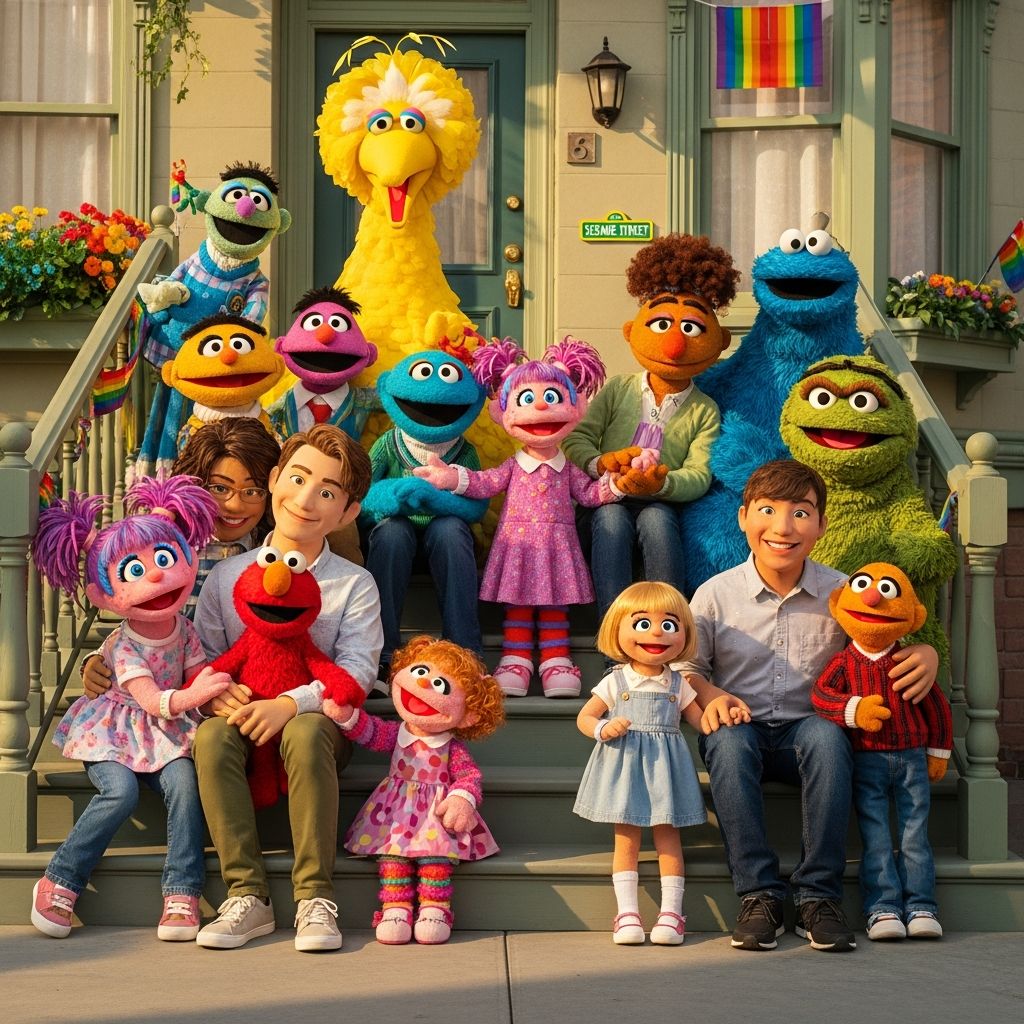
Sesame Street, the iconic children’s program launched in 1969, has long championed diversity and acceptance. Over its 50+ years, it has gradually incorporated LGBTQ+ elements, reflecting societal shifts toward greater inclusivity for young audiences.
Foundations of Diversity on the Street
From its inception, Sesame Street aimed to represent the real world to urban preschoolers. Creators emphasized inclusion across racial, socioeconomic, and cultural lines. This foundational approach naturally extended to family structures as cultural norms evolved.
Early episodes focused on broad acceptance messages, like the 1981 song “We All Sing with the Same Voice,” which included the line about having “one daddy” or “two.” Such lyrics subtly acknowledged varied family compositions without explicit labeling, fitting the era’s sensitivities.
Evolution of Family Representations
By the 2010s, Sesame Street began depicting diverse families more visibly. In segments like Elmo’s Father’s Day special, a smartphone character displayed images of children with two dads, normalizing same-sex parenting in everyday contexts.
Other vignettes showed photos of kids with two moms or blended families, integrated into educational montages about love and kinship. These were brief but pivotal, signaling the show’s commitment to mirroring contemporary society.
Landmark Introduction of Named Queer Characters
A turning point arrived in 2021 during Pride Month with Episode 5132, “Family Day.” Bike shop owner Nina introduced her brother Dave, his husband Frank, and their daughter Mia to the neighborhood. This marked the first named, recurring-potential queer family on the show.
Actor Alan Muraoka, who contributed to the episode, celebrated it as a continuation of Sesame Street’s inclusive legacy. The family participated in community activities, emphasizing that love defines family bonds regardless of structure.
- Dave and Frank’s portrayal highlighted everyday parenting joys and challenges.
- Mia’s excitement about Sesame Street reinforced the show’s appeal to all kids.
- The episode aired amid growing visibility of LGBTQ+ families in media.
The Bert and Ernie Debate: Symbolism vs. Reality
No discussion of Sesame Street’s queer history omits Bert and Ernie. Since a 2011 petition post-New York same-sex marriage legalization gathered over 10,000 signatures urging their “marriage,” the roommates have symbolized gay relationships.
Producers consistently clarified: Bert and Ernie are best friends teaching preschoolers about differences, not romantic partners. As puppets, they lack sexual orientations, prioritizing educational goals over adult interpretations.
| Aspect | Public Perception | Official Stance |
|---|---|---|
| Relationship | Gay couple icons (e.g., The New Yorker cover) | Best friends modeling platonic bonds |
| Purpose | Advocacy symbol | Educate on friendship across differences |
| Producer View | N/A | No sexual orientation; puppets |
Celebrity Guests Amplifying Queer Visibility
Sesame Street has hosted numerous LGBTQ+ celebrities, blending star power with lessons. These appearances educate while celebrating diversity.
- Billy Porter (Pose star) engaged in fun segments promoting self-expression.
- Reneé Rapp performed musical numbers with Elmo, showcasing joy and creativity.
- Ariana DeBose (West Side Story) shared a 2023 Pride TikTok with Elmo: “Everyone is welcome on Sesame Street.”
These guests often tie into themes like pride, acceptance, and community, making abstract concepts tangible for kids.
Broader Impacts on Children’s Media
Sesame Street’s steps influence the industry. Georgia Equality noted that one-third of same-sex couples raise children, deserving reflection on screen. The show addresses this without agendas, focusing on reality.
Post-2021 episode, advocates praised it for helping LGBTQ+ kids see themselves. It parallels inclusions like new African-American Muppets tackling race, hunger, and more.
Recent Developments and Future Outlook
As Sesame Street transitions to Netflix in 2025, its LGBTQ+ history gains renewed focus. Ongoing episodes continue subtle integrations, building on named characters.
Challenges persist: under-representation compared to societal prevalence, and avoiding punchline stereotypes seen in other Muppet properties.
Benefits of LGBTQ+ Inclusion in Kids’ TV
Research underscores positive effects:
- Reduces bullying by normalizing differences.
- Boosts self-esteem for queer youth.
- Teaches empathy to all viewers.
Sesame Workshop’s approach—heartfelt, non-political—sets a model for peers.
Frequently Asked Questions
Has Sesame Street always included LGBTQ+ themes?
Yes, subtly since the 1980s, evolving to explicit representations by 2021.
Are Bert and Ernie officially gay?
No, producers state they are puppets without sexual orientations, focused on friendship lessons.
What was the first named queer family on the show?
Dave, Frank, and Mia in the 2021 “Family Day” episode.
Why include LGBTQ+ content in preschool programming?
To reflect diverse real families, promote acceptance, and support all children’s emotional growth.
Who are notable LGBTQ+ guests on Sesame Street?
Billy Porter, Reneé Rapp, Ariana DeBose, among others bringing pride and education.
Navigating Conversations with Kids
Parents can use these episodes to discuss family variety. Simple prompts like “What makes a family?” open dialogues mirroring the show’s messages.
For queer families, visibility validates experiences; for others, it builds allies early.
Critiques and Ongoing Conversations
Some view inclusions as progressive wins; others debate age-appropriateness. Sesame balances by keeping content light, love-focused, avoiding explicit topics.
Future potential: Recurring queer Muppets or deeper storylines, staying true to preschool education.
References
- Sesame Street’s LGBTQ+ history explored as it moves to Netflix — PinkNews. 2025-05-20. https://www.thepinknews.com/2025/05/20/sesame-street-netflix-lgbtq/
- 23 LGBTQ+ celebrities who found their way onto “Sesame Street” — LGBTQ Nation. 2024-05-23. https://www.lgbtqnation.com/2024/05/23-lgbtq-celebrities-who-found-their-way-onto-sesame-street/
- The LGBT+ History of Sesame Street — ToughPigs. N/A. https://www.toughpigs.com/lgbt-sesame/
- Sesame Street features gay dads — YouTube (Atlanta News First). 2021 (approx.). https://www.youtube.com/watch?v=zfXU3SVYaMw