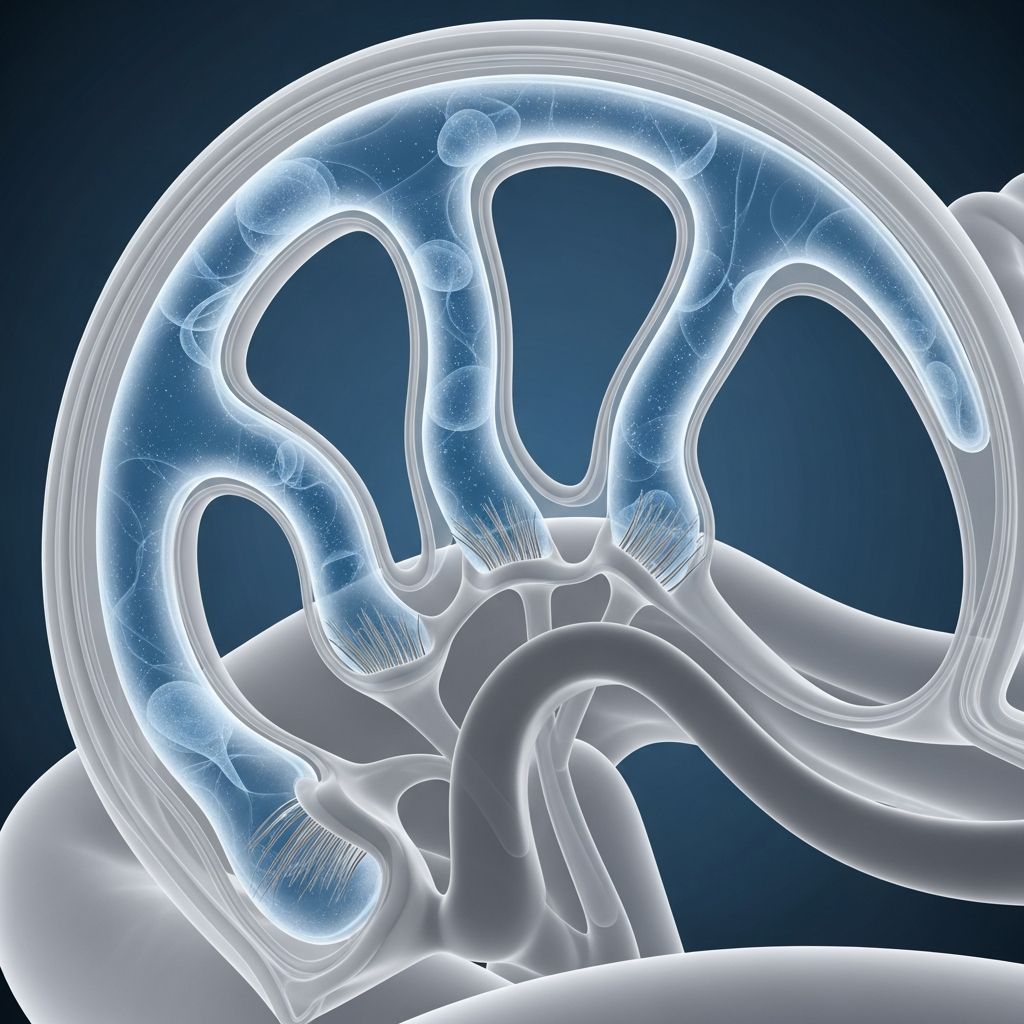
Deep inside each of your ears are three tiny, curved tubes called semicircular canals. These little tubes are filled with fluid and lined with special sensory cells that help your brain figure out how your head is moving so you can stay balanced and steady.
Even though they are very small, semicircular canals work all the time when you walk, jump, turn your head, or spin in a circle. Without them, standing, running, and even reading a book while you move your head would be much harder.
Where Are the Semicircular Canals?
Your semicircular canals are part of the inner ear, a protected area inside the bones on each side of your skull.
- They sit next to the cochlea, the spiral-shaped part that helps you hear sounds.
- They are also connected to the vestibule, which holds two other balance organs called the utricle and saccule.
- The whole group of balance parts (canals, utricle, and saccule) is called the vestibular system.
Because they are buried in solid bone, your semicircular canals are well protected from bumps and injuries.
The Three Canals: One Ear, Three Loops
Each ear has three semicircular canals, and each one is curved in a different direction.
- Horizontal (lateral) canal – mostly helps sense turning your head left and right (like shaking your head “no”).
- Superior (anterior) canal – mainly senses nodding your head up and down (like saying “yes”).
- Posterior canal – helps notice tilting your head toward your shoulders or leaning your head back.
Together, the three canals form almost a 3D cross, so they can sense head turning in any direction in space.
Inside a Canal: Fluid, Hairs, and a Jelly-Like Cap
Although they look like simple loops, each semicircular canal has several important parts inside.
- Endolymph: A special inner-ear fluid that fills the canals.
- Ampulla: A slightly wider bulge at one end of each canal.
- Crista: A small ridge inside the ampulla that holds the sensory cells.
- Hair cells: Tiny sensory cells with hair-like projections that can bend.
- Cupula: A jelly-like structure that sits on top of the hair cells like a cap.
When the fluid in the canal moves, it pushes on the cupula, which bends the hair cells. Those cells then send signals to your brain about how your head is moving.
How the Semicircular Canals Sense Movement
The semicircular canals are especially good at noticing when your head starts or stops rotating (turning).
- Your head moves – You turn, nod, or tilt your head.
- The canal moves with your head – Because it is attached to your skull, the canal turns at the same time.
- The fluid lags behind – The endolymph fluid does not move instantly; it has inertia, so it briefly stays in place.
- Fluid pushes the cupula – As the canal walls move around the fluid, the fluid seems to flow and pushes on the cupula.
- Hair cells bend – The bending of the cupula bends the hairs on the hair cells.
- Signals go to the brain – Hair cells change their electrical activity and send nerve messages along the balance nerve to the brain.
Your brain uses these signals to understand whether you are turning, how fast, and in which direction.
Teamwork Between Both Ears
The semicircular canals in your left and right ears do not work alone. They form pairs that send opposite messages when you turn your head.
| Canal on One Side | Partner Canal on the Other Side | Main Role |
|---|---|---|
| Left horizontal | Right horizontal | Senses turning head left or right |
| Left superior | Right posterior | Helps detect nodding and some tilts |
| Left posterior | Right superior | Helps detect head tilts and rolls |
When you turn your head:
- Canals on one side send stronger signals.
- The matching canals on the other side send weaker signals.
Your brain compares these messages to figure out exactly how you are moving.
Helping Your Eyes Stay Steady
One of the most important jobs of the semicircular canals is helping your eyes stay focused when your head moves. This is done through a reflex called the vestibulo-ocular reflex (VOR).
- When you turn your head, the canals send signals to your brain about the movement.
- Your brain quickly sends commands to your eye muscles.
- Your eyes move in the opposite direction of your head turn so that what you are looking at stays in focus.
This reflex works in fractions of a second and allows you to read a sign while walking, catch a ball, or look around a classroom without everything appearing blurry.
Why Spinning Makes You Dizzy
Many kids notice their semicircular canals most when they feel dizzy after spinning or riding on a fast amusement park ride.
- When you spin, the endolymph in the canals starts to swirl in the same direction as the canal.
- If you keep spinning at the same speed, the fluid eventually catches up and moves at the same speed as the canal, so you barely feel like you are moving.
- When you suddenly stop, your canals stop moving right away, but the fluid keeps moving for a short time.
- The moving fluid pushes the cupula and bends the hair cells as if you were still turning.
Your brain gets the message that you are still spinning, even though your eyes and muscles say you are standing still. That mismatch makes you feel dizzy or like the room is moving.
Semicircular Canals and Everyday Activities
You use your semicircular canals in almost everything you do:
- Walking and running – They help you keep your head steady so you do not fall over easily.
- Sports – Turning, jumping, flipping, and spinning in sports all rely on a well-working balance system.
- Reading in a moving car – Your canals work with your eyes, but if the signals do not match, you may feel motion sick.
- Video games and virtual reality – Your eyes may see movement that your canals do not sense, which can also cause dizziness.
What Happens If Semicircular Canals Do Not Work Right?
Health problems that affect the semicircular canals or other balance organs can make people feel unsteady.
- They may feel like they are spinning (a feeling called vertigo).
- They might have trouble walking straight or may bump into things.
- They can feel sick to their stomach or need to lie down.
Doctors who study the ear and balance can do special tests to see if the semicircular canals and the rest of the vestibular system are working properly.
Protecting Your Inner Ear and Balance
Although the semicircular canals are hidden deep inside your head, some habits can help protect your inner ears and keep your balance system healthy.
- Wear helmets for sports like biking, skating, or skiing to protect your head from injury.
- Avoid very loud noises for long periods, which can harm parts of the inner ear that help with hearing and may also affect balance.
- If you feel dizzy often, tell an adult so a doctor can check your ears and balance system.
Quick Facts About Semicircular Canals
- Each ear has three canals, shaped like loops.
- They are filled with a special inner-ear fluid called endolymph.
- They sense rotational head movements, like turning or spinning.
- They work with the utricle, saccule, eyes, and muscles to keep you balanced.
- They help your eyes stay fixed on things even when your head is moving.
Frequently Asked Questions (FAQs)
Are semicircular canals the same as the cochlea?
No. The cochlea is the part of the inner ear that turns sound waves into signals for hearing, while the semicircular canals mainly sense head rotation and help you balance.
Do semicircular canals work when I am sleeping?
Yes. Your semicircular canals can still sense head movements when you roll over in bed or sit up, and your brain uses that information to keep you feeling oriented in space.
Why do some people get motion sickness more easily?
Motion sickness often happens when the messages from your eyes and your semicircular canals do not match. For example, in a car your canals feel movement, but if you are reading, your eyes focus on something that looks still. That mismatch can make some people feel dizzy or sick.
Can you live without semicircular canals?
People with very weak or damaged semicircular canals can still live, but they may have trouble keeping their balance, especially in the dark or on uneven ground. Their brain has to rely more on their eyes and body sense (from muscles and joints) to stay steady.
How do doctors test semicircular canal function?
Doctors can use special tests that gently move your head or put warm or cool water or air in the ear canal to see how your eyes move. These tests examine how well your semicircular canals and vestibulo-ocular reflex are working.
References
- Semicircular canal — Encyclopaedia Britannica. 2023-05-15. https://www.britannica.com/science/semicircular-canal
- Vestibular System: Function & Anatomy — Cleveland Clinic. 2022-09-01. https://my.clevelandclinic.org/health/body/vestibular-system
- Inner Ear: Anatomy, Function & Related Disorders — Cleveland Clinic. 2022-08-01. https://my.clevelandclinic.org/health/body/24340-inner-ear
- The Semicircular Canals — Neuroscience, 2nd edition. Purves et al., NCBI Bookshelf. 2001-01-01. https://www.ncbi.nlm.nih.gov/books/NBK10863/
- Functions of Semicircular Canals — BYJU’S. 2021-06-10. https://byjus.com/neet/functions-of-semicircular-canals/