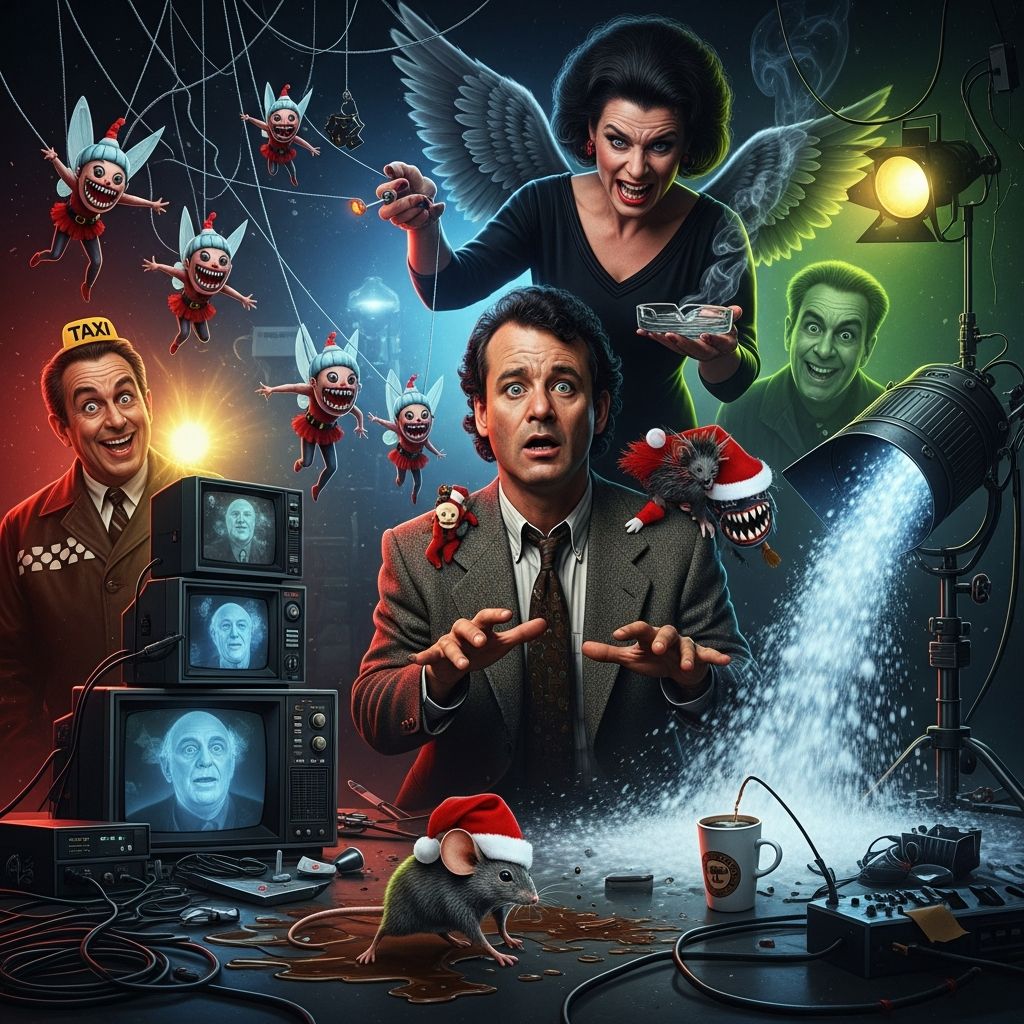
When people list cozy holiday favorites, they usually name films that feel like a warm blanket: It’s a Wonderful Life, White Christmas, or more recent comfort watches like Elf and The Holiday. By contrast, 1988’s Scrooged feels more like being shaken awake by someone who has had too much coffee and not enough therapy. It is loud, mean-spirited, visually chaotic, and yet, somehow, still marketed as a family Christmas movie.
This article explores how Scrooged twists Charles Dickens’ A Christmas Carol into a dark satire of television, why the tone feels so violently unstable, and how its combination of cruelty and sentiment accidentally created one of the strangest enduring Christmas cult films.
The Premise: Dickens Meets Network Television
At its core, Scrooged is a modernized riff on Dickens’ A Christmas Carol, swapping Victorian counting houses for a gleaming Manhattan TV headquarters. The film centers on Frank Cross, an icy, ratings-obsessed network president who is producing a live Christmas Eve broadcast of A Christmas Carol even as he acts like a contemporary Scrooge in his own life.
- Frank Cross as Scrooge stand-in: a ruthless executive who humiliates his staff, fires people on a whim, and uses fear as a management strategy.
- Television as setting: the ghost story unfolds in studios, control rooms, and offices, turning the machinery of television into a literal haunted space.
- Live Christmas broadcast: the network stages a flashy adaptation of Dickens while Frank simultaneously experiences a private, supernatural version of the same story.
This layering of a classic moral tale over a hyper-commercial TV backdrop allows the movie to function as a satire of media culture, even as it recycles the sentimental framework it pretends to mock.
Frank Cross: When Bill Murray Stops Winking
Bill Murray built his screen persona on sarcasm tempered with charm: even when his characters are cynical, there is usually a sense that he’s half in on the joke with the audience. In Scrooged, that safety valve is nearly gone.
Frank Cross is introduced as a man who:
- treats holiday programming entirely as a way to keep viewers glued to their sets,
- designs violent, apocalyptic promos to scare people into watching,
- ridicules and bullies subordinates in front of others,
- drinks heavily and isolates himself in his office while watching multiple screens at once.
Roger Ebert famously observed that Murray’s performance here is unusually harsh and seemingly joyless, lacking the comic warmth that often redeems his more abrasive roles. That choice is thematically consistent—Frank is supposed to be spiritually dead—but it also contributes to the film’s off-putting mood for viewers expecting easy comedy.
Haunted by the Glow of the Screen: The Ghosts Reimagined
The movie’s most inspired element may be how it reimagines Dickens’ three spirits as grotesque, physically aggressive manifestations that feel ripped from the world of television itself.
| Ghost | Form in Scrooged | Function and Tone |
|---|---|---|
| Christmas Past | a chain-smoking, cab-driving specter | mixes New York grit with surreal time travel sequences, blending black comedy with melancholy. |
| Christmas Present | a violent, glittery fairy who literally beats Frank | leans into slapstick cruelty, turning moral instruction into physical assault. |
| Christmas Yet to Come | a towering, cloaked figure with a screen-like face | creates an expressionist nightmare vision of the future, more horror than heartwarming fantasy. |
The sequence with the Ghost of Christmas Yet to Come is particularly striking: distorted sets, bizarre institutional halls, and exaggerated costumes combine to create a dreamlike, theatrical hellscape. Critics have noted that this portion, where Frank confronts the consequences of his behavior, is among the most effective sections of the film, precisely because it leans into surreal horror rather than broad comedy.
Violence, Cruelty, and the Strange Idea of “Holiday Fun”
A major reason Scrooged can feel jarring is its willingness to go far darker—and more physically violent—than most mainstream Christmas fare. Frustration, humiliation, and emotional neglect are central to Dickens’ original story, but this film adds:
- abrupt slapstick beatings (often played for laughs),
- gun violence and workplace meltdowns,
- images of death and decay,
- and a constant undercurrent of fear about job loss and corporate cruelty.
The tonal dissonance is intensified by the film’s marketing as a broad Bill Murray Christmas comedy. Parents expecting a jaunty holiday romp may find themselves navigating scenes of despair and terror that are closer to a psychological horror film than to a Hallmark special. This friction between expectation and reality is part of what has given the movie its reputation as a “train wreck” you can’t quite look away from.
Television as Villain, Mirror, and Religion
Beyond its surface story, Scrooged doubles as a critique of late-1980s American television culture. Media scholars have long argued that TV reshaped family routines, attention spans, and even politics, consolidating influence in the hands of a few networks and advertisers. The film taps into those concerns by presenting television as almost a secular religion that dictates how people experience Christmas.
Key satirical targets include:
- Ratings obsession: Frank treats human beings as numbers on a chart, illustrating a real-world trend in which audience measurement became the dominant currency of network decision-making in the 1980s.
- Fear-based promotion: his apocalyptic ad campaign exaggerates a style of sensationalism that media critics associated with tabloid-style news and attention-grabbing promos.
- Holiday programming as product: the network’s big Christmas show is less a celebration of generosity than a massive marketing event designed to sell ad slots and cement brand identity.
The irony, of course, is that Scrooged uses that very machinery—big studio production, corporate marketing, and a star-heavy cast—to deliver a supposed critique of the same system. Like Dickens’ own serialized publication model, the movie attacks commercialism while fully participating in it.
How It Handles Dickens’ Moral: Sincerity at Maximum Volume
Dickens’ A Christmas Carol ends on a note of tender renewal: Scrooge awakens transformed, treating others with kindness and generosity. The novella’s power lies partly in its intimacy; it is as much about quiet internal change as it is about grand gestures.
Scrooged, by contrast, chooses to make Frank’s redemption a live television event. In the final act, he hijacks the broadcast and delivers an extended monologue urging viewers to embrace the spirit of Christmas. Critics have noted that:
- the speech is unusually long and emotionally overwrought,
- it risks feeling more like a breakdown than a heartfelt confession,
- the attempt at sincerity is undercut by the film’s prior commitment to mean-spirited humor.
Yet this same excess is what some fans enjoy. The ending is so unabashed, so desperate to be moving, that it becomes a kind of meta-commentary on televised emotion: a man who has built his life on fake spectacle tries, for once, to use that spectacle for something authentic. Whether it works may depend largely on the viewer’s tolerance for big, messy feelings delivered at a shout.
Supporting Characters and the Shadow of Real-World Suffering
A crucial ingredient in any version of A Christmas Carol is the contrast between the wealthy protagonist and the vulnerable people around him. Here, Scrooged updates:
- Bob Cratchit into Grace, Frank’s overworked assistant juggling a stressful job and a struggling family.
- Tiny Tim into her traumatized child, who has stopped speaking after a violent event.
- Victorian poorhouses into contemporary homelessness, portrayed in shelters and city streets.
The film uses these elements to expose the emotional costs of corporate indifference and social neglect. Real-world research on homelessness and poverty has long highlighted how economic inequality and mental health challenges intersect, especially in large urban centers. While Scrooged rarely engages these issues with nuance, it does at least acknowledge that the holiday season can intensify the visibility—and pain—of people left outside the glow of prosperity.
A Tonal Tug-of-War: Comedy vs. Horror vs. Sentiment
Over the decades, critics and audiences have struggled to categorize Scrooged. Is it a comedy with horror flourishes, a horror film disguised as a Christmas story, or an emotional drama hiding inside slapstick?
The answer is: it is all of them, often within the same scene. That tonal instability explains why some consider it a failure, while others find it weirdly compelling. The film veers between:
- cartoonish violence (characters being hit, shoved, or terrified for laughs),
- surreal horror imagery (decay, death, apocalyptic visions),
- sardonic media satire (exec meetings, ad pitches, network politics),
- earnest emotional pleas about love, generosity, and second chances.
From a storytelling standpoint, this kind of genre blending can be risky, but it also reflects a broader trend in late-20th-century cinema, where filmmakers experimented with mixing horror, comedy, and drama to subvert audience expectations. Scrooged might not always balance those elements gracefully, but its lack of restraint is part of its cult appeal.
Why It Endures: A Christmas Movie for an Anxious Age
Despite its flaws—or because of them—Scrooged has carved out a persistent place in holiday viewing rotations. Several factors help explain its staying power:
- Bill Murray’s star power: even at his most abrasive, he remains compelling to watch, and many viewers bring affection from his other roles into this one.
- Recognition of modern anxieties: fears about work, relevance, media overload, and economic insecurity feel, if anything, more topical today than in 1988.
- Anti-cozy counterprogramming: some people seek out holiday fare that acknowledges darkness, cynicism, and burnout instead of wrapping everything in nostalgia.
- Shared experience of tonal chaos: in an era flooded with content, a movie that refuses to behave predictably can stand out precisely because it is uneven.
In this sense, Scrooged may function as a mirror for viewers who feel out of sync with more traditional, saccharine Christmas stories. Its message is ultimately the same as Dickens’—people can change, generosity matters, love is more important than profit—but the route it takes to get there is far more jagged and noisy.
Who Will Appreciate Scrooged Today?
Given its intensity and uneven humor, Scrooged is not a universal recommendation. It is best suited for viewers who:
- enjoy dark comedy and don’t mind cruelty being played for laughs,
- are curious about unconventional adaptations of classic literature,
- can handle horror-tinged imagery mixed with holiday themes,
- are interested in media satire and depictions of corporate culture.
Families with younger children or those looking for a gentle, reassuring Christmas watch may want to save this one for later years. Dickens’ message about compassion and redemption remains potent, but wrapped here in a spiky, abrasive package.
Frequently Asked Questions (FAQs)
Is Scrooged appropriate for kids?
Scrooged is often marketed as a Christmas comedy, but it includes disturbing images, strong language, scenes of emotional and physical violence, and some intense horror-style sequences. Parents should preview the film and consider the age and sensitivity of their children before including it in family viewing.
How faithful is Scrooged to Dickens’ A Christmas Carol?
The movie keeps the basic structure—three ghosts, a miserly central figure, a grim vision of the future, and eventual redemption—but changes almost everything else. The setting shifts to a television network, many characters are updated to contemporary roles, and the tone leans heavily into dark comedy and media satire rather than Victorian atmosphere.
Why do some critics dislike the film?
Critics have pointed to its relentless mean-spiritedness, tonal whiplash, and an overlong, emotionally forced ending as major weaknesses. For viewers expecting the gentle uplift of traditional Christmas movies, the film’s cruelty and chaotic energy can feel exhausting rather than cathartic.
Why has Scrooged become a cult favorite despite mixed reviews?
Many fans appreciate its willingness to be weird, abrasive, and stylistically bold. The combination of Bill Murray’s performance, the surreal ghost sequences, and its pointed critique of television culture has helped it stand out among more conventional holiday films, earning it a second life as a cult classic.
What makes Scrooged different from other Christmas movies?
Unlike most holiday films that prioritize coziness and sentimentality, Scrooged leans into anxiety, media overload, and corporate cynicism. It still arrives at a message of generosity and human connection, but it takes a jagged path through horror, satire, and emotional breakdown to get there.
References
- Scrooged movie review & film summary (1988) — Roger Ebert. 1988-11-23. https://www.rogerebert.com/reviews/scrooged-1988
- Scrooged (1988) [Revisited] — Mainlining Christmas. 2022-12-06. https://www.mainliningchristmas.com/2022/12/scrooged-1988-revisited.html
- ‘Scrooged’ Is Still the Perfect Christmas Movie 30 Years Later — The Ringer. 2018-11-23. https://www.theringer.com/movies/2018/11/23/18108261/scrooged-30th-anniversary-bill-murray-christmas-movie
- Retrospective Review: Scrooged (1988) — Reel Reactions. 2014-12-08. https://reelreactions.wordpress.com/2014/12/08/retrospective-review-scrooged-1988/
- The Nielsen Ratings — Museum of Broadcast Communications. 2016-01-01. https://www.museum.tv/eotvsection.php?entrycode=nielsenrati
- A Christmas Carol — Charles Dickens (original publication context and enduring cultural impact). Project Gutenberg. 1994-12-01 (public-domain e-text based on 19th-century editions). https://www.gutenberg.org/ebooks/46
- State of Homelessness: 2023 Edition — National Alliance to End Homelessness. 2023-04-06. https://endhomelessness.org/homelessness-in-america/homelessness-statistics/state-of-homelessness-2023/