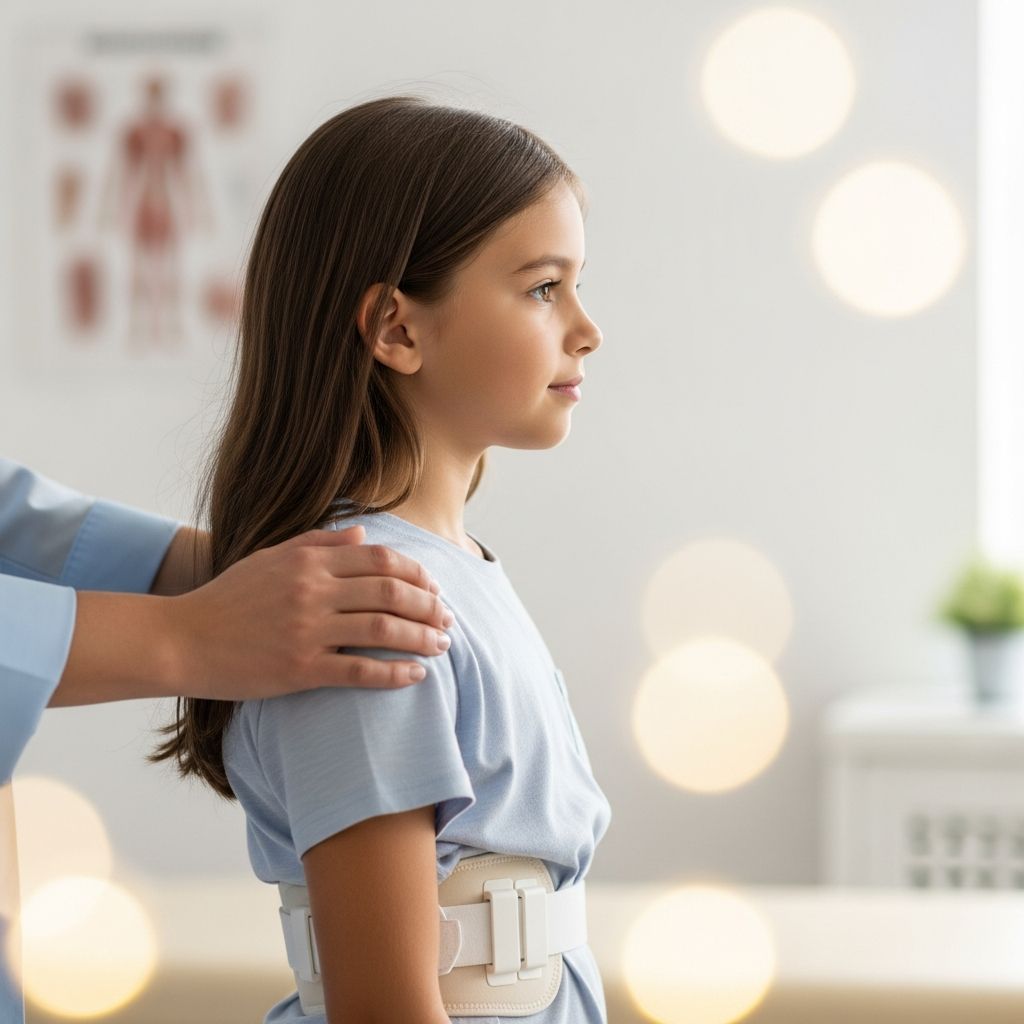
Scoliosis bracing serves as a non-surgical intervention to manage spinal curvature in growing children, primarily aiming to halt or slow progression during key developmental phases. Custom-fitted orthoses apply targeted pressure to guide spinal alignment as the child grows.
Understanding Scoliosis in Growing Children
Scoliosis involves an abnormal sideways curvature of the spine, often diagnosed in adolescents during rapid growth spurts. Adolescent idiopathic scoliosis (AIS) is the most common form, affecting otherwise healthy children without a clear underlying cause. Curves between 25 and 50 degrees in patients with remaining growth potential typically warrant bracing to prevent worsening that could lead to surgery.
Early detection through school screenings or routine check-ups allows for timely intervention. X-rays measure the Cobb angle, the standard metric for curve severity, guiding treatment decisions. Bracing is recommended when curves are moderate and skeletal maturity is not yet complete, as it leverages ongoing growth to influence spinal development.
How Scoliosis Braces Function to Control Curves
These orthotic devices work by exerting corrective forces on the spine. A rigid plastic shell molded to the child’s torso pushes against convex areas of the curve while allowing expansion in concave regions, promoting straighter alignment during wear. This three-dimensional correction addresses rotation, lateral bending, and lordosis often seen in scoliosis.
In-brace X-rays assess correction levels, with high-quality braces achieving around 50% reduction in curve magnitude while standing. The mechanism relies on consistent pressure to modulate uneven growth plate activity on the vertebral endplates, preventing further deformity.
Common Types of Scoliosis Braces
Several brace designs cater to different curve patterns and lifestyles. Here’s an overview:
- Boston Brace (TLSO): A widely used thoracolumbo-sacral orthosis covering from under the arms to the hips. Custom-fabricated from scans or casts, it’s effective for thoracic, lumbar, and thoracolumbar curves in AIS.
- Rigo-Cheneau Brace: An asymmetrical design providing enhanced three-dimensional correction with free spaces opposite pressure pads, improving both Cobb angle and cosmetic trunk appearance.
- Providence Nighttime Brace: Worn 8-10 hours overnight, suitable for milder curves. It maximizes correction in supine position but may show lower standing efficacy compared to full-time options.
- Gensingen Brace: A Chêneau derivative focusing on pattern-specific corrections, shown to improve surface rotation in thoracic and lumbar curves.
Selection depends on curve location, magnitude, growth remaining, and patient compliance potential. Orthotists collaborate with spine specialists to optimize fit.
Daily Brace Wearing Guidelines and Compliance
Success hinges on adherence. Full-time braces like the Boston require 18-23 hours daily, with short breaks for hygiene and select activities. Nighttime options demand strict overnight use. Studies confirm wear times over 17 hours correlate with significantly higher success rates in preventing progression.
| Brace Type | Recommended Wear Time | Typical Correction Achieved |
|---|---|---|
| Boston/TLSO | 18-23 hours/day | 40-50% in standing X-ray |
| Rigo-Cheneau | 18-23 hours/day | Up to 50% with 3D effect |
| Providence | 8-10 hours/night | High in supine, variable standing |
Monitoring via apps, temperature sensors, or odometers tracks compliance. Families receive education on proper donning, skin care, and adjustments as growth occurs.
Effectiveness Backed by Clinical Evidence
Prospective studies like the 1995 Nachemson trial showed Boston bracing prevented 6°+ progression in 70% of cases. Recent data reports 57% success rates across cohorts, with asymmetrical high-correction braces outperforming others in torso aesthetics and long-term stability.
Bracing doesn’t reverse curves but maintains them below surgical thresholds (typically 50°). Immature patients with higher in-brace correction see best outcomes, with some retaining improvements 10+ years post-treatment. Factors like brace quality, wear time, and curve maturity influence results.
Potential Challenges and Side Effects
While effective, bracing presents hurdles. Skin irritation, muscle atrophy from reduced motion, and fit adjustments during growth spurts are common. Full-time wear limits some sports, though swimming and low-impact activities often continue.
Psychological impacts are notable: 72% of adolescents report emotional distress from visible braces affecting body image and social interactions. Strategies like peer support groups mitigate these effects.
Emotional and Psychological Support During Treatment
Adolescents may experience anxiety, low self-esteem, or depression. Parents can foster resilience by normalizing the process, celebrating compliance milestones, and connecting with scoliosis communities. Counseling and body-positive messaging enhance quality of life.
- Encourage open discussions about feelings.
- Involve teens in brace selection for ownership.
- Access online forums and support networks.
Monitoring Progress and When to Adjust Treatment
Regular clinic visits with X-rays (every 4-6 months) track curve stability and growth via hand X-rays (Risser sign). Bracing continues until skeletal maturity, often 1-2 years post-menarche in girls or growth plate closure in boys.
If progression occurs despite compliance, options include brace redesign, nighttime-to-full-time switch, or surgical evaluation. Early high-quality bracing reduces surgery risk.
Daily Life Tips for Families
Integrate bracing seamlessly:
- Hygiene: Clean brace daily; use liners to absorb sweat.
- Clothing: Loose tops camouflage bulk.
- Activity: Follow orthotist guidelines; core exercises complement treatment.
- Sleep: Side-lying positions enhance comfort.
Nutrition supporting bone health and physical therapy for strength aid outcomes.
Frequently Asked Questions (FAQs)
Can my child play sports while wearing a brace?
Many activities are permitted with breaks; contact sports may be restricted. Consult your specialist for personalized advice.
How long will bracing last?
Typically until growth stops, monitored by X-rays—often 1-3 years depending on age at start.
Will the brace straighten my child’s spine completely?
No, it prevents worsening; some in-brace correction relaxes out-of-brace, but progression is halted.
What if the brace causes skin problems?
Inspect daily; use padding or seek orthotist adjustments promptly.
Is nighttime bracing as effective?
For select curves, yes, but full-time often shows superior standing correction.
Long-Term Outlook After Bracing
Post-treatment, most patients maintain stable curves without symptoms. Annual monitoring continues into adulthood. Bracing empowers non-surgical management, preserving lifestyle choices.
References
- Navigating Scoliosis Treatment: From Braces to Surgery and Beyond — The Core Institute. 2024. https://thecoreinstitutemi.com/navigating-scoliosis-treatment-from-braces-to-surgery-and-beyond/
- Boston (Style) Scoliosis Brace – Spinal Technology — Spinal Technology. N.D. https://spinaltech.com/scoliosis-braces/full-time-scoliosis-orthosis
- Brace treatment for patients with scoliosis: State of the art — PMC – NIH. 2021-11-12. https://pmc.ncbi.nlm.nih.gov/articles/PMC8603182/
- Scoliosis brace: MedlinePlus Medical Encyclopedia Image — MedlinePlus. N.D. https://medlineplus.gov/ency/imagepages/19467.htm
- Frequently Asked Questions about Scoliosis Braces — Hospital for Special Surgery (HSS). N.D. https://www.hss.edu/health-library/conditions-and-treatments/scoliosis-bracing
- Scoliosis Bracing — Hanger Clinic. N.D. https://hangerclinic.com/library/scoliosis-bracing/
- Psychological Impact of Brace Treatment on Adolescents with Idiopathic Scoliosis — American Orthopaedic Association. 2024-08-22. https://aoao.org/2024/08/22/psychological-impact-of-brace-treatment-on-adolescents-with-idiopathic-scoliosis-a-narrative-review/