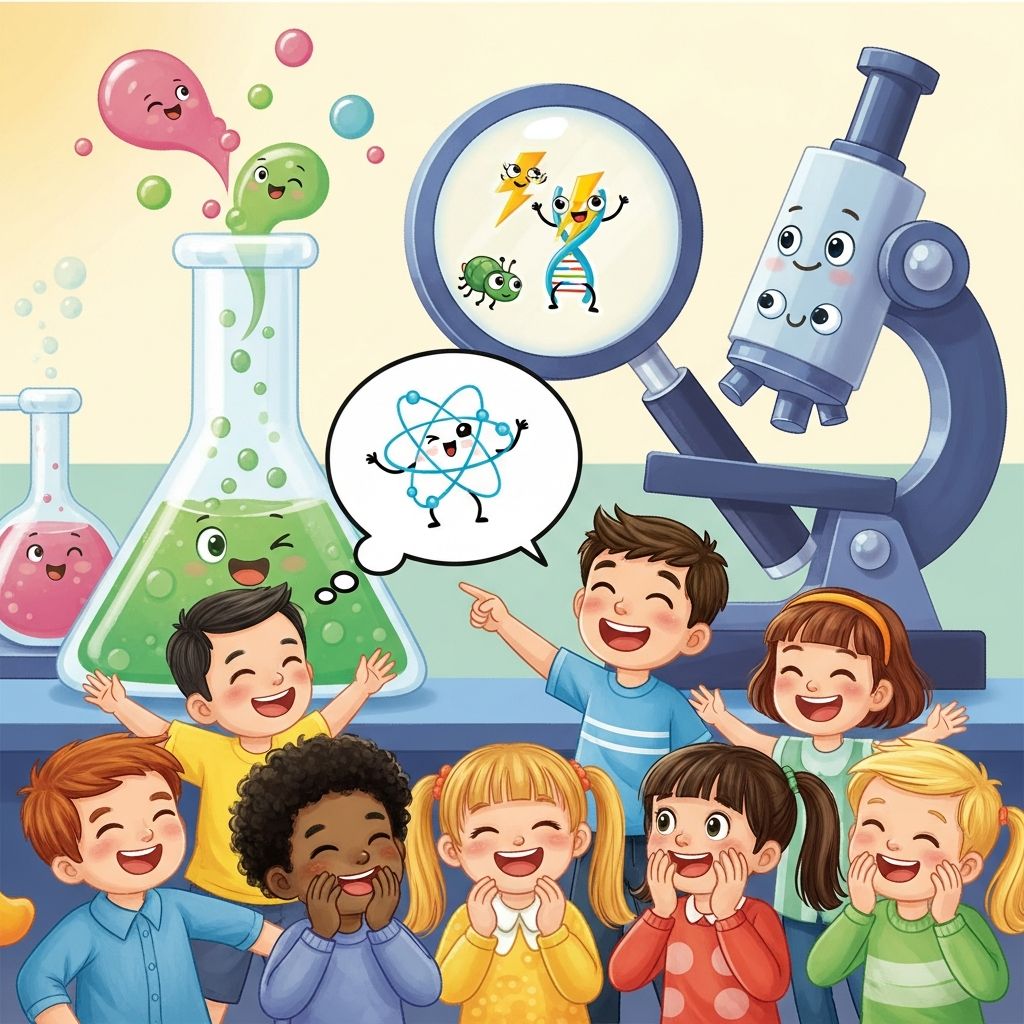
Laughing about science is one of the easiest ways to help kids feel that big ideas are friendly, not scary. A silly joke about atoms or planets can turn a hard concept into something fun and memorable, while also giving families and teachers a quick way to start great conversations about how the world works.
Why Science Jokes Help Kids Learn
Kids are naturally curious, and humor is a powerful tool for building on that curiosity. When children laugh at a joke, their brains are busy spotting patterns and making connections between ideas. Researchers have found that positive emotions like amusement can improve attention, memory, and problem-solving in the classroom. Short, playful moments of humor can also lower stress and make new information feel less intimidating.
That means a quick science joke is more than a throwaway laugh. Used well, it can:
- Introduce new vocabulary in a low-pressure way (like atom, gravity, orbit)
- Strengthen memory by tying facts to funny images
- Start discussions about real science ideas
- Build confidence in kids who think science is “too hard”
How to Use This Joke Collection
This guide is packed with kid-friendly science jokes plus short explanations that adults can use to turn a quick laugh into a mini STEM lesson. You can:
- Print a few jokes for lunchboxes or classroom doors
- Use a joke as a warm-up question before a science lesson
- Turn explaining the joke into a daily challenge
- Encourage kids to invent their own science puns
Chemistry Crack-Ups for Curious Kids
Chemistry jokes are full of wordplay on elements, molecules, and reactions. Even younger kids can enjoy the silly pictures they create, and older kids can dig into the real science behind the punchlines.
Kid-Friendly Chemistry Jokes
- Joke: Why did the chemist carry a pencil in the lab?
Answer: In case he needed to draw a conclusion. - Joke: What do you call two helium atoms that won’t stop laughing?
Answer: HeHe. - Joke: Why did the beaker feel shy at the party?
Answer: It was afraid to make a reaction. - Joke: What did the acid say to the base?
Answer: “You’re really bringing out my pH-eelings!” - Joke: Why was the periodic table always calm?
Answer: It had all its elements in order.
Simple Explanations You Can Share
| Joke Idea | Science Behind the Laugh |
|---|---|
| Helium “HeHe” | Helium’s symbol is He. Two helium atoms written together look like “HeHe,” which sounds like laughing. The periodic table lists helium as a noble gas. |
| Acid and base | Acids and bases are types of chemicals. Their strength is measured with the pH scale, where lower numbers are more acidic and higher numbers are more basic. |
| Periodic table calm | The periodic table organizes elements based on their properties, making patterns easier to see. Order helps scientists predict how elements behave. |
Physics Funnies: Motion, Forces, and More
Physics jokes often play with motion, forces, and energy. Even if kids don’t know the full math yet, they can understand the basic ideas of pushing, pulling, falling, and bouncing.
Light-Hearted Physics Jokes
- Joke: Why did the ball of clay sign up for physics class?
Answer: It wanted to become more well-rounded. - Joke: Why did the toy car fail the science test?
Answer: It couldn’t handle the pressure. - Joke: What did one magnet say to the other?
Answer: “I’m so attracted to you right now.” - Joke: Why can’t you argue with gravity?
Answer: Because it always brings you down. - Joke: Why was the light beam a great friend?
Answer: It always lightened the mood.
Turning Physics Puns into Learning
When you explain the joke, you can sneak in a quick science reminder:
- Magnets: Magnets have a north and south pole. Opposite poles attract, and like poles repel.
- Gravity: Gravity is the force that pulls objects toward each other. On Earth, it pulls everything toward the ground.
- Pressure: In science, pressure is force spread out over an area, like air pressing on the surface of your skin.
Space and Astronomy Jokes That Are Out of This World
Space jokes are especially fun because many kids are already fascinated by rockets, planets, and stars. You can use these jokes to review facts about our solar system and beyond.
Galactic Giggles
- Joke: Why did the student bring a ladder to astronomy club?
Answer: To reach for the stars. - Joke: How do planets stay tidy?
Answer: They orbit their mess into one corner. - Joke: Why did the moon skip dinner?
Answer: It was already full. - Joke: What kind of music do comets like?
Answer: Rock-et and roll. - Joke: Why don’t astronauts get lost?
Answer: They always follow their space directions.
Space Facts You Can Tie In
- Full moon: A full moon happens when Earth is between the sun and the moon, so we see the whole sunlit side.
- Orbit: An orbit is the path one object takes as it moves around another, like Earth around the sun.
- Comets: Comets are icy bodies that orbit the sun; when they get close, the ice turns to gas and dust and makes a bright tail.
Biology and Animal Jokes: Laughing at Life
Biology jokes use animals, plants, and the human body as their stars. Kids instinctively connect to living things, so these jokes are great for younger ages.
Nature-Themed Knee-Slappers
- Joke: Why did the plant go to school?
Answer: It wanted to improve its stalk market skills. - Joke: What did the nervous tree say before a storm?
Answer: “I hope I can leaf this behind.” - Joke: Why did the skeleton always win arguments?
Answer: He had a lot of backbone. - Joke: How do germs get around town?
Answer: On a micro-bus. - Joke: Why was the brain invited to every party?
Answer: It was the life of the neuron.
Easy Biology Connections
These jokes can lead to quick conversations about:
- Plants: Plants use roots to take in water and nutrients, stems to support leaves, and leaves for photosynthesis.
- Skeletons: Bones support the body and protect organs; humans have 206 bones as adults.
- Microbes: Germs like bacteria and viruses are tiny; many are harmless or helpful, while some can make us sick.
- Neurons: Brain cells called neurons send signals so we can think, move, and feel.
Technology and Robot Riddles
Computers, robots, and gadgets are part of kids’ daily lives, which makes technology jokes feel modern and relatable. They’re also a natural bridge to coding and engineering topics.
Techy One-Liners for Kids
- Joke: Why did the robot take a nap?
Answer: Its batteries were running low. - Joke: Why was the computer good at music?
Answer: It had great byte rhythm. - Joke: What did the tablet say to the Wi-Fi?
Answer: “We have a strong connection.” - Joke: Why was the smartphone late to class?
Answer: It lost its signal. - Joke: How do coders tell jokes?
Answer: With lots of lines of fun.
STEM Skills Hidden in the Humor
Use these to talk about:
- Robots: Machines that can sense, think (with code), and act in the world.
- Data and bytes: Computers store information as bits and bytes, which combine to make text, pictures, and sound.
- Coding: Giving a computer step-by-step instructions written in a programming language.
Make-Your-Own Science Jokes: A Quick Kid Guide
Once kids hear a few examples, many are eager to invent their own science jokes. That creativity is valuable: playing with language and ideas helps them practice flexible thinking and problem-solving.
Simple Formula for a Science Pun
Share this easy pattern and let kids fill in the blanks:
- Pick a science word (like gravity, cell, orbit, atom).
- Think of a common phrase or saying that sounds similar.
- Swap the normal word with your science word.
- Check: Does it still make sense and sound silly? If yes, you have a joke.
Example process (don’t give the punchline right away):
- Science word: orbit
- Common phrase: “in a bit”
- Mix them: “in an orbit”
- Now build a question that sets it up as a joke.
Conversation Starters After the Laugh
To keep the learning going, you can ask short follow-up questions such as:
- “What real science word did that joke use?”
- “What does that word mean in real life?”
- “Can you draw a picture of what’s happening in the joke?”
- “How would you change that joke to make a new version?”
Quick Tips for Parents and Teachers
Humor works best when it feels safe and kind. Educational organizations recommend using light, inclusive jokes that don’t single out students or rely on stereotypes. Here are a few guidelines for sharing science jokes in a healthy way:
- Keep it gentle: Avoid humor that might embarrass anyone or make a group the target of the joke.
- Check understanding: If kids look confused, explain the science word first, then repeat the joke.
- Invite participation: Let children tell the joke to someone else after they get it. Teaching strengthens memory.
- Mix ages: Simpler animal jokes often work best for younger kids; element and equation jokes can challenge older ones.
Frequently Asked Questions (FAQs)
Q: What age group are these science jokes best for?
A: Most of these jokes work well for kids ages 6–12. Younger children enjoy animal and space humor, while older kids appreciate puns about atoms, elements, and technology. You can always adapt or briefly explain a tricky word to fit your child’s level.
Q: How can teachers use science jokes in class without wasting time?
A: Use one short joke as a starter or brain break, then connect it directly to the day’s topic. For example, tell a gravity joke before a lesson on forces, or a plant pun before talking about photosynthesis. This keeps humor purposeful and quick while boosting attention.
Q: Do jokes really help kids remember science facts?
A: Studies on humor in education suggest that relevant, well-placed jokes can support memory, reduce anxiety, and keep students more engaged with the material. The key is that the joke should connect to the idea you want them to remember, not distract from it.
Q: How do I explain a joke without making it unfunny?
A: Let kids react first. If they laugh, you can ask, “What science word did that use?” If they look puzzled, give a very short explanation of the tricky word, then repeat only the punchline. Often, the “aha!” moment becomes a second laugh.
Q: My child wants more advanced science jokes. What should I add?
A: Try puns involving specific elements, famous scientists, or math terms—things like gravity, Newton, fractions, or black holes. You can even challenge older kids to write a joke that includes a real law of physics or a biology concept they just learned.
References
- Wanzer, M. B., Frymier, A. B., & Irwin, J. — Communication Education. 2010-01-01. https://doi.org/10.1080/03634520903367238
- Banas, J. A., et al. A review of humor in educational settings. — Communication Education. 2011-01-01. https://doi.org/10.1080/03634523.2010.543896
- pH Scale — U.S. Environmental Protection Agency. 2012-07-02. https://www.epa.gov/caddis-vol2/ph
- What is gravity? — NASA Space Place. 2022-03-01. https://spaceplace.nasa.gov/what-is-gravity/en/
- Moon Phases — NASA Moon. 2023-01-10. https://moon.nasa.gov/moon-in-motion/phases-moon/
- Germs: Protect Against Bacteria, Viruses — Mayo Clinic. 2022-11-02. https://www.mayoclinic.org/diseases-conditions/infectious-diseases/in-depth/germs/art-20045289