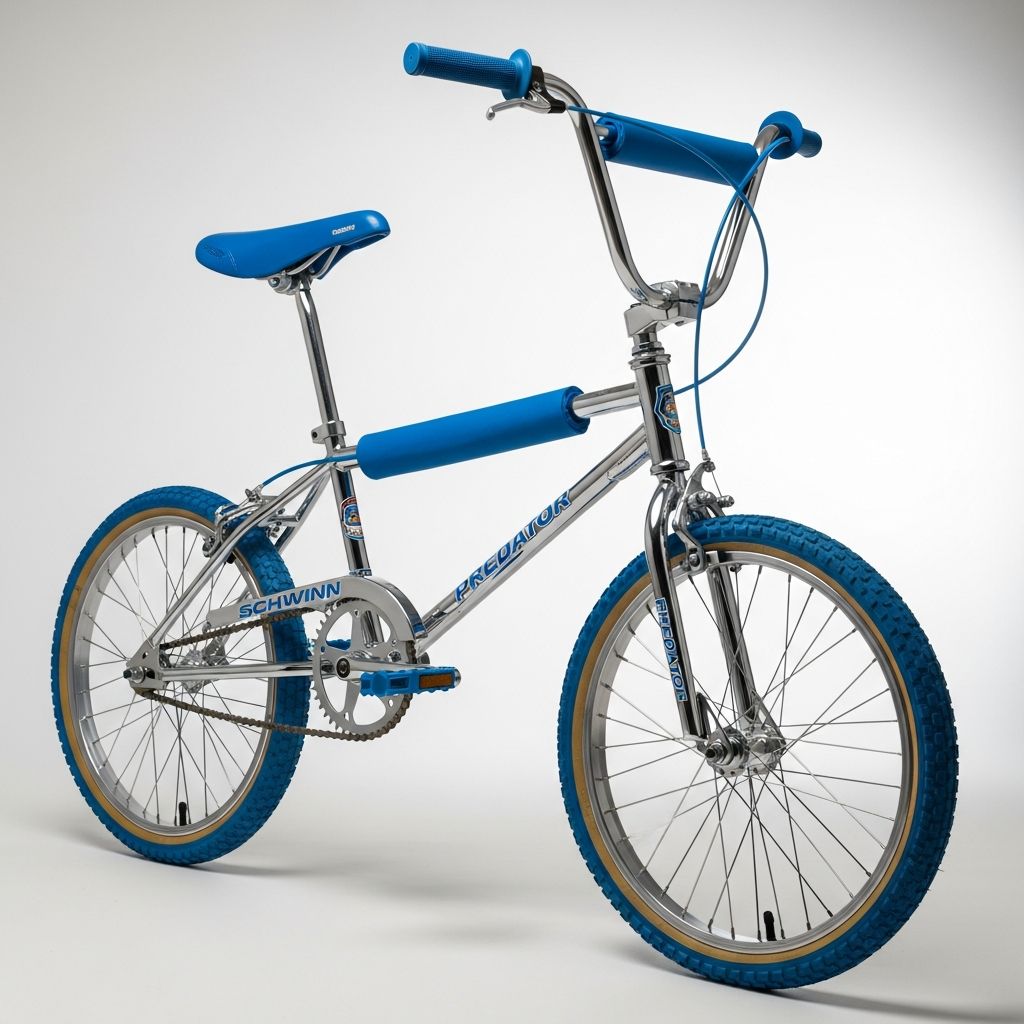
The Schwinn Predator Team 24 is more than a bike. It is a modern tribute to one of the most recognizable BMX machines of the early 1980s, reborn for riders who want to relive their childhood and share that feeling with their own kids.
Originally launched during the first big wave of BMX racing, the Predator line helped Schwinn reconnect with riders who needed a tougher, faster bike than the brand’s earlier cruisers and Stingrays could offer. The new Team 24 channels that heritage in a way that feels nostalgic, approachable, and surprisingly practical for everyday riding.
From BMX Tracks to Driveways: The Predator Origin Story
In the late 1970s and early 1980s, BMX racing exploded in popularity. Riders were pushing bikes far beyond what traditional kids’ models could handle, jumping curbs, tackling dirt tracks, and hammering on frames never designed for that kind of abuse. Schwinn responded by developing purpose-built BMX bikes built from stronger materials and engineered for aggressive riding.
The Predator series became Schwinn’s flagship BMX range in the early 1980s, built around:
- 4130 chromoly frames and forks for high strength and low weight.
- Bi-oval or tri-oval tubing that improved stiffness under pedaling and landing loads.
- Race-ready components such as Sugino cranksets, alloy rims, and quality BMX brakes.
The Team 24 was the 24-inch wheeled cruiser variant aimed at older kids and young teens, marketed as an “ultimate weapon” for BMX competition. It blended the race geometry of 20-inch BMX bikes with a slightly bigger, more stable wheel size.
The Classic 1983 Predator Team 24: What Made It Special?
While several Predator models existed, the early-1980s Team 24 occupies a special place in BMX history. Period catalogs and magazine tests highlighted several standout traits:
- Full 4130 chromoly frame and fork with bi-oval top and down tubes for strength without excess weight.
- Race-oriented geometry designed for riders roughly 9–15 years old, balancing stability and quick handling.
- Quality race parts like Tange headsets, Sugino cranksets, alloy rims, and BMX-specific tires.
- Distinctive graphics and color schemes that made the bike instantly recognizable at the track.
This combination of aggressive styling, real racing capability, and solid value helped the Predator line break Schwinn sales records in the early 1980s. For many riders, it became the bike they dreamed about while flipping through catalogs or watching BMX races on TV.
The Modern Reissue: A Tribute, Not a Time Capsule
Decades later, Schwinn revived the Predator Team 24 as part of a limited retro-inspired collection, explicitly positioning it as a tribute to the 1983 model rather than a perfect replica. Enthusiasts quickly pointed out several key differences between the vintage race bike and the modern cruiser.
| Feature | Original Team 24 (1980s) | Modern Predator Team 24 Tribute |
|---|---|---|
| Frame material | Full 4130 chromoly tubing | High-tensile steel frame |
| Primary use | Competition BMX racing | Recreational cruising and light BMX-style riding |
| Component level | Alloy race parts and branded components | Mostly steel and value-focused components |
| Design language | Period-correct 1980s graphics | Retro-inspired paint and decals echoing 1983 model |
| Target rider | Serious young racers | Adults chasing nostalgia and families seeking a fun cruiser |
Instead of chasing full authenticity, Schwinn aimed to capture the feeling of a classic BMX while using cost-conscious parts and construction. The result is a bike that looks like it rolled out of a 1980s race ad, but is realistically tuned for neighborhood paths, park laps, and casual wheelies with the kids.
Design Details That Trigger Instant Nostalgia
Even without race-tier tubing, the Predator Team 24 tribute leans hard into visual cues from the era:
- Bold 1980s-inspired graphics with high-contrast colors and large logos that look straight off an old BMX poster.
- 24-inch wheels with BMX-style tires that maintain the cruiser stance of the original race bike.
- Peg-free, clean frame layout that mirrors the racing focus of vintage BMX bikes rather than freestyle trick models.
- One-piece crankset echoing the simple and durable cranks seen on many midrange BMX bikes of the era.
To riders who grew up in the 1980s, small details like the curved top tube, the angles of the bars, and the stance of the frame can instantly evoke memories of local tracks, dirt lots, and hours spent hopping curbs.
How It Rides Today: Cruiser First, Racer Second
Because the current Predator Team 24 uses high-tensile steel instead of chromoly and value-oriented components instead of racing hardware, it is best thought of as a retro-styled cruiser that can handle light BMX-style fun rather than a dedicated race bike.
Riders can generally expect:
- Smooth, planted feel from the heavier steel frame and 24-inch wheels, which make it stable at neighborhood speeds.
- Comfortable upright position that works well for parents cruising with kids, commuting short distances, or rolling around town.
- Durable but not ultralight build, so it can take everyday knocks but will not match the acceleration of a modern pro-grade BMX race bike.
For serious BMX racing, modern purpose-built chromoly race frames with optimized geometry and lightweight components will outperform a tribute bike like this by a wide margin. But for most people drawn to the Predator name today, the goal is not podiums—it is smiles.
Why Nostalgia Bikes Appeal to Parents
Retro reissues like the Predator Team 24 land at a perfect intersection of emotion and practicality. Parents who once pored over BMX catalogs now have the income to finally buy the bike they could not afford as kids. At the same time, they are looking for ways to get their own children outside, away from screens, and moving more.
Public health guidance consistently highlights the importance of regular physical activity for children and adults. The U.S. Centers for Disease Control and Prevention recommends that children and adolescents get at least 60 minutes per day of moderate-to-vigorous physical activity, and adults at least 150 minutes per week of moderate-intensity activity such as brisk cycling. Recreational biking is specifically cited as a practical way to meet these targets for many families.
A nostalgic BMX-style cruiser offers:
- Motivation for parents who are more likely to ride regularly if they genuinely love the bike they own.
- A conversation starter that encourages kids to ask about “what bikes were like when you were my age.”
- Shared family activity where parent and child can ride together without a big learning curve.
That emotional link between a parent’s memories and a child’s new experiences is a major part of the Predator Team 24’s appeal.
Who the Predator Team 24 Is (and Isn’t) For
Understanding what this bike is designed to do helps set realistic expectations and leads to better purchasing decisions.
Ideal Riders
- Adults who grew up in the BMX era and want a stylish, rideable tribute for neighborhood rides or park loops.
- Parents who want a cool-looking bike to keep up with kids on scooters, bikes, or skateboards.
- Casual riders and collectors who appreciate vintage-inspired design but do not need race-ready performance.
Probably Not the Best Fit For
- Serious BMX racers who need modern chromoly race frames, clip-in pedals, and track-optimized components.
- Dedicated mountain bikers looking for suspension, disc brakes, and off-road stability.
- Long-distance commuters who may benefit more from multi-speed drivetrains, rack mounts, and fenders.
Tips for Getting the Most Out of a Retro BMX Cruiser
If you pick up a Predator Team 24 or something similar, a few thoughtful tweaks can maximize comfort and enjoyment:
- Dial in fit: Adjust seat height so your leg is slightly bent at the bottom of the pedal stroke, and rotate the bars until your wrists feel neutral.
- Upgrade contact points: A more padded saddle, better grips, or quality platform pedals can dramatically improve comfort and control.
- Maintain tire pressure: Keeping the tires properly inflated reduces pinch flats and makes the bike roll more efficiently.
- Keep brakes tuned: Periodic cable adjustment and pad replacement ensure consistent stopping power—a must if you ride with kids.
Even basic maintenance—cleaning the chain, checking bolts, and occasionally lubricating moving parts—goes a long way toward keeping the bike safe and enjoyable to ride.
Retro Looks, Modern Reality
The Predator Team 24 reissue illustrates a broader trend in the bike industry: brands revisiting iconic models through a modern manufacturing and marketing lens. While purists may debate details such as frame material or component level, there is no denying that bikes like these bring more people back into the cycling world.
For riders who remember the original BMX boom, the bike offers a way to reconnect with something formative from their past. For their kids, it is simply a cool, bright, and fun machine to ride. Bridging those two experiences may be the most valuable thing a nostalgic bike can do.
Frequently Asked Questions (FAQs)
Q: Is the modern Schwinn Predator Team 24 made from the same material as the original?
A: No. The original Team 24 used full 4130 chromoly tubing, which offered high strength with relatively low weight. The modern tribute bike uses high-tensile steel, which is durable but heavier and not as performance oriented.
Q: Can I use the new Predator Team 24 for competitive BMX racing?
A: It is possible to enter local events on almost any bike, but the Predator Team 24 tribute is not optimized for modern BMX racing. Contemporary race bikes use lightweight chromoly or aluminum frames, advanced geometry, and high-end components designed specifically for the track. The Predator tribute is better suited to recreational cruising, pump tracks, and casual jumps.
Q: Is the Predator Team 24 a good choice for kids?
A: It can work well for older kids or teens who fit the frame size and want a stylish BMX-style bike. However, younger children may be more comfortable on lighter, purpose-built youth bikes with appropriately sized frames and wheels. Always prioritize correct fit and the ability to reach the ground and brakes safely.
Q: How does riding a bike like this benefit my health?
A: Regular cycling contributes to cardiovascular fitness, muscular endurance, and overall health. Guidance from public health agencies such as the CDC notes that both adults and children can count brisk cycling toward their weekly physical activity goals, reducing the risk of chronic diseases and improving mental well-being.
Q: Will a retro-styled BMX cruiser keep its value?
A: Mass-produced tribute bikes usually do not appreciate the way rare vintage race frames can, but they may hold value reasonably well if maintained and kept in good cosmetic condition, especially if production runs are limited and demand among nostalgic riders remains strong.
References
- 1984 Schwinn BMX Catalog — BikeHistory.org. 1984-01-01. https://bikehistory.org/catalogs/1984-BMX.html
- 1980s Schwinn Predator BMX Bikes, and all the good parts — YouTube (Down It Goes). 2021-07-20. https://www.youtube.com/watch?v=b0h53eQeEhc
- 2021 Schwinn Predator Team 24 — Rat Rod Bikes Forum. 2021-02-15. https://ratrodbikes.com/threads/2021-schwinn-predator-team-24.118093/
- Predator Team Alloy Test (BMX Action, April 1983) — Oldschoolmags.com. 1983-04-01. https://oldschoolmags.com/tests/Schwinn_Pred_Team_Alloy_BMXA8304.pdf
- Schwinn Brought Back the Predator Team 24 BMX Cruiser — SugarCayne.com. 2019-10-01. https://www.sugarcayne.com/2019/10/schwinn-predator-team-24-bmx-cruiser/
- Physical Activity Basics — Centers for Disease Control and Prevention (CDC). 2022-06-02. https://www.cdc.gov/physicalactivity/basics/index.htm