Reimagining Halloween in an Unprecedented Time
The year 2020 presented unprecedented challenges to holiday traditions across the globe, and Halloween proved no exception. As families prepared for their favorite autumn celebration, public health officials recognized the need to provide guidance that would allow people to enjoy the holiday while protecting their communities from disease transmission. The Centers for Disease Control and Prevention released comprehensive recommendations that categorized Halloween activities into risk levels, enabling families to make informed decisions based on their local epidemiological conditions and personal circumstances.
Rather than viewing this as a cancellation of the holiday itself, these guidelines represented an opportunity to explore creative alternatives that maintained the spirit of Halloween—costumes, candy, and festive atmosphere—while adhering to evidence-based safety practices. Understanding these recommendations and implementing them thoughtfully allowed families to celebrate meaningfully without compromising public health.
Understanding Risk Stratification in Holiday Celebrations
The public health approach to Halloween safety in 2020 employed a tiered framework that recognized the varying levels of transmission risk associated with different activities. This stratification allowed families and communities to customize their celebrations based on local conditions and individual risk factors.
Higher-risk activities encompassed those that had become emblematic of traditional Halloween celebrations. These included door-to-door candy collection, large indoor costume gatherings, and group-based festivities that naturally involved close proximity and extended contact between households. The transmission risk associated with these activities was not arbitrary but grounded in epidemiological understanding: respiratory viruses spread most efficiently through sustained exposure in indoor environments where ventilation may be limited.
Moderate-risk activities represented a middle ground, allowing for some social interaction while implementing specific protective measures. These might include outdoor celebrations with limited group sizes, masked interactions, and activities that maintained physical separation.
Lower-risk activities prioritized celebration within isolated household units or among members of established “bubbles”—groups of people who had agreed to limit their interactions to one another. These activities maintained the celebratory elements of Halloween while minimizing exposure to unknown individuals.
Lower-Risk Activities: Celebrating Within Your Household
The safest approach to Halloween celebration involved activities that kept festivities contained within household or established bubble groups. These alternatives proved remarkably creative and provided genuine entertainment value without requiring exposure to individuals outside one’s immediate circle.
Pumpkin carving represented an accessible and engaging household activity that required minimal preparation. Families could select pumpkins from local farms or markets, establish a designated carving workspace, and create designs ranging from traditional to elaborate. This activity accommodated multiple skill levels and age groups, making it inclusive for family members of varying abilities.
Home decoration projects extended the festive atmosphere throughout residential spaces. Exterior decorations and interior embellishments allowed families to participate in community aesthetics while remaining safely within their homes. These projects could involve multiple family members in coordinated efforts, creating bonding experiences during preparation and enjoyment phases.
Indoor scavenger hunts adapted the treasure-hunting element of traditional trick-or-treating into a household context. Families could create themed hunts with Halloween-related clues, hidden candies, and prizes, providing the excitement of discovery and reward without exposure to external populations.
Costume creation and contests encouraged creative expression and entertainment without requiring public display. Family members could design and construct costumes, participate in judging activities, and photograph their creations for memory preservation and potential virtual sharing.
Navigating Personal Protective Equipment Considerations
An essential distinction emerged in guidance surrounding masks and costume elements. While Halloween traditionally featured masks as costume components, medical and public health experts clarified that costume masks alone provided insufficient protection against respiratory viral transmission.
Costume masks—such as those resembling fictional characters or designed for theatrical purposes—typically consisted of single-layer materials without proper respiratory sealing. These masks often contained gaps around the edges, which compromised their ability to filter respiratory particles effectively. Additionally, their design prioritized appearance over function, making them unsuitable as primary protective equipment.
Proper Mask Layering and Design
When mask protection became necessary during Halloween activities, specific design criteria ensured effectiveness. Appropriate protective masks required at least two layers of breathable fabric that completely covered both the mouth and nose without leaving gaps around the facial perimeter. This construction allowed for filtration while maintaining breathability and comfort during extended wear.
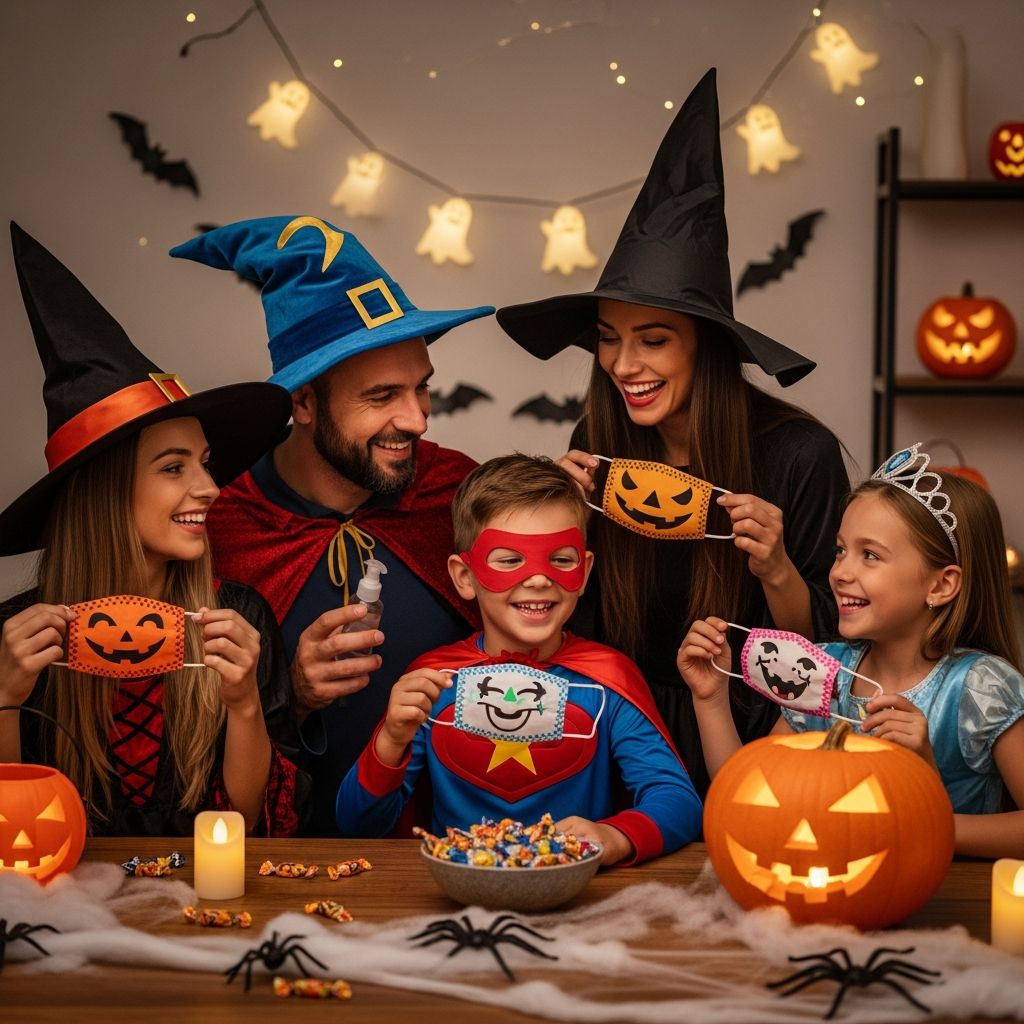
For those determined to combine costume elements with protective measures, Halloween-themed cloth masks offered a solution. These masks incorporated festive designs and colors while meeting functional protective requirements. They provided visual participation in holiday costume culture while maintaining public health safeguards.
An important cautionary note addressed the practice of layering costume masks over protective cloth masks. This combination could create respiratory difficulty, making wearers—particularly children—more likely to remove the protective layer entirely, thereby negating its benefit. A single, well-designed mask that incorporated both protective and aesthetic elements represented the optimal approach.
Reconsidering Traditional Trick-or-Treating
The standard practice of house-to-house candy collection represented one of the highest-risk Halloween activities in pandemic conditions. This activity involved multiple risk factors that compounded transmission potential:
- Close proximity to household members of unknown health status
- Extended contact with multiple individuals across an extended geographical area
- Handling of shared items and surfaces across numerous residential properties
- Difficulty maintaining consistent physical distancing during transaction moments
- Potential removal of protective equipment for eating or speaking clearly
Communities with lower infection rates could implement modified versions of trick-or-treating with enhanced safety protocols. These modifications included limiting group size to family units or established household bubbles, maintaining six-foot distances during candy exchanges, wearing appropriate protective equipment, and practicing frequent hand sanitization throughout the activity. Even with these modifications, communities experiencing higher infection rates were advised to forego this activity entirely.
Geographic Considerations and Travel Implications
The epidemiological landscape of 2020 varied significantly across regions, creating situations where infection rates differed substantially between adjacent communities and across greater distances. This variation had direct implications for Halloween planning.
Public health authorities specifically advised against travel outside one’s immediate geographic region to participate in Halloween festivities elsewhere. This recommendation reflected multiple concerns: traveling from low-incidence to higher-incidence areas increased personal risk, while traveling from higher-incidence to lower-incidence areas posed transmission risks to receiving communities.
Interstate travel for holiday activities magnified these concerns, potentially facilitating disease spread across state boundaries where coordinated public health response became more complex. Families were encouraged to celebrate within their home communities using available resources rather than seeking out special events in distant locations.
Health Status Assessment and Social Responsibility
Beyond specific activity recommendations, the overarching principle guiding safe Halloween celebration involved honest assessment of personal health status and commitment to community protection.
Individuals experiencing any symptoms consistent with respiratory illness—including cough, fever, sore throat, or loss of smell or taste—were advised to abstain entirely from in-person Halloween participation. This included avoiding trick-or-treating, attending gatherings, and distributing candy to visiting children. Illness symptoms represented clear contraindications to any public health-involving activity.
Additionally, individuals who had undergone travel or had been exposed to multiple people in recent days were advised to exercise caution even without displaying symptoms. Asymptomatic transmission—where individuals carried and transmitted infection without experiencing symptoms—represented a documented phenomenon in 2020, making pre-symptomatic caution an important element of social responsibility.
Recent exposure to confirmed COVID-19 cases created obvious necessity for isolation and non-participation in group activities. Public health guidance was unambiguous: those with potential exposure must refrain from in-person Halloween participation.
Candy Safety and Handling Practices
Specific concerns emerged regarding candy safety in trick-or-treating scenarios. While the novel coronavirus was not known to be foodborne, the candies collected during trick-or-treating would be touched by multiple individuals, potentially contaminated with respiratory droplets, and then handled by recipients before consumption.
Families who collected candy using modified trick-or-treating approaches were advised to:
- Request that candy distributors drop treats directly into bags rather than allowing direct handling by recipients
- Wash hands thoroughly immediately after collecting all candy
- Consider allowing collected candy to sit for 24-48 hours before consumption, as respiratory viral particles had demonstrated reduced viability after such time periods
- Supervise young children to ensure they did not consume unwashed candy during collection activities
For household members who stayed home and distributed candy to visiting trick-or-treaters, maintaining physical distance during exchanges and practicing hand hygiene between interactions represented essential practices.
Community Variation in Risk Assessment
The appropriateness of specific Halloween activities varied substantially based on local pandemic conditions. Communities with consistently low infection rates, declining case numbers, and adequate healthcare capacity could support more traditional celebrations with safety modifications. Conversely, communities experiencing surge conditions, high hospitalization rates, or healthcare system strain required adherence to lower-risk activity recommendations.
Individual families needed to assess their specific circumstances including:
- Local transmission rates and trend direction
- Household composition, particularly presence of vulnerable individuals such as elderly family members or those with chronic health conditions
- Personal health status of all household members
- Vaccination status where applicable
- Comfort level with accepted risk among household members
Frequently Asked Questions About Safe Halloween Celebration
Can my child wear a costume mask as their sole protective equipment during trick-or-treating?
No. Costume masks do not provide adequate respiratory protection. If trick-or-treating occurs, children should wear a cloth mask with at least two layers that fully covers the nose and mouth without gaps. Alternatively, a Halloween-themed cloth mask that meets these specifications combines protection with festive appearance.
Is it safe to travel to a neighboring state for Halloween festivities?
Public health guidance discouraged interstate travel for Halloween activities. Travel between regions with differing infection rates increases both personal risk and the potential to transmit illness across community boundaries. Celebrating locally with household members represents the safer alternative.
What should I do with collected trick-or-treat candy before my family eats it?
Allow candy to sit for 24-48 hours before consumption, as this reduces the viability of respiratory viruses on surfaces. Additionally, wash hands thoroughly after collection and have children wash hands before eating any treats.
Can I celebrate Halloween with my family’s “bubble” if I’m showing no symptoms?
Only if no one in your household has recent travel history or potential disease exposure. Asymptomatic individuals can transmit illness, making pre-symptomatic caution important even without obvious symptoms.
What activities are genuinely safe for Halloween celebration at home?
Pumpkin carving, home decorating, indoor scavenger hunts, costume contests among household members, and themed movie nights all provide festive experiences while maintaining safety through isolation within household units.
References
- CDC Halloween Guidelines for 2020 — Centers for Disease Control and Prevention. 2020-10-12. https://www.cdc.gov/coronavirus/2019-ncov/daily-life-coping/holidays/halloween.html
- Trick or Treating is Cancelled, Says CDC’s 2020 Halloween Guidelines — Fatherly. 2020-10-12. https://www.fatherly.com/news/cdc-halloween-2020-guidelines
- CDC COVID-19 Prevention Guidance — Centers for Disease Control and Prevention. 2024-01-15. https://www.cdc.gov/coronavirus/2019-ncov/prevent-getting-sick/index.html
- Trick-or-Treating, Costumes, and More: Tips for Celebrating Halloween Safely in 2020 — Better.net. 2020-10-15. https://better.net/arts-events/trick-or-treating-costumes-and-more-tips-for-celebrating-halloween-safely-in-2020/