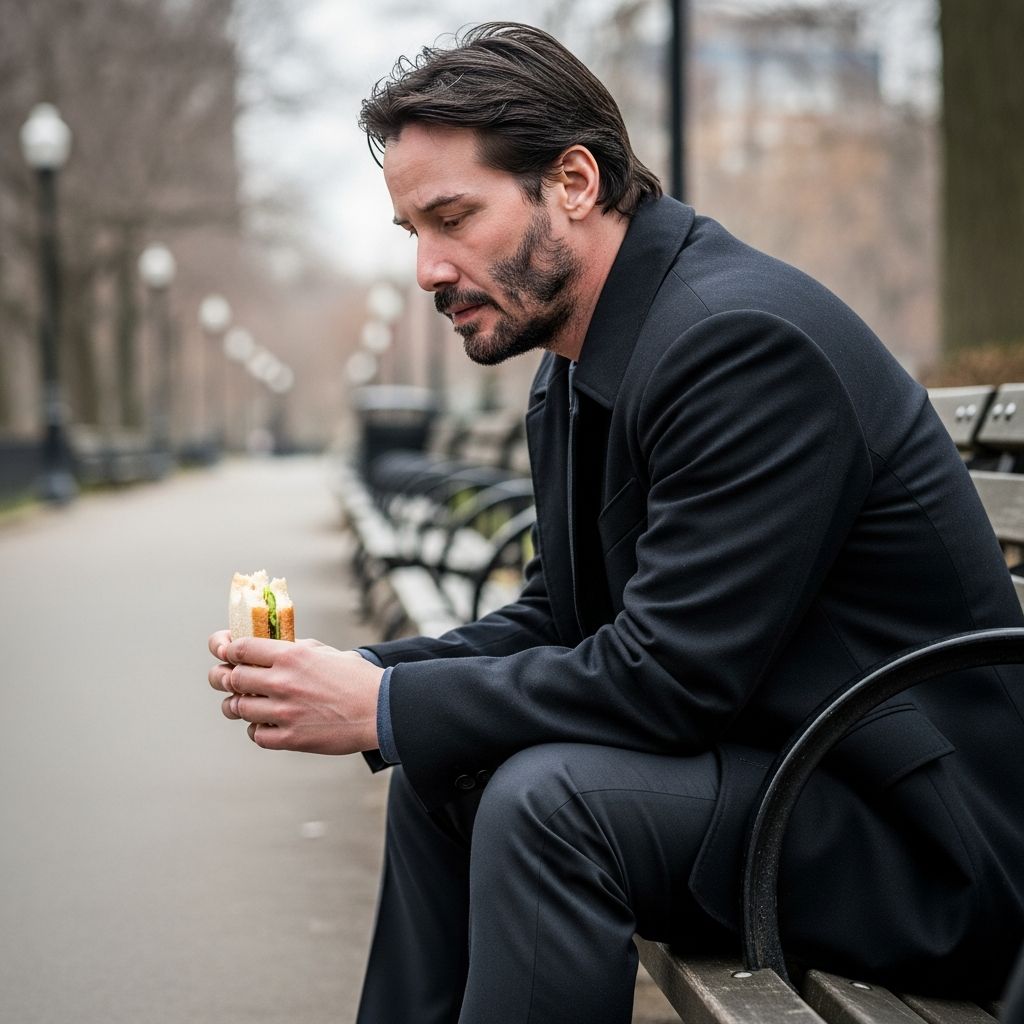
The image of Keanu Reeves sitting alone on a bench with a sandwich in his hand became one of the most recognizable memes of the 2010s, labeled by the internet as “Sad Keanu.” What started as a single candid photograph quickly turned into a global phenomenon, sparking jokes, fan art, concern, and even genuine affection for the famously private actor.
This article explores how the meme began, how Keanu himself has explained it, and what the whole saga reveals about grief, empathy, and the way we treat celebrities in the age of social media.
From Ordinary Lunch to Viral Meme
The photo that became known as “Sad Keanu” shows the actor alone on a park bench, holding a sandwich and looking pensive. Within a short time of being posted online, users began adding captions, Photoshop edits, and jokes that framed him as perpetually lonely or heartbreakingly sad.
The image went far beyond a fleeting joke. It inspired:
- Thousands of meme variations across forums, imageboards, and social platforms
- Photoshop edits placing Keanu on iconic scenes, fictional landscapes, or next to strangers
- Online campaigns such as unofficial “Cheer Up Keanu” days, where fans posted messages of support
- Merchandise and fan tributes, from T-shirts to posters and fan art
What made the meme distinctive was not just its humor, but the warmth and protectiveness that eventually grew around it. Instead of mocking him, many people felt genuinely moved by the idea of a beloved actor looking despondent and alone.
What Keanu Reeves Says About ‘Sad Keanu’
For years, Keanu Reeves largely ignored the meme in public. When he did finally speak about it more directly, his reaction was understated and surprisingly practical.
Appearing on The Late Show with Stephen Colbert in 2021, Reeves was shown the infamous photo and immediately responded, “I’m just eating a sandwich, man!” He explained that he was simply thinking, dealing with normal life concerns, and—very simply—hungry. The introspective look that millions of people read as deep sorrow was, to him, a quiet moment in a busy day.
Years earlier, in a BBC interview, he had already described the meme as “good, clean fun,” while frankly admitting that, in general, he would prefer not to have his private moments captured and spread around the world.
Key takeaways from Keanu’s own comments include:
- He was not consciously posing or expressing deep grief in that moment; he was simply lost in thought.
- He accepts the meme with humor and doesn’t publicly resent the internet’s fascination.
- He still values his privacy and has consistently said he prefers a quiet, private life.
A Meme Intertwined with a Tragic Personal History
The reason “Sad Keanu” resonated so strongly was not only the photo itself, but also the real-life pain many people knew he had experienced. Over time, stories about Reeves’ tragedies circulated widely, often alongside the meme.
Some of the hardships commonly referenced include:
- A difficult childhood shaped by instability and his father’s absence
- The death of close friend and fellow actor River Phoenix in the 1990s
- The stillbirth of a daughter late in pregnancy with his then-partner Jennifer Syme, followed by Syme’s death in a car accident not long after
- His sister’s long battle with leukemia and his quiet support and charitable work related to her illness
These events created a public narrative of Reeves as a man who had endured extraordinary sorrow while remaining gentle, humble, and kind. When the bench photo surfaced, many people projected that history onto the image. The meme was no longer just a joke about a famous actor eating alone; it became a symbol of someone carrying invisible grief in a noisy world.
How ‘Sad Keanu’ Shaped Public Perception of Celebrity Sadness
Most celebrity memes exaggerate glamour, scandal, or arrogance. “Sad Keanu” did something different: it humanized a movie star by making him look fragile and relatable. That shift helped normalize public conversations about the emotional lives of famous people.
| Type of Celebrity Meme | Typical Tone | Effect on Public Perception |
|---|---|---|
| Scandal or meltdown memes | Mocking, judgmental, gossipy | Reinforces distance; celebrities as spectacles |
| Luxury or flexing memes | Envious, aspirational | Presents celebrities as untouchable and ultra-privileged |
| “Sad Keanu”–style memes | Bittersweet, protective, empathetic | Highlights vulnerability; celebrities as people with real pain |
In the era when the meme spread, conversations about mental health were becoming more open in mainstream media. Public figures began speaking frankly about depression, anxiety, and loss, encouraging others to seek help and support. Against that backdrop, the widespread instinct to “hug the sad guy on the bench” fit into a broader shift toward empathy.
Still, this compassion existed alongside voyeurism. Millions of strangers speculated about whether Keanu was depressed, what his life must be like, and whether the photo reflected unresolved trauma, all without knowing what he was actually thinking that afternoon. The meme held up a mirror to how easily we project our own stories onto someone else’s unguarded moment.
Privacy, Consent, and the Ethics of a Viral Photo
Behind the humor lies a serious question: what does it mean when a stranger’s candid photo becomes global entertainment without their explicit consent? Reeves is a public figure, and legal protections for his image in public spaces are limited. However, that does not fully resolve the ethical debate around such memes.
Key ethical tensions include:
- Consent vs. legality: The photo may be lawful to share, but the subject did not agree to being turned into a meme.
- Context collapse: A private moment (eating lunch, thinking about the day) is stripped of context and globally reinterpreted as deep sorrow.
- Emotional projection: Viewers map their own experiences with sadness or loneliness onto the image, sometimes forgetting the person in the photo is living a different story.
Social scientists note that viral images often detach from their original context, a process sometimes called context collapse—where content intended for a small audience is suddenly visible to everyone, stripped of nuance and original meaning. In “Sad Keanu,” the collapse was extreme: a single frame spawned countless narratives about loss, depression, and existential dread, none of which were actually confirmed by the subject.
Reeves’s good-natured response arguably stopped the meme from sliding into cruelty. By meeting it with humor and calm, he signaled that he was not devastated by the online attention, even if he might have preferred the moment remain private.
From Meme to Art: ‘Sad Keanu’ in Keanu’s Own Work
The story of the meme took another interesting turn when Keanu Reeves participated in a comic book project whose visuals nodded directly to the “Sad Keanu” image. In interviews promoting his comic BRZRKR, Reeves and the creative team acknowledged that one panel depicting a solitary, battle-worn character sitting on a bench deliberately echoed the now-famous photograph.
This reinterpretation did several things at once:
- Reclaimed the image: Reeves had a hand in reshaping and reusing the visual language the internet had imposed on him.
- Blended fiction and reality: The panel fused his public persona—stoic, wounded, resilient—with a fictional immortal warrior in the comic’s storyline.
- Transformed a meme into narrative art: What began as a candid snapshot became part of a crafted universe with its own mythology and themes of violence, immortality, and sorrow.
By leaning into the visual instead of rejecting it, Reeves illustrated another way public figures can engage with memes: not by trying to erase them, but by reframing them in work they control.
Why ‘Sad Keanu’ Touched People Around the World
Many memes fade in weeks; “Sad Keanu” lingered for years. Several factors help explain why it resonated on such a deep level:
- Universality of the emotion: Almost everyone has experienced a moment of sitting alone, eating quickly, and feeling lost in thought. The image captured that common, unglamorous human experience.
- Contrast with his movie persona: Reeves is widely known for action roles like The Matrix and John Wick—characters who are composed, capable, and powerful. Seeing him appear vulnerable created a striking emotional contrast.
- Existing knowledge of his grief: Fans familiar with his personal losses were primed to read sadness into the photo, creating a richer emotional backstory for the meme.
- Rising mental health awareness: As discussions about depression and anxiety became more mainstream, people seemed eager to express care and solidarity—even through jokes and image macros.
In an era defined by curated perfection on social media, the photo’s imperfections—an unflattering candid angle, a simple lunch, an unguarded expression—felt oddly honest. The meme unintentionally suggested that even wildly successful people might still grapple with isolation, grief, or existential questions.
Lessons About Empathy in the Meme Age
Although it started as a joke, “Sad Keanu” can be read as a case study in how online culture handles vulnerability, both real and imagined. Several lessons emerge:
- We crave emotional authenticity. The internet gravitated toward an image that seemed unproduced and spontaneous, especially in contrast to heavily staged red-carpet photos and promotional shots.
- Empathy and intrusion can coexist. Many people who shared the meme did so out of affection and concern, yet the very act of turning a private moment into a meme blurs ethical lines.
- Public narratives are powerful but incomplete. The bench photo was often connected to Keanu’s documented tragedies, but by his own account, that moment was about everyday thoughts and hunger, not necessarily overwhelming despair.
- People are more than their saddest image. Reeves has repeatedly emphasized that the biggest misconception about him is that he is permanently sad or tragic, reminding audiences that everyone moves through changing phases of joy and pain.
In a broader sense, the meme underscores a paradox of digital life: we can feel profound affection for someone we only know through screens, while simultaneously contributing to the exposure that may make their private life more difficult.
FAQs About the ‘Sad Keanu’ Meme
Was Keanu Reeves actually sad in the ‘Sad Keanu’ photo?
Based on his own explanation, no—not in the way the meme suggests. Keanu has said he was simply eating a sandwich, thinking about things, and that he was hungry, not posing in deep despair.
When did the ‘Sad Keanu’ meme become popular?
The photograph began circulating widely online around 2010. It quickly spread across forums, image boards, and social media, evolving into one of the most recognizable memes of that decade.
How has Keanu reacted to the meme over the years?
He has described it as “good, clean fun” and has largely taken it in stride, though he has also said he prefers to keep his private life quiet and would rather not be photographed at unguarded moments.
Did the meme change Keanu Reeves’s public image?
The meme amplified an existing perception of him as gentle, introspective, and marked by tragedy. Combined with stories of his generosity and private grief, it deepened public sympathy and affection rather than harming his reputation.
What does ‘Sad Keanu’ tell us about online culture?
It highlights how quickly a single candid image can escape its original context, how eagerly people project emotional narratives onto public figures, and how empathy, humor, and privacy concerns often collide in the meme age.
References
- Keanu Reeves reveals story behind ‘sad Keanu’ meme — Rolling Stone UK. 2021-12-15. https://www.rollingstone.co.uk/film/news/keanu-reeves-story-behind-sad-keanu-8409/
- Keanu Reeves reveals the story behind viral ‘sad Keanu’ meme — The Independent. 2021-12-14. https://www.the-independent.com/arts-entertainment/films/news/keanu-reeves-sad-keanu-meme-b1977110.html
- The Tragic Truth Behind The “Sad Keanu” Meme — Goalcast (YouTube). 2020-09-01. https://www.youtube.com/watch?v=hA4DdADQcZk
- “I Was Hungry” – Decoding The ‘Sad Keanu’ Meme With Keanu Reeves — The Late Show with Stephen Colbert (YouTube). 2021-12-14. https://www.youtube.com/watch?v=rZM5Fb-9dto
- Keanu Reeves Spills the Beans on the ‘Sad Keanu’ Meme — Nerdist. 2021-12-15. https://nerdist.com/article/keanu-reeves-explains-sad-keanu-meme/
- Depression — National Institute of Mental Health (NIMH). 2023-02-01. https://www.nimh.nih.gov/health/topics/depression
- Networked Privacy and Context Collapse — danah boyd, various talks and publications referencing context collapse, summarized in academic and conference materials. 2010. https://www.danah.org/papers/