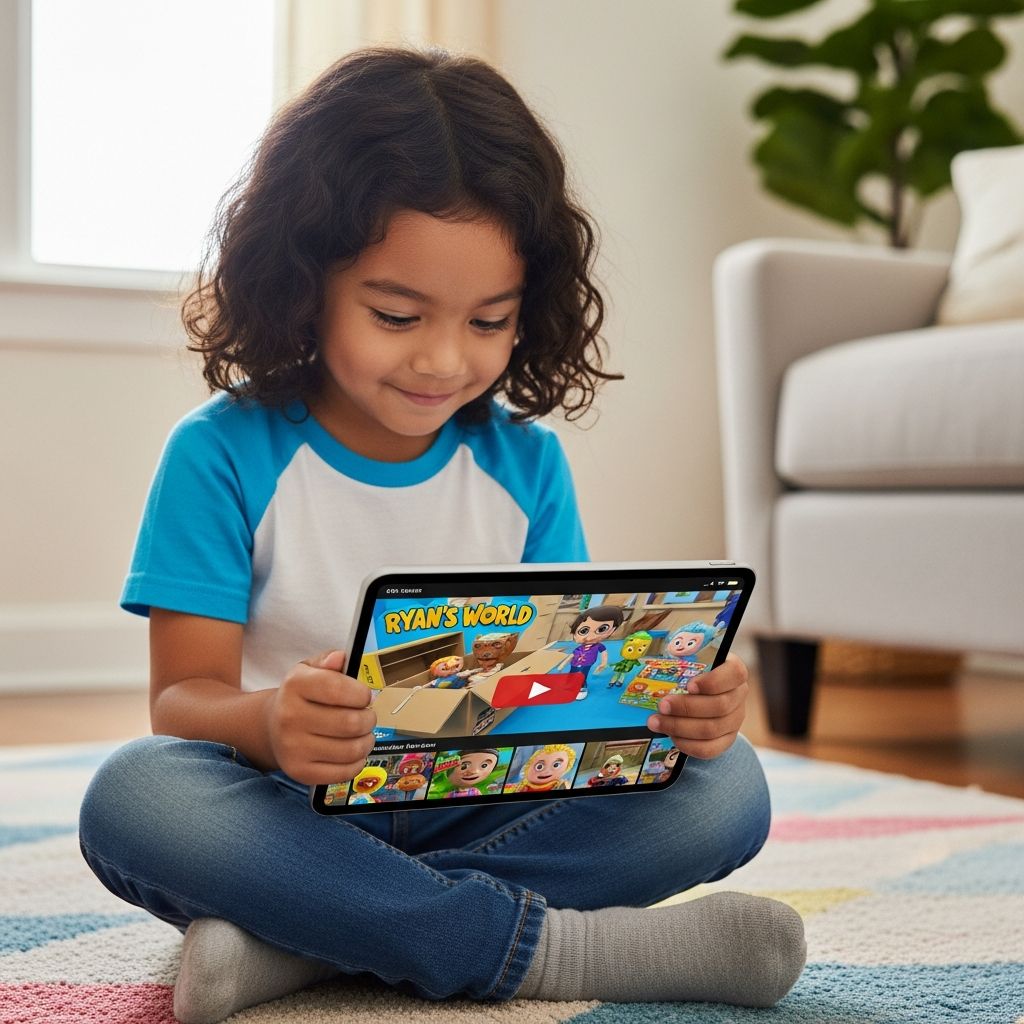
Ryan’s World is one of the biggest children’s entertainment brands on YouTube and beyond, blending toy play, sketches, animated characters, and branded products into a vast kids’ empire. For many families, it is a daily presence on TV, tablets, and phones. This guide breaks down what parents need to know and offers practical, research-based ways to keep viewing healthy.
What Exactly Is Ryan’s World?
Ryan’s World began in 2015 as a simple toy-unboxing YouTube channel featuring a young boy, Ryan Kaji, opening and playing with toys on camera. Since then, it has grown into a global franchise that includes multiple YouTube channels, TV and streaming shows, toys, clothing, games, and branded products in major retailers.
| Aspect | What Parents Will See |
|---|---|
| Main YouTube channel | Videos of Ryan and his family doing pretend play, challenges, toy play, science activities, and skits. |
| Spinoff channels | Animated stories, video-game themed content, language-specific channels (e.g., Spanish, Japanese). |
| Merchandise | Toys, clothing, school supplies, and more under the Ryan’s World brand. |
| Production company | Content is produced by the family-owned company Sunlight Entertainment, which manages multiple channels and a professional team. |
For a preschooler or early elementary-aged child, all of this usually boils down to something much simpler: a fun kid playing, colorful characters, and constant excitement.
Why Kids Are So Drawn to Ryan’s World
There are clear reasons many children become devoted viewers of Ryan’s World.
- Peer appeal: Young kids are naturally drawn to other children, especially slightly older peers who seem confident and fun. Developmental research shows that children often learn and imitate behaviors modeled by peers they admire.
- Bright visuals and fast pacing: The editing is quick, scenes change often, and the colors are intense, which can hold short attention spans.
- Predictable structure: Many videos follow similar patterns (introductions, challenges, unboxings, pretend storylines), giving kids a familiar routine.
- Toys and rewards: Unboxings, surprises, and prizes tap into children’s interest in novelty and reward — what’s inside the next box?
- Extensions into real life: Seeing the same characters on toys, clothing, and games reinforces the brand and keeps kids thinking about it beyond screen time.
These features are not unique to Ryan’s World; they are typical of popular children’s digital content. The difference is the size and reach of this one brand.
How Commercial Is the Content?
Ryan’s World blurs the line between entertainment and marketing more than many traditional children’s shows. Videos often feature toys, products, or characters that also exist in stores, and the brand partners with numerous licensees worldwide.
This raises specific concerns:
- Embedded advertising: Young children have difficulty telling the difference between content and advertising. The American Academy of Pediatrics (AAP) notes that children under about 8 years struggle to recognize persuasive intent in ads.
- Product-driven stories: Many plots revolve around toys, merchandise, or collectibles that kids may then ask for.
- Ubiquity of the brand: When the same characters appear in videos, stores, and apps, children can experience a constant sense of wanting more related items.
At the same time, YouTube has introduced rules and labeling requirements for content aimed at children, including restrictions on targeted advertising to kids, which affect how channels like Ryan’s World make money and structure videos.
What Research Says About Kids, YouTube, and Screen Time
Ryan’s World is just one example of a broader shift: more children are watching on-demand online video platforms instead of traditional TV. Parenting decisions about this channel benefit from understanding the larger evidence on kids’ media use.
Developmental considerations
- Preschoolers (roughly 2–5 years): At this stage, children are learning rapidly through imitation and play. The AAP emphasizes that high-quality, age-appropriate media, used in moderation and with adult guidance, can support learning.
- Early elementary (roughly 6–8 years): Children begin to understand simple storylines and rules but still have limited ability to critically evaluate advertising or influencer marketing.
Potential benefits of channels like Ryan’s World
When used thoughtfully, some aspects of Ryan’s World can align with broader research on positive media use:
- Modeling play: Seeing pretend play and creative use of toys can give kids ideas for off-screen play at home.
- Family involvement: Videos that include parents and siblings may normalize family activities and cooperation.
- Light educational themes: Some videos integrate simple science experiments or problem-solving, which can reinforce curiosity.
However, the overall educational value depends heavily on the specific videos chosen and how parents engage with the content.
Risks and downsides
Research and expert guidance highlight several concerns relevant to Ryan’s World and similar channels:
- Excessive screen time: The AAP recommends limiting recreational screen use and prioritizing sleep, physical activity, and offline play. Binge-watching kids’ channels can easily crowd out these essentials.
- Materialism and toy pressure: Regular exposure to unboxing and product-focused content is associated with stronger materialistic values and increased requests for advertised products in children.
- Attention challenges: Highly stimulating, fast-paced content may make slower-paced activities (reading, independent play) seem less appealing, though evidence is still developing and mixed.
- Blurry advertising boundaries: When entertainment and promotion are intertwined, children may be more susceptible to persuasive messages.
Is Ryan’s World “Good” or “Bad” for Toddlers and Young Kids?
There is no single answer that fits every family. Instead of labeling the channel as entirely good or bad, it is more helpful to ask targeted questions:
- How much time is my child spending watching this versus playing, reading, and sleeping?
- Does my child become more demanding about toys or products after watching?
- Can my child stop watching without a meltdown, or is it a constant battle?
- Am I able to watch with my child sometimes and talk about what we see?
- Does my child imitate prosocial behaviors (sharing, cooperating) or more negative ones (whining, constant asking for things)?
If you notice more conflicts, demands, or emotional dysregulation linked to the channel, that is an important signal to adjust how and when it is used.
Practical Guidelines for Parents Considering Ryan’s World
Using Ryan’s World in a balanced way is possible with a few concrete strategies grounded in expert recommendations.
1. Set clear screen time boundaries
The AAP encourages families to create a media use plan that sets limits and prioritizes healthy activities such as sleep, physical play, and in-person interaction.
- Decide in advance how many episodes or how many minutes your child can watch.
- Use timers or visual schedules so children can see when screen time will end.
- Keep screens out of bedrooms, especially near bedtime, to protect sleep.
2. Watch together when possible
Co-viewing — watching with your child and talking about what you see — can greatly increase the value of media.
- Comment on feelings and behavior: “He looks excited to open that toy. How do you feel when you get a new toy?”
- Highlight sharing and kindness when they appear on screen.
- Ask questions: “What do you think will happen next?” or “Is that real or pretend?”
3. Talk openly about advertising and money
Even with young kids, you can begin simple conversations about how YouTube works.
- Use simple language: “Sometimes they show toys because a company paid them, like a commercial inside the show.”
- Explain that not everything on screen needs to be bought: “We can enjoy watching without having the toy.”
- Practice saying “no” calmly and consistently when children ask for products.
4. Connect screen time to real-life play
Use the channel as a springboard, not a substitute, for offline play.
- After an episode involving building or science, try a simple hands-on version at home.
- Encourage your child to reenact favorite stories using toys they already own instead of buying new ones.
- Rotate a small set of toys so “old” items feel new again when they reappear.
5. Model balanced media habits
Children learn from what they see adults doing. The AAP emphasizes that parents’ own technology use patterns matter.
- Show that you also put devices away at mealtimes or before bed.
- Avoid scrolling on your phone while expecting your child to stop watching.
Red Flags: When It May Be Time to Pause or Stop
Even with boundaries, some children react poorly to hyper-stimulating, commercial content. Consider a break or stronger limits if you notice:
- Frequent tantrums when you turn videos off.
- Escalating demands for specific toys or products linked to the channel.
- Less interest in other activities that used to be enjoyable (playing outside, reading, imaginative play).
- Sleep problems when watching close to bedtime.
If these issues persist, it may help to switch to calmer, more clearly educational shows or to cut back overall screen time and see whether behavior improves.
Comparing Ryan’s World to Other Kids’ Content
Not all children’s media is the same. Thinking in terms of quality and purpose can clarify where Ryan’s World fits among your options.
| Type of Content | Main Goal | Typical Features |
|---|---|---|
| Public media education shows (e.g., many PBS programs) | Teach academic or social skills | Clear learning objectives, slower pacing, less direct product promotion. |
| Commercial cartoons and series | Entertainment with some merch | Story-based episodes, recurring characters, moderate product tie-ins. |
| Influencer-style channels (like Ryan’s World) | Entertainment plus branding and products | Real children and families, frequent toys, direct ties between on-screen items and store products. |
Many families use a mix of all three but reserve the most time for clearly educational or story-driven shows, keeping influencer-style content to a smaller slice of the media diet.
Building a Family Policy for Ryan’s World
Because every child and household is different, it helps to create a simple family policy about channels like Ryan’s World. You might decide:
- On which days, if any, Ryan’s World is allowed.
- How many episodes or minutes are okay in one sitting.
- Whether toys and products from the brand will be purchased rarely, sometimes, or not at all.
- That at least one adult will occasionally co-watch episodes.
Writing these decisions down, even briefly, and sharing them with caregivers (grandparents, babysitters) helps keep expectations consistent.
Frequently Asked Questions (FAQs)
Q: Is Ryan’s World appropriate for toddlers?
Many families do allow toddlers to watch Ryan’s World, but professional guidelines recommend very limited and carefully chosen media for children under 3, emphasizing interactive play and caregiver engagement instead. If you choose to allow it, keep viewing short, watch with your child, and focus on calm, less chaotic videos.
Q: How much Ryan’s World is too much in one day?
Rather than focusing on a single number, look at the whole day: sleep, physical activity, reading, and face-to-face interaction should take priority. Many experts suggest keeping total recreational screen time for young children to roughly an hour per day, and Ryan’s World should be only a portion of that.
Q: My child is obsessed with Ryan’s toys. What can I do?
Normalize wanting things seen on screen, but set clear purchasing rules. You might limit branded toys to birthdays or special occasions, emphasize gratitude for toys already owned, and help your child create wish lists instead of expecting immediate purchases. Reducing exposure to unboxing-style videos can also ease constant requests.
Q: Are there educational benefits to Ryan’s World?
Some videos incorporate basic science, problem-solving, or social themes, but the channel is primarily entertainment and brand-driven. To maximize learning, co-watch, ask questions, and connect on-screen activities to real-world play. For more direct education, consider supplementing with slower-paced, curriculum-informed shows or public media.
Q: What if my child copies behavior from the videos?
Imitation is a key way children learn. If your child imitates helpful or kind behaviors, praise and reinforce them. If they copy whining, shouting, or demanding toys, label those behaviors as unacceptable, explain what you expect instead, and consider pausing or changing the content if negative imitation continues.
References
- About Ryan’s World — Sunlight Entertainment / Ryan’s World. 2024. https://ryans.world/about/
- Ryan’s World YouTube Channel – Case Study — The Shorty Awards. 2023. https://shortyawards.com/15th/na-4
- Media and Young Minds — American Academy of Pediatrics. 2016-10-01. https://publications.aap.org/pediatrics/article/138/5/e20162591/60325/Media-and-Young-Minds
- Children, Adolescents, Advertising, and the Media — American Academy of Pediatrics. 2013-11-01. https://publications.aap.org/pediatrics/article/132/5/950/31488/Children-Adolescents-Advertising-and-the-Media
- Ryan’s World – YouTube Channel — YouTube. Accessed 2025. https://www.youtube.com/channel/UChGJGhZ9SOOHvBB0Y4DOO_w