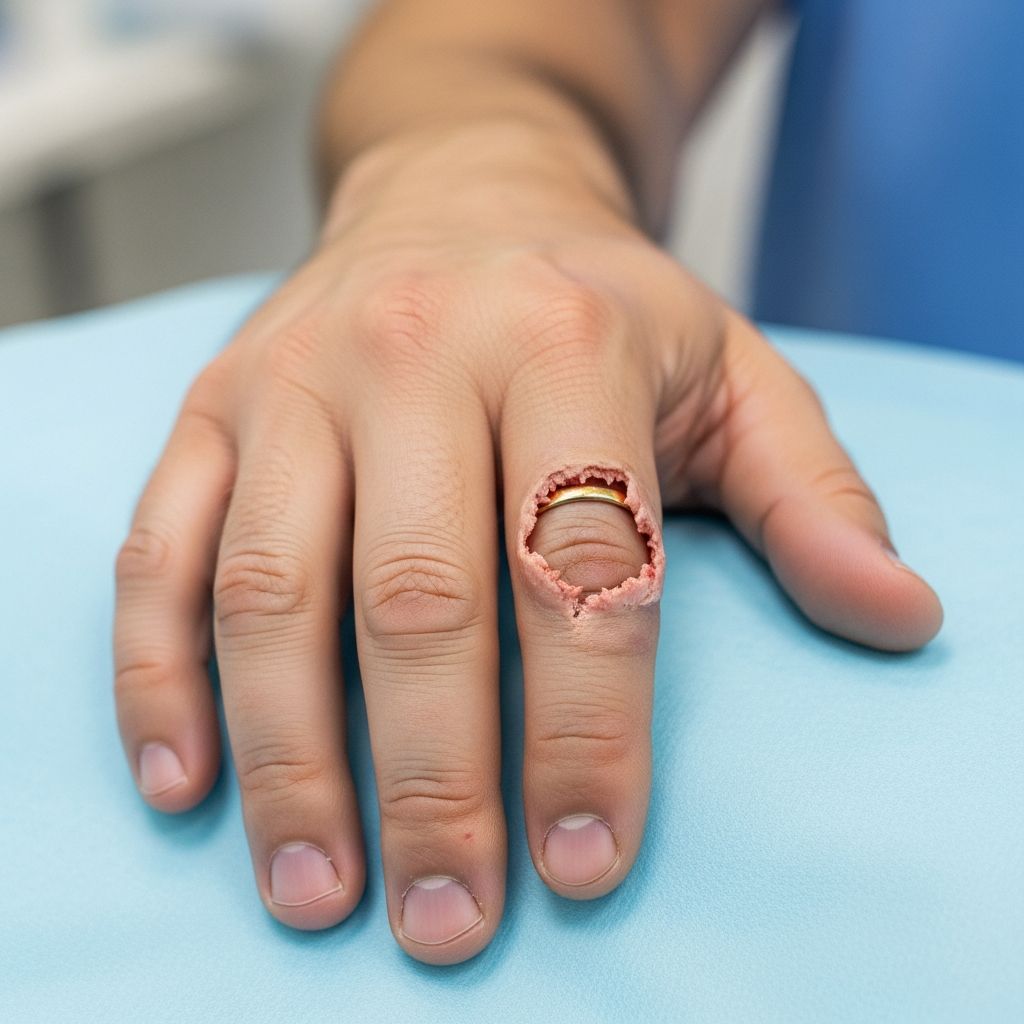
Ring avulsion, commonly called degloving, represents a devastating injury where a ring snags on an object and forcibly rips away skin, muscles, tendons, and sometimes bone from a finger. This medical emergency can result in partial or complete finger loss if not addressed swiftly. While rare, these incidents underscore the need for caution with jewelry during daily activities.
Understanding the Mechanics of Ring Avulsion Injuries
The injury initiates when a ring lodges on a fixed object—like machinery, fences, or even furniture—while the body moves abruptly. The ring’s edges act like a blade, slicing through soft tissues as it’s yanked. This can bruise vessels in milder cases or fully detach the finger’s covering in extremes, exposing bone and halting circulation.
Soft tissues separate from deeper structures, a process mirroring glove removal from a hand—hence ‘degloving.’ Nerves, arteries, and bones often suffer too, complicating recovery. High-speed pulls, such as from industrial equipment, amplify damage.
Classifications of Ring Avulsion Severity
Medical professionals categorize ring avulsions into three classes based on tissue and vascular damage, guiding treatment urgency.
| Class | Description | Blood Flow Status | Typical Outcomes |
|---|---|---|---|
| Class 1 | Mild wounds, often fingertip-limited | Intact circulation | Stitches, bandaging; full recovery likely |
| Class 2 | Extended tissue damage, vessel injury | Compromised circulation | Vascular surgery required; therapy follows |
| Class 3 | Complete degloving or detachment | No circulation; possible amputation | Reattachment attempts; high risk of loss |
These distinctions, established in orthopedic literature, determine if simple closure suffices or if microsurgery is needed.
Common Scenarios Leading to These Traumatic Events
- Workplace Hazards: Construction sites, factories, and farms pose risks from hooks, conveyor belts, or tools snagging rings.
- Sports and Fitness: Weightlifting, gymnastics, or team sports like basketball can catch rings on equipment or opponents.
- Household Mishaps: Slips near doors, cabinets, or tables mimic celebrity cases like Jimmy Fallon’s table fall.
- Medical Vulnerabilities: Swelling from arthritis or heat traps rings, worsening removal attempts.
Active individuals and manual laborers face elevated risks, with machinery pulling at dangerous velocities.
Immediate Response: First Steps After an Incident
Time is critical—call emergency services without delay. Control bleeding by pressing firmly with sterile gauze; elevate the hand above heart level to curb swelling. Avoid removing the ring yourself if attached, as this risks further trauma. Preserve any detached parts in a clean bag on ice for potential reattachment.
Do not apply tourniquets unless bleeding is life-threatening, and never delay professional care. Emergency teams assess circulation via color, temperature, and pulse.
Medical Interventions and Surgical Approaches
Diagnosis involves physical exams and imaging like X-rays or angiograms to evaluate vessel and bone integrity. Nearly all cases demand surgery.
- Class 1: Debridement and suturing under local anesthesia.
- Class 2: Microvascular repair to restore blood flow, followed by tissue reconstruction.
- Class 3: Complex reattachments using grafts; amputation if viability fails.
Post-op, patients endure months of therapy to regain motion and strength. Infections loom large due to exposed tissues, necessitating antibiotics and vigilant monitoring.
Long-Term Consequences and Rehabilitation Challenges
Even successful repairs leave scars, stiffness, and sensation loss. Class 3 survivors often face permanent impairment, affecting grip and dexterity. Psychological impacts include trauma from disfigurement.
Rehabilitation includes occupational therapy with splints, exercises, and pain management. Full function may elude many, especially workers unable to resume physical roles.
Prevention Strategies: Safeguarding Your Hands
Avoiding rings in risky settings is paramount. Opt for silicone bands that break away under force. Remove jewelry before workouts, chores, or jobs involving machinery.
- Use ring holders or necklaces for sentimental pieces.
- Choose low-profile, flexible alternatives for active lifestyles.
- Educate family on risks, particularly for those with swelling-prone fingers.
Workplaces should enforce no-ring policies near hazards.
Real-Life Accounts and Public Awareness
Jimmy Fallon’s 2015 injury spotlighted ring avulsions, with his finger requiring hours of surgery despite no amputation. Similar tales from grease fittings or sports gear highlight unpredictability.
These stories drive campaigns urging ring removal in dangers zones, saving digits annually.
Frequently Asked Questions About Ring Avulsions
What exactly is degloving in ring injuries?
Degloving occurs when force pulls skin and underlying fat from bone and tissue, fully or partially, via the ring’s edge.
How common are these finger injuries?
Rare overall, but prevalent among athletes, laborers, and in medical swelling cases; underreported due to stigma.
Can a finger always be saved after avulsion?
No—Class 3 often leads to amputation if circulation can’t restore promptly.
Are silicone rings completely safe?
They snap under pressure, vastly reducing avulsion risk compared to metal.
What if my ring is stuck due to swelling?
Lubricate with soap; seek medical aid if needed—cutting may be required emergently.
Choosing Safer Jewelry for Everyday Protection
Prioritize durability-tested silicone or rubber rings from reputable makers. Metal wearers should select smooth, snug fits without stones. For professions, adhere to safety protocols banning rings.
Balance sentiment with safety—many display rings symbolically off-finger during risks.
References
- Why You Should Leave Your Wedding Ring Home This Summer — Heiden Orthopedics. 2023. https://heidenortho.com/why-you-should-leave-your-wedding-ring-home-this-summer/
- Does Your Wedding Ring Put You At Risk Of Degloving? — Banner Health. 2023-05-15. https://www.bannerhealth.com/healthcareblog/teach-me/degloving-a-reason-to-take-off-your-wedding-ring
- Degloving Accidents: No Wedding Rings Beyond This Point — Habbas & Associates. 2022. https://www.habbaspilaw.com/degloving-accidents-ring-avulsion/
- Ring Avulsion Injury: Causes, Prevention, and More — Healthline. 2023-11-01. https://www.healthline.com/health/ring-avulsion
- What Is Ring Avulsion? Everything You Need to Know — Enso Rings. 2024. https://ensorings.com/articles/what-is-ring-avulsion
- Ring Avulsion (Injury): What It Is, Causes & Prevention — Cleveland Clinic. 2023-08-20. https://my.clevelandclinic.org/health/diseases/22368-ring-avulsion