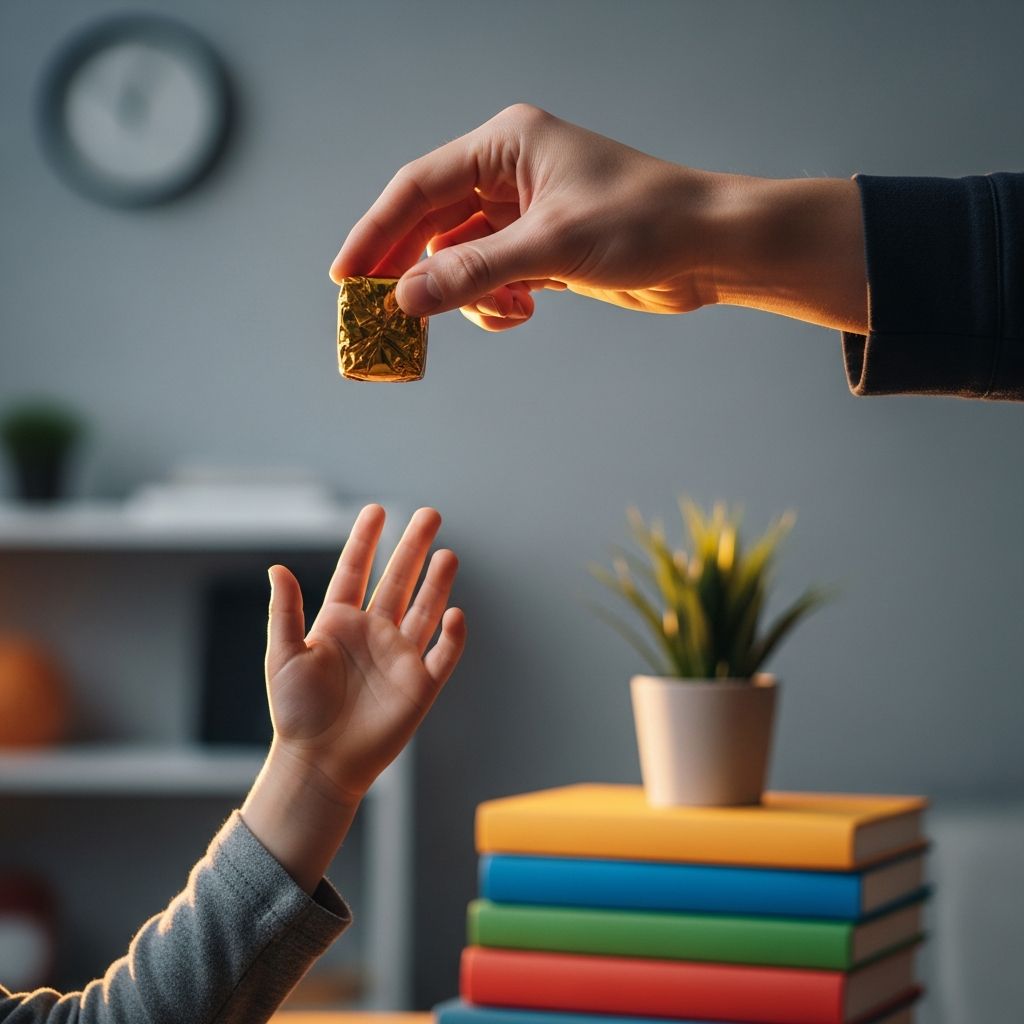
Almost every caregiver has dangled a cookie or a cartoon in front of a cranky child and thought, “Is this smart parenting or am I just bribing my kid?” The answer usually lies not in what you offer, but when and why you offer it.
Understanding the difference between a reward and a bribe can transform daily power struggles into calm, predictable routines. Instead of feeling manipulated by your child’s behavior, you can become a confident guide who uses motivation as a tool, not a desperate last resort.
Why This Distinction Matters
At first glance, rewards and bribes look almost identical: both involve giving something your child values in exchange for cooperation. The deeper impact, however, shows up over time in your child’s habits, expectations, and sense of responsibility.
- Bribes tend to reinforce chaos in the moment and slowly teach kids to misbehave to get what they want.
- Well-planned rewards reinforce effort and progress, helping kids connect their choices to positive outcomes.
When you are clear about which tool you are using, you can avoid accidently paying for tantrums and start investing in the behaviors and values you truly care about.
Core Differences Between Rewards and Bribes
Three key questions usually reveal whether you are rewarding or bribing: When is the incentive offered? What behavior is it tied to? And who is in charge in that moment?
| Aspect | Reward | Bribe |
|---|---|---|
| Timing | Planned before a situation or given calmly after positive behavior | Offered in the heat of the moment during misbehavior |
| Who leads? | Adult sets expectations and conditions ahead of time | Child’s meltdown, whining, or refusal drives the deal |
| Behavior reinforced | Effort, skills, cooperation, and improvement | Tantrums, stalling, and emotional “hostage-taking” |
| Long-term message | “My actions have predictable consequences.” | “If I make things hard enough, adults will cave in.” |
| Adult emotions | Calm, intentional, generally in control | Panicked, exhausted, or desperate to stop a scene |
What Healthy Rewards Look Like
Healthy rewards are not about buying perfection; they are about acknowledging effort and reinforcing habits you want your child to keep using, even when no one is watching. Done well, they are short-term tools that slowly give way to intrinsic motivation.
Characteristics of Effective Rewards
- Specific: The child knows exactly what behavior earns the reward.
- Proportionate: The size of the reward matches the difficulty of the task.
- Time-limited: Rewards are used as training wheels, not forever.
- Value-aligned: They never undermine health, safety, or family values.
- Predictable: Expectations rarely change mid-stream or under pressure.
Most importantly, effective rewards sit on top of a warm relationship. Praise, shared joy, and a sense of teamwork should always matter more than the sticker, screen time, or toy itself.
What Turns an Offer Into a Bribe
A bribe is less about the object and more about the pattern: an adult feels stuck, the child is melting down, and something extra is suddenly offered just to stop the storm. The child quickly discovers that escalating behavior, not cooperation, brings the best deals.
Warning Signs You’re Slipping Into Bribery
- You only offer the incentive after your child starts yelling, refusing, or bargaining.
- The “deal” keeps growing because your first offer didn’t work.
- You feel pressured to give more each time to keep the peace.
- Your child starts asking, “What will you give me if I do it?” for everyday tasks.
- When you say no to the reward, behavior suddenly gets worse.
Over time, this pattern can create a household where adults feel extorted and kids feel powerful only when they are difficult. No one enjoys that dynamic for long.
Examples: Reward or Bribe?
Consider these common situations. The difference is subtle, but it changes everything about what your child learns.
- Before a challenging event: “After we finish at the dentist, we’ll stop at the park if you use your calm body and follow directions.” – This is a reward because the plan is clear ahead of time and linked to positive behavior.
- During a meltdown in the store: “Fine, you can have the candy. Just stop screaming.” – This is a bribe because the treat is offered in response to negative behavior.
- After unexpected cooperation: Your child handles a long car ride better than usual, so you say, “You did great back there. Let’s choose a special game when we get home.” – This functions as a reward because it recognizes positive behavior after the fact.
Notice that the same item—candy, a park trip, a special game—can be either a reward or a bribe, depending on timing and emotional tone.
Designing a Simple Reward System That Works
You do not need elaborate charts and glitter pens to use rewards well. A basic system, used consistently for a few weeks, can dramatically reduce conflict around common flashpoints like mornings, homework, or bedtime.
Step-by-Step Blueprint
- Pick one target behavior. Choose a specific, observable behavior such as “put toothbrush away after brushing” or “stay in bed after lights out.” Avoid vague goals like “be good.”
- Define success clearly. Explain in simple language what success looks like: what your child will do, when, and for how long.
- Choose a reasonable reward. Match the reward to your child’s age and the task’s difficulty. For small kids, tiny privileges or tokens work better than big purchases.
- Set a time frame. Decide how often the reward is given: immediately, daily, or at the end of the week. Younger children usually need quicker feedback.
- Track progress visually. Stickers, check marks, or colored dots help kids see their effort adding up.
- Phase out gradually. Once the habit sticks, shrink the reward or tie it to bigger goals so your child starts acting responsibly with less external incentive.
Keep in mind that a reward system is not a contract of perfection. Expect some missed days and use them as chances to problem-solve together instead of abandoning the whole plan.
Preventing Entitlement and “What Do I Get?” Syndrome
One of the biggest fears adults have about rewards is raising a child who expects payment for every act of cooperation. The antidote is not to avoid rewards completely, but to use them strategically and talk openly about internal values.
Guidelines to Keep Rewards Healthy
- Differentiate chores from extras. Some tasks are expected as part of family life and do not earn special treats; others can be linked to rewards during training periods.
- Use your words, not just stuff. Pair rewards with praise that names the effort: “You stuck with that puzzle even when it was hard.”
- Avoid constant negotiation. If your child asks, “What do I get?” for everything, remind them that some responsibilities simply come with being in the family.
- Rotate, don’t escalate. Change up small privileges or experiences rather than always offering “more” or “bigger.”
Over time, emphasize how good it feels to master a new skill or help someone else, so that pride, contribution, and connection join the mix of motivators your child responds to.
Emotions, Power, and the Parent–Child Dance
Rewards and bribes are never just about behavior; they are also about power and emotion. A calm adult is far more likely to use rewards wisely, while an overwhelmed adult is more vulnerable to bribery patterns.
Staying in the Driver’s Seat
- Pause before making offers; even three deep breaths can prevent a bribe.
- Use predictable routines so your child knows what is coming without constant bargaining.
- Decide privately what you are willing to offer before entering challenging situations like stores or long outings.
- Accept some public discomfort; a short-lived tantrum is better than years of feeling manipulated.
When you show that you can tolerate big feelings without instant payoffs, your child learns that boundaries are steady and that strong emotions are survivable, not emergencies that must be bought away.
Special Situations: Neurodiversity, Anxiety, and Big Transitions
Some children—such as those with attention differences, autism, anxiety, or trauma histories—may need more structured, consistent reinforcement for longer periods. That does not automatically turn rewards into bribes; it simply reflects that their nervous system needs extra support.
- Break tasks into smaller steps so success feels attainable.
- Offer more frequent, smaller rewards to maintain motivation.
- Collaborate with teachers or therapists so expectations stay consistent across settings.
- Check that rewards do not punish your child for symptoms beyond their control.
In these contexts, rewards become part of a broader support plan rather than a quick fix for momentary inconvenience.
Sample Phrases to Use Instead of Bribes
Having go-to language makes it easier to stay out of bribery territory. Here are some simple scripts you can adapt to your child’s age and your family’s style.
- Before an event: “When we finish our shopping and you stay by the cart, then we’ll pick a song to play in the car.”
- During resistance: “I hear that you don’t want to leave the park. It’s still time to go. We can talk about something fun to do after dinner once you are in the car seat.”
- After success: “You handled that appointment really well. Let’s choose a book to read together as a treat.”
- When asked for a deal: “This is something you do because you’re part of the family, not something you get paid for.”
These phrases keep you calm, set clear limits, and let any rewards feel like recognition rather than ransom.
FAQs About Rewards and Bribes
Are all treats considered bribes?
No. A treat becomes a bribe only when it is offered reactively in response to misbehavior in order to stop it quickly. The same treat, offered ahead of time as part of a clear plan or after calm cooperation, functions as a reward.
Will using rewards make my child less motivated in the long run?
Rewards can undermine motivation if they are used for everything, all the time, or if they replace any sense of pride, contribution, or connection. Used sparingly to jump-start new habits, and paired with genuine encouragement, they can actually support the development of internal motivation.
What if my child refuses to cooperate unless there is a reward?
This is usually a sign that rewards or bribes have been overused or inconsistently applied. Step back, clarify which tasks are simply expectations, and be prepared to follow through calmly on limits even when there is pushback. You can then reintroduce small, carefully chosen rewards only for truly new or challenging behaviors.
Is it ever okay to “bribe” just to survive a crisis?
In emergencies or genuinely unsafe situations, immediate de-escalation may be the priority, and you might use any tool at hand to keep everyone safe. What matters is that this remains the rare exception, not the everyday pattern, and that you later reflect on how to handle similar situations with more planning and less panic.
How long should I keep a reward system in place?
Most systems work best when used intensively for a few weeks, then gradually faded as the new behavior becomes routine. If the system must continue indefinitely for your child to cooperate at all, it may be time to revisit expectations, relationship patterns, or underlying challenges that make the task so difficult.
Bringing It All Together
In the end, rewards and bribes are simply tools—neither magical nor disastrous on their own. What gives them power is the pattern in which they are used, the emotions that surround them, and the lessons your child walks away with.
When you stay proactive, clear, and calm, you teach your child that effort matters, boundaries can be trusted, and cooperation is part of being in a family—not something that always comes with a price tag attached.