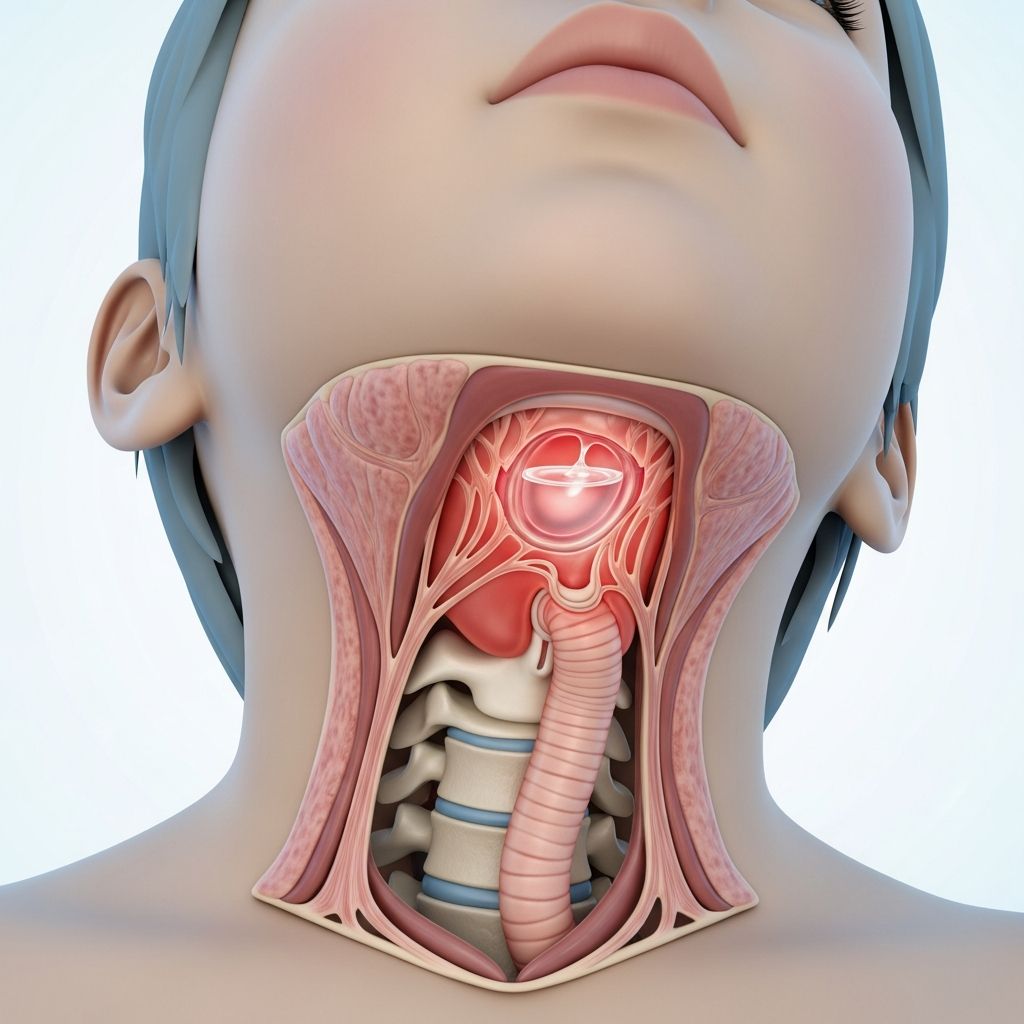
A retropharyngeal abscess is a pocket of pus that forms in the deep tissues at the back of the throat, in a space called the retropharyngeal space behind the pharynx. It is a serious infection that can block a child’s airway or spread to other parts of the body if not treated quickly.
This guide explains what parents need to know about this condition, including causes, symptoms, diagnosis, treatment, recovery, and prevention, using clear language while reflecting what medical experts recommend.
1. What Is a Retropharyngeal Abscess?
The retropharyngeal space lies behind the throat and in front of the spine. In young children, this space contains several clusters of lymph nodes that help the body fight infections in the nose, throat, and sinuses.
- A retropharyngeal abscess forms when these lymph nodes or nearby tissues become infected and fill with pus.
- It is considered a type of deep neck space infection, which can be life-threatening if it narrows or blocks the airway or spreads into the chest or bloodstream.
- The condition is seen more often in young children but can occur at any age.
Because the infection sits so close to the airway, breathing, swallowing, and neck movement can all be affected.
2. Who Is Most at Risk?
Retropharyngeal abscess occurs in both children and adults, but it is most common in young children, typically under 5 years old.
- In young children, infections in the nose, throat, or ears can easily spread to the lymph nodes in the retropharyngeal space.
- In older children and adults, trauma to the back of the throat (for example, from a foreign object or medical procedure) is a more frequent trigger.
| Age group | Common triggers |
|---|---|
| Infants and young children | Upper respiratory infections (colds), tonsillitis, ear or sinus infections spreading to lymph nodes |
| Older children and adults | Injury to the back of the throat, dental infections, or procedures that seed bacteria into the deep neck space |
3. How Does a Retropharyngeal Abscess Develop?
Most retropharyngeal abscesses start as a bacterial infection in nearby areas of the head and neck.
3.1 Typical causes
- Recent upper respiratory infection – such as a cold, sore throat, or tonsillitis.
- Ear or sinus infections – bacteria can spread through lymphatic channels to nodes in the retropharyngeal space.
- Throat or neck injury – a sharp object, instrumentation, or forceful injury to the back of the throat can introduce bacteria directly into deep tissues.
- Dental or oral infections – less common in small children but a possible source in older children and adults.
Multiple types of bacteria often work together to cause the abscess, including common organisms from the mouth and upper airway.
3.2 From infection to abscess
- A child develops an infection in the throat, nose, ears, or sinuses.
- Bacteria reach lymph nodes behind the throat or spread directly into the retropharyngeal space.
- The immune system sends white blood cells to fight the infection, and pus begins to collect.
- Instead of clearing, the infected area becomes a walled-off pocket of pus, forming an abscess.
- The abscess can expand, pressing on the airway and nearby structures.
4. Signs and Symptoms Parents May Notice
Early symptoms can resemble a routine throat infection, which is why careful observation is so important. As the abscess enlarges, symptoms usually become more severe and specific.
4.1 Common early symptoms
- Fever, often high
- Sore throat that may appear out of proportion to what is seen on a quick look in the mouth
- Painful swallowing or refusal to eat and drink
- Neck pain or stiffness
- Swollen, tender glands (lymph nodes) in the neck
4.2 Worrisome later symptoms
As the abscess grows or the airway becomes irritated, more alarming symptoms can appear:
- Difficulty breathing or fast breathing
- Stridor – a high-pitched, harsh noise when the child breathes in
- Drooling because swallowing is too painful or difficult
- Refusal to lie flat – the child may prefer sitting upright to breathe more easily
- Trouble opening the mouth fully
- Torticollis – the child holds the neck twisted or tilted and resists movement
- Muffled or “hot-potato” voice
- Visible bulge or swelling at the back of the throat when examined by a clinician
Emergency warning signs: Call emergency services or go to an emergency department immediately if your child has:
- Severe trouble breathing or noisy breathing
- Blue or gray lips or skin
- Extreme difficulty swallowing, drooling, or inability to handle secretions
- Very stiff, painful neck with high fever
5. How Doctors Diagnose Retropharyngeal Abscess
A prompt and accurate diagnosis is critical because of the risk of airway blockage and serious complications. Doctors rely on a combination of history, physical examination, and imaging tests.
5.1 Medical history and examination
The clinician will ask about:
- Recent colds, sore throats, ear or sinus infections
- Any injury or object in the back of the throat
- How quickly symptoms appeared and worsened
- Breathing, swallowing, and neck movement difficulties
During the physical exam, they may look for:
- High fever and signs of serious illness
- Neck stiffness, pain, or abnormal head posture
- Swollen lymph nodes or neck swelling
- Bulging in the back of the throat or asymmetry
- Noisy breathing or signs of airway distress
5.2 Imaging tests
To confirm the diagnosis and see the size and location of the abscess, doctors often use imaging.
- CT scan of the neck with contrast is widely used and can show a fluid-filled collection typical of an abscess and its relationship to the airway.
- MRI may sometimes be used to better define deep tissue involvement, but is less common in emergency settings.
Blood tests may also be ordered to look for signs of infection, such as elevated white blood cell counts or inflammatory markers, although these are not specific for retropharyngeal abscess.
6. Treatment: How Doctors Manage Retropharyngeal Abscess
Retropharyngeal abscess is a medical emergency that usually requires care in the hospital. The main goals are to protect the airway, control the infection, and drain the abscess when needed.
6.1 Protecting the airway
Because swelling and pus are close to the windpipe, doctors first assess how well the child is breathing.
- Children with significant breathing difficulty may need oxygen or airway support right away.
- In severe cases, a breathing tube or emergency airway procedure may be required to prevent complete blockage.
6.2 Intravenous antibiotics
All children with a confirmed retropharyngeal abscess are typically admitted to the hospital and started on broad-spectrum intravenous (IV) antibiotics that target common upper airway bacteria, including anaerobes.
- Common first-line options in children include combinations such as ampicillin–sulbactam or clindamycin given by vein.
- If the child appears septic or does not respond, additional antibiotics such as vancomycin or linezolid may be added.
- IV antibiotics usually continue until the child shows clear improvement and has been free of fever for at least 24 hours.
6.3 Surgical drainage
Many children also need the abscess drained to remove pus and relieve pressure.
- Drainage is generally recommended if:
- The abscess is large (for example, greater than about 2–2.5 cm on imaging), or
- Symptoms do not improve after 24–48 hours of IV antibiotics, or
- There are signs of airway compromise.
- Drainage is often done through the mouth under general anesthesia, using instruments to access and open the abscess safely.
- A sample of pus is collected to identify specific bacteria and adjust antibiotics if needed.
6.4 Transition to oral antibiotics and discharge
Once the child is breathing comfortably, eating and drinking again, and has been without fever for a day or more:
- IV antibiotics are usually switched to oral antibiotics, such as amoxicillin–clavulanate or clindamycin, for about 10–14 days to fully clear the infection.
- The child can then be discharged home with instructions for follow-up and what warning signs to watch for.
7. Potential Complications
With fast treatment, most children recover without problems. However, untreated or delayed cases can lead to serious complications because of the abscess’s location near vital structures.
- Airway obstruction – swelling or pus compresses the airway, causing severe breathing difficulty or respiratory arrest.
- Spread of infection to the chest – infection can extend into the mediastinum (the central chest area), leading to mediastinitis, a life-threatening condition.
- Sepsis – bacteria enter the bloodstream and cause widespread infection and organ dysfunction.
- Lung complications – aspiration of pus into the lungs can cause pneumonia or lung abscesses.
- Blood clot in neck veins – infection around large neck veins may lead to thrombosis.
These risks highlight why urgent evaluation is necessary when a child has severe neck pain and trouble breathing or swallowing.
8. Outlook and Recovery
When diagnosed early and treated with appropriate antibiotics and drainage, the outlook for children with retropharyngeal abscess is generally excellent.
- Most children recover fully without long-term problems.
- Hospital stays vary depending on severity but often last several days.
- The abscess returns in a small percentage of cases (about 1–5%) and usually responds to repeat treatment.
After going home, it is important to:
- Give all antibiotics exactly as prescribed, even if the child feels better early.
- Keep scheduled follow-up visits with the pediatrician or ear, nose, and throat (ENT) specialist.
- Watch for renewed fever, neck pain, breathing difficulty, or trouble swallowing, and seek care immediately if they occur.
9. Can Retropharyngeal Abscess Be Prevented?
Not every case can be prevented, but certain steps may reduce risk:
- Treat ear, sinus, and throat infections promptly as directed by a healthcare professional.
- Finish all prescribed antibiotics for significant bacterial infections to limit spread or relapse.
- Protect the back of the throat – avoid letting young children put sharp objects in their mouths and supervise them with small toys or sticks.
- Maintain good oral hygiene as children grow older to reduce dental sources of infection.
- Keep routine vaccinations up to date, as recommended by your child’s healthcare provider.
10. Frequently Asked Questions (FAQs)
Q1: Is a retropharyngeal abscess contagious?
The abscess itself is not contagious, but the underlying infection (such as a sore throat or tonsillitis) can be caused by germs that spread between people. Good handwashing, covering coughs and sneezes, and avoiding sharing utensils can help limit spread of those germs.
Q2: How is retropharyngeal abscess different from a peritonsillar abscess?
Both are pockets of pus in the throat but occur in different locations. A retropharyngeal abscess forms behind the throat in the deep neck space, while a peritonsillar abscess forms next to a tonsil. Both usually need antibiotics and sometimes surgical drainage, but retropharyngeal abscess carries a higher risk for airway obstruction because of its deeper position.
Q3: Can my child be treated at home without hospitalization?
Because retropharyngeal abscess can progress quickly and affect breathing, children are usually treated in the hospital with IV antibiotics, close monitoring, and possible surgical drainage. Home treatment alone is not considered safe once an abscess is suspected or confirmed.
Q4: How long will my child need antibiotics?
The total course typically includes several days of IV antibiotics in the hospital, followed by about 10–14 days of oral antibiotics at home, depending on the child’s age, severity of infection, and response to treatment.
Q5: When should I suspect something more serious than a regular sore throat?
You should seek urgent medical evaluation if your child has a sore throat plus any of the following: high fever, severe neck pain or stiffness, difficulty breathing, drooling, refusal to lie down, very painful swallowing, or an unusual head and neck position. These may indicate a deep neck infection such as a retropharyngeal abscess rather than a simple throat infection.
References
- Retropharyngeal abscess — BMJ Best Practice. 2023-10-10. https://bestpractice.bmj.com/topics/en-us/599
- Retropharyngeal Abscess — StatPearls, NCBI Bookshelf. 2023-08-14. https://www.ncbi.nlm.nih.gov/books/NBK441873/
- Retropharyngeal Abscess: Causes, Symptoms & Treatment — Cleveland Clinic. 2022-07-20. https://my.clevelandclinic.org/health/diseases/24026-retropharyngeal-abscess
- Retropharyngeal abscess — MedlinePlus Medical Encyclopedia. 2022-06-30. https://medlineplus.gov/ency/article/000984.htm
- Retropharyngeal Abscess | Nemours KidsHealth — Nemours Children’s Health. 2022-02-01. https://kidshealth.org/en/parents/retropharyngeal-abscess.html